
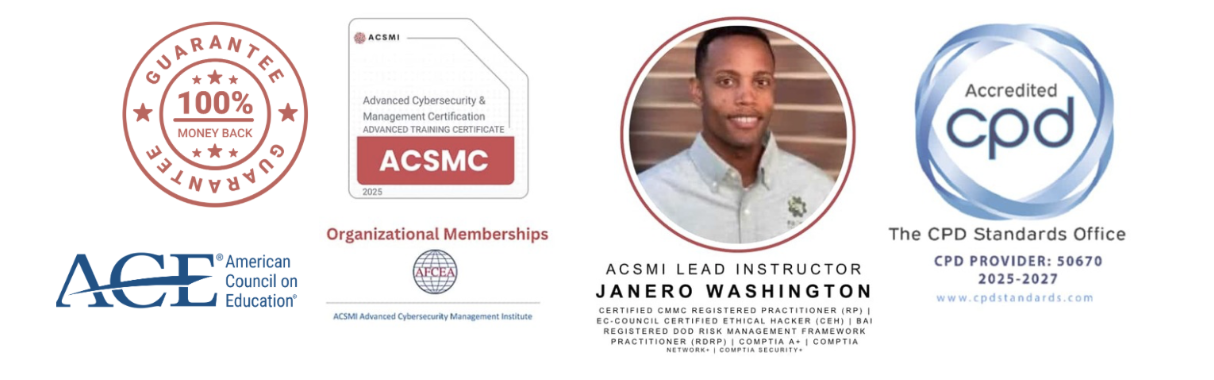
Accreditations & Partnerships
ACSMI Cybersecurity Certification
Accredited, Trusted, and Industry-Connected
At ACSMI (Advanced Cybersecurity Management Institute), we believe real trust starts with real credentials. In cybersecurity, credibility is not a vibe. It is auditability, standards alignment, and proof that training outcomes are measurable in environments where failure has consequences.
Our Advanced Cybersecurity and Management Certification is built to be recognized immediately by employers and reviewers because it is backed by globally recognized accreditations, strategic partnerships, and direct industry oversight.
When you train with ACSMI, you are not only learning cybersecurity. You are earning credentials designed to withstand scrutiny from security leaders, compliance stakeholders, and workforce evaluators who do not reward marketing language. They reward programs that produce professionals who can perform.
Our Professional Accreditations
CPD Accredited (Globally)
170+ Hours of Advanced Training
ACSMI’s cybersecurity certification is accredited through the Continuing Professional Development (CPD) Certification Service, including 170+ verified CPD hours. That verification matters because it makes the program legible across industries, countries, and hiring systems that need to understand whether training is real.
CPD accreditation signals that ACSMI’s training meets recognized standards for professional development and that learning hours and outcomes are structured, documented, and reviewable. For learners, it reduces friction. You do not need to convince an employer that your training was serious. CPD accreditation makes seriousness visible through an established standards framework.
What CPD is designed to do is confirm that your education supports lifelong career development and professional relevance. In cybersecurity, that translates into training that is mapped to real-world expectations, not course completion for its own sake.
ACE-Recognized Program
American Council on Education
ACE ID: AEDG-0006
Credit Recommendation: 6 Semester Hours in Cybersecurity or Computer Information Systems
ACSMI’s Advanced Cybersecurity Program is evaluated and listed in the ACE National Guide (2025–2028). This is a high-trust academic and workforce signal because ACE credit recommendations are based on external evaluation of course rigor, learning outcomes, assessment structure, and instructional design.
Key Details
ACE Evaluation Period: 08/01/2025 – 07/31/2028
Credit Type: Course
Length: 170 Hours (8 Weeks)
Minimum Passing Score: 70
ACE Credit Recommendation
3 SH – Cybersecurity Essentials (Lower-Division Baccalaureate)
3 SH – Cybersecurity Administration (Lower-Division Baccalaureate)
Why this matters
ACE recognition bridges the gap between professional training and formal academic recognition. It signals that ACSMI’s program was evaluated against standards that prioritize measurable competence, not only participation. For many learners, this improves mobility: it can support academic progression and strengthen hiring credibility in organizations that value credit-bearing education signals.
Program outcomes reinforced through ACE alignment include
Applying risk frameworks, encryption, IAM, and layered defense strategies
Using tools such as SIEM, IDPS, Splunk, Wireshark, and Metasploit in scenario-based environments
Conducting red team, blue team, and purple team drills and vulnerability assessments
Executing breach response simulations and incident workflows
Adapting security strategy across finance, healthcare, and critical infrastructure contexts
Preparing for global certification tracks such as CISSP, CEH, CISM, OSCP, and CySA+
ACE recognition does not exist to impress. It exists to provide external validation that the program is structured to produce outcomes that can be evaluated and trusted.
Nationally-Accredited Vocational Training
via Partnership with Advanced Education Group (AEG)
Through partnership with AEG, ACSMI programs are held up to the standards required for post-secondary vocational training (non-degree granting), supporting access to reimbursement and funding pathways in environments where vocational eligibility matters.
This designation matters because it confirms the program’s intent is practical employability, not academic theory detached from workforce use. It also reinforces the program’s positioning as job-focused training built for real operational readiness.
In cybersecurity, employability is not achieved by completing topics. It is achieved by proving you can perform within constraints, standards, and accountability systems. Vocational recognition supports that workforce alignment.
Strategic Partnerships Powering Your Career
AFCEA International Membership
ACSMI is an official organizational member of AFCEA (Armed Forces Communications and Electronics Association).
This matters because defense and government-adjacent ecosystems prioritize standards discipline, security rigor, and professional credibility. AFCEA alignment supports professional networking, exposure to defense-sector expectations, and connection to broader communications and cybersecurity leadership communities.
In practical terms, it signals that ACSMI is connected to ecosystems where cybersecurity is evaluated through outcomes, not marketing.
YM Careers Job Board Partnership
ACSMI partners with YM Careers to support direct employer pipelines for ACSMI-certified specialists, including cybersecurity-focused listings designed to reduce the distance between certification completion and job opportunity visibility.
The intent is simple: credibility must convert into career momentum. Certifications should not end at a certificate page. They should connect to hiring environments.
Our Industry and Academic Advisory Boards
Fortune 500 Advisory Board Oversight
ACSMI’s curriculum is reviewed quarterly by Fortune 500 CISOs, SOC leaders, and researchers.
This is a critical credibility mechanism because cybersecurity changes faster than most educational systems. Advisory oversight ensures the curriculum stays aligned to threat intelligence, workforce needs, and real hiring expectations.
Quarterly review is not a marketing promise. It is a structural safeguard against curriculum drift. It ensures that learners train on what organizations are dealing with now, not what was relevant several years ago.
Educational Innovation Advisory
This advisory layer exists for one reason: mastery is not only about content volume. It is about retention, transfer, and the ability to apply knowledge under pressure.
This advisory focus ensures ACSMI’s training remains:
Scientifically optimized for long-term retention
Designed for accelerated mastery rather than passive consumption
Adapted for tech-integrated learning environments
Continuously improved for measurable performance outcomes
In cybersecurity, knowledge that cannot be recalled under pressure is not knowledge. It is risk. Instructional design must be built for performance.
Leadership Driving Accreditation and Excellence
ACSMI’s academic leadership is structured to sustain accreditation integrity and standards alignment, including oversight related to ISO 21001, ANSI, and DoD 8140 alignment. This role exists to ensure the program remains reviewable, auditable, and continuously modernized as cybersecurity expectations evolve.
This leadership function protects learners. In cybersecurity education, credibility collapses when governance is vague and quality assurance is inconsistent. A defined academic authority exists to prevent that.
Director of Cyber Education – Janero Washington
Janero Washington brings practitioner-aligned leadership with credentials including: Certified Ethical Hacker (CEH), CISSP Affiliate, and CompTIA CySA+.
This role leads curriculum-to-compliance mapping under frameworks such as NIST, SOC 2, FedRAMP, and HIPAA, and integrates practical lab simulations and compliance-based assessments.
That mapping matters because cybersecurity is not only technical execution. It is controlled execution under standards. Professionals are hired for their ability to operate inside governance systems, not outside them.
Why Accreditation Matters for Your Cybersecurity Career
Global Recognition
CPD and ACE signals are trusted by multinational employers because they reflect structured, reviewable education rather than informal training.
Career Mobility
Vocational eligibility and ACE credit recommendations can strengthen funding access, reimbursement eligibility, and hiring confidence, particularly in environments that require formalized training signals.
Built-In Trust
Quarterly advisory oversight reduces the gap between what is taught and what employers expect. It signals that your training is continuously aligned to the market.
Compliance Readiness
Training designed with real frameworks in mind prepares learners for security work across finance, healthcare, and defense-adjacent expectations where compliance failures are career-ending.
Our Commitment to Continuous Improvement
ACSMI does not treat accreditation as a finish line. We treat it as a living standard.
That means:
Quarterly curriculum updates reflecting emerging threats and workforce expectations
Ongoing accreditation compliance through renewals and audits
Sustained partnerships and curriculum evolution in areas such as AI security, blockchain defense, and zero trust strategy
At ACSMI, accreditation is not a badge. It is a promise that your cybersecurity education is structured to remain future-proof, employer-approved, and globally respected as the field evolves.
Programs provide non-degree professional education and certification training. Completion does not confer government licensure or guarantee eligibility for any particular position. Employers and independent credentialing organizations establish their own education, experience, certification, and hiring requirements.
FAQ: Accreditations and Partnerships at ACSMI
1) What does CPD accreditation prove about the ACSMI program?
CPD accreditation proves that ACSMI’s training is structured as professional development with verified learning hours and a standards-based approach to program design. In practice, that means the program is not just a collection of videos or topics. It is designed around defined outcomes, reviewable learning structure, and documented time investment. For learners, CPD reduces credibility friction because employers and professional bodies can recognize that your education meets a known standard rather than relying on your personal explanation. CPD does not grant licensure, and it does not guarantee a job. What it does is signal that your training is real, structured, and aligned with professional development expectations.
2) What is the difference between CPD and ACE recognition, and why do both matter?
CPD is a professional development accreditation focused on structured learning hours and career-relevant growth. ACE recognition is an academic-facing evaluation that can support credit recommendation within higher education systems. Together, they cover two credibility lanes: employer recognition and academic legitimacy. CPD makes your training portable across industries and geographies as a continuing education credential. ACE adds an additional layer by evaluating the program for academic rigor and measurable outcomes during the listed period 08/01/2025 to 07/31/2028. If you are building a career with long-term mobility, both signals matter because they strengthen how your training is interpreted by both workforce and academic reviewers.
3) How does ACE credit recommendation work for this program?
ACSMI’s program is listed in the ACE National Guide with ACE ID: AEDG-0006 and a recommendation of 6 semester hours in cybersecurity or computer information systems. The structure includes a minimum passing score requirement of 70 and an evaluated length of 170 hours (8 weeks). The recommended breakdown is 3 SH in Cybersecurity Essentials and 3 SH in Cybersecurity Administration, both at the lower-division baccalaureate level. The critical point is that ACE provides a recommendation. Acceptance of credit is determined by the receiving institution. ACSMI does not promise transfer decisions. What ACSMI provides is a program evaluated for credit-worthiness under ACE standards.
4) What does “exempt vocational training provider” mean for cybersecurity learners?
It means the program is positioned and validated as job-focused vocational education rather than purely academic theory. Through ACSMI’s partnership with CCRPS, this framework can support access to funding and reimbursement pathways in environments where vocational status matters. For learners, the value is practical: it strengthens the program’s credibility as employability-oriented training and can expand options for organizations or individuals seeking eligible training programs. It does not change the program into a degree, and it does not grant licensure. It simply reinforces that the training is designed to produce real workforce capability.
5) How do advisory boards actually improve training quality instead of just sounding impressive?
Advisory boards matter only if they change curriculum decisions. ACSMI’s advisory oversight is designed to do exactly that. Quarterly review by Fortune 500 CISOs, SOC leaders, and researchers means curriculum relevance is checked against current threat realities, workforce needs, and operational standards. This reduces the risk of stale training. In cybersecurity, outdated education is not neutral. It creates false confidence. Advisory oversight helps ensure what you learn remains aligned with what security teams are confronting now, including tool usage, incident patterns, and the skill expectations hiring managers evaluate during interviews and performance reviews.
6) Why does ACSMI emphasize ISO, ANSI, and DoD 8140 alignment leadership?
Because cybersecurity careers increasingly involve operating inside formal standards and compliance ecosystems. ISO 21001 alignment signals education management discipline. ANSI alignment supports standards-based credibility structures. DoD 8140 relates to workforce qualification expectations in defense-adjacent environments. Whether you work directly in government or not, these frameworks shape how organizations interpret competence, training legitimacy, and role readiness. Oversight by a Chief Academic Officer with responsibility for these alignments signals that ACSMI is not casual about governance. It treats educational credibility like cybersecurity itself: through controls, audits, and continuous modernization.
7) Does ACSMI’s accreditation mean I will get hired or pass advanced certs like CISSP or OSCP?
Accreditation does not guarantee hiring, and no ethical institution should claim it does. What ACSMI’s accreditation and partnerships do is strengthen the credibility of your training and increase employer confidence that your education is structured and outcomes-driven. The program is designed to prepare you for real-world work and to support pathways toward certifications such as CISSP, CEH, CISM, OSCP, and CySA+. Passing any certification still depends on your preparation, practice, and exam performance. What ACSMI provides is a scenario-based training system that builds the skill foundation and operational thinking those certifications and employers expect.
8) How does ACSMI ensure the program stays future-proof after accreditation?
ACSMI treats accreditation as a living standard, not a one-time badge. The program is supported by quarterly curriculum updates, advisory review, ongoing alignment work, and continuous instructional optimization. This includes modernization for evolving threat landscapes and AI-integrated learning environments. Practically, that means the training system is designed to evolve as tools, attacker tactics, compliance demands, and enterprise architectures evolve. In cybersecurity, the only stable strategy is continuous improvement. ACSMI’s commitment is that the program remains employer-relevant, standards-aligned, and performance-focused rather than frozen in the year it was first accredited.