
GRC analyst interviews expose a major weakness in cybersecurity preparation: candidates can define frameworks but struggle to apply them when evidence is missing, controls fail, or executives challenge risk findings. Employers expect practical judgment across risk assessments, compliance controls, audits, and regulatory obligations. These 60 scenario-based questions provide model answers, evidence requirements, and decision-making techniques to strengthen GRC career preparation and help candidates demonstrate job-ready cybersecurity skills.

1) GRC Analyst Interview Questions 1–12: Risk Assessment, Ownership & Treatment
Risk management interview questions test whether candidates can translate technical weaknesses into business decisions. Strong answers identify the risk scenario, affected assets, relevant controls, accountable owner, and defensible treatment options.
This section is especially important for candidates pursuing GRC analyst positions, cybersecurity risk management careers, or IT audit roles.
Q1. A company stores sensitive customer information in an unencrypted database. How would you assess the risk?
Model answer: First, identify the data classification, database exposure, access permissions, and possible threat scenarios. Determine whether encryption at rest is an applicable requirement and whether compensating controls exist. Assess potential confidentiality impact and likelihood before recommending encryption, access restrictions, or other treatment.
Record the scenario in the risk register with a named owner, assessment rationale, and target remediation date. Explain how this aligns with privacy risk management, technical control assessment, and risk-based remediation.
Q2. What is the difference between inherent risk and residual risk?
Model answer: Inherent risk represents the exposure assessed before considering controls, according to the organization's defined methodology. Residual risk represents the exposure remaining after accounting for relevant controls and their effectiveness.
For example, an internet-accessible application may have high inherent risk, while validated MFA, monitoring, and restricted permissions may reduce its residual risk.
The crucial interview point is that control existence alone does not prove risk reduction. Your GRC assessment process should incorporate actual control effectiveness, documented through audit testing and a consistent risk evaluation method.
Q3. A vulnerability has low likelihood but catastrophic potential impact. How would you prioritize it?
Model answer: Evaluate realistic exploitation conditions, affected business processes, existing safeguards, and the magnitude of potential damage. A low-frequency event can still warrant urgent treatment if its consequences exceed organizational risk tolerance.
Consider whether the scenario involves essential services, regulated data, or an inability to recover.
Present the likelihood and impact assumptions separately, including uncertainty. Seek treatment or formal acceptance from the appropriate authority if the exposure exceeds risk appetite. This demonstrates judgment relevant to security leadership and GRC specialist responsibilities.
Q4. How would you calculate and defend a cybersecurity risk score?
Model answer: Start with the approved assessment methodology. If the organization uses a 5×5 likelihood-impact matrix, a likelihood rating of 4 and impact rating of 5 produces an illustrative score of 20 out of 25.
Explain the criteria behind each rating, including exposure, threat capability, business criticality, and controls.
An ordinal score is a prioritization aid rather than a mathematically precise financial loss estimate. For more advanced risk analysis, examine calibrated probabilities and loss ranges. Interviewers assessing GRC competency expect you to recognize the limitations of risk-scoring models.
Q5. What would you do if a business owner refuses to accept ownership of a high-risk finding?
Model answer: Clarify the affected business process, system ownership, and the organization's accountability model. Explain why the identified owner is relevant, then request a resolution through the established governance process.
If responsibility remains disputed, escalate to the appropriate risk committee or accountable executive rather than assigning ownership arbitrarily.
Maintain the finding and its status throughout the dispute. Clear accountability is fundamental to enterprise risk management, cybersecurity governance, and defensible audit remediation tracking.
Q6. How do risk appetite and risk tolerance differ?
Model answer: Risk appetite describes the broad level and types of risk an organization is prepared to pursue or retain while achieving objectives. Risk tolerance defines acceptable variation or boundaries for specific exposures or performance measures.
For example, a company might have low appetite for customer data exposure and establish a tolerance requiring critical access-control findings to be resolved within a defined period.
Use both concepts when recommending risk treatment decisions. A strong GRC analyst connects the concepts to measurable thresholds and appropriate executive oversight.
Q7. A critical risk cannot be eliminated immediately. What treatment options would you consider?
Model answer: Evaluate avoidance, mitigation, transfer or sharing, and acceptance, using the organization's documented risk methodology.
For example, temporarily disabling an exposed service could avoid a specific risk. Network restrictions and enhanced monitoring could reduce exposure while engineering implements a permanent fix.
Insurance may help transfer some financial consequences while leaving operational and reputational exposure with the organization.
Ensure treatment decisions have owners, deadlines, and residual-risk assessments. This demonstrates risk management discipline, control-selection judgment, and leadership-level communication.
Q8. What information should appear in a cybersecurity risk register?
Model answer: Include a unique identifier, risk scenario, affected asset or process, threat and vulnerability context, business impact, likelihood, inherent rating, controls, residual rating, owner, treatment decision, action owner, due date, and review status.
Record assumptions, assessment dates, approval evidence, and links to supporting findings.
The register should support decisions and follow-up, rather than becoming an administrative archive. This is valuable in GRC program management, risk specialist work, and security audit preparation.
Q9. A company installs a new security tool, but the residual risk score remains high. Why?
Model answer: Investigate whether the tool addresses the relevant threat scenario, covers the affected systems, and operates effectively.
A vulnerability scanner may improve visibility while leaving vulnerabilities unresolved. Similarly, an EDR product may have limited value if critical endpoints are missing agents or alerts receive no response.
Review implementation coverage, effectiveness testing, and remaining exposure before revising the rating.
This distinguishes security control deployment from actual risk reduction, a distinction interviewers expect from capable GRC professionals.
Q10. How would you assess the risk of a new business application before launch?
Model answer: Establish the application's business purpose, data sensitivity, architecture, integrations, users, and external dependencies.
Identify relevant threat scenarios, compliance obligations, and existing safeguards. Evaluate gaps in authentication, logging, access control, recovery, and vendor responsibilities.
Document required security conditions, residual risks, and accountable launch approvals.
For an application processing personal information, involve appropriate privacy stakeholders. For cloud-hosted systems, assess cloud security responsibilities and the organization's security governance requirements.
Q11. When should a previously accepted risk be reassessed?
Model answer: Reassess at the scheduled review date and after material changes, such as new threats, incidents, changes in business impact, control failures, regulatory changes, or significant infrastructure modifications.
For example, accepting limited exposure for a small internal application may become inappropriate after the application begins processing regulated customer information.
Risk acceptance should identify scope, assumptions, authority, and expiration or review conditions.
This demonstrates the ongoing monitoring expected in cybersecurity risk roles, compliance governance, and organizational security leadership.
Q12. A risk assessment relies on incomplete asset information. How would you proceed?
Model answer: Record the missing information, identify potentially affected systems, and obtain evidence from infrastructure, cloud, procurement, and business owners.
Use a provisional assessment with an explicit confidence level when an immediate decision is necessary. Prioritize discovering unknown assets that may process sensitive data or support critical services.
Avoid presenting the assessment as complete until scope limitations are addressed.
An experienced GRC analyst understands that weak asset inventories undermine risk evaluations, control testing, and incident preparedness.
GRC Analyst Interview Preparation: 30 Essential Risk, Control & Framework Evidence Checks
Use this matrix to practice identifying the evidence, decisions, and escalation requirements behind common GRC interview scenarios.
| GRC Interview Scenario | Evidence to Request | Decision or Action | Common Candidate Mistake |
|---|---|---|---|
| 1. Inherent risk assessment | Threat scenarios, business impact criteria, relevant asset details. | Determine baseline exposure under the approved methodology. | Assuming every vulnerability creates critical risk. |
| 2. Residual risk assessment | Control inventory, coverage reports, effectiveness testing. | Evaluate exposure after considering operating controls. | Reducing scores simply because tools are installed. |
| 3. Risk acceptance | Business justification, authorization, review date. | Confirm approval authority and defined acceptance conditions. | Treating indefinite acceptance as automatic permission. |
| 4. Risk scoring dispute | Rating criteria, exposure evidence, impact assumptions. | Resolve disagreements using documented methodology. | Changing the rating to satisfy a stakeholder. |
| 5. Critical asset classification | Data inventory, business process mapping, impact analysis. | Assign sensitivity and business-criticality classification. | Classifying assets only by technical complexity. |
| 6. MFA control assessment | Identity policy, enrollment coverage, exception list, sign-in records. | Identify accounts or authentication paths outside enforcement. | Using a settings screenshot as complete operating evidence. |
| 7. User access review | Complete user population, reviewer decisions, revocation tickets. | Verify review completeness and timely access removal. | Accepting sign-off without proof of remediation. |
| 8. Privileged access monitoring | Admin account list, approvals, usage and activity logs. | Evaluate authorization, least privilege, and monitoring. | Ignoring service accounts and emergency access. |
| 9. Employee offboarding | Termination timestamps, account-disable events, asset returns. | Test revocation timeliness and completeness. | Inspecting only the primary identity provider. |
| 10. Change management testing | Change tickets, approvals, deployments, testing records. | Confirm changes followed appropriate authorization and validation. | Accepting retrospective approval as normal evidence. |
| 11. Vulnerability management | Authenticated scan scope, findings, remediation tickets, exceptions. | Assess coverage, aging, severity, and treatment progress. | Counting vulnerabilities without business context. |
| 12. Backup recovery testing | Backup configuration, restore-test records, recovery results. | Determine whether recovery objectives are demonstrably achievable. | Equating successful backups with proven restoration. |
| 13. Log retention compliance | Retention settings, sample logs, legal requirements, system inventory. | Compare configured and actual retention against obligations. | Assuming default platform settings meet policy. |
| 14. Incident response testing | Exercise reports, incident records, lessons learned, action tracking. | Identify response weaknesses and overdue improvement actions. | Accepting an incident response plan as proof of readiness. |
| 15. NIST CSF alignment | Current profile, target outcomes, gap assessments. | Prioritize missing outcomes under the six CSF functions. | Treating the framework as a mandatory universal control checklist. |
| 16. ISO 27001 control selection | Risk treatment decisions, Statement of Applicability, control records. | Verify inclusion, exclusion justification, and implementation status. | Assuming every Annex A control must be implemented identically. |
| 17. SOC 2 Type II review | Auditor opinion, testing exceptions, report period, system scope. | Assess relevant assurance and remaining vendor exposure. | Ignoring exceptions and complementary user-entity controls. |
| 18. NIST SP 800-53 mapping | Applicable control baseline, implementation statements, assessment results. | Map relevant requirements and record inherited or tailored controls. | Assuming the entire catalog applies to every organization. |
| 19. PCI DSS scope determination | Cardholder data flows, network diagrams, segmentation evidence. | Identify in-scope systems and applicable requirements. | Assuming outsourced payments eliminate all merchant responsibilities. |
| 20. Framework cross-mapping | Control objectives, requirement wording, implementation evidence. | Reuse suitable evidence while preserving requirement-specific gaps. | Treating similar framework language as identical compliance obligations. |
| 21. Vendor due diligence | Service scope, assurance reports, data flows, subcontractor details. | Rate vendor criticality and determine required safeguards. | Using the same questionnaire for every vendor. |
| 22. Vendor audit exception | Exception description, affected period, management response. | Assess whether the exception creates exposure for the organization. | Treating any audit report as unconditional approval. |
| 23. Third-party security incident | Incident notice, affected services, data inventory, contractual terms. | Assess exposure, notification obligations, and containment needs. | Waiting for the vendor to complete its entire investigation. |
| 24. Regulatory obligations register | Applicable laws, contracts, jurisdictions, business activities. | Assign owners and map requirements to operational controls. | Applying every international regulation universally. |
| 25. Data retention review | Retention schedule, system settings, deletion records, legal holds. | Verify disposal and retention obligations are satisfied. | Deleting data without checking preservation requirements. |
| 26. Audit finding remediation | Finding details, corrective action, owner, retest results. | Close findings only after sufficient validation. | Closing actions when management merely promises a fix. |
| 27. Business continuity assessment | Business impact analysis, RTO/RPO targets, recovery exercises. | Identify recovery capability gaps and business consequences. | Confusing backup frequency with tested recovery performance. |
| 28. Security exception request | Justification, affected assets, mitigating controls, approval authority. | Define expiry, monitoring, and escalation requirements. | Allowing permanent exceptions without governance review. |
| 29. Executive risk reporting | Top exposures, trends, treatment progress, decisions required. | Translate technical issues into business-level options. | Reporting raw vulnerability counts without context. |
| 30. GRC program maturity | Risk register, control ownership, audit results, governance cadence. | Identify priority gaps and propose a measurable improvement plan. | Buying software before defining ownership and processes. |
Interview practice guide based on common GRC activities and established risk, audit, and security governance concepts. Requirements and evidence expectations vary by organization, applicable standard, and jurisdiction.
2) GRC Analyst Interview Questions 13–24: Security Control Testing & Audit Evidence
A frequent GRC interview failure is confusing the presence of a policy with evidence that its controls work.
Employers want analysts who understand control design, implementation, operating effectiveness, and defensible audit documentation.
These questions test the responsibilities associated with cybersecurity auditors, compliance specialists, and security policy analysts.
Q13. How do you distinguish control design effectiveness from operating effectiveness?
Model answer: Design effectiveness asks whether a control, if performed as specified, is capable of addressing the relevant risk or requirement. Operating effectiveness asks whether the control actually functioned as intended during the relevant period.
For a quarterly access review, inspect whether the procedure defines complete populations, appropriate reviewers, and remediation requirements. Then test actual reviews and resulting access removals.
The distinction matters during IT security audits, GRC control evaluations, and risk treatment assessments.
Q14. Explain preventive, detective, and corrective controls using one cybersecurity scenario.
Model answer: Consider unauthorized access to an administrative account.
MFA and restricted privileges act as preventive controls. Suspicious login alerts and privileged activity monitoring provide detective capabilities. Account containment, credential rotation, and access remediation provide corrective or response capabilities.
Determine which controls are appropriate for the specific risk scenario and assess whether their combined effect is sufficient.
This demonstrates practical understanding of IAM security, SOC monitoring, and enterprise control design.
Q15. An administrator shows you that MFA is enabled. Is that sufficient audit evidence?
Model answer: Inspect the relevant policy and confirm its enforcement scope. Identify excluded users, service accounts, emergency-access arrangements, and applications that might bypass the intended authentication flow.
Obtain appropriate configuration exports, enrollment or coverage reports, exception approvals, and evidence of enforcement during the assessment period.
A screenshot may establish a configuration state at one moment, but further evidence may be needed to support operating effectiveness.
This is a classic identity management control-testing scenario and an important GRC audit skill, especially when assessing cloud authentication controls.
Q16. How would you test a quarterly user access review?
Model answer: Establish the review period and obtain the complete in-scope user and privilege population. Verify that authorized reviewers assessed access appropriately, identified unnecessary privileges, and initiated required changes.
Sample completed reviews and trace revocation decisions to evidence of actual access removal.
Check whether the review occurred at the mandated frequency and whether exceptions were escalated.
These steps connect identity governance, audit testing, and GRC compliance monitoring.
Q17. A terminated employee retains access to a SaaS application for five days. What would you investigate?
Model answer: Determine when termination occurred, when access should have been revoked, whether the account was usable, and whether any activity occurred during the exposure period.
Review identity integration, offboarding tickets, application ownership, and automated deprovisioning processes.
Assess confidentiality and integrity impact, document the control failure, and confirm remediation.
A mature response also considers whether similar accounts were affected. This supports IAM risk management, privacy exposure assessments, and security control testing.
Q18. A production change was implemented before approval. How do you test the exception?
Model answer: Determine whether the change qualified for an authorized emergency-change procedure. Inspect timing, change documentation, required testing, implementation records, and subsequent review.
If the process required prior approval and no approved exception applied, document the deviation.
Assess whether the control failure affected security, availability, or system integrity, and recommend corrective action.
This demonstrates IT audit competency, compliance exception management, and the ability to assess operational security risks without assuming every emergency change is unauthorized.
Q19. Vulnerability scans show 200 critical findings. How would you assess the control failure?
Model answer: Verify scan coverage, finding validity, affected assets, exposure, and remediation age. Determine whether vulnerabilities are exploitable in the environment and whether high-value systems are affected.
Review patching requirements, compensating controls, exceptions, and overdue remediation tickets.
Report prioritized exposure and control effectiveness rather than relying solely on the count.
This connects vulnerability risk management, security operations evidence, and GRC reporting responsibilities.
Q20. Backup dashboards report 100% success. How would you verify recoverability?
Model answer: Check backup scope, scheduling, retention, encryption, access controls, and protection against deletion or tampering.
Review restoration exercises demonstrating that required systems and data can actually be recovered. Compare observed recovery performance against approved recovery objectives.
Identify any systems excluded from testing and document limitations.
A successful backup job confirms a narrower outcome than business recovery readiness. This distinction is essential to risk and resilience assessments, control assurance, and cybersecurity governance.
Q21. How would you verify compliance with a 90-day security log retention requirement?
Model answer: Confirm which systems and log categories fall within the requirement. Obtain system configurations, storage settings, and samples establishing the oldest accessible records.
Verify that retention covers the required events, that timestamps are trustworthy, and that collection gaps do not undermine the conclusion.
Investigate whether archiving, deletion policies, and storage limitations affect accessibility.
The evidence should support the actual security logging requirements, SOC investigation needs, and audit assurance objectives.
Q22. A policy is approved and published, but employees ignore it. Is the control compliant?
Model answer: Evaluate the specific requirement and supporting evidence. Approval may satisfy a documentation requirement, while ineffective implementation could fail a separate operating control.
Determine whether employees were trained, whether technical enforcement exists, how exceptions are handled, and whether monitoring identifies violations.
Document each deficiency against the applicable criterion rather than issuing a vague finding.
This highlights the difference between security policy development, GRC operational effectiveness, and risk control assurance.
Q23. You discover that the audit sampling population is incomplete. What should you do?
Model answer: Stop relying on the sample until population completeness and accuracy are established.
Reconcile the population against authoritative sources, investigate missing records, and determine whether omissions affect particular systems or periods.
After resolving the discrepancy, select a sample using the approved methodology and document any limitations.
Sample size alone cannot compensate for an incomplete population. This is a fundamental security audit principle, relevant to GRC evidence collection and effective compliance assurance.
Q24. What would you do if the only evidence available was collected after the audit period?
Model answer: Establish whether the material can legitimately support a conclusion about the period under assessment. Current settings may demonstrate today's configuration while offering insufficient proof of historical operation.
Request contemporaneous logs, tickets, immutable records, historical exports, or other reliable evidence.
If sufficient retrospective evidence is unavailable, communicate the limitation and determine its effect on the testing conclusion.
Strong audit professionals protect evidentiary integrity, an essential skill in GRC analyst roles and regulatory compliance reviews.
3) GRC Analyst Interview Questions 25–36: NIST, ISO 27001, SOC 2 & PCI DSS
Framework questions test your ability to select the correct reference, interpret its requirements, and assess evidence against the intended outcome.
Memorizing framework names offers limited value if you cannot distinguish a risk management process, a control catalog, a management-system standard, and an independent assurance report.
The following scenarios reflect competencies expected in GRC specialist careers, regulatory compliance positions, and IT security auditing.
Q25. How would you explain NIST Cybersecurity Framework 2.0 to an executive?
Model answer: NIST CSF 2.0 organizes cybersecurity risk management around six functions: Govern, Identify, Protect, Detect, Respond, and Recover.
Explain that the framework helps the organization understand its current posture, define target outcomes, prioritize gaps, and communicate risk across business functions.
The Govern function makes responsibility, strategy, and oversight explicit.
For a cybersecurity governance discussion, connect these functions to measurable outcomes, accountable owners, and risk reduction priorities, using the same judgment expected of GRC analysts.
Q26. An organization wants to improve its NIST CSF maturity. Where would you start?
Model answer: Establish the relevant organizational scope, business objectives, and current cybersecurity outcomes. Develop a Current Profile, define a Target Profile, and identify gaps.
Prioritize gaps using business impact, risk exposure, feasibility, and available resources.
Use appropriate CSF Tier considerations to discuss the rigor of cybersecurity governance and management practices.
Avoid treating Tier numbers as a simplistic maturity ladder. Effective security governance planning, risk assessment, and GRC program evaluation require context-specific targets.
Q27. What is the difference between NIST CSF and the NIST Risk Management Framework?
Model answer: CSF provides a flexible structure for organizing and communicating cybersecurity outcomes. The NIST Risk Management Framework provides a structured process for managing security and privacy risk throughout an information system's lifecycle.
The RMF steps are Prepare, Categorize, Select, Implement, Assess, Authorize, and Monitor.
Use CSF for strategic cybersecurity posture discussions and RMF when a system requires its structured assessment and authorization approach.
Both can support enterprise cybersecurity governance, risk treatment programs, and control assurance.
Q28. How would you use NIST SP 800-53 without applying every control blindly?
Model answer: Identify the organization's applicable obligations, system context, and selected control baseline or requirements.
Use SP 800-53 as a security and privacy control catalog, then determine appropriate controls, enhancements, tailoring decisions, and implementation responsibilities.
Document inherited controls and assessment results where relevant.
Be aware that the Rev. 5 control catalog received Release 5.2.0 updates in 2025, particularly involving software and patch integrity.
This demonstrates control-selection competence, security audit awareness, and practical risk-based governance.
Q29. What is an ISO 27001 Statement of Applicability, and how would you review it?
Model answer: The Statement of Applicability documents the controls necessary for the organization's information security risk treatment, the rationale for inclusion, whether they are implemented, and justification for excluding Annex A controls.
Review the SoA against the risk assessment, risk treatment plan, actual implementation, and defined ISMS scope.
Investigate controls listed as implemented when operating evidence is missing.
A sound review connects ISO-aligned security governance with risk treatment decisions and audit verification procedures.
Q30. How many controls are in ISO/IEC 27001:2022 Annex A, and must all be implemented?
Model answer: Annex A contains 93 controls grouped into organizational, people, physical, and technological themes.
The organization selects necessary controls through its risk treatment process and must justify relevant inclusion and exclusion decisions within its Statement of Applicability.
ISO 27001 also includes management-system requirements that extend beyond Annex A, including evaluation and continual improvement.
Explain this distinction during GRC interviews, especially when discussing policy governance or risk-based control implementation.
Q31. What is the difference between SOC 2 Type I and Type II reports?
Model answer: A SOC 2 Type I report addresses the suitability of control design at a specified point in time. A Type II report also evaluates operating effectiveness over a defined review period.
When reviewing a Type II report, inspect scope, auditor opinion, testing results, exceptions, and period coverage.
Neither report automatically establishes that every customer-specific risk has been addressed.
This is important in vendor risk management, security assurance work, and GRC compliance evaluations.
Q32. Which SOC 2 Trust Services Criteria categories should a GRC analyst understand?
Model answer: The five categories are Security, Availability, Processing Integrity, Confidentiality, and Privacy.
Security is foundational to SOC 2 engagements; the other categories are included as relevant to the service organization's commitments and objectives.
During a review, determine which categories appear in the report and whether its system scope covers the services your organization uses.
For example, a service supporting sensitive personal data may require additional privacy risk review, beyond examining general security controls and vendor assurance evidence.
Q33. How does SOC 1 differ from SOC 2?
Model answer: SOC 1 focuses on controls at a service organization relevant to user entities' internal control over financial reporting. SOC 2 addresses controls relevant to the Trust Services Criteria.
For example, a payroll processor may provide SOC 1 assurance relevant to financial reporting, while a cloud service provider may offer SOC 2 assurance relevant to security and availability.
The appropriate report depends on the assurance objective.
This distinction matters in IT auditing, GRC assurance assessment, and risk-based third-party review.
Q34. How would you determine the scope of PCI DSS for an organization using outsourced payment processing?
Model answer: Map payment flows and determine which systems store, process, or transmit cardholder data, along with connected or security-impacting systems.
Review the payment architecture, contractual responsibilities, applicable validation method, and segmentation evidence.
Outsourcing payment functions may reduce the organization's assessment scope but does not automatically remove all PCI DSS obligations.
Discuss applicable requirements under PCI DSS v4.0.1 and verify the organization's specific obligations.
A strong answer combines regulatory compliance analysis, vendor risk assessment, and technical control evidence.
Q35. A vendor has ISO 27001 certification. Can you skip its security assessment?
Model answer: Determine whether the certification is valid, issued by an appropriate certification body, and covers the services, locations, and systems relevant to your organization.
Examine the certificate scope and consider remaining risks, including sensitive-data processing, subcontractors, resilience, and incident notification.
Certification offers useful assurance but cannot replace all customer-specific due diligence.
For a critical supplier, supplement the certificate with appropriate GRC risk evaluation, privacy assessment, and third-party control review.
Q36. Your company must satisfy ISO 27001, SOC 2, and NIST-aligned requirements. How would you avoid duplicate work?
Model answer: Establish a common internal control inventory and map each applicable requirement to relevant control objectives, owners, and evidence.
For example, a tested access-review process may provide evidence supporting multiple frameworks.
However, verify differences in scope, assessment periods, required procedures, and assurance criteria before reusing evidence.
Maintain traceability from each obligation to its controls and any gaps.
This is a valuable skill for GRC program development, security policy management, and regulatory assurance teams.
Quick Poll: Which GRC Interview Scenario Would Expose Your Biggest Weakness?
Imagine you're interviewing for a GRC analyst role tomorrow. Which situation would make you struggle to give a confident, evidence-based answer?
4) GRC Analyst Interview Questions 37–48: Vendor Risk, Regulatory Compliance & Audit Findings
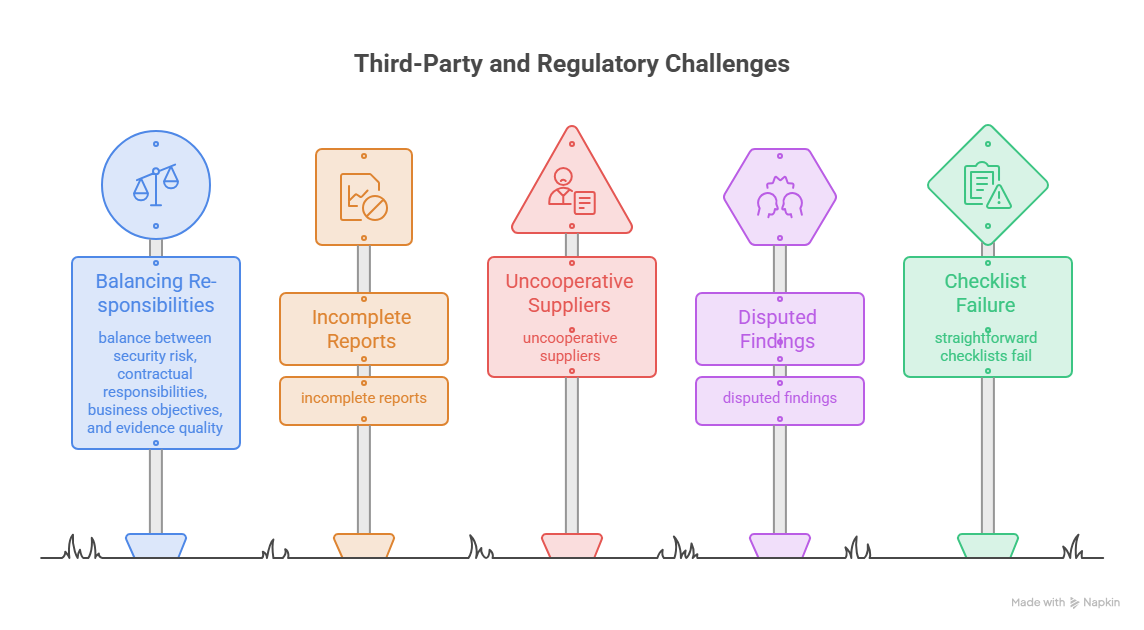
Third-party and regulatory scenarios require a careful balance between security risk, contractual responsibilities, business objectives, and evidence quality.
Interviewers frequently introduce incomplete reports, uncooperative suppliers, or disputed findings to see how candidates respond when straightforward checklists fail.
The following questions are valuable for GRC analysts, privacy professionals, and cybersecurity regulatory specialists.
Q37. A critical vendor's SOC 2 Type II report contains several exceptions. What would you do?
Model answer: Review the auditor's opinion, affected controls, exception details, management response, and the period covered.
Determine whether the exceptions relate to services or data your organization depends upon. Assess compensating controls, potential exposure, and remediation commitments.
Escalate significant residual risk to the appropriate owner before approving or continuing the relationship.
The number of exceptions alone is insufficient for a conclusion. This demonstrates risk-based vendor assessment, audit interpretation, and GRC assurance judgment.
Q38. A vendor's SOC 2 report ended six months ago. Would a bridge letter solve the coverage gap?
Model answer: A bridge letter may provide management representations about changes or events after the report period, but it does not extend the auditor's examination or provide equivalent independent assurance.
Review the letter's dates, scope, and statements. Request additional evidence when significant changes or risks justify it.
Consider compensating measures until the next report becomes available.
A strong answer distinguishes vendor assurance documentation from independent testing and connects the remaining uncertainty to third-party risk treatment and compliance governance.
Q39. Your software supplier relies on several subcontractors. How would you assess the additional risk?
Model answer: Identify which subcontractors process data, host infrastructure, provide essential services, or influence security controls.
Map relevant dependencies and determine whether security obligations flow down contractually.
Review assurance coverage, geographic considerations, access permissions, incident notification expectations, and continuity arrangements.
For SOC reports, inspect subservice organization treatment and related customer responsibilities.
This strengthens supply-chain risk assessments, privacy compliance evaluations, and GRC third-party governance.
Q40. How would you classify a vendor as low, medium, or high risk?
Model answer: Evaluate the inherent exposure created by the service, considering data sensitivity, privileged access, business criticality, integration depth, regulatory impact, and substitutability.
Then assess the relevant controls and assurance to estimate residual risk.
A marketing tool with access to public content may carry different exposure from a payroll platform processing employee records.
Use defined thresholds and document the rating rationale. This demonstrates vendor risk scoring, privacy-aware supplier assessment, and GRC control prioritization.
Q41. A vendor refuses to provide its security audit report. How would you proceed?
Model answer: Clarify the reason and determine whether a report can be reviewed under an NDA or through a controlled assurance portal.
Where appropriate, request alternative evidence such as certifications, independent assessment summaries, relevant policies, or targeted control attestations.
Assess the reliability and limitations of that alternative evidence.
For a critical vendor, unresolved assurance gaps may require escalation, additional contractual protections, or reconsideration of the service.
This demonstrates GRC due diligence, supplier risk management, and professional audit evidence evaluation.
Q42. A vendor informs you of a data breach. What are your first GRC actions?
Model answer: Activate the relevant third-party incident and escalation procedures. Establish what happened, which services and data may be affected, and which facts remain unknown.
Coordinate with security operations, legal, privacy, procurement, and business owners.
Review contractual notification terms and potential regulatory deadlines, while supporting investigation and containment decisions.
Maintain a documented timeline and update risk assessments as evidence develops.
This combines privacy incident management, vendor risk governance, and security operations coordination.
Q43. Which contractual security provisions would you review before onboarding a critical supplier?
Model answer: Review data protection obligations, permitted uses, access restrictions, incident notification, subcontractor controls, audit rights, business continuity, deletion and return requirements, and termination arrangements.
Confirm which party is accountable for each responsibility and whether the commitments match the vendor's actual service model.
Coordinate final legal interpretation with qualified counsel.
This demonstrates practical third-party governance, regulatory risk awareness, and privacy protection planning.
Q44. A business unit wants to transfer customer data to another country. What would you assess?
Model answer: Identify the data categories, originating and receiving jurisdictions, processing purposes, recipients, transfer mechanisms, and applicable privacy laws.
Determine which contractual, technical, and organizational safeguards may be required.
Involve privacy and legal specialists when assessing jurisdiction-specific obligations and transfer restrictions.
Record the decision, legal basis where applicable, and any necessary risk treatment.
This demonstrates the cross-functional reasoning expected in privacy analyst careers, regulatory compliance roles, and chief privacy officer development.
Q45. A department wants to delete customer records, but an audit preservation requirement may apply. What do you recommend?
Model answer: Identify the applicable retention schedule, legal or regulatory requirements, contractual commitments, and any litigation or investigation holds.
Coordinate with legal and records-management owners before authorizing deletion.
Determine which records can be disposed of, which require preservation, and how the organization will document both decisions.
Excessive retention can create unnecessary exposure, while premature deletion can violate obligations.
A strong GRC response balances privacy lifecycle management, regulatory requirements, and operational evidence.
Q46. How would you build a regulatory obligations register for an international organization?
Model answer: Identify relevant entities, jurisdictions, business activities, data types, contracts, and regulatory regimes.
Work with legal specialists to determine which obligations apply. Document each requirement, its source, responsible owner, implementation controls, required evidence, reporting deadlines, and review frequency.
Establish a process for tracking changes and reassessing applicability.
For example, an EU financial-sector organization may have obligations under DORA, while PCI DSS applicability depends on payment-card activities.
This requires regulatory specialist expertise, privacy governance, and compliance-control mapping.
Q47. Management disputes an audit finding and insists the control is effective. How would you respond?
Model answer: Present the specific assessment criterion, evidence reviewed, testing procedure, and observed exception.
Ask management whether additional evidence or relevant context was overlooked.
Reassess the conclusion objectively if credible new information emerges.
If disagreement remains, document both positions and escalate through the established audit governance process.
Avoid allowing pressure to determine the outcome.
This demonstrates professional independence in cybersecurity auditing, GRC control assurance, and enterprise risk governance.
Q48. How would you present the top five cybersecurity risks to a board committee?
Model answer: Present each risk as a concise business scenario, explaining potential consequences, current exposure, trend, accountable owner, treatment status, and decisions required.
Distinguish material changes from routine updates.
Avoid overwhelming executives with raw vulnerability counts or unexplained technical terminology.
For example, explain how prolonged privileged access could affect customer data and which investment or governance decision is needed.
This demonstrates executive risk communication, cybersecurity leadership readiness, and GRC reporting competence.
5) GRC Analyst Interview Questions 49–60: Crisis Decisions, Executive Pressure & Real-World Governance
Senior interviewers frequently move beyond routine compliance questions and present situations involving conflicting priorities, incomplete information, or pressure from management.
They want to understand whether you can apply governance principles without exceeding your authority or delaying urgent security responses.
A useful answering method is to establish the scope, identify the relevant requirement, inspect available evidence, explain the risk, recommend a decision, and define ownership and follow-up.
These skills support progression from GRC analyst to risk specialist and eventually toward security leadership.
Q49. A ransomware incident disrupts business operations. What should the GRC analyst do?
Model answer: Support the incident response structure by identifying affected obligations, risk owners, relevant contractual commitments, and notification requirements.
Coordinate with security operations, legal, privacy, and business continuity personnel. Preserve a reliable decision and communications record.
Help determine whether control failures require formal findings and corrective action.
Avoid interfering with technical containment decisions assigned to incident responders.
This demonstrates coordination between GRC governance, SOC incident response, privacy obligations, and business risk management.
Q50. A senior executive requests an exemption from MFA because it slows down their workflow. How would you respond?
Model answer: Identify the applicable authentication requirement, executive account privileges, potential exposure, and whether an approved exception mechanism exists.
Explore secure alternatives, such as phishing-resistant authentication or appropriately configured authentication methods that improve usability.
If an exception remains necessary, require documented justification, compensating safeguards, appropriate approval, and a defined expiration.
Apply the organization's authorization standards consistently, regardless of seniority.
This demonstrates identity governance, security policy enforcement, executive risk communication, and GRC exception management.
Q51. The CEO accepts a critical risk that violates the organization's established risk appetite. What happens next?
Model answer: Confirm the assessment, impact, assumptions, legal constraints, and authorization requirements.
Determine whether the CEO has appropriate authority under the organization's governance structure and whether additional board or committee approval is required.
Explain any regulatory or contractual restrictions that cannot be waived through internal acceptance.
Document the decision and escalate unresolved governance conflicts through the established process.
Risk acceptance must be traceable and appropriately authorized. This is central to enterprise risk governance, executive cybersecurity accountability, and regulatory compliance.
Q52. A critical system has no identified business owner. How would you resolve the issue?
Model answer: Identify the business processes supported by the system, relevant stakeholders, funding responsibility, data ownership, and operational dependencies.
Work with governance leadership to establish an accountable owner and obtain formal confirmation.
Until ownership is resolved, escalate material security exposures and maintain clear interim responsibility for urgent actions.
A missing owner affects more than asset inventory accuracy. It can delay risk treatment, weaken access management, obstruct audit remediation, and undermine GRC accountability.
Q53. Employees are using an unauthorized SaaS application containing customer data. How would you assess it?
Model answer: Establish the service's purpose, data categories, access privileges, integrations, vendor identity, and current exposure.
Determine whether the application violates applicable procurement, privacy, or security requirements.
Coordinate with business stakeholders to assess whether approved alternatives exist and whether migration or remediation is necessary.
Preserve business-critical data and assess dependencies before directing service removal.
This demonstrates effective shadow IT risk assessment, cloud security governance, privacy compliance, and policy enforcement.
Q54. Your company plans to use an AI vendor to process confidential documents. What risks would you evaluate?
Model answer: Examine data classification, retention, vendor access, subprocessors, model-training and reuse terms, output accuracy, integration permissions, and incident handling commitments.
Assess risks such as unauthorized disclosure, prompt injection, excessive access, and unreliable generated conclusions.
Determine which vendor controls, contractual protections, monitoring arrangements, and human-review requirements are appropriate.
Document remaining exposure before approval.
This demonstrates emerging AI security assessment skills, privacy risk evaluation, third-party governance, and AI-related cybersecurity risk management.
Q55. A cloud provider says infrastructure security is its responsibility. What should the customer still assess?
Model answer: Review the provider's shared-responsibility documentation for the actual service model.
Determine who is responsible for identity permissions, application security, customer data, configuration, logging, encryption settings, vulnerability management, and incident response.
Evaluate whether contractual commitments and customer configurations adequately cover those responsibilities.
For example, a cloud provider may secure physical infrastructure while the customer remains accountable for excessive access permissions.
This is important in cloud security careers, IAM assessments, GRC risk reviews, and security control assurance.
Q56. A business application has an RTO of four hours and an RPO of one hour. What would you test?
Model answer: RTO represents the target time for restoring a business process or service after disruption. RPO represents the maximum tolerable amount of data loss measured in time.
Examine recovery architecture, backup frequency, dependencies, restoration procedures, and test results.
Verify whether exercises demonstrate recovery within four hours and data restoration consistent with a one-hour RPO.
Document gaps and their business consequences.
This supports operational resilience assessment, audit evidence testing, security governance, and GRC control evaluation.
Q57. Which key risk indicators would you recommend for a cybersecurity risk dashboard?
Model answer: Select indicators that reveal meaningful changes in exposure and support decisions.
Examples include overdue critical vulnerability remediation, privileged accounts without required safeguards, unresolved high-risk vendor findings, failed recovery exercises, and expired risk exceptions.
Define the denominator, calculation method, reporting frequency, accountable owner, and escalation threshold for each indicator.
Distinguish KRIs, which signal exposure, from KPIs that measure operational performance.
This demonstrates risk dashboard development, GRC reporting skills, executive security communication, and risk governance oversight.
Q58. You discover a conflict of interest during a security control assessment. What would you do?
Model answer: Disclose the conflict through the relevant professional and organizational process.
For example, an analyst who designed a control may face an independence concern when asked to provide an objective assessment of its effectiveness.
Recommend independent review or additional oversight where necessary.
Document the decision and preserve the integrity of the assessment.
This demonstrates professional judgment expected in IT audit careers, GRC assurance positions, regulatory compliance work, and cybersecurity leadership.
Q59. An external audit begins in 30 days, but several control owners have missing evidence. How would you prioritize?
Model answer: Establish the audit scope, applicable criteria, assessment period, and outstanding evidence requests.
Prioritize controls according to significance, evidence availability, risk exposure, and expected audit impact.
Assign accountable owners, establish deadlines, and monitor progress through a centralized tracker.
Escalate material blockers while documenting unresolved limitations accurately.
Avoid creating retrospective records that falsely imply controls operated during the required period.
This is essential to cybersecurity audit readiness, compliance program coordination, regulatory accountability, and security governance reporting.
Q60. You join a company with no mature GRC program. What would you accomplish in your first 90 days?
Model answer: During the first 30 days, understand business objectives, applicable obligations, critical assets, existing controls, risk ownership, and prior findings.
During days 31–60, establish a prioritized risk register, control inventory, ownership model, and recurring evidence collection process.
During days 61–90, implement governance reporting, remediation tracking, and a practical review cadence.
Prioritize material risks and sustainable processes before selecting additional software.
This demonstrates a credible path toward building a GRC career, establishing enterprise risk management, strengthening policy governance, and eventually supporting security leadership responsibilities.
6) FAQs: GRC Analyst Interviews, Framework Knowledge & Career Preparation
-
GRC interviews commonly assess risk identification, inherent and residual risk, control effectiveness, audit evidence, framework interpretation, vendor assessments, and remediation tracking.
Scenario questions frequently examine how candidates respond when controls fail, stakeholders dispute findings, or compliance evidence is incomplete.
Candidates should prepare to explain their decisions using business context, supporting evidence, and appropriate escalation procedures.
For entry-level GRC positions, foundational knowledge matters, but practical judgment can make a candidate more convincing.
Study risk management processes, control assurance procedures, and security governance responsibilities together.
-
Yes. Some employers recruit junior GRC analysts from IT support, finance, audit, legal operations, privacy, quality assurance, and business administration backgrounds.
Transferable skills include documentation, evidence review, process evaluation, stakeholder communication, and structured problem-solving.
However, candidates should understand basic cybersecurity concepts, including authentication, access control, vulnerability management, incident response, and data classification.
A practical starting project could involve conducting a simulated risk assessment, constructing a risk register, evaluating several controls, and preparing a management report.
These deliverables support a GRC career transition and provide verifiable cybersecurity portfolio evidence.
Candidates comparing SOC and GRC entry routes should consider which responsibilities align with their existing strengths.
-
Start with NIST CSF 2.0, ISO/IEC 27001:2022, and the fundamentals of SOC 2 assurance.
Learn how NIST CSF describes cybersecurity outcomes, how ISO 27001 structures an information security management system, and how SOC 2 reports provide independent assurance over relevant service-organization controls.
Then expand according to the jobs you intend to pursue.
NIST SP 800-53 is particularly relevant to control assessment environments using NIST control catalogs. PCI DSS becomes important for payment security, while privacy and financial-sector regulations depend on the organization and jurisdiction.
For GRC specialist preparation, focus on applying requirements to real control evidence.
Additional cybersecurity regulatory knowledge and IT audit methodology will strengthen your answers.
-
Explain the method you would use to reach a defensible decision.
For example, identify the applicable business activity, jurisdiction, contractual requirements, and relevant control objective.
State which authoritative requirement you would consult and what evidence you would request.
Then explain how you would evaluate the exposure, involve the appropriate stakeholders, and document the outcome.
Avoid inventing control identifiers, legal deadlines, or regulatory obligations.
Employers assessing regulatory compliance judgment value accuracy and disciplined verification.
Your answer should demonstrate the foundations of risk analysis, evidence assessment, and GRC decision-making.
-
Create a simulated organization with realistic business processes, systems, sensitive data, and defined security requirements.
Develop a risk register containing at least ten credible risk scenarios. Establish a control inventory and map selected controls to relevant framework objectives.
Generate synthetic evidence such as access-review records, change tickets, policy documents, and remediation plans.
Then assess the control evidence, identify deficiencies, and produce a concise management report.
Clearly label the environment as simulated and explain any assumptions.
This provides useful evidence for a cybersecurity portfolio, especially when preparing for entry-level GRC work.
Strong documentation can also improve your cybersecurity resume and prepare you for technical interview assessments.
-
Useful certifications depend on career stage and employer requirements.
For beginners, foundational security education and introductory risk or governance training can establish useful knowledge.
Candidates with relevant experience may consider credentials such as ISACA CRISC or CISA, depending on whether their work focuses on risk management or auditing. These certifications have experience requirements that candidates should verify directly.
CISSP may become relevant later for broader security governance responsibilities, although full certification also has experience requirements.
Before selecting an examination, evaluate the value of certifications versus practical experience, the appropriate timing for CISSP, and the risk of collecting too many certifications.
Practical competence in control assessment and risk reporting remains valuable throughout a GRC career.
