
Security+ demonstrates foundational security knowledge, but employers also want evidence that you can investigate alerts, analyze systems, and make defensible security decisions. The right cybersecurity projects transform certification knowledge into tested detections, incident reports, configuration changes, and reproducible technical findings. This guide identifies the highest-value projects after Security+, explains how to build them, and shows how to present the results on your resume. Use these projects to strengthen your cybersecurity portfolio, understand SOC hiring expectations, and develop practical security skills.

1) What Makes a Cybersecurity Project Valuable After Security+?
A useful post-Security+ project answers a hiring manager's most important question: Can this candidate apply security concepts to realistic technical problems and explain the results?
CompTIA Security+ covers security concepts, threats, architecture, operations, and governance. Its security operations objectives include incident response, investigations, log sources, automation, and vulnerability management. These areas translate particularly well into practical SOC analyst projects, security engineering exercises, and risk assessment work.
With Security+ V8 (SY0-801) expected in November 2026, candidates should also monitor updated examination objectives. The projects below develop practical abilities that transfer across exam versions.
The difference between a completed lab and job-ready evidence
Consider two applicants who have installed Splunk.
The first applicant includes a screenshot of the dashboard and writes, "Built a cybersecurity monitoring system."
The second applicant collects authentication events, simulates password spraying, develops a detection, compares malicious and benign test events, and documents the resulting investigation.
The second submission provides evidence of SIEM investigation ability, detection engineering, and incident documentation. A reviewer can inspect the detection logic, evaluate the findings, and ask specific technical questions.
Every serious project should contain five elements:
Security problem: Define the risk, threat, or operational weakness being investigated.
Technical environment: Identify systems, tools, data sources, permissions, and boundaries.
Hands-on work: Demonstrate analysis, configuration, detection, investigation, or remediation.
Verification: Test whether the intended security outcome occurred, including failure cases.
Evidence: Preserve sanitized logs, configurations, test results, and explanations.
These elements give projects value across entry-level cybersecurity applications, technical hiring tests, and practical certification preparation.
Choose projects according to your target position
For a Tier 1 SOC analyst role, prioritize alert triage, Windows event analysis, phishing investigations, and incident-response documentation. These align with SOC entry requirements and practical interview exercises.
For a security engineering position, prioritize access control, endpoint hardening, segmentation, cloud configuration, and detection-as-code. These complement cloud security career pathways and security automation skills.
For a GRC or cybersecurity risk role, develop control assessments, risk registers, audit evidence, and business-impact analyses. These demonstrate capabilities relevant to GRC specialists, IT auditors, and risk management professionals.
For an offensive security position, begin with authorized web application testing, vulnerability validation, remediation verification, and documented findings. This produces transferable evidence for penetration-testing careers and security research roles.
Establish a safe laboratory before starting
Use virtual machines, local containers, simulated cloud environments, or intentionally vulnerable systems that you control. Create separate testing identities and avoid importing genuine customer records.
Use snapshots before configuration changes. Restrict vulnerable applications to isolated laboratory networks, and configure spending alerts if you use billable cloud resources.
For a beginner, a Windows VM, a Linux VM, a monitoring system, and synthetic event data provide enough material for several projects. Follow a structured home-lab setup, then add components only when the next investigation requires them.
30 Cybersecurity Projects After Security+: Skills & Job-Proof Matrix
Match your target career to a technical project, then produce evidence another analyst can verify.
| Project | Effort / Career | Technical Skills Demonstrated | Verifiable Portfolio Deliverable |
|---|---|---|---|
| 1. Password-spray detection | Low · SOC | Windows events, SIEM correlation | Detection query, attack and benign tests, incident timeline |
| 2. Phishing investigation | Low · SOC | SPF, DKIM, DMARC, URL analysis | Sanitized header review and disposition report |
| 3. Sysmon process investigation | Medium · SOC | Process trees, command-line telemetry | Annotated host timeline with supporting event IDs |
| 4. Network packet investigation | Low · SOC | Wireshark, TCP, DNS, HTTP | Annotated PCAP and protocol findings |
| 5. Suricata IDS deployment | Medium · SOC | Traffic monitoring, signature validation | Test traffic, alerts, and false-positive review |
| 6. Ransomware response tabletop | Low · SOC / GRC | Containment, escalation, recovery decisions | Incident playbook, decision log, lessons learned |
| 7. SOC alert triage queue | Medium · SOC | Severity, confidence, ticket documentation | Ten labeled alerts with justified dispositions |
| 8. MITRE ATT&CK detection map | Medium · SOC | Threat behaviors, observable evidence | Technique-to-detection matrix and coverage gaps |
| 9. Sigma detection rules | Medium · SOC | YAML detection logic, test validation | Three tested rules and reproducible event fixtures |
| 10. DNS beaconing investigation | Medium · SOC | DNS frequency, timing, corroboration | Hypothesis, analysis, and documented conclusion |
| 11. Windows endpoint hardening | Low · Engineering | Firewall, auditing, access restrictions | Baseline comparison and verification logs |
| 12. Linux SSH hardening | Low · Engineering | SSH configuration, authentication controls | Configuration changes and valid/invalid login tests |
| 13. VLAN and firewall segmentation | Medium · Engineering | Least privilege, network access control | Network diagram and allowed/denied traffic matrix |
| 14. Cloud IAM least privilege | Medium · Cloud / IAM | Role scopes, identity authorization | Policy and positive/negative authorization tests |
| 15. Public storage exposure audit | Low · Cloud | Bucket permissions, configuration review | Before/after settings and unauthorized-access tests |
| 16. Cloud audit-log investigation | Medium · Cloud / SOC | Sign-in events, activity trails, identity context | Event correlation and escalation summary |
| 17. Identity lifecycle automation | Medium · IAM | Provisioning, deprovisioning, entitlement review | Workflow tests and permission revocation evidence |
| 18. Privileged access review | Low · IAM / GRC | Access inventory, entitlement analysis | Exception register and recommended role changes |
| 19. Vulnerability management cycle | Medium · Engineering | Scanning, exposure evaluation, remediation | Verified findings, priorities, and rescans |
| 20. Web application access-control test | Medium · AppSec | Authorization and session behavior | Approved test cases and corrected permission logic |
| 21. Web input-validation assessment | Medium · AppSec | Input handling, safe rendering, parameterization | Controlled test cases and remediation verification |
| 22. Python log parser | Low · SOC / Automation | JSON parsing, normalization, exception handling | Working script, tests, and sample output |
| 23. Automated IOC enrichment | Medium · Automation | API requests, caching, confidence assessment | Script with mock data, rate handling, test coverage |
| 24. SOAR-style triage playbook | Medium · Automation | Workflow orchestration, approvals, escalation | Execution trace and safe-failure demonstrations |
| 25. Backup restoration drill | Low · Engineering / GRC | Recovery, integrity, RPO/RTO | Restoration runbook, evidence, measured recovery times |
| 26. Security control audit | Low · GRC | Control mapping, evidence inspection | Control matrix and gap remediation plan |
| 27. Cyber risk register | Low · GRC | Likelihood, impact, ownership, residual risk | Prioritized risks and treatment decisions |
| 28. Third-party vendor assessment | Medium · GRC | Supplier risk and assurance evidence | Vendor questionnaire and documented findings |
| 29. AI assistant access-control test | Medium · AppSec / AI | Prompt injection, retrieval authorization | Blocked-action tests and trust-boundary analysis |
| 30. Full incident simulation | High · SOC | Detection, investigation, escalation, response | Complete case file with timeline and lessons learned |
Effort estimates are relative. Use authorized test environments and synthetic data. Commercial or cloud tools may have licensing, resource, or usage costs.
2) The Six Best Cybersecurity Projects to Build Immediately After Security+
These six projects offer a strong combination of transferable skills, manageable complexity, and evidence relevant to entry-level cybersecurity roles.
They are arranged in a suggested learning order for candidates seeking a technical security position. Your specific career goal may justify starting with a different project.
Project 1: Build a SIEM Lab and Detect Password Spraying
BEST FOR: SOC ANALYST • DETECTION ENGINEERING • THREAT MONITORING
Tools: Wazuh or Splunk, Windows, Windows Event Logs, optional Sysmon.
Start by deploying a Windows test endpoint and a SIEM platform. Configure event collection and verify that authentication records appear with correct timestamps, usernames, and source information.
Generate controlled authentication failures involving several fictional test accounts. Include legitimate failed logons as comparison events.
Build detection logic that groups failures by source, account, and time window. A password-spray scenario typically involves a small number of guesses distributed across numerous identities. A single account experiencing repeated failures may indicate a different pattern.
For Windows Security logs, Event ID 4625 records failed logons and Event ID 4624 records successful logons. Your investigation should examine relevant logon types, source details, and whether subsequent authentication succeeded.
What to submit: A lab diagram, log-source inventory, detection query, known-positive and known-negative tests, and an incident report.
Critical validation: Confirm the rule triggers for the simulated attack and explain which ordinary login patterns may produce false positives. Record the test dataset size and any missed detections.
Resume bullet: "Developed and validated a SIEM detection for simulated password spraying, correlating Windows authentication events across [N] laboratory accounts and documenting alert-triage findings."
This single project supports SOC portfolio development, SOC technical interviews, and entry-level hiring assessments.
Project 2: Investigate Network Traffic With Wireshark and Suricata
BEST FOR: NETWORK SECURITY • SOC ANALYST • INCIDENT TRIAGE
Tools: Wireshark, Suricata, isolated Linux and Windows systems, synthetic packet captures.
Collect packet captures of ordinary DNS lookups, HTTP requests, TLS connections, and test traffic designed to trigger an IDS signature.
Document the relationship between IP addresses, transport protocols, ports, DNS responses, and application-layer behavior.
Next, configure Suricata to inspect traffic and generate alerts against an authorized test fixture. Compare the resulting alert with the underlying PCAP. Determine which signature matched, which traffic fields support the finding, and what other evidence is needed to classify the activity.
The most important learning point is that a signature match represents an observation requiring interpretation. It does not automatically establish a successful intrusion.
What to submit: An annotated PCAP, network diagram, Suricata rule or signature reference, corresponding alert, and investigation notes.
Critical validation: Test both matching and nonmatching traffic, confirm that packet timestamps and alert timestamps align, and explain the visibility limits created by encrypted payloads.
Resume bullet: "Analyzed laboratory network traffic using Wireshark and Suricata, validating IDS alerts against packet evidence and documenting suspected activity and false-positive conditions."
This project strengthens CCNA-related networking knowledge, security operations skills, and hands-on security portfolios.
Project 3: Run a Complete Vulnerability Management Cycle
BEST FOR: SECURITY ANALYST • VULNERABILITY MANAGEMENT • SECURITY ENGINEERING
Tools: Greenbone/OpenVAS or an appropriately licensed vulnerability scanner, isolated test hosts, vendor advisories, patching tools.
Choose two or three laboratory hosts with different applications and configuration profiles. Inventory the assets and record their software versions before scanning.
Run an authorized vulnerability assessment. For each important result, determine whether the affected service actually exists, whether the vulnerable component is reachable, and whether exploitation is known or plausible.
Prioritize remediation using vulnerability severity alongside asset exposure, business importance, exploitation evidence, and available compensating controls. A highly rated issue on an isolated system may require less urgent action than a lower-rated flaw actively exploited on an exposed service.
Apply available patches or configuration changes. Rescan and verify that the specific affected component has been corrected.
What to submit: Asset inventory, original findings, validation notes, remediation priority, change log, and before-and-after evidence.
Critical validation: Distinguish scanner-reported remediation from independently verified correction. Record unresolved findings and explain why they remain.
Resume bullet: "Performed a vulnerability management assessment across [N] authorized laboratory hosts, validated affected services, prioritized remediation, and verified configuration changes through rescanning."
The project adds practical depth to cybersecurity risk management, security engineering preparation, and technical cybersecurity interviews.
Project 4: Complete a Phishing Email Investigation
BEST FOR: TIER 1 SOC • EMAIL SECURITY • INCIDENT RESPONSE
Tools: Sanitized email samples, header-analysis tools, DNS lookup utilities, controlled URL inspection tools, investigation-ticket template.
Create a set of synthetic phishing and benign email messages representing supplier invoice fraud, credential harvesting, executive impersonation, and legitimate automated notifications.
Analyze the visible sender, return path, reply-to address, received headers, SPF, DKIM, and DMARC results where available. Compare domain spelling, reply paths, and message claims against established organizational context.
A DMARC pass is useful evidence about domain authentication and alignment, but a genuine compromised sender can still distribute harmful content. Similarly, an authentication failure can arise from legitimate forwarding or configuration problems.
Prepare a triage verdict for each sample with confidence, supporting evidence, unresolved questions, and recommended action.
What to submit: Sanitized headers, a comparison of suspicious and benign samples, indicators, incident tickets, and an escalation runbook.
Critical validation: Include at least one sample where unusual indicators turn out to have a plausible benign explanation.
Resume bullet: "Investigated [N] synthetic phishing and legitimate email samples, examining authentication results, message headers, and URL indicators to produce documented triage decisions."
This work translates directly into SOC interview scenarios, entry-level SOC applications, and technical resume evidence.
Project 5: Secure a Cloud Environment With Least-Privilege IAM
BEST FOR: CLOUD SECURITY • IAM • SECURITY ENGINEERING
Tools: An AWS or Azure test environment, cloud IAM controls, audit logging, synthetic data, budget alerts.
Create a fictional business application that requires one identity to read test files while another can manage a limited set of resources.
Start with documented requirements and design the smallest permission set needed to perform the intended operations. Create policies or roles, then test permitted and prohibited actions.
Include common failure cases: an identity attempts to access another team's resource, a credential expires, a role has an unnecessary wildcard permission, or a storage configuration permits broader access than intended.
For a cloud storage example, keep the resource private and validate that unauthorized requests are denied. Maintain audit logs identifying the caller, operation, resource, and result.
What to submit: Architecture diagram, permission matrix, policy configuration, audit evidence, and authorized-versus-denied test results.
Critical validation: Demonstrate both successful legitimate access and blocked unauthorized access. A policy that denies everything is secure against access but fails the application's functional requirements.
Resume bullet: "Designed and validated least-privilege IAM policies in an authorized cloud laboratory, testing permitted and denied resource operations and documenting access-control improvements."
These capabilities support IAM careers, cloud security pathways, and digital identity management.
Project 6: Conduct an End-to-End Incident Response Simulation
BEST FOR: SOC ANALYST • INCIDENT RESPONDER • SECURITY OPERATIONS
Tools: SIEM, Sysmon or other endpoint telemetry, simulated incident evidence, structured investigation workbook, response runbook.
Develop a fictional intrusion scenario involving a suspicious authentication event followed by abnormal endpoint activity and unexpected network communication.
You can generate the necessary evidence using harmless controlled activity or prepared event fixtures. Destructive malware and uncontrolled attacks are unnecessary.
Start with an initial alert. Identify the affected identity, host, observable actions, and available evidence. Build a timeline and formulate a hypothesis.
Next, evaluate containment choices, such as suspending a compromised test identity or isolating a laboratory endpoint. Record the evidence supporting each recommendation and the operational consequences.
Finally, document eradication, recovery, and lessons-learned considerations without claiming to have performed actions that were only simulated.
What to submit: Initial alert, evidence log, incident timeline, severity assessment, escalation record, containment decision, final report, and improvement recommendations.
Critical validation: Ask another person to reconstruct the incident using only your documentation. Missing timestamps, unexplained assumptions, and unsupported conclusions indicate work to improve.
Resume bullet: "Completed an end-to-end simulated incident investigation, correlating endpoint and authentication evidence, reconstructing the event timeline, and documenting containment recommendations and recovery considerations."
This is especially useful for SOC job applicants without experience, incident-response interview preparation, and technical portfolio development.
3) How to Turn Security+ Projects Into Evidence Employers Can Verify
Installing a tool and publishing screenshots creates an incomplete portfolio. Hiring managers need enough information to understand what you configured, why the activity mattered, and whether your conclusions hold up under questioning.
A useful cybersecurity project portfolio should function like a compact technical case study. This is particularly important for candidates facing the experience catch-22 or trying to improve an entry-level security resume.
A portfolio structure that makes projects easy to evaluate
Create a separate repository or portfolio page for each substantial project. Organize it using the following structure:
README: Security problem, scope, tools, environment, and key findings.
Architecture: Network or application diagram showing systems and trust boundaries.
Configuration: Sanitized SIEM rules, policies, scripts, or configuration files.
Test cases: Legitimate behavior, suspicious behavior, and expected outcomes.
Evidence: Representative logs, packet captures, screenshots, and investigation notes.
Findings: Results, severity considerations, limitations, and recommended improvements.
Reproduction: Steps another person can follow using an authorized test environment.
A SIEM detection project should include its detection query and event fixtures. A cloud IAM project should include permission tests. A GRC project should provide its assessment criteria, evidence, and treatment rationale.
Score each project with a 10-point job-proof rubric
Use five criteria, scoring each from zero to two.
1. Reproducibility: Zero if the setup is undocumented; one if partially described; two if another reviewer can reproduce the relevant test.
2. Technical evidence: Zero if conclusions have no supporting artifacts; one if evidence is incomplete; two if logs, configurations, or other artifacts directly support the findings.
3. Validation: Zero if the project only shows the expected success case; one if some failure conditions were tested; two if positive, negative, and relevant edge cases were evaluated.
4. Security reasoning: Zero if the project simply follows instructions; one if some decisions are explained; two if tradeoffs, alternative explanations, and residual risks are justified.
5. Communication: Zero if findings are unclear; one if the README is understandable but incomplete; two if the report communicates methods, results, and limitations precisely.
A project earning eight to ten points on this self-assessment is generally stronger as a portfolio submission than one consisting primarily of installation screenshots. The score is a learning rubric, not an employer-recognized certification or a prediction of hiring success.
Review your projects using the same discipline applied to cybersecurity technical tests, SOC investigations, and security control audits.
Validate detection projects with meaningful measurements
For detection projects, distinguish between precision and recall.
Precision measures how many flagged events were actually positive cases in your labeled test set. Recall measures how many known positive cases your rule successfully identified.
Also count false positives and false negatives, and inspect the conditions that caused them.
A detection that flags every event may achieve high recall but overwhelm analysts with irrelevant alerts. Excessively restrictive logic may reduce false positives while missing genuine suspicious behavior.
Document the test set's composition and avoid making production-level claims based on a handful of laboratory events.
This level of analysis makes detection engineering projects more credible and prepares you for questions about SOC alert fatigue and technical investigation standards.
Convert technical results into strong resume bullets
Use this structure:
Action + Technology + Security Scenario + Verified Result
An example is:
Created and validated three SIEM detections for simulated authentication abuse, documenting matched events, false-positive conditions, and investigation outcomes.
Only use the number three if you actually built and tested three detections.
Label simulated activities accurately and distinguish professional responsibilities from self-directed training.
For job applications, select your two or three strongest projects rather than filling an entire page with shallow exercises. Review SOC resume guidance, recruiter-verifiable project evidence, and SOC hiring requirements when selecting which achievements deserve the most prominent placement.
Quick Poll: What's Holding You Back After Passing Security+?
Select your biggest obstacle and submit to reveal the most useful project to tackle next.
Submit
Browser-based self-assessment. Answers are not stored or counted.
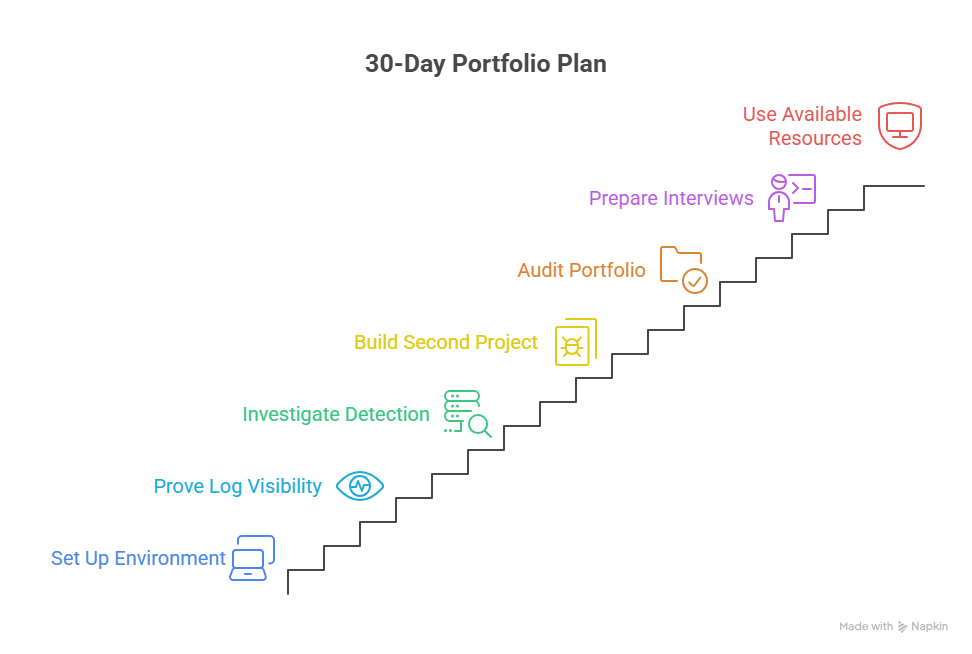
4) A 30-Day Cybersecurity Project Plan After Passing Security+
A focused 30-day plan can produce two substantial portfolio projects and one smaller supporting exercise. The following schedule assumes approximately eight to twelve hours of learning and laboratory work per week.
Candidates starting without practical IT experience may need additional time for networking fundamentals, operating-system administration, and beginner cybersecurity labs.
Week 1: Set up the environment and prove log visibility
Choose a primary platform and document the configuration. For SOC candidates, this could be Wazuh or Splunk with a Windows test endpoint.
Start by collecting ordinary authentication and system events. Confirm the source host, event identifier, timestamp, and relevant user or process information are present.
Add Sysmon telemetry if required by your chosen investigation. Modern Windows environments may provide built-in Sysmon capabilities, while other configurations use the standalone Sysinternals implementation. Follow the instructions appropriate to your supported system.
Remember that Sysmon records endpoint activity; detection and alerting require additional analysis or monitoring logic.
Week 1 acceptance criteria:
An identifiable test endpoint produces the expected events.
Events arrive in the monitoring platform with usable fields.
The collection configuration and time settings are documented.
The environment is isolated and uses approved test data.
Deliverable: Architecture diagram, log-source inventory, configuration notes, and representative event samples.
This provides a foundation for SOC detection projects, incident investigation skills, and practical cybersecurity portfolios.
Week 2: Complete a detection investigation with negative testing
Simulate one known suspicious behavior, such as password spraying against fictional accounts. Collect the resulting events and develop a detection that recognizes the scenario.
Add ordinary login activity as a negative test. This reveals whether your logic produces unnecessary alerts under expected operating conditions.
Investigate the results independently. Record the observations, relevant event fields, and uncertainty.
Where appropriate, map the behavior to a relevant MITRE ATT&CK technique. The mapping should describe observed behavior rather than claim that a specific adversary or intrusion has been confirmed.
Week 2 acceptance criteria:
A written detection hypothesis explains the expected behavior.
At least one known-positive case is recognized.
Known-negative cases have been evaluated.
Results include an incident timeline or evidence-supported summary.
False positives and missed detections are acknowledged.
Deliverable: Working detection, test fixtures, investigation report, and initial portfolio README.
These artifacts support SOC technical hiring assessments, entry-level security resumes, and defensive security skills.
Week 3: Add a second project that demonstrates a different skill
Avoid building two nearly identical dashboards. Select a project that introduces another security responsibility.
For SOC candidates, combine SIEM detection with phishing investigation or packet analysis. For cloud candidates, combine IAM controls with an audit-log investigation. For GRC candidates, combine a vulnerability assessment with a risk treatment plan.
This demonstrates range while keeping the portfolio relevant to a specific career direction.
Week 3 acceptance criteria:
The second project addresses a distinct security problem.
Technical findings are supported by appropriate artifacts.
A failed or unauthorized condition is explicitly tested.
The final report distinguishes observations from assumptions.
Deliverable: Second project repository or report with its own evidence and validation results.
This approach balances specialization with transferable skills. It is particularly useful when exploring SOC versus GRC, comparing cloud security and SOC work, or evaluating an IAM career path.
Week 4: Audit your portfolio and prepare for interviews
Review every project using the 10-point scoring rubric. Ask whether a stranger could reproduce the important result without contacting you for missing configuration details.
Sanitize evidence before publication. Remove genuine credentials, API keys, personal information, cloud account identifiers, and sensitive infrastructure details.
Write two or three resume bullets drawn directly from completed activities. Include verified metrics where they improve the statement.
Finally, practise explaining each project in five minutes. Cover the original problem, tools, evidence, result, limitations, and what you would improve with additional time.
Week 4 acceptance criteria:
Two substantial projects have working evidence.
Each project includes both successful and unsuccessful test outcomes.
Repository instructions are understandable and reproducible.
Resume claims accurately reflect completed work.
You can defend important technical decisions without reading a script.
Deliverable: Two interview-ready project pages, an updated resume, and a prepared technical explanation.
Review SOC resume examples, cybersecurity technical interview exercises, and recruiter-verifiable security portfolios before submitting applications.
A lower-resource alternative
A powerful computer or paid cloud subscription is unnecessary for every project.
If your device cannot comfortably run multiple VMs, start with synthetic phishing samples, saved packet captures, local Python log-processing scripts, and structured incident simulations.
Use prepared Windows event fixtures for detection testing when full monitoring infrastructure is temporarily impractical. Clearly explain the limitations of using replayed data instead of live telemetry.
The strongest initial project is one you can complete, verify, and explain using resources available to you. This is especially relevant for candidates evaluating cybersecurity training ROI and certifications versus practical experience.
5) Which Projects Should You Put on Your Resume for SOC, Cloud, IAM, GRC, or Pentesting Jobs?
A hiring manager should immediately understand why a project is relevant to the position.
A cybersecurity portfolio containing ten unrelated tutorials can be harder to evaluate than three strong projects that map directly to the vacancy's responsibilities.
Best project combinations by career goal
SOC Analyst: Combine a SIEM authentication detection, phishing investigation, and endpoint incident timeline. This demonstrates monitoring, triage, correlation, and documentation. These responsibilities align with entry-level SOC hiring criteria and SOC interview expectations.
Cloud Security Analyst: Combine least-privilege IAM, cloud audit-log investigation, and storage exposure assessment. Prioritize policy enforcement and verified authorization decisions. These projects build on cloud security career preparation and digital identity fundamentals.
IAM Analyst: Combine role-based access control, identity lifecycle automation, and privileged-access review. Demonstrate provisioning, access restrictions, deprovisioning, and audit trails. This complements IAM career development and identity management specialist skills.
GRC Analyst: Combine a risk register, security control audit, and supplier assessment. Explain evidence requirements, accountable owners, and treatment decisions. These activities support GRC specialist roles, cybersecurity auditing, and cybersecurity regulatory careers.
Junior Pentester or Application Security Candidate: Combine authorized web access-control testing, input-validation assessment, and remediation verification. Show reproducible findings and the security improvements resulting from them. These demonstrate useful skills for offensive security careers and security research positions.
Translate projects into defensible interview stories
For every resume-worthy project, prepare answers to five questions:
What security problem were you trying to investigate or solve?
Which evidence established the initial hypothesis?
How did you rule out plausible alternative explanations?
What control, detection, or decision resulted from the investigation?
How did you verify the outcome, and what limitations remain?
For example, a candidate describing a password-spray detection should understand the difference between spraying and brute forcing, why one failed login is insufficient evidence, and how detection thresholds affect false positives.
A candidate describing a cloud IAM project should explain why an authorization test must demonstrate both permitted and denied behavior.
This level of preparation addresses the gaps frequently encountered by cybersecurity graduates struggling to get hired and candidates encountering practical cybersecurity interviews.
How to select your next certification after building projects
Projects can reveal which further qualification would add value.
If network analysis remains difficult, strengthen your networking foundations before cybersecurity specialization.
If you enjoy alert triage and incident investigations, examine CySA+ and other post-Security+ certifications.
If you prefer practical blue-team exercises, evaluate the differences between BTL1 and Security+.
If cloud identity and authorization are your strengths, pursue deeper platform-specific training and build more advanced cloud security projects.
The goal is to use project performance to inform your learning strategy. This helps avoid excessive credential accumulation without meaningful increases in job-ready cybersecurity skills.
6) Best Cybersecurity Projects After Security+: Frequently Asked Questions
-
Two or three substantial, well-documented projects provide a useful starting portfolio for many entry-level applications.
For a SOC role, one SIEM investigation, one phishing or network-analysis project, and one incident-response case study demonstrate complementary skills.
Each project should include a reproducible method, relevant security evidence, validation results, and a clear explanation of your findings.
You can begin applying while continuing to develop additional projects, especially when your existing experience meets the vacancy's requirements.
Use SOC hiring expectations, cybersecurity portfolio standards, and entry-level resume guidance to decide when your strongest projects are ready.
-
Several valuable projects can be completed using freely available software, synthetic data, and equipment you already own.
Packet analysis, Python log parsing, phishing investigation, basic incident documentation, and local access-control testing can often be performed without paid platforms.
More extensive SIEM environments may require additional memory, storage, or computing resources. Cloud projects can incur usage charges even when free-tier options are available.
For a low-resource starting point, choose beginner SOC exercises, reproducible security projects, or technical investigation practice.
-
For someone targeting a Tier 1 SOC position, a Windows authentication investigation using a SIEM is an excellent starting point.
It combines security monitoring, authentication concepts, alert detection, event correlation, and incident documentation.
A candidate can demonstrate the difference between legitimate failed logons and suspicious multi-account authentication patterns while developing a reproducible detection.
For someone targeting GRC, a control assessment or risk register may be more relevant. Cloud-focused candidates may benefit from an IAM authorization project.
Your choice should align with the responsibilities described in SOC versus GRC career comparisons, cloud security career guidance, or IAM role expectations.
-
A home lab provides evidence of practical skills when its documentation allows another person to understand and verify the work.
Useful repositories contain configurations, detection queries, test cases, sanitized logs, diagrams, and reports. They should explain the purpose of the project and the conditions under which its findings are valid.
A public repository does not establish professional experience by itself. Its value depends on technical relevance, correctness, and demonstrable outcomes.
Use cybersecurity projects recruiters can evaluate as a quality benchmark, strengthen your resume with project evidence, and practise explaining your work in interviews.
-
Use accurate action verbs, identify the technology involved, and describe what you genuinely accomplished.
If you simulated an incident, explicitly label it as a simulation. If you recommended containment without executing it, describe the recommendation rather than claiming operational authority.
Include measurable outcomes only when supporting evidence exists.
For example, "Developed and tested three detection rules against a labeled laboratory dataset" communicates more useful information than an unsupported claim of preventing cyberattacks.
Review ATS-friendly cybersecurity resume examples, SOC analyst hiring standards, and technical interview preparation before submitting your application.
-
For SOC candidates, Windows event analysis and network traffic investigation offer valuable starting points because they build skills in authentication, process behavior, and network communication.
Linux administration adds useful experience with permissions, services, authentication logs, and system hardening.
Cloud projects become particularly valuable when the target role involves IAM, cloud logging, workload security, or configuration management.
A balanced starting combination might include a Windows detection project, a Wireshark investigation, and a cloud IAM exercise.
Build your sequence around networking foundations, SOC practical skills, and cloud security career requirements.
