
Choosing between CompTIA Security+ and CySA+ can determine whether your next certification strengthens your job prospects or simply adds another credential to your resume. Security+ develops broad cybersecurity foundations, while CySA+ focuses on threat detection, vulnerability analysis, and incident response. For candidates navigating a competitive cybersecurity job market, understanding that difference is essential. This guide compares exam costs, difficulty, hiring relevance, and practical skills so you can choose the certification that supports your cybersecurity career goals and avoid expensive certification mistakes.

1) Security+ vs CySA+: What Actually Changes Between These Certifications?
The deciding factor is your ability to demonstrate the skills associated with each certification. Security+ provides broad coverage of how organizations protect systems, identities, networks, and information. CySA+ concentrates on analyzing security evidence, investigating suspicious activity, and prioritizing defensive action.
For someone pursuing cybersecurity without IT experience, Security+ usually provides the more appropriate starting point. Candidates already performing monitoring, vulnerability management, or incident triage may find CySA+ better aligned with their responsibilities.
Security+ SY0-701: Broad Security Knowledge
CompTIA Security+ SY0-701 covers five examination domains:
General Security Concepts — 12%
Threats, Vulnerabilities, and Mitigations — 22%
Security Architecture — 18%
Security Operations — 28%
Security Program Management and Oversight — 20%
The exam establishes familiarity with controls, cryptography, identity management, network defense, incident response fundamentals, and organizational security requirements.
Security+ is particularly relevant for candidates considering IT support versus cybersecurity careers, moving from help desk into security, or preparing for foundational SOC analyst responsibilities.
An important 2026 update: Security+ SY0-801 is expected to launch around November 17, 2026. The current English SY0-701 exam is scheduled to retire June 11, 2027. Candidates should match study materials to the exact version they intend to take. Earning Security+ through an older active examination version still provides the same certification, subject to its normal renewal cycle.
CySA+ CS0-004: Security Analysis and Operational Judgment
The current CompTIA CySA+ CS0-004 examination launched June 23, 2026. It focuses on four domains:
Security Operations — 34%
Vulnerability Management — 26%
Incident Response and Management — 24%
Reporting and Communication — 16%
CySA+ evaluates a more specialized collection of skills. Candidates must interpret security evidence, evaluate detection results, understand vulnerability prioritization, investigate incidents, and recommend defensible actions.
For example, an analyst may encounter five failed authentications followed by a successful login. A Security+ learner should understand authentication threats and security monitoring controls. A CySA+ learner should also be prepared to evaluate source addresses, account context, event order, possible explanations, and escalation requirements.
That practical distinction matters for SOC technical interviews and hands-on cybersecurity assessments.
CySA+ CS0-003 remains available during the current version transition, with its English retirement scheduled for December 22, 2026. New students should generally target CS0-004 and verify that their study resources match its objectives.
Which Should You Choose Based on Experience?
Choose Security+ first when your knowledge of TCP/IP, operating systems, authentication, firewalls, or security controls still contains significant gaps. It also offers flexibility if you are considering cloud security, governance and compliance, or identity management careers.
Choose CySA+ next when you already understand the fundamentals and want to demonstrate stronger analytical capabilities for SOC, incident response, or vulnerability-management positions. Complement the certification with SIEM investigations and recruiter-verifiable portfolio projects.
Neither examination has a mandatory prerequisite, although CompTIA recommends approximately two years of relevant security or systems administration experience for Security+ and approximately four years in analyst-related work for CySA+.
Security+ vs CySA+: 30-Point Certification Decision Matrix
| Comparison Factor | CompTIA Security+ | CompTIA CySA+ |
|---|---|---|
| 01. Current recommended exam | SY0-701 (V7) | CS0-004 (V4) |
| 02. Certification focus | Broad cybersecurity foundations | Defensive analysis and incident response |
| 03. Typical career stage | Early career or IT-to-security transition | Developing or experienced security analyst |
| 04. Mandatory prerequisite | None | None |
| 05. Recommended experience | Network+ and approximately two years in security or systems administration | Approximately four years in SOC or vulnerability analysis |
| 06. Maximum questions | 90 | 85 |
| 07. Exam duration | 90 minutes | 165 minutes |
| 08. Passing score | 750 on a 100–900 scale | 750 on a 100–900 scale |
| 09. Question formats | Multiple-choice and performance-based | Multiple-choice and performance-based |
| 10. US standard voucher price | Approximately $439 | Approximately $439 |
| 11. Certification validity | Three years | Three years |
| 12. CEUs for renewal | 50 through the CEU renewal route | 60 through the CEU renewal route |
| 13. Security architecture | Significant foundational coverage | Applied context for investigations |
| 14. Threat identification | Recognizing attacks and mitigations | Analyzing indicators and threat activity |
| 15. SIEM knowledge | Monitoring concepts and controls | Operational analysis and event correlation |
| 16. Vulnerability management | Vulnerabilities and mitigation fundamentals | Assessment, prioritization, remediation validation |
| 17. Incident response | Processes, roles and foundational concepts | Investigation, response and case management |
| 18. Log analysis | Basic interpretation and monitoring concepts | Detailed event evaluation and investigative reasoning |
| 19. Governance and risk | Broad security governance coverage | Risk-informed operational reporting |
| 20. Performance-based preparation | Control selection and technical scenarios | Analysis and investigation scenarios |
| 21. Networking expectations | Foundational protocols and network security | Network behavior and security evidence analysis |
| 22. Operating system knowledge | Understanding host security fundamentals | Investigating endpoint events and context |
| 23. Entry-level IT roles | More directly aligned with baseline security knowledge | Often more specialized than necessary |
| 24. SOC analyst preparation | Useful foundation | More directly aligned with daily analysis work |
| 25. Vulnerability analyst preparation | Foundational understanding | Strong alignment with vulnerability workflows |
| 26. GRC career flexibility | Broad relevance to governance foundations | Most useful for technical risk and response roles |
| 27. Recommended portfolio work | Network, identity and control demonstrations | SIEM detections, incident cases and vulnerability triage |
| 28. Main preparation challenge | Covering numerous security domains accurately | Interpreting complex operational evidence |
| 29. Common investment mistake | Expecting a foundational certificate alone to secure a job | Taking an analyst certification without analyst-level preparation |
| 30. Best next action | Build fundamentals and a basic security lab | Build incident investigations and verified detection projects |
Exam details reflect October 2026 versions and approximate US voucher pricing. Confirm regional prices, availability and exam objectives with CompTIA before booking.
2) Exam Difficulty: Why CySA+ Demands More Analytical Experience
CySA+ is generally more challenging for candidates with limited practical security experience. Its questions emphasize interpreting evidence and choosing appropriate actions in realistic operational situations. Security+ covers more foundational breadth, which can also be difficult for students with weak technical backgrounds.
Both require a scaled passing score of 750 out of 900. This score is determined through CompTIA's scoring system and should not be interpreted as a simple 75% correct requirement.
How Security+ Tests Your Knowledge
A Security+ scenario might describe a company requiring stronger authentication for remote workers and ask you to identify an appropriate security control.
The challenge involves understanding authentication factors, conditional access, potential risks, and business requirements.
Other questions may require identifying encryption mechanisms, network security components, vulnerability types, or incident response procedures.
Students preparing with Security+ practice examinations should focus on understanding why incorrect options fail. Recognizing terminology alone provides weak preparation for performance-based questions.
Build small exercises around networking fundamentals, identity security, and security configuration projects. Explain the underlying control, the risk it addresses, and the trade-offs involved in implementing it.
How CySA+ Tests Your Investigation Skills
A CySA+ scenario might provide authentication logs showing repeated failures, an eventual success, an unfamiliar source address, and activity involving a privileged account.
You would need to determine which evidence matters, assess the likely threat, and select an appropriate response.
The exam can also require interpreting vulnerability information, prioritizing remediation, evaluating security alerts, and communicating findings.
This aligns more closely with SOC analyst interview scenarios, practical security investigations, and security analyst technical assessments.
Consider a vulnerability assessment identifying three findings:
A critical vulnerability on an isolated test server.
A high-severity vulnerability on an internet-facing authentication service with evidence of active exploitation.
A medium-severity vulnerability affecting a privileged administrative system.
A capable analyst considers exposure, exploitability, compensating controls, asset importance, and business consequences before prioritizing remediation. Severity scores alone provide an incomplete decision framework.
Developing this judgment through hands-on cybersecurity labs is particularly valuable for candidates pursuing vulnerability management careers.
A Four-Part Readiness Assessment
Before committing to CySA+, test yourself on four tasks.
Authentication investigation: Given Windows 4624 and 4625 events, explain which accounts were targeted, whether successful logons occurred, and what evidence supports escalation.
Endpoint investigation: Given process-creation events, identify unusual parent-child relationships and explain why the command-line context matters.
Vulnerability prioritization: Given three vulnerability findings, justify remediation order using exposure and business risk.
Incident reporting: Given an incident timeline, write a concise summary identifying confirmed facts, unresolved questions, and recommended next actions.
If these activities require extensive prompting, strengthen your SOC home lab skills before scheduling CySA+.
Candidates who can perform these tasks independently have a stronger basis for preparing for analyst-focused certifications and discussing their work in SOC recruitment assessments.
3) Security+ vs CySA+ Costs, Hiring Value, and Return on Investment
The standard US exam voucher price for both Security+ and CySA+ was approximately $439 in October 2026. Purchasing one attempt at each therefore costs approximately $878 before any training materials, laboratory expenses, optional retake arrangements, or applicable taxes.
Regional pricing, academic discounts, bundles, and promotions may alter the actual amount.
The more important financial question is whether the next certification helps you qualify for a specific role or demonstrate a capability employers are currently evaluating.
When Security+ Offers Better Career Value
Security+ generally offers greater flexibility for candidates entering IT or transitioning toward security.
It provides foundational knowledge relevant to entry-level cybersecurity pathways, IT support transitions, and several technical security specializations.
However, candidates should evaluate the difference between meeting a certification requirement and meeting an employer's experience requirement.
An employer seeking experience with Active Directory, network troubleshooting, or security monitoring may still require evidence of those abilities from a certified applicant.
This is why cybersecurity graduates struggle to secure interviews despite earning formal credentials. Supplement Security+ with practical network administration skills, security labs, and a credible entry-level resume.
When CySA+ Offers Better Career Value
CySA+ becomes more relevant when your target positions involve alert investigation, security monitoring, vulnerability assessment, or incident response.
Someone already working with endpoint alerts, SIEM searches, and remediation workflows may be able to connect CySA+ directly to measurable experience.
For candidates pursuing SOC analyst positions, the strongest application pairs CySA+ with documented investigations. Employers can examine the candidate's technical projects and evaluate whether the credential reflects practical competence.
CySA+ does not guarantee a higher salary. Compensation depends on job responsibilities, location, experience, industry, clearance requirements where applicable, and employer budgets. Use cybersecurity salary comparisons to evaluate roles rather than assigning a salary premium to a certification.
Include Renewal and Opportunity Costs
Both certifications normally remain valid for three years.
Under CompTIA's Continuing Education program, Security+ requires 50 CEUs and CySA+ requires 60 CEUs through the CEU renewal pathway. Other permitted renewal methods exist, and applicable fees depend on the method.
CySA+ is higher than Security+ in CompTIA's renewal hierarchy. Earning CySA+ can renew an active Security+ certification under the applicable rules.
There is also an opportunity cost. Spending eight weeks preparing for a certification means eight weeks unavailable for another activity, such as strengthening SOC interview skills, developing SIEM portfolio evidence, or applying for realistic entry-level security roles.
Before paying for either exam, review 20 relevant job descriptions. Record which certifications employers request, which technical skills recur, and which experience requirements you can currently satisfy.
This offers a stronger basis for calculating certification value than generic promises about cybersecurity career growth.
Quick Poll: What's Making Your Next Cybersecurity Certification Decision Difficult?
Choose the biggest problem holding you back from committing to Security+ or CySA+.
Use your selection to focus on the most relevant certification roadmap below.
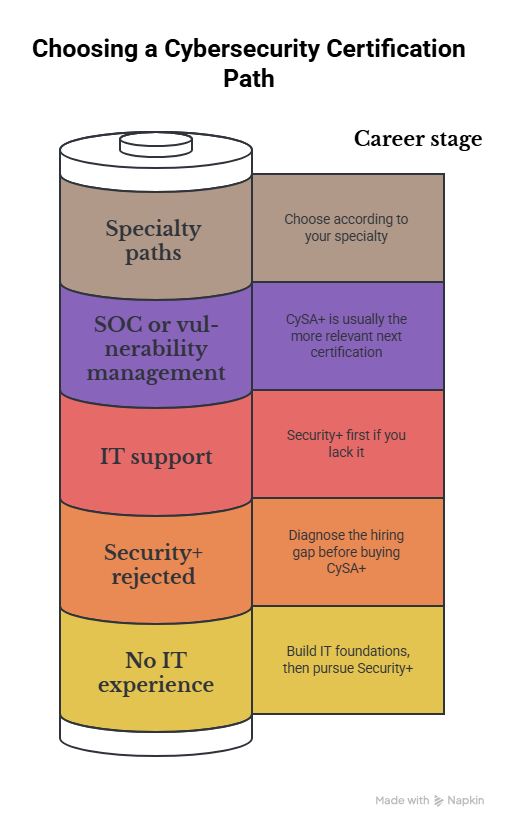
4) Which Certification Should You Take Next? Five Real Career Scenarios
The correct choice becomes clearer when you examine your present skills and the role you want to reach. Use these five scenarios to avoid spending money on a credential that addresses the wrong problem.
Scenario 1: You Have No IT Experience and Want Your First Cybersecurity Job
Recommended path: Build IT foundations, then pursue Security+.
Start by learning TCP/IP, DNS, operating-system administration, user permissions, and basic security controls.
Security+ provides a structured framework for understanding security concepts, but employers may also expect basic troubleshooting ability.
If you are considering cybersecurity with no experience, compare realistic entry routes through IT support, help-desk positions, and junior SOC opportunities.
Action: Build a small Windows and Linux lab, practice authentication troubleshooting, and document three practical exercises before attempting advanced analyst certifications.
Scenario 2: You Already Have Security+ but Keep Getting Rejected
Recommended path: Diagnose the hiring gap before buying CySA+.
Review your application history. Determine whether employers are rejecting you before interviews or during technical assessments.
If you receive few interviews, evaluate the match between your resume and advertised job requirements. Improve your ATS-friendly cybersecurity resume, add verifiable technical project evidence, and investigate common graduate rejection patterns.
If interviews expose weaknesses in log analysis or alert investigation, complete hands-on SOC lab exercises and practice technical assessment scenarios.
CySA+ becomes a stronger investment once you can identify specific analyst skills it will help you develop or validate.
Scenario 3: You Work in IT Support or System Administration
Recommended path: Security+ first if you lack it; consider CySA+ after developing operational security skills.
Your existing knowledge of endpoints, account management, troubleshooting, and infrastructure can provide useful preparation for security work.
Apply it to defensive activities: review suspicious authentication events, analyze administrative permissions, investigate endpoint alerts, and document system vulnerabilities.
Follow a structured IT-to-cybersecurity transition while building SOC portfolio projects.
You may also find network-focused certification preparation useful if your current position offers limited exposure to routing, traffic analysis, or network troubleshooting.
Scenario 4: You Already Work in a SOC or Vulnerability Management
Recommended path: CySA+ is usually the more relevant next certification.
Your existing responsibilities may closely match CySA+'s security operations, vulnerability management, and incident response objectives.
Use real, appropriately sanitized work examples to identify exam topics requiring improvement. Candidates with experience investigating SIEM alerts may need additional study in risk-based vulnerability prioritization or incident reporting.
Review the best certifications after Security+ and compare CySA+ against practical blue-team certifications.
If your next role emphasizes management, architecture, or senior security responsibilities, investigate the long-term SOC career pathway before choosing another technical credential.
Scenario 5: You Want Cloud Security, GRC, IAM, or Penetration Testing
Recommended path: Choose according to your specialty.
Security+ can supply a useful foundation across these paths, but CySA+ concentrates on defensive analysis.
For cloud security roles, cloud platform administration, identity controls, and audit logging may deserve priority.
For GRC positions, focus on controls, risk assessments, evidence collection, and compliance career requirements.
For identity security careers, develop authentication, authorization, privileged access, and digital identity management skills.
Candidates pursuing offensive security should consider penetration testing career developments alongside network and application security labs.
Selecting a specialized path early can prevent the certification accumulation problem that leaves candidates with credentials poorly aligned with their desired jobs.
5) An Eight-Week Study Plan for Security+ and CySA+ Candidates
A productive study plan should prepare you to pass the exam while developing skills you can explain during an interview. The proportion of time devoted to theory versus hands-on practice should change depending on which certification you choose.
The following roadmap assumes you already have basic computer and networking familiarity. Candidates entering cybersecurity without previous experience may need additional preparation before beginning the eight-week sequence.
Weeks 1–2: Establish the Required Foundation
Security+ candidates: Review networking, identity and access management, authentication mechanisms, cryptography, and security controls. Connect each topic to an actual system or organizational requirement.
Practice identifying common protocols, firewall behavior, encryption use cases, and the principles behind least privilege.
Use networking certification guidance to identify fundamental gaps, then reinforce concepts through a basic cybersecurity home lab.
CySA+ candidates: Review security monitoring architecture, log collection, endpoint telemetry, and vulnerability assessment concepts.
Configure a SIEM or use a prepared dataset. Practice finding suspicious authentication events and identifying the users, hosts, and addresses involved.
This supports SOC technical skill development and creates material for hands-on portfolio documentation.
Weeks 3–4: Develop Applied Technical Skills
Security+ candidates: Focus on threats, security architecture, vulnerability management fundamentals, and incident response procedures.
For each topic, answer three questions: What risk is present? Which control addresses it? What limitations does that control introduce?
Practice performance-based scenarios involving network segmentation, access-control decisions, and secure system configurations.
Use technical project examples to connect theory to real environments, particularly when preparing an entry-level cybersecurity resume.
CySA+ candidates: Build three investigation exercises covering authentication anomalies, suspicious processes, and vulnerability prioritization.
For authentication analysis, use Windows Event IDs 4624 and 4625. For process investigations, inspect Sysmon Event ID 1 where available.
Document the evidence supporting each finding, along with reasonable benign explanations.
These tasks directly support SOC technical interview preparation, blue-team certification skills, and job-ready investigation projects.
Weeks 5–6: Practice Decision-Making Under Exam Conditions
Security+ candidates: Complete timed practice assessments and analyze errors by exam objective.
Separate mistakes into three categories: missing knowledge, misunderstanding the scenario, and selecting an answer before reviewing the requirements.
For performance-based questions, practice interpreting diagrams and choosing controls based on explicit business needs.
If your results repeatedly expose foundational gaps, revisit the relevant objectives before buying additional practice resources. Candidates comparing Security+ with alternative beginner credentials should ensure their preparation matches their intended exam version.
CySA+ candidates: Practice interpreting longer scenarios, investigating partial evidence, and selecting appropriate responses under time constraints.
Create a short incident report containing the timeline, suspected activity, affected systems, supporting evidence, uncertainty, and recommended next action.
For vulnerability exercises, explain remediation priority using exploitability, exposure, compensating controls, and business impact.
Use SOC analyst scenario questions and practical cybersecurity assessments to evaluate how confidently you can defend your decisions.
Weeks 7–8: Validate Readiness and Prepare Your Career Evidence
Security+ candidates: Complete full-length practice exams under a 90-minute limit and review your performance against the official objective outline.
Look for consistent competence across all domains. Repeatedly missing questions about cryptography, identity, or incident response indicates specific preparation gaps.
CySA+ candidates: Practice mixed scenarios under the exam's 165-minute limit, combining log analysis, vulnerability prioritization, response decisions, and reporting.
Review explanations carefully, especially when several answer choices appear technically plausible.
Both groups should produce at least one verifiable portfolio artifact. Security+ candidates might document secure configuration and authentication controls. CySA+ candidates can produce a complete SOC investigation case study.
Use the resulting work to strengthen your cybersecurity project resume and prepare for technical hiring assessments.
Final Exam Booking Checklist
Before purchasing your voucher, verify your target exam code, current objectives, available test language, retirement schedule, voucher validity, and testing policies.
For late 2026, the transition between Security+ SY0-701 and SY0-801 deserves particular attention. Candidates already prepared for SY0-701 can consider taking that version while available. Those beginning a longer preparation cycle should evaluate SY0-801 materials instead.
For CySA+, CS0-004 is the current updated exam. Candidates using CS0-003 resources should compare the published objectives before scheduling a test.
Finally, prioritize the examination that directly addresses your next career requirement. Candidates struggling with cybersecurity job-market competition should evaluate whether their largest weakness is foundational knowledge, practical investigation ability, or evidence of professional experience.
That distinction can prevent another costly cycle of certification collecting without job progress.
6) FAQs: Security+ vs CySA+ Certification Decisions
-
Security+ is generally the better first certification because it covers the security foundations needed to understand more specialized defensive work.
Beginners should develop networking, operating-system, identity, and security-control knowledge before attempting advanced investigation scenarios.
If you are following a 12-month cybersecurity career-change roadmap, combine Security+ preparation with foundational technical practice.
Consider IT support career routes and beginner SOC labs to develop relevant experience.
The goal is to become technically prepared for the work employers expect, rather than relying entirely on an examination result.
-
Yes. CompTIA does not require Security+ as a formal prerequisite for CySA+.
However, CySA+ assumes a substantial understanding of cybersecurity concepts and emphasizes practical defensive analysis. Candidates who skip Security+ should already possess equivalent foundational knowledge.
Before booking CySA+, assess your ability to interpret authentication logs, prioritize vulnerabilities, and explain incident response decisions.
Use SOC analyst practice scenarios, SIEM home-lab projects, and technical security exercises to evaluate readiness.
-
CySA+ is generally more difficult for candidates who lack operational security experience because it places greater emphasis on analytical interpretation, investigation, and defensive decision-making.
The exam allows up to 165 minutes for 85 questions, compared with Security+'s 90 minutes for up to 90 questions.
However, Security+ can also be challenging for learners without networking or systems knowledge.
The best preparation strategy combines structured study with hands-on cybersecurity training.
For CySA+, concentrate on practical blue-team analysis and SOC investigation exercises.
-
CySA+ can improve your knowledge and demonstrate additional specialization, particularly when employers request analytical security skills.
Its hiring value depends on your experience, practical capabilities, local job opportunities, and the technical requirements of specific positions.
If you already hold Security+ but receive few interviews, review your cybersecurity resume evidence and compare your qualifications against SOC hiring manager requirements.
If you repeatedly fail technical assessments, improve your hands-on investigation skills before purchasing another credential.
-
Earning CySA+ can renew an active Security+ certification through CompTIA's higher-level certification renewal pathway, provided the applicable Continuing Education requirements are satisfied.
Both certifications normally have three-year validity periods.
Security+ requires 50 CEUs for renewal through the CEU pathway, while CySA+ requires 60. Other authorized renewal methods may also be available.
If you already have Security+, review renewal timing before selecting the next credential. Your longer-term plans might also include cloud security qualifications or advanced cybersecurity certifications.
-
CySA+ and BTL1 emphasize different aspects of defensive security preparation.
CySA+ is a CompTIA certification focused on security operations, vulnerability management, incident response, and reporting. BTL1 emphasizes practical blue-team activities and hands-on security investigation.
The better choice depends on the recognition of each credential among your target employers and your current practical experience.
Candidates struggling with hands-on SOC assessments should compare BTL1 versus Security+ preparation and evaluate the broader post-Security+ certification pathway.
