
An entry-level SOC analyst resume must prove you can investigate suspicious activity, interpret security logs, distinguish false positives from genuine threats, and document incidents clearly. Employers need evidence of those capabilities even when your experience comes from home labs, internships, or IT support. This guide provides an ATS-friendly resume template, practical detection and incident-response bullet examples, and methods for translating SOC home-lab projects into credible achievements. You'll also learn how to address entry-level hiring barriers while preparing for SOC technical interviews.
1) What Entry-Level SOC Hiring Managers Actually Look for in a Resume
The strongest entry-level SOC resumes demonstrate three capabilities: recognizing suspicious security events, investigating those events using available evidence, and communicating what should happen next.
These are foundational responsibilities in SOC analyst jobs, including Tier 1 monitoring and initial triage positions. Candidates exploring help-desk-to-cybersecurity transitions can demonstrate overlapping skills through authentication troubleshooting, endpoint management, and incident ticket documentation.
The difference between knowing a security tool and demonstrating SOC competence
Consider two candidates applying for the same position.
Candidate A lists Splunk, Wireshark, Microsoft Sentinel, Wazuh, MITRE ATT&CK, and incident response under technical skills.
Candidate B describes configuring log ingestion, analyzing failed authentication attempts, correlating Windows events, and documenting a simulated password-spraying investigation.
Candidate B provides stronger evidence because the description explains how tools were applied to a security problem. This distinction is central to cybersecurity resume improvement, verifiable project portfolios, and SOC hiring assessments.
A practical resume bullet should communicate:
Action + Security Evidence + Investigation Method + Result
For example:
Investigated simulated password-spraying activity in Splunk by correlating Windows Event IDs 4625 and 4624, documenting affected accounts and the indicators supporting escalation.
The statement identifies the scenario, relevant telemetry, analysis method, and work product. It also makes the laboratory context explicit.
The five types of evidence worth prioritizing
Detection evidence: Show which suspicious behaviors you identified, what logs you examined, and how you distinguished activity from legitimate operations. Relevant practice includes SIEM investigation projects and beginner security monitoring labs.
Triage evidence: Explain how you assessed alert context, severity, affected assets, and escalation criteria. These abilities are frequently tested through SOC scenario questions and practical analyst assessments.
Incident-response evidence: Demonstrate investigation timelines, containment recommendations, evidence preservation, and incident reports. For first-time SOC applicants, a documented simulation can establish familiarity with response workflows.
Technical operations evidence: Highlight Windows logging, Linux commands, network analysis, endpoint troubleshooting, and scripting. These foundations are particularly useful for candidates comparing IT support and security careers or building CCNA-level networking skills.
Communication evidence: Show how you recorded findings, maintained tickets, justified conclusions, and handed off unresolved investigations. Accurate documentation becomes especially important when progressing toward advanced SOC responsibilities or security management positions.
How to use metrics without inventing professional experience
Useful measurements include the number of distinct test scenarios investigated, alerts reviewed, detection rules validated, endpoints monitored, records correlated, or incident reports completed.
However, context must accompany every measurement.
If a laboratory contains 15 simulated attacks, describe them as simulated. A claim that you handled 15 production incidents would materially misrepresent that experience.
Similarly, improving detection accuracy from 70% to 90% means little unless the resume or supporting portfolio identifies the test dataset, sample size, and evaluation method.
Applicants relying on certifications and practical labs should prioritize defensible evidence over inflated accomplishments. This approach also avoids the certification-collector problem.
Entry-Level SOC Analyst Resume: 30 Skills, Evidence Types & Bullet Starters
Match the hiring requirement to evidence you can demonstrate. Replace placeholders with verified information.
| SOC Responsibility | Evidence to Collect | Resume Bullet Starter | Claim to Avoid |
|---|---|---|---|
| 1. SIEM monitoring | Indexed log sources and saved searches | Configured SIEM ingestion for [N] log sources | Managed enterprise SOC without experience |
| 2. Windows authentication analysis | 4624 and 4625 event samples | Correlated successful and failed Windows logons | Prevented breaches with no supporting evidence |
| 3. Password-spray detection | Multi-account login patterns and detection query | Identified simulated password spraying across [N] accounts | Detected real attackers in a home lab |
| 4. Brute-force analysis | Timestamped failed attempts and source IPs | Investigated repeated authentication failures against [N] test users | Eliminated account compromise without verification |
| 5. Sysmon telemetry | Process creation and connection events | Analyzed Sysmon process and network activity | Claims of full EDR expertise from basic logs |
| 6. Suspicious PowerShell | Command-line and parent-process details | Investigated simulated suspicious PowerShell execution | Claiming malware attribution from one indicator |
| 7. Endpoint triage | Process tree, hashes, and host timeline | Correlated endpoint indicators to build a test incident timeline | Claiming isolation privileges never held |
| 8. Phishing investigation | Headers, URLs, sender authentication results | Analyzed [N] simulated phishing messages and documented findings | Claiming every suspicious email was malicious |
| 9. Network packet analysis | PCAP and protocol findings | Reviewed DNS, HTTP, and TCP traffic using Wireshark | Claiming decryption of traffic never decrypted |
| 10. DNS anomaly detection | Resolver logs and domain patterns | Investigated unusual DNS frequency and destination patterns | Calling every unknown domain command-and-control |
| 11. Firewall analysis | Source, destination, port, and action logs | Reviewed firewall denies to identify unauthorized connection attempts | Claiming prevention from log review alone |
| 12. IDS alert analysis | Suricata signatures and associated traffic | Validated IDS alerts against packet-level evidence | Equating an alert signature with confirmed intrusion |
| 13. Detection engineering | Rule logic and matching events | Developed [N] detection rules for controlled attack scenarios | Listing untested detections as production-ready |
| 14. Sigma rules | YAML rule and test results | Authored and validated Sigma detection content | Claiming cross-platform accuracy without testing |
| 15. False-positive tuning | Before-and-after labeled alert results | Refined rule conditions using [N] benign test events | Inventing a production false-positive reduction |
| 16. MITRE ATT&CK mapping | Technique mapping and behavioral evidence | Mapped [N] simulated behaviors to ATT&CK techniques | Mapping every event without evidence |
| 17. Threat intelligence enrichment | IOC assessment with source and date | Enriched suspicious indicators using documented intelligence sources | Treating reputation matches as conclusive |
| 18. Alert prioritization | Severity criteria and asset context | Prioritized test alerts by impact, confidence, and affected asset | Assigning critical severity to all alerts |
| 19. Incident ticket creation | Ticket with timestamps and disposition | Documented [N] laboratory investigations using a structured ticket format | Inventing production ticket volumes |
| 20. Incident escalation | Escalation criteria and analyst handoff | Prepared escalation summaries with evidence and next actions | Claiming authority to declare incidents |
| 21. Containment recommendation | Runbook and containment decision record | Recommended endpoint isolation during a simulated compromise | Claiming production containment not performed |
| 22. Evidence preservation | Hashes, timestamps, and handling notes | Preserved and verified laboratory evidence using SHA-256 hashes | Claiming forensic chain of custody without records |
| 23. Incident timeline reconstruction | Correlated host and network events | Reconstructed simulated attack sequences from timestamped telemetry | Assuming event order without time validation |
| 24. Vulnerability triage | Scanner output, exposure, and asset details | Prioritized findings using severity and exploitation context | Claiming remediation from scanning alone |
| 25. Endpoint hardening | Configuration differences and validation | Applied and verified [N] defensive configuration changes | Claiming complete endpoint protection |
| 26. Python scripting | Script, input samples, and unit tests | Developed Python parser for normalized security event reporting | Claiming automation without a working script |
| 27. SOAR workflow practice | Playbook and simulated workflow execution | Designed automated enrichment with approval checkpoints | Claiming unsupervised production automation |
| 28. Cloud alert triage | Cloud sign-in and activity logs | Investigated anomalous identity events in a cloud test tenant | Claiming access to systems never used |
| 29. Incident reporting | Executive and technical investigation reports | Produced reports documenting indicators, impact, and next steps | Claiming breach impact without supporting facts |
| 30. Playbook improvement | Before-and-after documented procedure | Revised triage steps based on findings from repeated test scenarios | Claiming organizational process adoption without proof |
Replace [N] with a measured count, omit any activity you have not performed, and label simulated investigations clearly.
2) Entry-Level SOC Analyst Resume Template: ATS-Friendly, One-Page Structure
For most applicants seeking their first commercial SOC role, a focused one-page resume is a useful starting format. Candidates with substantial relevant experience may need additional space.
Use a single-column layout with standard headings, readable fonts, conventional dates, and selectable text. Avoid icons, complex graphics, and text boxes when targeting conventional applicant tracking systems.
Federal and specialized application processes can have different formatting requirements, so follow the specific job announcement.
The template below is designed for someone with laboratory experience, basic technical skills, and little or no formal security employment. Replace every placeholder and remove anything you cannot substantiate.
Copy-paste SOC analyst resume template
ENTRY-LEVEL SOC ANALYST RESUME
YOUR FULL NAME
City, State/Country | Phone | Professional Email | LinkedIn | GitHub/Portfolio
ENTRY-LEVEL SOC ANALYST
PROFESSIONAL SUMMARY
Entry-level cybersecurity candidate with hands-on experience investigating [specific attack types] in a [Splunk/Wazuh/Sentinel] laboratory. Analyzed [specific logs], developed [number] validated detection rules, and documented [number] simulated incident investigations. Seeking a Tier 1 SOC analyst role focused on monitoring, alert triage, and incident escalation.
TECHNICAL SKILLS
Security Monitoring: [SIEM], log analysis, alert triage, correlation
Detection & Response: [EDR or Sysmon], MITRE ATT&CK, incident documentation, phishing analysis
Networking & Systems: TCP/IP, DNS, HTTP/S, Windows Event Logs, Linux
Tools & Scripting: [Wireshark, Suricata, Python, other actually used tools]
SECURITY PROJECTS
SOC Detection and SIEM Investigation Lab | [Dates]
Configured [SIEM] to collect [log sources] from [number] test systems.
Created and tested [number] detection rules for [specific simulated scenarios].
Analyzed [event IDs or network indicators] and documented findings in [number] investigation reports.
Phishing and Incident Response Simulation | [Dates]
Examined [number] synthetic phishing samples using header, URL, and sender-authentication checks.
Correlated relevant indicators and drafted escalation recommendations using a documented runbook.
RELEVANT EXPERIENCE
[Actual Job Title] | [Actual Organization] | [Dates]
[Specific troubleshooting, account administration, logging, or ticket-management responsibility].
[Demonstrable result or verified operational metric].
CERTIFICATIONS
[Earned certification, issuer, date; do not list planned credentials as earned]
EDUCATION
[Qualification] | [Institution] | [Completion or expected completion date]
How to adapt the template to your background
For graduates with no employment history: Place technical projects before professional experience. Prioritize investigations with clear evidence rather than generic university assignments. A detailed SOC home lab and a focused security portfolio can demonstrate more relevant skills than a long coursework section.
For help-desk professionals: Move relevant employment experience higher. Highlight account lockouts, Windows event analysis, endpoint configuration, access administration, and ticket escalation where these were actual responsibilities. Connect that evidence to the help-desk-to-SOC transition and first-job hiring expectations.
For career changers: Retain transferable achievements involving incident handling, regulated processes, technical troubleshooting, data analysis, or structured documentation. Then demonstrate security-specific capabilities through beginner SOC projects and verifiable technical results.
For certified applicants without practical experience: List earned credentials accurately and support them with laboratory evidence. A Security+ credential alone may satisfy a job filter, but supporting projects make the candidate's capabilities easier to assess. Review Security+ versus practical labs when allocating study time.
Which technical skills belong in the skills section?
Group skills by function rather than presenting a long sequence of vendor names.
Relevant categories include SIEM monitoring, detection engineering, incident response, endpoint telemetry, network investigation, operating systems, and scripting. Use exact platform names only when you have actually worked with them.
For example, Microsoft Sentinel, Splunk, and Wazuh may all be relevant, but practical familiarity with one platform is easier to defend than unsubstantiated proficiency in all three.
A candidate who has only used Sysmon should describe Windows endpoint telemetry and Sysmon analysis, rather than claiming commercial EDR experience.
That level of accuracy improves preparation for SOC technical interviews, hands-on hiring tests, and entry-level screening requirements.
3) SOC Analyst Resume Bullet Examples: Threat Detection, Alert Triage, and Incident Response
Your resume's most important lines should describe security work at the level an analyst would perform it.
A strong bullet identifies the telemetry, investigative action, and outcome. A weak bullet simply names a security tool or claims generalized expertise.
The following examples are grouped by SOC responsibility. Choose only those supported by your actual work and adapt their metrics, environment, and results. For additional practice, use SOC scenario questions, build security detection projects, and prepare for practical SOC assessments.
A. Detection engineering and SIEM investigation bullets
These are best suited to candidates who have configured log collection, written detection queries, or tested suspicious activity in a controlled environment.
Example 1 — Windows authentication detection
- Developed and tested a Splunk search to identify simulated password-spraying behavior by correlating Windows Event ID 4625 failures across multiple user accounts and source addresses.
Example 2 — Successful logon correlation
- Correlated Event IDs 4624 and 4625 to investigate successful authentication following repeated failures, documenting source hosts, affected accounts, and the sequence of events.
Example 3 — Sysmon process monitoring
- Configured Sysmon process-creation telemetry and investigated suspicious parent-child process relationships using Event ID 1, command-line information, and executable paths.
Example 4 — DNS analysis
- Examined DNS query patterns in a simulated incident to identify unusual domain activity, validating suspicious observations against process and network evidence.
Example 5 — Detection rule development
- Authored and tested [N] detection rules against controlled attack and benign scenarios, documenting matching events, missed detections, and rule limitations.
For these examples, include your actual detection logic in a SIEM portfolio project. A reviewer should be able to inspect the query and understand what activity generates an alert. That proof is especially helpful when applying for SOC roles without experience.
B. Alert triage and investigation bullets
Triage involves determining whether an alert warrants further investigation, establishing relevant context, and making an appropriate disposition or escalation decision.
Example 6 — Alert prioritization
- Classified simulated SIEM alerts by behavioral evidence, affected asset sensitivity, and potential impact, documenting severity decisions and recommended investigation steps.
Example 7 — False-positive analysis
- Investigated benign administrative activity that triggered detection rules, compared event characteristics, and refined test conditions to reduce unnecessary alerts.
Example 8 — Multi-source correlation
- Correlated authentication, endpoint, and firewall events to reconstruct a simulated unauthorized-access attempt and prepare a structured investigation summary.
Example 9 — Endpoint alert investigation
- Reviewed suspicious process execution, executable hashes, and associated network connections to determine whether an endpoint alert required escalation.
Example 10 — Threat intelligence enrichment
- Enriched suspicious domains, IP addresses, and file hashes using documented reputation sources, differentiating corroborated indicators from inconclusive matches.
These examples demonstrate the analytical approach expected in entry-level security operations. Strengthen them through log-analysis training and realistic SOC interview scenarios.
C. Incident-response and containment bullets
Incident-response bullets should show decision-making and evidence handling. Distinguish actions performed in production from actions recommended or simulated in a laboratory.
Example 11 — Incident documentation
- Prepared incident investigation reports documenting affected hosts, event timelines, indicators of compromise, supporting evidence, and recommended next actions.
Example 12 — Containment assessment
- Evaluated endpoint isolation as a containment option during a simulated malware incident, documenting operational impact and escalation requirements.
Example 13 — Investigation timeline
- Reconstructed a simulated intrusion timeline from Windows logs, Sysmon telemetry, and network events, identifying the earliest observable suspicious activity.
Example 14 — Evidence preservation
- Collected laboratory evidence files, recorded acquisition details, and generated SHA-256 hashes to support subsequent integrity verification.
Example 15 — Phishing incident response
- Examined synthetic phishing messages using sender authentication results, email headers, and embedded URLs, producing investigation reports with recommended containment actions.
Example 16 — Incident handoff
- Created structured incident escalation summaries containing observed facts, affected assets, investigation status, and outstanding questions for senior analyst review.
Accurate scope matters. If you only wrote a containment recommendation, describe it as a recommendation. Claiming you isolated production systems without doing so could undermine your credibility during technical hiring assessments.
Candidates can develop these skills through SOC investigation exercises, home-lab security incidents, and security operations training.
D. Network security and endpoint investigation bullets
These examples demonstrate useful technical foundations for candidates transitioning from general IT support into security operations.
Example 17 — Packet capture analysis
- Used Wireshark to examine DNS, TCP, and HTTP traffic in laboratory packet captures, identifying unusual communication patterns and documenting supporting packet evidence.
Example 18 — IDS investigation
- Deployed Suricata in a test environment and compared intrusion detection alerts against packet captures to validate observed network activity.
Example 19 — Windows system investigation
- Examined Windows Security and Sysmon events to investigate authentication anomalies, process execution, and changes relevant to a simulated compromise.
Example 20 — Network segmentation
- Configured and verified firewall rules restricting unnecessary access between laboratory subnets, documenting allowed and denied communication paths.
Example 21 — Linux security analysis
- Reviewed Linux authentication and system logs to identify repeated login failures, privilege-related events, and unusual service activity in a controlled environment.
These bullets are particularly suitable for candidates building networking foundations, transitioning from help-desk roles, or developing beginner SOC laboratory experience.
E. Security automation, vulnerability management, and documentation bullets
Example 22 — Python log processing
- Developed a Python script to parse structured security events, normalize timestamps, and generate a repeatable summary of suspicious authentication activity.
Example 23 — Vulnerability prioritization
- Reviewed laboratory vulnerability scan findings and prioritized remediation according to asset exposure, potential impact, and available exploitation evidence.
Example 24 — Detection testing
- Created positive and negative test cases for security detections, documented false-positive conditions, and verified rule behavior after configuration changes.
Example 25 — Playbook development
- Drafted a phishing triage playbook defining evidence collection, escalation criteria, decision points, and final incident documentation requirements.
Example 26 — Operational reporting
- Produced technical investigation summaries with timestamps, relevant indicators, confidence limitations, and recommended follow-up actions.
These examples support applications involving cybersecurity automation, vulnerability management, and SOC operational monitoring.
How to strengthen a bullet with a measurable result
Compare these three versions of a detection project:
Weak: Used Splunk for cybersecurity monitoring.
Better: Built Splunk searches to investigate failed authentication events and identify suspicious account activity.
Stronger: Developed and tested a Splunk detection for simulated password spraying across [N] laboratory accounts, correlated authentication events, and documented [N] validated test outcomes.
The stronger version gives reviewers a concrete investigation to discuss. If you have measured accuracy improvements, add them with the test scope.
For example, a measured reduction in false positives from 12 to 5 across 50 labeled benign test events can be described as reducing false positives in that specific evaluation set. It should not be presented as an enterprise-wide operational improvement.
The same accuracy standard applies to certification-backed applicants, cybersecurity graduates entering the workforce, and candidates translating practical projects into résumé achievements.
Quick Poll: What's Stopping Your SOC Analyst Resume From Getting Interviews?
Choose your biggest resume problem and reveal a targeted improvement plan.
Submit
Browser-based self-assessment. Responses are not stored or aggregated.
4) How to Build Three SOC Resume Projects That Recruiters Can Actually Evaluate
When professional experience is limited, projects should establish what you can do independently.
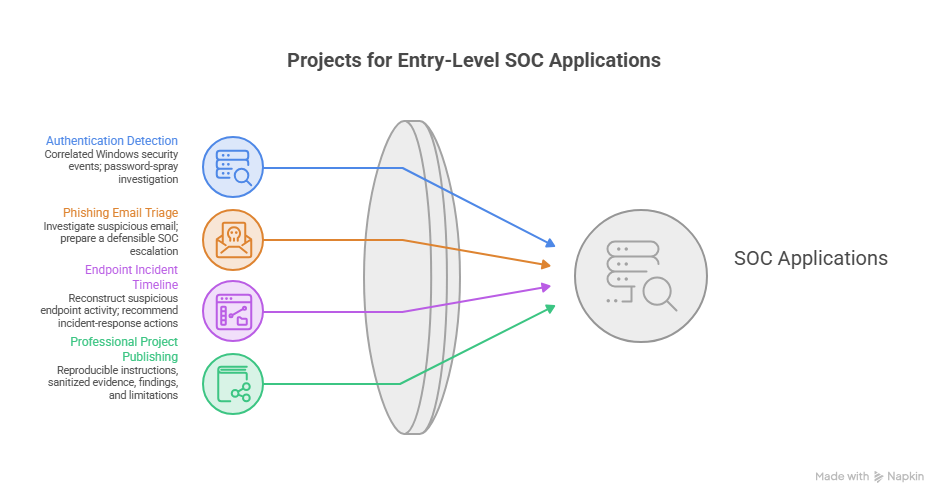
The ideal project contains an objective, a reproducible test, an investigation, a defensive decision, and supporting evidence. These elements turn home-lab experience into material suitable for technical screening and strengthen entry-level SOC applications.
Project 1: Windows Authentication Detection and Password-Spray Investigation
Objective: Detect suspicious authentication activity using correlated Windows security events.
Build a Windows test environment and configure Windows event collection into Splunk, Wazuh, or another SIEM.
Generate controlled successful and unsuccessful authentication events using accounts you own. Include ordinary login errors, repeated failures against one account, and low-volume failures against multiple accounts.
Create a detection that considers usernames, source addresses, timestamps, event counts, and the pattern of affected accounts.
Compare your findings with legitimate administrative activity so the rule does not automatically classify every authentication failure as malicious.
Evidence to publish: Event samples, detection logic, screenshots of matching events, false-positive analysis, and a structured incident report.
Resume-ready bullet:
Developed and tested a SIEM detection for simulated password spraying, correlating Windows authentication events across multiple laboratory accounts and documenting investigation findings.
This project combines security monitoring fundamentals, SOC investigative reasoning, and practical detection evidence.
Project 2: Phishing Email Triage and Incident Escalation
Objective: Demonstrate that you can investigate a suspicious email and prepare a defensible SOC escalation.
Create a controlled set of synthetic phishing and legitimate email samples. Include examples featuring domain impersonation, suspicious links, misleading reply-to fields, and payment-change requests.
Examine sender headers, SPF, DKIM, DMARC results where present, URL destinations, attachment metadata, and other available indicators.
Separate confirmed observations from hypotheses. A domain's unusual appearance or low reputation should prompt further evaluation rather than automatically establishing malicious intent.
Write an investigation ticket containing the reported behavior, available evidence, affected identities, recommended containment, and outstanding questions.
Evidence to publish: Sanitized email headers, indicator assessment, decision criteria, incident ticket, and escalation summary.
Resume-ready bullet:
Investigated synthetic phishing messages by analyzing sender authentication results, email headers, and suspicious URLs, producing structured triage reports and escalation recommendations.
Candidates can strengthen this project with SOC investigation exercises, technical interview preparation, and documentation-focused portfolio development.
Project 3: Endpoint Incident Timeline and Containment Analysis
Objective: Reconstruct suspicious endpoint activity from available telemetry and recommend appropriate incident-response actions.
Deploy a Windows laboratory endpoint with Sysmon. Generate benign test activity and authorized simulated suspicious behavior using a controlled exercise.
Collect process-creation details, command-line information, network connections where configured, and relevant Windows events.
Create a timeline identifying the earliest observed activity, associated processes, affected resources, and subsequent actions.
Evaluate containment options, including endpoint isolation, account restriction, or additional monitoring. Explain the operational consequences of each option.
Evidence to publish: Process tree, timestamped timeline, event correlation, incident report, and containment decision record.
Resume-ready bullet:
Reconstructed a simulated endpoint compromise using Sysmon process telemetry and Windows security events, documenting suspicious execution patterns and recommended containment steps.
The investigation supports endpoint security competencies, incident-response skills, and future advanced SOC roles.
How to publish projects professionally
Create a separate repository or portfolio page for each substantial project. Include an overview, architecture, tools, investigation steps, sanitized evidence, findings, and limitations.
Make setup and verification instructions reproducible wherever possible. Use fictional identities, synthetic sensitive data, and isolated test environments.
Include selected artifacts rather than overwhelming readers with raw logs. For example, one annotated detection query and two relevant event samples may communicate more than hundreds of lines of unfiltered telemetry.
Link the strongest one or two projects directly from your resume. Select projects that align with the position's responsibilities rather than listing every exercise you have completed.
This approach makes technical portfolios more useful during SOC interviews and helps address common cybersecurity graduate hiring difficulties.
5) ATS Optimization, Resume Tailoring, and Common Mistakes That Cost SOC Interviews
A technically competent candidate can still produce a resume that hides the most relevant evidence.
The solution is to align your documented experience with the specific responsibilities in the target job posting. This requires more precision than inserting every cybersecurity keyword into a skills section.
Match job requirements to evidence, not just terminology
Imagine a job posting requesting experience with SIEM monitoring, Windows event logs, endpoint triage, phishing analysis, and incident documentation.
A suitable resume should demonstrate those responsibilities through actual projects or work history.
For example, a candidate with Splunk and Sysmon laboratory experience can show how both tools were used together during an investigation. Someone who completed SOC home-lab exercises should emphasize concrete investigation outcomes rather than a broad claim of cybersecurity proficiency.
Candidates interested in SOC hiring requirements should compare multiple postings to identify recurring responsibilities. For career changers, this also reveals where prior professional experience is relevant.
Build a role-specific keyword map
Start with the target vacancy and identify its technical requirements, operational responsibilities, and communication expectations.
Common SOC terminology includes Security Information and Event Management (SIEM), log analysis, alert triage, incident response, endpoint detection and response (EDR), indicators of compromise, MITRE ATT&CK, phishing analysis, and vulnerability management.
Place each term in the most appropriate section.
A SIEM platform you configured belongs in technical skills and in the project where you used it. Incident documentation should appear alongside an actual report or ticket example. A certification should appear only if earned, or be accurately labeled as in progress when appropriate.
This keeps the resume readable while supporting ATS-oriented cybersecurity applications, security career transitions, and technical recruiter verification.
Avoid these seven resume failures
Unsubstantiated tool proficiency: Listing CrowdStrike, Splunk, and Sentinel as expert-level skills when you have only watched tutorials creates a problem during technical interviews. Describe actual hands-on security experience.
Generic project descriptions: A statement such as "completed a cybersecurity laboratory" provides little information. Explain the detection, investigation, and reporting work completed.
Misrepresented laboratory experience: Simulated incident handling should be described as laboratory work. Presenting it as production SOC employment may create serious credibility problems during practical hiring assessments.
Keyword stuffing: Repeating SIEM, EDR, malware, and threat hunting throughout unrelated sections weakens readability. Every technical term should connect to a genuine skill or demonstrated activity.
Unnecessary visual complexity: Multi-column layouts, graphics, unusual symbols, and text boxes can create parsing problems in some applicant tracking systems. A straightforward format keeps the content accessible.
Unsupported performance claims: Statements about preventing breaches, improving enterprise detection accuracy, or reducing incident response time require reliable evidence. Use verified project metrics and clearly identify the testing environment.
Weak technical explanations: If you cannot explain your detection logic, alert evidence, or investigation outcome, the resume bullet is too ambitious. Practise SOC interview questions and reproduce your security portfolio findings.
Resume formatting and submission checklist
Use conventional section titles such as Professional Summary, Technical Skills, Projects, Experience, Certifications, and Education.
Keep dates consistent and use a professional email address. Include functioning LinkedIn and portfolio links where they add value.
Use PDF or DOCX according to the employer's instructions. Before applying, copy the text from the exported file into a plain-text editor and inspect whether headings, bullets, and dates remain readable. This basic check can reveal extraction problems, although it cannot guarantee compatibility with every ATS.
Avoid fabricated ATS scores or promises of guaranteed interview selection. Applicant tracking systems and employer screening workflows differ.
A seven-day SOC resume improvement sprint
Day 1: Collect five relevant entry-level SOC job descriptions. Identify common responsibilities and tools.
Day 2: Compare those requirements against your genuine work history, certifications, and completed cybersecurity projects.
Day 3: Select your strongest detection investigation and improve its documentation.
Day 4: Prepare a second project emphasizing incident triage, phishing analysis, or endpoint telemetry.
Day 5: Rewrite your resume using specific actions, evidence sources, and defensible outcomes. Apply the ATS-friendly security resume principles.
Day 6: Conduct a technical self-interview. Explain each project, relevant event IDs, detection conditions, and investigation conclusions using SOC interview practice scenarios.
Day 7: Tailor the resume to suitable positions and review your applications against the entry-level cybersecurity hiring reality.
Keep a record of applications, relevant requirements, screening outcomes, and interview feedback. Use patterns to determine whether to improve résumé targeting, technical evidence, or interview performance.
6) SOC Analyst Resume FAQs: Entry-Level Applications, Certifications, and Interview Preparation
-
Yes, some Tier 1 and trainee positions accept candidates with limited professional security experience. Eligibility varies by employer, location, and the complexity of the environment being monitored.
Strong applications demonstrate networking fundamentals, log interpretation, basic incident triage, and accurate documentation.
Candidates can build these capabilities through a beginner SOC home lab, develop portfolio evidence employers can verify, and prepare using SOC interview scenarios.
-
Include exercises that demonstrate responsibilities relevant to the target role.
A completed alert investigation, documented detection rule, or incident timeline provides stronger resume evidence than a generic list of training platforms.
For each project, explain what you investigated, what evidence you used, and what you concluded. Keep platform achievements in proportion to their practical relevance.
Build supporting hands-on security projects, develop SIEM investigation experience, and compare certifications with laboratory value.
-
Include earned certifications relevant to the target position, such as Security+, CySA+, BTL1, or appropriate networking and vendor-specific credentials.
The value of a certification depends on the employer's requirements and your ability to demonstrate associated skills.
Candidates should distinguish between earned certifications, scheduled examinations, and training currently in progress. Avoid presenting course participation as an independently awarded professional certification.
Compare certification options after Security+, examine BTL1 versus Security+ for SOC roles, and consider networking certification benefits.
-
Measure work performed in your actual training environment.
Useful examples include the number of simulated incidents investigated, detection rules tested, alert samples reviewed, log sources integrated, or investigation reports produced.
Identify the scope whenever the metric might be mistaken for production experience.
For example, "Validated three detection rules against 40 labeled laboratory events" communicates a specific, defensible achievement.
Use project-based resume guidance, develop repeatable technical evidence, and practise explaining SOC investigation outcomes.
-
Windows Event ID 4624 records successful logon events, while 4625 records failed logon attempts. Event ID 4688 can provide process-creation information when the necessary auditing is enabled.
Sysmon Event ID 1 commonly provides process-creation telemetry. Sysmon Event ID 3 provides network connection information when configured to collect it.
Candidates should understand the conditions that generate events, important fields, and how to correlate multiple sources. Memorizing numbers without understanding their investigative role offers limited value.
Develop these skills through SOC laboratory exercises, detection portfolio projects, and technical interview preparation.
-
AI tools can help organize content, improve grammar, compare job terminology, and suggest clearer bullet structure.
Their output requires verification. Resume generators may introduce technologies you never used, invent numerical achievements, or describe laboratory exercises as commercial employment.
Review every claim before submission. Retain precise tool names, relevant event identifiers, and accurate project scope.
Use AI-assisted drafting alongside technical resume guidance, current SOC hiring expectations, and practical project evidence.
