
A cybersecurity portfolio can contain impressive dashboards, complex scripts, and dozens of completed labs yet still fail to generate interviews. Hiring managers need evidence that you can investigate problems, validate findings, and communicate results independently. This 100-point cybersecurity portfolio rubric helps identify weaknesses in entry-level project evidence, assess SOC-ready technical skills, and improve technical interview readiness. Use it to determine which projects deserve space on your resume and which require substantial revision.
1) What Hiring Managers Actually Evaluate in a Cybersecurity Portfolio
A useful portfolio assessment begins with one question: Can a reviewer establish what the candidate personally accomplished?
Anyone can publish screenshots from a SIEM dashboard or upload scripts to GitHub. Stronger candidates demonstrate why they performed specific actions, what evidence they collected, how they tested their conclusions, and which limitations remained unresolved.
These distinctions matter when reviewing cybersecurity portfolios without professional experience, comparing certifications against practical skills, and preparing for scenario-based cybersecurity interviews.
The 100-point portfolio scoring system
This rubric contains 30 assessment criteria grouped into ten competency areas.
Each criterion carries a weight according to its contribution to the overall assessment. Together, the weights total exactly 100 points.
Assign every criterion a rating from 0 to 4:
0 — Missing: No relevant evidence is provided, or the submitted work contradicts the claimed competency.
1 — Claimed: The candidate mentions the skill or activity but provides insufficient proof.
2 — Partial: Some valid evidence exists, but important reasoning, validation, or documentation is missing.
3 — Demonstrated: The deliverable provides credible, reasonably complete evidence with limited weaknesses.
4 — Strong: The work is technically sound, independently explainable, appropriately validated, and easy to assess.
Calculate the weighted score for each criterion using:
Criterion score = (Rating ÷ 4) × Criterion weight
For example, a criterion worth 6 points receives 4.5 points when rated 3 out of 4.
Add all 30 weighted scores to obtain a final result out of 100.
This is an ACSMI self-assessment framework designed to simulate a rigorous technical review. Actual employers use different evaluation methods and may place greater emphasis on particular technologies or responsibilities.
How to interpret your final score
0–49
Rebuild or replace
50–69
Targeted revision
70–84
Promising evidence
85–100
Strong presentation
A score above 85 suggests strong evidence across the selected criteria. It cannot guarantee an interview or job offer. Role alignment, employer preferences, and competitive conditions still matter.
For applicants concerned about cybersecurity hiring competition, the score is most useful as a revision tool.
Apply a mandatory security and integrity gate
Before scoring, inspect the project for serious problems involving professional conduct or sensitive information.
A project should be withheld from public publication if it contains exposed credentials, private customer records, proprietary employer data, unauthorized testing, or material that violates challenge disclosure restrictions.
Fixing those problems takes priority over improving the numerical score.
A project claiming production-level security expertise while exposing real API keys creates an obvious contradiction.
Similarly, presenting a copied walkthrough as independent work undermines the evidence expected from recruiter-verifiable projects.
How to use the 30-check assessment matrix
For every row, compare your project against the strong-evidence example. Assign a 0–4 rating based on the actual published artifacts, then apply the listed maximum weight.
Treat every check as a separate criterion, including checks within the same category.
The strongest SOC portfolio projects, security engineering projects, and hands-on cybersecurity labs will satisfy the criteria through different kinds of evidence.
Cybersecurity Portfolio Rubric: 30 Hiring-Manager Checks Worth 100 Points
Rate every criterion from 0 to 4. Multiply the rating by its maximum points and divide by 4. Add all weighted scores for your total out of 100.
| Assessment Criterion | Max Points | Strong Evidence: What Earns 4/4 | Common Weakness |
|---|---|---|---|
| 1. Role alignment Role Fit |
5 | Project directly demonstrates a named responsibility in the target job. | Impressive technology with little relevance to the advertised role. |
| 2. Task ownership Role Fit |
4 | Clearly identifies the candidate's personal work, decisions, and deliverables. | Ambiguous contribution within a copied or group project. |
| 3. Realistic scope Role Fit |
3 | Defines a plausible security scenario with relevant technical constraints. | Artificial demonstration without a meaningful security objective. |
| 4. Technical methodology Technical Accuracy |
6 | Uses technically appropriate tools, configurations, and investigation steps. | Incorrect commands, inappropriate tools, or unexplained configuration choices. |
| 5. Interpretation accuracy Technical Accuracy |
5 | Every significant conclusion is consistent with the supporting evidence. | Labels suspicious activity as confirmed compromise without proof. |
| 6. Technical context Technical Accuracy |
4 | Explains relevant protocols, permissions, systems, or attack mechanisms. | Shows tool output without explaining underlying system behavior. |
| 7. Independent hypotheses Independent Reasoning |
5 | Records competing explanations and why evidence supported one. | Follows a prepared solution without independent analysis. |
| 8. Tool selection Independent Reasoning |
4 | Justifies selected tools and understands their limitations. | Runs tools because a tutorial recommends them. |
| 9. Troubleshooting Independent Reasoning |
3 | Documents obstacles, diagnostic steps, and reasoned corrections. | Deletes failed attempts and presents an unrealistically perfect process. |
| 10. Primary evidence Evidence Quality |
4 | Includes appropriately sanitized logs, queries, outputs, or configurations. | Only includes decorative dashboard screenshots. |
| 11. Evidence traceability Evidence Quality |
4 | Links each major claim to identifiable supporting artifacts. | Conclusions cannot be located within the supplied evidence. |
| 12. Timeline and context Evidence Quality |
4 | Preserves relevant timestamps, event ordering, and system context. | Disconnected screenshots without sequence or interpretation. |
| 13. Positive validation Testing and Validation |
4 | Demonstrates that the technique, detection, or security control works. | Assumes success because a tool produced output. |
| 14. Negative testing Testing and Validation |
3 | Tests benign or failure scenarios and documents expected differences. | Tests only the scenario the project was designed to pass. |
| 15. Limitations Testing and Validation |
3 | Identifies false positives, blind spots, assumptions, and missing telemetry. | Claims perfect detection or complete protection without evidence. |
| 16. Environment description Reproducibility |
3 | Documents system versions, architecture, dependencies, and configuration. | Environment cannot be recreated from the documentation. |
| 17. Repeatable procedure Reproducibility |
3 | Provides sufficient authorized steps to reproduce the stated results. | Missing prerequisites, settings, or essential configuration details. |
| 18. Expected outputs Reproducibility |
2 | Explains expected results and how to identify unsuccessful execution. | No meaningful success criteria or troubleshooting guidance. |
| 19. Authorization and scope Security Hygiene |
3 | Clearly identifies authorized targets, boundaries, and test conditions. | Unclear authorization or inappropriate testing of external systems. |
| 20. Secret and data handling Security Hygiene |
3 | Excludes real credentials and sensitive records; uses safe sample data. | Exposed tokens, passwords, personal data, or confidential logs. |
| 21. Ethical disclosure Security Hygiene |
2 | Respects employer confidentiality, licenses, and challenge disclosure rules. | Publishes restricted solutions or material without appropriate permission. |
| 22. Executive summary Communication |
4 | Clearly explains the problem, finding, and consequence in plain language. | Begins with lengthy tool output and never establishes significance. |
| 23. Technical findings Communication |
3 | Organizes evidence, analysis, and conclusions into a coherent report. | Unstructured narrative with unclear conclusions. |
| 24. Actionable recommendations Communication |
3 | Provides specific remediation, escalation, or follow-up actions. | Offers generic advice such as improving security. |
| 25. Risk prioritization Operational Relevance |
3 | Prioritizes findings using severity, context, confidence, and likely impact. | Treats every alert or vulnerability as equally urgent. |
| 26. Remediation verification Operational Relevance |
3 | Explains or demonstrates how a proposed fix would be verified. | Stops immediately after discovering the weakness. |
| 27. Professional handoff Operational Relevance |
2 | Identifies what another analyst, administrator, or stakeholder needs next. | Leaves findings without a clear next owner or decision. |
| 28. Repository navigation Reviewer Usability |
2 | README explains the goal, outcome, and where supporting artifacts live. | Reviewers must inspect unrelated files to understand the project. |
| 29. Evidence accessibility Reviewer Usability |
2 | Reports, sanitized artifacts, and key results are directly accessible. | Broken links, inaccessible files, or unlabeled attachments. |
| 30. Interview explainability Reviewer Usability |
1 | Candidate can concisely defend choices, limitations, and findings. | Cannot explain the project without opening a tutorial. |
| TOTAL AVAILABLE POINTS | 100 | Score each criterion independently on the 0-4 evidence scale. | |
Categories: Role Fit 12, Technical Accuracy 15, Independent Reasoning 12, Evidence Quality 12, Testing and Validation 10, Reproducibility 8, Security Hygiene 8, Communication 10, Operational Relevance 8, Reviewer Usability 5. Total: 100 points. Unsafe or unauthorized public artifacts require correction regardless of score.
2) How to Score a Cybersecurity Project: A Worked 75.5/100 Example
Consider a candidate applying for a junior SOC analyst position.
Their portfolio includes a project titled "Suspicious Authentication Investigation Using Splunk and Windows Event Logs."
The candidate configured Windows event collection, generated test authentication activity, developed SIEM searches, and documented suspicious login patterns.
At first glance, this looks like a strong SOC portfolio project. However, a closer evaluation reveals several weaknesses that could emerge during SOC technical interviews.
Score the project across all ten competency areas
For this example, assume the candidate receives the same 0–4 rating on all three checks within each category.
Role Fit — 12/12: The project directly involves SOC responsibilities, including authentication monitoring, event investigation, and analyst reporting. The candidate's contribution is clearly documented.
Technical Accuracy — 11.25/15: Log collection and query logic are technically sound, but some event interpretations need better context.
Independent Reasoning — 6/12: The candidate followed a prepared investigation sequence and provides limited evidence of alternative hypotheses or independent troubleshooting.
Evidence Quality — 12/12: Sanitized event samples, query outputs, relevant timestamps, and supporting screenshots are available.
Testing and Validation — 5/10: The detection identifies the intended scenario, but benign authentication activity and possible false positives receive insufficient testing.
Reproducibility — 6/8: Environment documentation is mostly complete, although several configuration details require clarification.
Security Hygiene — 8/8: The project uses an authorized laboratory, synthetic accounts, and sanitized data.
Communication — 7.5/10: The report explains the findings but offers limited guidance for further investigation.
Operational Relevance — 4/8: The candidate provides minimal incident prioritization, remediation verification, or professional handoff guidance.
Reviewer Usability — 3.75/5: The repository is reasonably organized, although the candidate's independent contributions could be more prominent.
Final weighted score: 75.5/100.
This project falls within the promising evidence range. It offers credible technical work, but the score exposes important weaknesses in independent investigation, validation, and operational decision-making.
These weaknesses are particularly relevant because SOC hiring managers need analysts who can interpret unfamiliar activity and defend their conclusions.
How to improve the score without rebuilding the project
The candidate should preserve the existing environment and expand the investigation.
First, introduce a benign authentication scenario that resembles the suspicious pattern. Compare the events and identify which characteristics support escalation.
Second, document at least two competing explanations for the original alert. Show which evidence increases or decreases confidence in each explanation.
Third, add a concise handoff section describing the alert disposition, recommended next actions, missing information, and possible remediation.
If these improvements raise the Independent Reasoning, Testing and Validation, and Operational Relevance categories from 2/4 to 3/4, the score increases by 7.5 points, reaching 83/100.
That improvement is grounded in additional demonstrated skills rather than cosmetic changes.
It also produces stronger material for technical assessments, project-based resume achievements, and security operations interviews.
Why polished GitHub repositories can still score poorly
Presentation improves access to evidence, but it cannot compensate for weak technical work.
A project with elaborate graphics and detailed installation instructions may score highly for reviewer usability while receiving low scores for independent analysis and validation.
Conversely, a technically excellent investigation may remain difficult to evaluate when logs, reasoning, and findings are scattered across poorly labeled files.
The solution is to assess technical substance and presentation separately.
For candidates confronting cybersecurity resume rejection patterns, project clarity can improve how efficiently their work is assessed.
However, demonstrating a professional-level troubleshooting process requires more than attractive screenshots.
The portfolio should allow a reviewer to distinguish what happened, how you investigated it, and why your conclusion is credible.
3) Role-Specific Rubrics: What SOC, Pentesting, Cloud, and GRC Recruiters Want
The same 100-point framework can evaluate different cybersecurity specializations, but the evidence required to earn a high score changes by role.
A penetration testing project might demonstrate accurate vulnerability validation. A SOC project might demonstrate evidence correlation and incident triage. A GRC project might demonstrate risk assessment and control evaluation.
The assessment should reflect the responsibilities associated with the target position.
SOC analyst projects: Evaluate the quality of the investigation
A strong SOC analyst portfolio should establish whether the candidate can investigate suspicious events and communicate defensible findings.
A useful project begins with an alert and follows its evidence through analysis, disposition, and escalation.
For example, a suspicious PowerShell execution scenario could involve Windows process events, command-line details, parent processes, relevant network connections, and user activity.
The reviewer should be able to identify the candidate's investigative hypotheses and understand what evidence supports the final conclusion.
High-scoring evidence: A documented incident timeline, meaningful SIEM queries, relevant event samples, false-positive considerations, and an analyst handoff.
Weak evidence: A screenshot containing an alert titled "Malicious PowerShell" without supporting investigation.
Candidates can strengthen these skills through SOC home labs, independent security investigations, and SOC interview scenarios.
Where MITRE ATT&CK mapping is included, the selected technique should reflect observed behavior. A tool name or single suspicious event may be insufficient evidence to confirm a specific technique.
Penetration testing projects: Evaluate methodology and reporting
An offensive security project must demonstrate an authorized assessment process and technically sound findings.
Discovering a vulnerability is one component of the work. The candidate should also explain how it was identified, safely validated, prioritized, and communicated.
Consider an application with an insecure access-control implementation.
A strong report identifies the affected functionality, explains the authorization weakness, demonstrates the issue within an approved lab environment, and recommends a specific corrective measure.
It should also describe how to verify the fix.
High-scoring evidence: Clearly defined scope, relevant test conditions, reproducible findings, contextual impact, and remediation guidance.
Weak evidence: A collection of exploitation screenshots without enough context to establish the underlying vulnerability.
Applicants pursuing penetration testing careers should prioritize independent methodology and written reports. These deliverables also strengthen hands-on certification preparation and recruiter-evaluable technical portfolios.
Cloud security projects: Evaluate configuration, identity, and remediation
Cloud security portfolios should establish whether the candidate understands how configuration decisions create or reduce risk.
For example, create a small authorized cloud environment with deliberately excessive access permissions.
Document the initial policy, identify the excessive privileges, explain the potential exposure, and replace the policy with an appropriately restricted version.
Then test whether legitimate functionality continues to work while unauthorized access is prevented.
High-scoring evidence: Infrastructure architecture, IAM policy examples, relevant audit logs, validation results, and documented remediation.
Weak evidence: A screenshot of a deployed cloud instance with little explanation of its security configuration.
A candidate pursuing cloud security roles should connect every claimed skill to a concrete configuration or investigation.
For identity management careers, valuable evidence might include permission reviews, account lifecycle workflows, privileged access controls, and authentication troubleshooting.
These are more relevant than collecting unrelated exploitation exercises.
GRC projects: Evaluate risk judgment and control evidence
A governance, risk, and compliance portfolio requires different evidence from a technical detection portfolio.
Consider a simulated access-control assessment involving several business applications.
The candidate could inventory relevant controls, identify excessive privileges, assess their potential consequences, and produce a risk treatment recommendation.
The strongest deliverable clearly separates the control requirement, observed evidence, identified gap, risk assessment, responsible owner, and follow-up action.
High-scoring evidence: A justified risk rating, documented control assessment, supporting evidence, and measurable remediation criteria.
Weak evidence: A generic spreadsheet containing risk categories without supporting observations.
This approach is particularly relevant to GRC specialist responsibilities, cybersecurity audit careers, and risk management positions.
Automation and security engineering projects: Evaluate reliability
Security automation portfolios often fail to distinguish a working demonstration from a tool that could be maintained in a real operational environment.
Consider a Python script that enriches security alerts with contextual information.
The initial version might work for one sample event. A stronger version validates input formats, handles missing fields, records errors, supports testing, and avoids exposing credentials.
A high-scoring project should also document expected input, output, dependencies, operational limits, and failure behavior.
High-scoring evidence: Tested automation logic, readable code, example inputs and outputs, error handling, dependency documentation, and secure configuration.
Weak evidence: A copied script that works once but fails silently when its input changes.
Candidates pursuing cybersecurity automation engineering, AI security roles, or security-focused data science should demonstrate their ability to validate outputs and manage technical uncertainty.
A sophisticated automation project becomes valuable when another analyst can understand its purpose, trust its documented behavior, and identify when human review is necessary.
Quick Poll: What's the Biggest Weakness in Your Cybersecurity Portfolio?
Imagine a hiring manager has only two minutes to review your best project. Which problem would make you least confident about your chances?
4) How to Fix a Low-Scoring Cybersecurity Portfolio in Seven Days
A weak project usually needs better evidence, tighter scope, stronger validation, or clearer reporting.
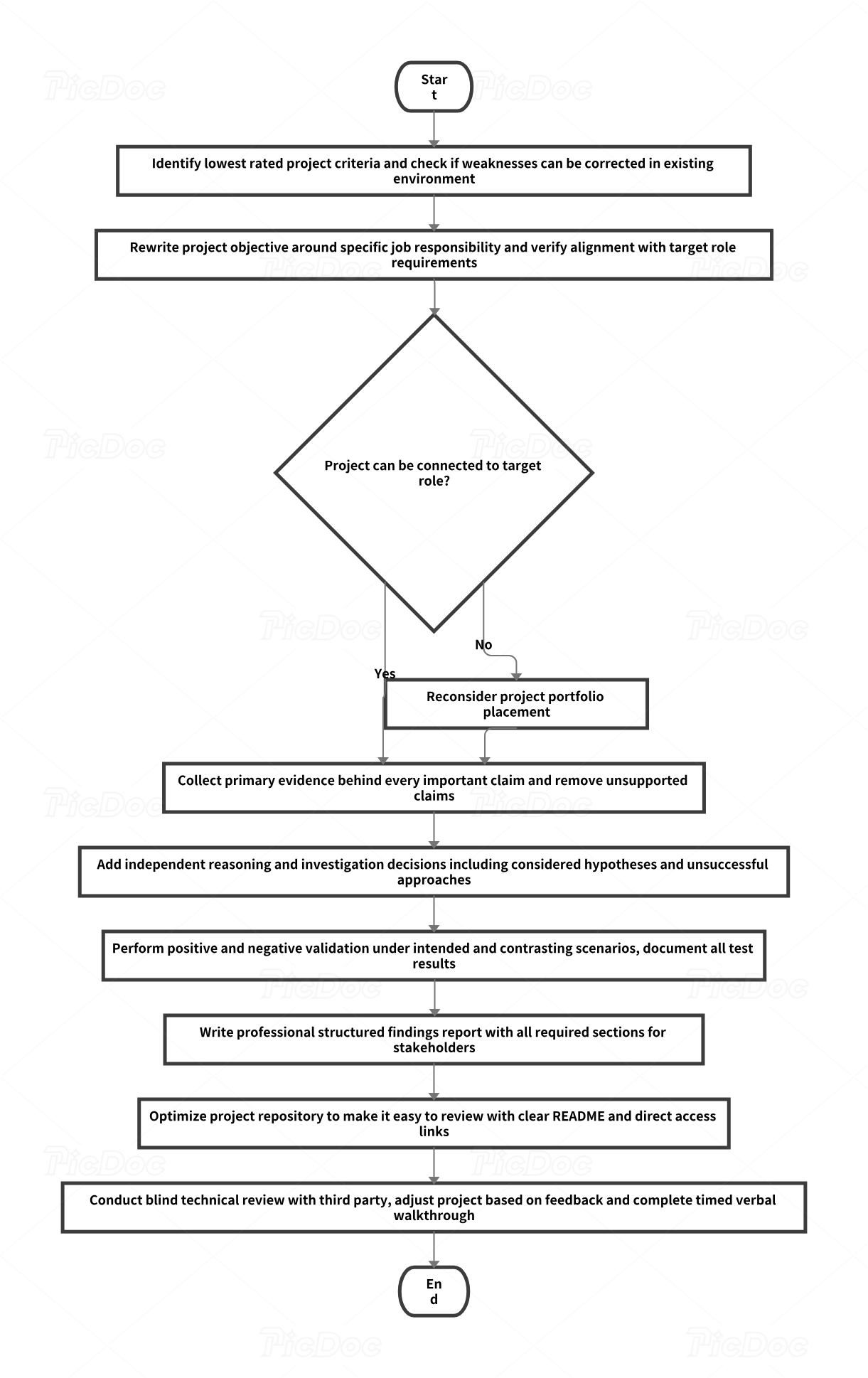
Rebuilding everything from scratch can waste useful work. Begin by identifying which criteria received the lowest ratings and whether their weaknesses can be corrected within the existing environment.
For example, a beginner SOC portfolio with functional alert collection may already demonstrate technical competence. Its main weakness could be the absence of investigation and decision-making evidence.
The following seven-day process is designed to improve one existing project. Allocate time according to complexity and available resources.
Day 1: Rewrite the project objective around a specific job responsibility
Replace broad descriptions such as "Built a cybersecurity lab" with an explicit technical objective.
A stronger objective might be:
"Investigate suspicious authentication activity, reconstruct the relevant event sequence, and determine whether the evidence supports escalation."
This identifies the problem, required actions, and expected output.
Compare the objective against several genuine SOC analyst job requirements, cloud security responsibilities, or GRC job expectations.
If the project cannot be connected to the target role, reconsider its portfolio placement.
Day 2: Collect the primary evidence behind every important claim
Review each major finding and identify its supporting artifact.
For a detection project, this could include the relevant query, sample events, timestamps, and triggering conditions.
For a configuration assessment, it could include the original policy, corrected configuration, and validation results.
For a penetration testing report, it could include authorized test conditions and evidence demonstrating the specific weakness.
Remove unsupported claims or label them as unconfirmed hypotheses.
This improves the quality of technical portfolio evidence and makes the work easier to defend during practical hiring assessments.
Day 3: Add independent reasoning and investigation decisions
Explain which hypotheses you considered and how you selected subsequent actions.
A useful investigation record might state that repeated authentication failures initially suggested password guessing, but additional evidence indicated a misconfigured scheduled task.
The documented conclusion should show how the evidence changed your interpretation.
Also record relevant unsuccessful approaches. An investigation that required troubleshooting can demonstrate sound judgment when the reasoning is clear.
This is especially important for candidates relying on hands-on cybersecurity certifications or guided laboratory training to compensate for limited employment experience.
Day 4: Perform positive and negative validation
Test whether the technique performs as expected under the intended conditions.
Then test a contrasting scenario.
For example, evaluate whether a detection rule distinguishes suspicious authentication behavior from legitimate repeated sign-ins.
Document the input, expected behavior, observed result, and any unexpected findings.
A failed test can still provide valuable evidence when it identifies a limitation or helps correct an inaccurate assumption.
The goal is to strengthen security detection engineering skills and provide evidence that extends beyond successful demonstrations.
Day 5: Write a professional findings report
Organize the report around the information another analyst or stakeholder would need.
Include an executive summary, scope, environment, methodology, findings, evidence, limitations, impact, and recommended actions.
For an incident investigation, include the alert disposition and escalation recommendation.
For a vulnerability assessment, include remediation guidance and verification criteria.
For a GRC assessment, include risk ownership and control implications.
A well-structured report strengthens recruiter-verifiable experience and helps demonstrate professional communication expected in cybersecurity analyst interviews.
Day 6: Make the project easy to review
Your repository README should provide an immediate understanding of the project's purpose.
Use a clear title followed by a concise summary of the problem, environment, candidate contribution, key findings, and technical deliverables.
Provide direct links to the final report, relevant queries or code, sanitized evidence, and reproduction instructions.
A practical repository structure could include separate folders for documentation, configuration, analysis, evidence, and tests.
Avoid forcing reviewers to search through dozens of screenshots to understand the outcome.
This is particularly important for entry-level cybersecurity resumes because reviewers may have limited time to investigate individual projects.
Day 7: Conduct a blind review and rescore
Ask someone with relevant technical knowledge to evaluate the repository without receiving additional explanations.
Provide the 30-check rubric and target job description.
Ask the reviewer to identify the project's objective, your contribution, the most significant finding, and the evidence supporting that finding.
If they cannot locate essential information, improve the repository.
Then perform a timed verbal walkthrough.
Explain the project in 90 seconds and answer follow-up questions concerning tool selection, false positives, technical limitations, and remediation.
Compare the revised score against the original baseline.
For cybersecurity candidates struggling to get interviews, a focused improvement cycle can provide clearer evidence of skill development than adding another unfinished project.
5) Portfolio Examples: What Separates Weak Projects From Recruiter-Ready Evidence?
The most useful way to understand a portfolio rubric is to compare projects that use similar technologies but demonstrate different levels of competence.
The following examples illustrate how a candidate can transform ordinary lab work into stronger evidence for a target role.
Example 1: SIEM dashboard project vs complete threat investigation
Weak project: "Installed Splunk and Created a Security Dashboard."
The repository contains screenshots showing ingested Windows events, a dashboard with several charts, and basic search queries.
This demonstrates initial familiarity with the technology, but its value to a hiring manager is limited. The project provides little evidence of investigative reasoning, alert validation, or incident handling.
Stronger project: "Investigation of Suspicious Authentication Activity Using Splunk."
The candidate develops a controlled authentication scenario, collects the resulting events, and creates searches that correlate related activity.
The report explains why the observed behavior warrants investigation, identifies alternative explanations, and documents the evidence required for escalation.
A separate test evaluates benign authentication behavior and records the resulting false-positive considerations.
The final deliverables include sanitized logs, search queries, an investigation timeline, limitations, and recommended follow-up actions.
This version demonstrates SOC investigation skills, hands-on SIEM experience, and incident-response communication.
The improvement comes from investigating and validating security activity rather than merely displaying it.
Example 2: Completed penetration testing lab vs professional assessment
Weak project: "Completed 15 Penetration Testing Machines."
The repository lists machine names, screenshots of successful exploitation, and brief descriptions of tools used.
The candidate demonstrates exposure to offensive techniques, but the evidence does little to establish independent methodology or professional reporting competence.
Stronger project: "Authorized Web Application Access-Control Assessment."
The candidate defines the assessment scope, identifies the application's trust boundaries, investigates access-control behavior, and safely validates a specific weakness.
The final report distinguishes the observed vulnerability from potential consequences.
It includes reproducible findings, relevant evidence, remediation guidance, and a verification plan.
The candidate also explains the tools selected and the limitations of the assessment.
This better supports penetration testing career preparation and strengthens practical technical interview evidence.
For external challenge environments, the candidate should follow applicable disclosure policies or reproduce the concepts in an original, authorized lab.
Example 3: Cloud deployment tutorial vs validated security improvement
Weak project: "Deployed a Secure Cloud Environment."
The candidate provides an architecture diagram and screenshots of a running virtual machine but offers little evidence that security controls were configured correctly.
Claims involving secure access, logging, and least privilege remain unsupported.
Stronger project: "Cloud IAM Least-Privilege Assessment and Remediation."
The candidate creates a controlled environment containing a deliberately excessive permission policy.
They document the initial access behavior, identify which permissions exceed the application requirements, and implement a restricted policy.
They then verify that the application retains legitimate access while prohibited actions fail.
The deliverables include policy configurations, test results, relevant audit evidence, and a discussion of remaining limitations.
This project demonstrates cloud security competency, identity management knowledge, and security risk assessment skills.
How many projects should your portfolio contain?
For an entry-level portfolio, three to five carefully selected projects can provide a practical starting point.
Choose projects that collectively demonstrate distinct capabilities rather than repeating the same basic exercise.
For example, an aspiring SOC analyst might present an authentication investigation, a network traffic analysis, and a detection engineering project.
A cloud security candidate might select an IAM assessment, an audit logging investigation, and a secure configuration validation project.
Evaluate each project individually using the 100-point rubric.
Then review the collection for overlap. Five projects that all demonstrate basic alert ingestion provide less evidence of breadth than a smaller selection covering investigation, validation, and operational response.
The cybersecurity portfolio project selection guide can help identify suitable project types, while home lab preparation provides an environment for producing original evidence.
The final 90-second hiring-manager review
Before linking a project on your resume, open the repository as though you were seeing it for the first time.
Within 90 seconds, a reviewer should be able to identify the problem, the candidate's contribution, the principal result, and the location of the supporting evidence.
The project should also withstand deeper examination.
An effective cybersecurity portfolio supports both rapid screening and detailed technical discussion.
If a project is visually impressive but cannot survive questions about its methodology, assumptions, or results, revise it before relying on it during cybersecurity interviews.
6) FAQs: Cybersecurity Portfolio Scoring, Project Quality, and Hiring Readiness
-
Within this ACSMI rubric, a score of 70–84 indicates promising evidence, while 85–100 indicates strong performance across the selected criteria.
These thresholds are intended for self-assessment and project improvement.
A strong score becomes more useful when the project aligns directly with the advertised role.
For example, a high-scoring incident investigation is especially relevant to SOC analyst applications, while a well-validated IAM project may support identity security careers.
Use the score alongside actual hiring requirements rather than treating it as a universal employment benchmark.
-
Some hiring managers and technical interviewers review linked repositories, particularly when projects are relevant to the vacancy.
Others rely on resumes, screening assessments, or interview discussions.
A portfolio should therefore support several forms of evaluation.
Use project-based resume bullets to communicate the strongest achievements, maintain accessible technical evidence, and prepare to explain projects during practical interviews.
A well-organized repository makes independent verification easier when an employer chooses to investigate your work.
-
Yes, provided the projects comply with the platforms' disclosure rules and accurately represent your independent contribution.
The strongest examples explain your investigative methodology, technical reasoning, and findings.
Avoid presenting guided exercises as original discoveries or publishing restricted challenge solutions.
You can also reproduce learned concepts inside a separate authorized environment.
This helps transform guided security labs into recruiter-evaluable portfolio projects.
The independent evidence generally matters more than the number of completed challenges.
-
Use the artifacts that best substantiate the project's claims.
A detection engineering project may benefit from queries, test events, results, and a report explaining detection limitations.
A security automation project may require source code, test cases, input examples, and documentation.
A GRC assessment may require control evidence, risk justifications, and remediation recommendations.
Screenshots can provide useful supporting context, but they should establish something meaningful.
The best SOC portfolio evidence connects observable data with investigative conclusions.
For cybersecurity automation portfolios, reliability testing and understandable implementation details can be particularly important.
-
A strong portfolio can demonstrate practical capabilities that are difficult to communicate through qualifications alone.
However, some employers require particular degrees, certifications, or professional experience.
Candidates should evaluate the qualifications appearing in their target vacancies and build projects that address the responsibilities those employers expect.
For someone breaking into cybersecurity without IT experience, projects involving networking, Windows administration, security logging, and incident investigation can help establish technical credibility.
Combining certifications with hands-on evidence and understanding the degree-versus-certification trade-off creates a more informed application strategy.
-
Three strong, relevant projects can be easier to evaluate and discuss than ten overlapping projects with limited evidence.
Each project should demonstrate a distinct, professionally useful capability.
For a SOC portfolio, this could mean alert investigation, network analysis, and detection validation.
For a penetration testing portfolio, the emphasis might be web security assessment, infrastructure evaluation, and remediation reporting.
Use the 100-point scoring framework to identify your strongest work and prioritize technical evidence recruiters can verify.
A smaller portfolio also makes it easier to prepare detailed explanations for technical interviews.
