
Social Engineering: Tactics and Defense Mechanisms
Social engineering is the exploitation of human emotion and behavior, not technical systems. Attackers use authority, urgency, and fabricated trust to manipulate individuals into surrendering sensitive access or data. This makes it uniquely dangerous: you can’t patch a human like software. In many cases, the victim doesn’t even realize they’ve been breached—until financial loss or data exposure is irreversible.
From multi-billion-dollar corporations to small clinics, no organization is immune. Attacks like the 2023 MGM breach prove that a single manipulated employee can override millions in security investment. These incidents highlight a critical truth: humans are the true attack surface. Most cybersecurity programs focus on digital defenses, but without training against social engineering, they’re structurally incomplete. It’s not about technical literacy—it’s about behavioral awareness, pattern recognition, and fast decision-making under pressure. That’s the real front line in modern cybersecurity.

Anatomy of a Social Engineering Attack
Social engineering follows a structured psychological blueprint, not chaos. Threat actors don’t randomly guess—they exploit predictable human behaviors and cognitive shortcuts. From initial reconnaissance to clean exit, every stage is designed to build trust, manipulate response, and avoid detection. Understanding this anatomy is critical for designing effective defenses that address more than just technical vulnerabilities.
Psychological Principles Behind It
Attackers rely on psychological triggers, not brute force. The most exploited principles include:
Authority: Pretending to be a senior executive, law enforcement, or IT admin creates immediate compliance. People follow perceived rank.
Urgency: “Your account will be locked in 10 minutes”—this shuts down critical thinking.
Scarcity: Limited-time offers or fake system errors push victims to act before verifying.
Trust exploitation: Using a familiar name, spoofed email, or LinkedIn profile lowers suspicion.
Humans rely on mental shortcuts (heuristics) to speed up decisions. Attackers exploit this “cognitive autopilot” by mimicking trusted patterns. People don't analyze every message; they respond to signals—branding, tone, or authority triggers—even when they're fake.
Common Phases of Attack
Most social engineering attacks follow four tactical phases:
Reconnaissance: Gathering intel from public sources (LinkedIn, company websites, breached databases). The attacker maps roles, communication styles, and weaknesses.
Engagement: Establishing contact via email, phone, social media, or even in-person. This is where trust is manufactured.
Exploitation: Triggering action—clicking a link, sharing credentials, or granting access. Often feels routine to the victim.
Exit: Covering tracks, deleting traces, and preparing for long-term access or sale of credentials.
Victims often don’t report attacks because they either don’t realize it happened or feel embarrassed. This silence allows attackers to scale operations undetected. Cybersecurity isn’t just about firewalls—it’s about recognizing these silent, human-level intrusions.
| Attack Phase | Psychological Triggers Used | Tactics & Examples |
|---|---|---|
| Reconnaissance |
|
Uses LinkedIn profiles, company bios, and breach data to mimic language, roles, and context—creating believable identities. Gathers visual and linguistic cues (logos, email formats, job titles) to craft messages that pass initial “gut check” evaluations. |
| Engagement |
|
Sends emails or messages posing as executives, IT admins, or HR—targets emotions and role expectations to lower skepticism. Fakes limited access windows (e.g., “only 3 licenses left”) to keep targets focused on outcome rather than risk. |
| Exploitation |
|
“Act now” language shuts down analytical thinking. Victims may input passwords, wire funds, or install malware without questioning due to perceived legitimacy. |
| Exit |
|
Deletes trails while staying undetected, sometimes sending “confirmation” messages that mirror legitimate communications. |
Common Tactics Used in Social Engineering
Social engineering attacks evolve, but the core tactics remain brutally effective because they weaponize human behavior. These methods bypass the most advanced systems by targeting what no firewall can filter—trust. Understanding the real-world deployment of these tactics is non-negotiable for any cybersecurity defense.
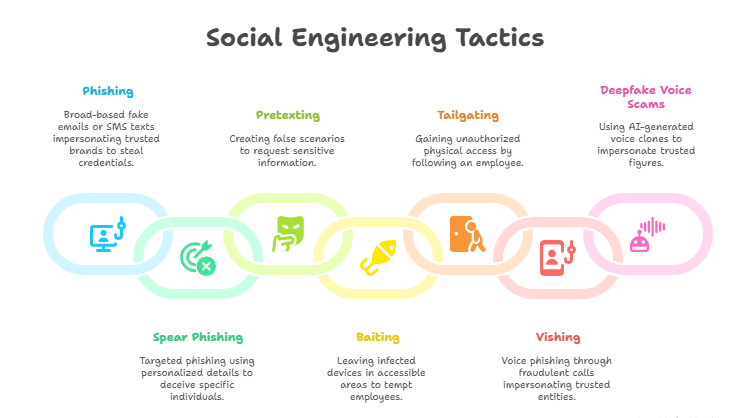
Phishing and Spear Phishing
Phishing is the most widespread social engineering attack—91% of data breaches begin with a phishing email. Attackers use fake emails or SMS texts impersonating known services like banks, vendors, or internal departments. A convincing subject line or login page clone is enough to extract credentials, MFA tokens, or payment information.
Spear phishing narrows this approach—targeting specific individuals based on prior reconnaissance. These emails reference internal projects, names, or executive chains, increasing the chance of success.
The 2023 MGM breach is a case in point. A single Vishing call to IT support, posing as an employee, triggered system-wide compromise. Once inside, ransomware was deployed, slot machines were bricked, and tens of millions in losses followed. The entry wasn’t technical—it was trust.
Pretexting, Baiting, and Tailgating
Pretexting involves creating a believable backstory to extract information. Attackers impersonate auditors, HR reps, or even vendors requesting “routine” verification of details.
Baiting introduces malicious devices—most often infected USBs—placed in lobbies, parking lots, or even handed directly to employees under pretense. Curiosity and helpfulness become vulnerabilities.
Tailgating exploits physical access. An attacker follows an employee through a secure door, pretending to be new staff or burdened with packages. Access granted without authentication.
In all three, social trust becomes a vulnerability. Attackers use small talk, urgency, and confidence to disarm suspicion. These tactics thrive in friendly, collaborative environments—where trust is cultural currency.
Vishing and Deepfake Voice Scams
Vishing (voice phishing) involves fraudulent calls, often mimicking banks, IT, or executives. But the rise of AI-powered deepfakes has made voice scams more dangerous. Attackers now clone voices of CEOs or family members to authorize wire transfers, password resets, or critical approvals.
These aren't future threats—they're active today. In 2023, multiple banks and crypto firms reported fraud driven by deepfake audio impersonation—no passwords hacked, just voices mimicked.
Real-World Impact and Famous Case Studies
Social engineering isn't just a clever trick—it’s a billion-dollar threat vector. In incident after incident, attackers bypassed world-class infrastructure by targeting a single weak point: a human decision. These breaches underscore why employee vigilance must be as critical as firewall tuning or endpoint detection.
Human Error Over Tech Vulnerability
Most breaches don’t exploit software—they exploit people. The 2022 Twitter hack involved 130 high-profile accounts, including Elon Musk and Barack Obama, used to push a cryptocurrency scam. Entry was gained not through hacking servers, but by phishing internal staff for access to admin tools.
The Pentagon also faced a 2023 email phishing operation targeting DoD officials. Attackers posed as journalists and used spoofed media accounts to elicit sensitive information. No zero-days, no malware—just believable emails and well-researched personas.
In both cases, advanced security systems failed—not due to flaws in technology, but due to a lack of human-layer awareness. Organizations often overinvest in tech while undertraining their real perimeter: people.
Financial and Reputational Damages
The financial toll of social engineering is staggering. According to IBM’s 2024 Cyber Resilience Report, 95% of breaches involved human manipulation, not software exploits. The average cost of a breach involving social engineering? $4.91 million—higher than any other attack category.
But financial loss is only half the impact. Breached companies suffer brand erosion, stakeholder distrust, and regulatory scrutiny. Publicly traded firms often see stock drops within 48 hours of disclosure. For example, after the Uber 2022 breach—initiated through multi-factor fatigue phishing—their stock dipped and reputational damage lingered long after technical recovery.
Regulatory bodies are also cracking down. Non-compliance with GDPR or HIPAA due to social engineering incidents can lead to multi-million-dollar fines. And because these attacks often involve employee negligence or policy failure, legal liabilities multiply.
In short: a manipulated intern can cost more than a compromised server.

Organizational and Individual-Level Defenses
No amount of firewalls, antivirus software, or intrusion detection systems can block a well-crafted lie. That’s why defending against social engineering demands a behavioral-first strategy, executed across training, policy, and monitoring. Prevention starts with reshaping how individuals perceive trust—and how organizations institutionalize doubt.
Awareness Training and Red Team Simulations
The most effective countermeasure against social engineering is consistent, real-world simulation-based training. It’s not enough to teach what phishing is—teams must experience it. Red team exercises simulate live attacks: phishing emails, pretext calls, bait USBs. These expose blind spots and create muscle memory under pressure.
Phishing drills and “social engineering war games” improve response rates by up to 78% in six months. Platforms that gamify awareness—scoring departments on response time, click rate, and escalation success—transform boring policy into daily readiness.
These simulations also teach detection mindset: unusual requests, authority impersonation, suspicious urgency—all become flags rather than instructions. Security becomes part of the job, not just a quarterly quiz.
Policy Design and Access Controls
Policies aren’t just documentation—they’re defense architecture. The principle of least privilege should govern every system and user. Only essential access is granted, and it should be role-based, time-limited, and reviewed quarterly.
Layered trust is vital: a single employee should never have both access and approval authority on sensitive functions. Rotate admin credentials, disable unused accounts, and enforce multi-channel verification for sensitive actions. Social engineering thrives on centralized control with loose checks—policies must eliminate that combination.
Behavior Monitoring and Incident Response
Technical controls are not obsolete—they’re just incomplete. Tools like Security Information and Event Management (SIEM) platforms must be calibrated to detect social engineering indicators: multiple failed MFA attempts, impossible travel logins, or privilege escalation requests.
Just as important are internal panic mechanisms. Encourage employees to report suspicious emails or calls without fear of reprimand. Create “suspicion channels”—dedicated inboxes, Slack bots, or hotline numbers.
The faster a team reports, the faster the threat is neutralized. And every report, even false alarms, helps train your incident response and inform new defense patterns. Silence is the real breach.
| Defense Category | Key Strategies and Insights |
|---|---|
| Awareness Training & Red Teaming |
|
| Policy Design & Access Control |
|
| Behavior Monitoring & Incident Response |
|
Advanced Threats and Emerging Trends
Social engineering is no longer manual—it’s scalable, automated, and increasingly AI-powered. What once took days of reconnaissance and scripting can now be replicated in seconds by generative models and synthetic media. The attackers are evolving, and so must the defenders.
Deepfakes, AI Chatbots, and Social Bots
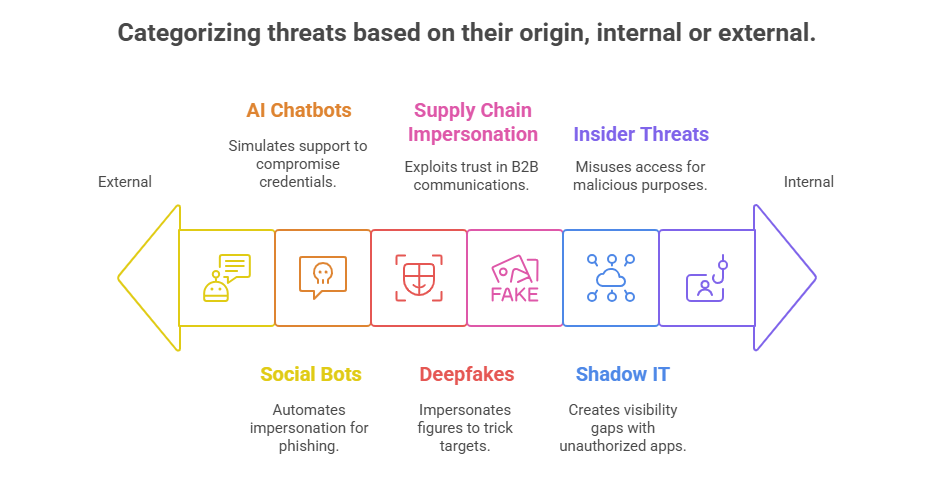
AI is radically transforming social engineering. Attackers now deploy deepfake videos and voice clones to impersonate executives, often in high-stakes situations like urgent fund transfers or login approvals. These deepfakes aren’t future threats—they’ve already been used to steal over $35 million in a single incident (UAE, 2021).
Chatbots trained on stolen company data or open-source LLMs are being deployed to engage victims in real-time. They simulate customer support agents, HR reps, or tech admins and guide users to malicious actions.
LinkedIn impersonation bots are another rising vector. They auto-connect, engage targets with job offers, and escalate to credential harvesting. When paired with supply chain attacks—impersonating vendors or partners—trust is weaponized at scale.
Insider Threats and Social Engineering
Not all attackers come from outside. Some are employees, contractors, or vendors who use their legitimate access for malicious purposes. These insider threats often stem from disgruntlement, financial pressure, or ideology—but the tactics they use mirror social engineering playbooks.
Shadow IT—unauthorized devices, apps, or backchannels—creates hidden vulnerabilities. Whistleblowers may expose data unintentionally, while others may intentionally leak sensitive material as revenge or coercion.
Because insiders already have trust, they bypass the very controls meant to stop outsiders. Training, logging, and zero-trust access models are essential—not just for outsiders, but for everyone on the payroll.
Why Learning Social Engineering Defense Matters
Most cybersecurity professionals are trained to think in code, not in conversation. But modern breaches don’t begin with malware—they begin with a message, a phone call, or a cloned profile. That’s why mastering social engineering defense is no longer optional—it’s core to enterprise resilience, compliance, and career growth.
The Advanced Cybersecurity & Management Certification (ACSMC) from ACSMI embeds social engineering defense as a primary module, not an afterthought. Unlike surface-level awareness courses, this certification trains professionals to both identify and simulate real-world attacks—preparing them to lead internal defenses, conduct ethical tests, and close the gap between user behavior and system integrity.
Covered in the Advanced Cybersecurity & Management Certification
The ACSMC includes dedicated labs on phishing simulations, attack tree analysis, and human-layer threat mapping. Trainees use case studies from high-profile breaches—like Twitter, MGM, and LinkedIn impersonations—to reverse-engineer attacker logic.
The curriculum guides learners through:
Real-time detection of deepfake communication attempts
Construction and analysis of social engineering attack chains
Deployment of red team simulations to stress-test staff responses
Policy design that aligns behavioral defenses with enterprise IT
This is not theory—ACSMC students are trained using actual threat frameworks, modeled to replicate what organizations face daily. From zero-trust policy deployment to crafting executive-level awareness programs, the certification equips learners to neutralize social engineering before it activates.
Boosting Your Career with Social Engineering Expertise
Today’s SOC teams, penetration testers, and compliance leads must show multi-dimensional expertise. Knowing network protocols isn’t enough—you need to understand how humans are breached, not just systems.
The ACSMC prepares professionals for roles like:
Threat Intelligence Analyst
Red Team Operator
Cyber Risk Manager
Insider Threat Specialist
Hiring managers increasingly prioritize candidates who can translate technical risk into human risk mitigation. Whether you're advising on policy, leading a training simulation, or reporting on incident response metrics, social engineering acumen signals strategic value.
Frequently Asked Questions
-
Social engineering in cybersecurity refers to manipulating individuals into disclosing confidential information or granting unauthorized access. Unlike malware or brute-force attacks, social engineering exploits human behavior—using deception, trust, and urgency. It's dangerous because technical defenses can’t block a convincing phone call or email that appears to come from a CEO or IT admin. Many breaches begin with a single employee being tricked into sharing credentials or clicking a malicious link. Attackers often research their targets to create customized, believable lures. Because there are no software signatures to detect, many organizations don’t realize they’ve been breached until damage has already occurred. That’s why training against human manipulation is critical in every cybersecurity program.
-
igh-profile breaches like the 2023 MGM Resorts hack and the 2022 Twitter compromise were both social engineering attacks. In the MGM case, attackers impersonated an employee over a phone call to IT support, gained access credentials, and deployed ransomware—resulting in system-wide shutdowns and millions in losses. The Twitter breach involved phishing internal employees to access admin tools and hijack celebrity accounts. In both incidents, there was no software vulnerability—just a well-executed manipulation of trust. Other common examples include business email compromise (BEC), fake tech support calls, deepfake CEO voice scams, and USB bait drops. These cases prove that even companies with strong infrastructure can fall victim when humans are the entry point.
-
Phishing casts a wide net—sending fake emails or texts to thousands in hopes of stealing credentials. Spear phishing is highly targeted, customized using research from LinkedIn, breached data, or corporate sites. These messages appear to come from known contacts and reference internal details, making them far more effective. Vishing, or voice phishing, uses phone calls instead of emails. Attackers impersonate trusted figures—like IT staff, HR, or bank agents—and may use AI to replicate voices. The key difference lies in targeting and medium. Phishing is general and email-based. Spear phishing is personalized and strategic. Vishing is audio-based and often paired with urgency or authority to push victims into action without verification.
-
Most people don’t report social engineering attacks because they don’t realize they’ve been targeted—or they feel embarrassed. Many attacks are subtle and plausible, such as a fake request from a coworker or an urgent IT notice. Victims often think the interaction was legitimate, or they blame themselves for falling for it. In workplaces without a clear, blame-free reporting structure, employees fear repercussions or being labeled careless. This silence enables attackers to operate longer and target more victims. Organizations must create a culture where reporting suspicious activity is rewarded, not punished. The faster an attack is reported—even if it turns out to be a false alarm—the better the chance of stopping it.
-
Protection starts with employee education, but that alone isn’t enough. Companies must run regular phishing simulations, train staff on behavioral cues (like urgency or authority), and implement technical controls such as multi-factor authentication (MFA). Policies should follow the principle of least privilege, ensuring no one person has unchecked access. Physical security—like preventing tailgating—and clear reporting channels are essential. Organizations should also deploy Security Information and Event Management (SIEM) tools to monitor for anomalies. Finally, simulate social engineering attacks using red teams to stress-test your people, not just your systems. Prevention isn’t about perfection—it’s about creating multiple layers that make manipulation harder and easier to detect.
-
AI is amplifying the scale and realism of social engineering attacks. Deepfake voice technology now allows attackers to clone voices of CEOs, partners, or relatives—leading to highly convincing phone scams. AI-powered chatbots can impersonate customer service agents, HR reps, or vendors, tricking users into sharing information. Attackers also use AI to analyze social media profiles and tailor spear phishing messages in seconds. LinkedIn bots are being deployed to simulate networking outreach, escalating to credential harvesting or malware. Because AI reduces the time and skill needed to run convincing attacks, it’s expanding access to social engineering tactics. That’s why real-time human training must evolve alongside AI detection tools.
-
Yes, individuals can defend against social engineering by adopting vigilant digital habits. Always verify unexpected requests—whether via email, text, or call—through a secondary communication channel. Don’t click unknown links, open unexpected attachments, or plug in found USB devices. Use password managers and enable MFA everywhere, even on personal accounts. Stay updated on new attack tactics, especially deepfakes and AI-driven impersonations. If something feels “off,” trust your instinct and investigate before responding. Social engineers rely on urgency and trust—slow the interaction down. By thinking critically and refusing to act without verification, individuals can break the attack chain at the human level, even without enterprise-grade defenses.
-
The Advanced Cybersecurity & Management Certification (ACSMC) recognizes that social engineering is the primary cause of most breaches, yet often the least-trained area in cybersecurity programs. The course dedicates full modules to identifying, simulating, and defending against social engineering attacks. Trainees work through real-world breach scenarios, run phishing simulations, and analyze attacker psychology. This makes ACSMC graduates capable of leading behavioral defense strategies, not just configuring firewalls. With the rise of deepfakes and AI impersonation, technical skills alone are no longer sufficient. ACSMC fills this critical gap—preparing professionals to operate across both technical and human security layers.
The Take Away
Cybersecurity is no longer a battle of code versus code—it’s a battle of humans versus manipulation. Social engineering attacks don’t break systems; they break trust. That’s why the most advanced firewall or AI detection system still fails if one employee holds the digital door open.
To defend against modern threats, organizations must treat people as part of the security stack, not a liability. Continuous training, red team drills, behavioral monitoring, and policy enforcement are all essential—but they must be grounded in an understanding of how attackers think.
Smart technology requires smarter people. And smarter people aren’t just technically trained—they’re psychologically aware. With deepfake scams, AI-powered phishing, and insider threats on the rise, social engineering defense is no longer an enhancement. It’s the core. Train, test, simulate, and adapt—because in cybersecurity, the next breach won’t ask for permission.
