
Future of Cloud Security: Predictive Analysis of Key Trends (2026–2030)
Cloud security in 2026 is no longer “protect the perimeter.” It’s identity-first, API-driven, and deployment-speed dependent. If your controls can’t keep up with ephemeral workloads, SaaS sprawl, and policy drift, you end up paying for tools while attackers exploit the gaps between them.
This guide predicts the cloud security trends that will matter most through 2030, and shows how to turn them into an execution plan. Along the way, you’ll see how cloud risk connects to regulatory pressure, ransomware economics, and the skills gap shaping modern security teams.
1. Cloud Security in 2026: The Threat Model Has Already Changed
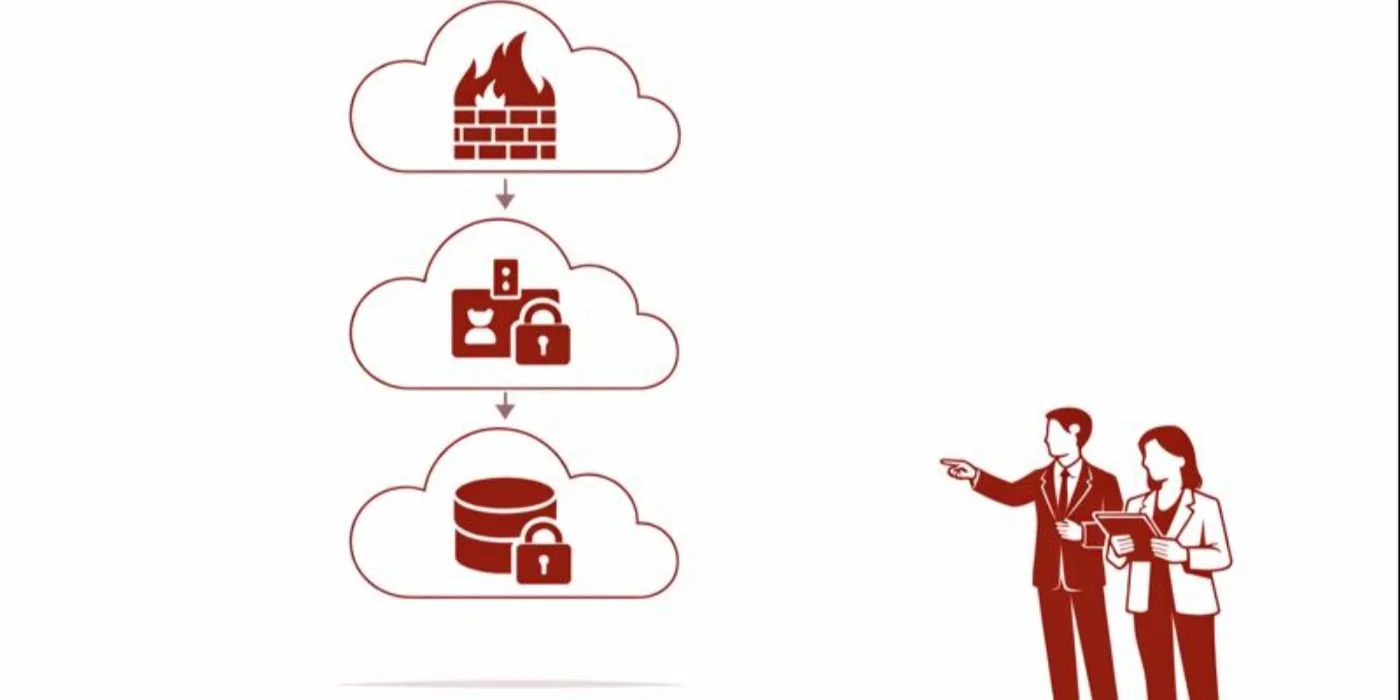
If your cloud incidents still start with “a malware alert,” you’re behind. In cloud, the common starting points are valid credentials, misconfiguration, and exposed data paths that silently become business impact. The same story repeats: identity sprawl leads to overprivileged access, a mis-scoped role allows lateral movement, logs are fragmented across services, and containment becomes slow and political. This is where compliance pressure compounds the damage because drift happens gradually until audit week. For the bigger picture on regulation velocity, connect your cloud roadmap to future compliance trends and the rise of privacy regulation shifts, then map your controls against next-generation standards and evolving audit practices.
The uncomfortable truth is that many orgs still run cloud security as a set of disconnected tools. That’s how you end up with CSPM findings no one owns, SIEM alerts no one can validate, and “temporary” exceptions that become permanent. Cloud attackers love that organizational latency. They don’t need zero-days if they can chain small mistakes. The fastest wins come from consolidating posture, identity, runtime protection, and response into one operating model, while training teams on the competencies that matter. Tie your skills plan to future cybersecurity competencies and align your detection strategy to next-gen SIEM direction, because cloud incidents are won or lost on telemetry quality and response speed.
Finally, cloud risk is now inseparable from business continuity. Ransomware crews increasingly target cloud backups, SaaS admins, and identity control planes, not just endpoints. If you want a threat baseline, anchor your strategy to the state of ransomware analysis, and cross-check what “impact” looks like across sectors via the 2025 data breach report and SMB legislation impact forecasts, because cloud security budgets are increasingly justified through regulatory and insurer expectations.
| Capability / Trend | What It Does | Why It Matters | Most Useful For | Adoption Window |
|---|---|---|---|---|
| CNAPP consolidation | Unifies CSPM, CWPP, CIEM, and workload protection signals | Reduces tool gaps and speeds triage with shared context | Multi-cloud orgs | 2026–2027 |
| CSPM with attack-path prioritization | Links misconfigurations into exploitable paths | Stops “10,000 findings, zero action” failure mode | Cloud platform teams | 2026 |
| CIEM for least privilege | Right-sizes entitlements and flags privilege creep | Prevents “valid access” lateral movement | Identity-heavy orgs | 2026–2028 |
| Identity Threat Detection & Response (ITDR) | Detects abnormal identity behavior and token abuse | Cloud breaches often begin at identity control planes | SaaS + cloud | 2026–2027 |
| DSPM (Data Security Posture Management) | Finds sensitive data, exposure paths, and risky permissions | Data exposure is the fastest path to regulatory impact | Data-heavy orgs | 2026–2029 |
| SSPM (SaaS Security Posture Management) | Monitors SaaS configs, admin roles, risky integrations | SaaS drift creates silent exposure and takeover risk | App-led companies | 2026–2028 |
| KSPM for Kubernetes | Hardens clusters, RBAC, admission controls, and runtime | K8s misconfig becomes instant blast radius | Platform engineering | 2026 |
| Runtime cloud workload protection (CWPP) | Detects malicious process/network behavior in workloads | Prevents “passed CI, attacked in prod” reality | Prod workloads | 2026–2027 |
| Policy-as-code (OPA/Rego style) | Turns security policy into versioned, testable rules | Makes compliance continuous instead of episodic | DevSecOps | 2026–2029 |
| IaC scanning with drift detection | Finds risky infra configs pre-deploy + flags drift after | Stops “secure in code, insecure in reality” | Terraform-heavy orgs | 2026 |
| Secrets management modernization | Centralizes secrets, rotation, and leakage detection | Hardcoded secrets remain a top breach accelerant | APIs + microservices | 2026–2028 |
| Key management & crypto agility | Improves key governance and prepares for algorithm changes | Supports privacy requirements and future crypto shifts | Regulated industries | 2027–2030 |
| Confidential computing adoption | Protects data-in-use via hardware-based enclaves | Reduces insider and platform-layer risk | Sensitive workloads | 2027–2030 |
| Cloud DLP 2.0 (context-aware) | Detects exfil paths across cloud storage, SaaS, endpoints | Prevents silent staging and mass data theft | Data-centric orgs | 2026–2029 |
| API security posture + runtime | Maps APIs, auth, exposure, and abnormal usage | APIs are the new attack surface for cloud apps | SaaS builders | 2026–2028 |
| SASE + ZTNA convergence | Secure access to apps with identity-based policy | Reduces VPN-era lateral movement risk | Remote workforces | 2026–2027 |
| CASB evolution (integration governance) | Controls SaaS integrations, tokens, and shadow apps | Stops third-party SaaS becoming a breach bridge | SaaS-heavy orgs | 2026–2028 |
| Cloud-native forensics readiness | Standardizes evidence capture and timelines in cloud | Shortens incident timelines and legal exposure | Mature SOCs | 2026–2029 |
| Immutable backups for cloud workloads | Adds write-once retention for critical backups | Ransomware targets backup deletion first | Critical systems | 2026 |
| SOAR playbooks for cloud containment | Automates isolation, key rotation, and access revocation | Cuts response time from hours to minutes | Lean SOC teams | 2026–2028 |
| Security data lake + normalized telemetry | Centralizes cloud logs with consistent schemas | Enables real detection engineering, not alert chasing | Enterprise SOC | 2026–2029 |
| Breach & attack simulation for cloud | Validates detections and response with safe tests | Proves controls work before attackers do | Security validation | 2027–2030 |
| SBOM + supply chain enforcement | Tracks dependencies and blocks risky components | Prevents dependency-driven compromise | Software orgs | 2026–2029 |
| eBPF-based cloud runtime visibility | Low-overhead observability for processes and syscalls | Better detections without massive agent cost | Linux-heavy stacks | 2027–2030 |
| Continuous compliance scoring | Measures control posture daily with evidence trails | Turns audits into a byproduct of operations | Regulated orgs | 2026–2028 |
| Tenant-to-tenant isolation hardening | Reduces shared-service blast radius and privilege bridging | Limits impact when a tenant admin is compromised | Large enterprises | 2026–2029 |
| Cloud network microsegmentation | Granular policies between workloads and services | Stops silent east-west movement | Hybrid environments | 2026–2028 |
| GenAI guardrails for cloud usage | Controls prompts, data exposure, and model access paths | Prevents accidental leakage through AI workflows | AI-enabled orgs | 2026–2029 |
| Cross-cloud incident response runbooks | Standardizes containment across providers | Stops chaos during multi-cloud incidents | Multi-cloud SOC | 2026 |
| Cloud risk quantification (control-to-impact) | Maps cloud risks to revenue, downtime, and regulatory loss | Makes security decisions budget-proof | Exec stakeholders | 2027–2030 |
| Unified exposure management | Combines posture, vuln, identity, and data into one view | Prioritizes what truly reduces breach likelihood | Security leaders | 2027–2030 |
2. The 2026–2030 Trend Map: What Will Actually Move the Needle
Most cloud security programs fail for a simple reason: they optimize for “coverage” instead of outcome. The table above is designed to help you choose capabilities that reduce breach probability and shrink blast radius. Start with CNAPP consolidation only if it removes duplication and improves response. Otherwise, you’re just buying a new dashboard. Your true north should be: fewer identity-driven incidents, fewer data exposures, and faster containment. Build this against cybersecurity compliance reporting, align privacy controls with GDPR evolution expectations and GDPR compliance reality, then measure maturity using evidence patterns from NIST adoption insights.
A practical way to prioritize is to group trends into four “must-win” layers. Layer one is identity and entitlement control (CIEM + ITDR + ZTNA), because stolen credentials are the easiest path to cloud compromise. Layer two is posture and drift control (CSPM, SSPM, IaC scanning, continuous compliance), because your environment changes faster than your policies. Layer three is data exposure control (DSPM, cloud DLP, key management), because data incidents are the fastest route to regulator attention. Layer four is runtime and response (CWPP, eBPF visibility, SOAR runbooks), because prevention is never perfect. If you want to understand how attackers monetize that “never perfect,” connect this to phishing trend analysis and the modern exploitation loop described in the state of endpoint security data, since endpoint-to-cloud pivoting is still common.
Cloud strategy also needs to recognize industry pressure. Finance will prioritize identity and data controls due to fraud economics and audit expectations, which aligns with finance cybersecurity trend predictions. Healthcare will over-index on data exposure, third-party risk, and continuous compliance, consistent with healthcare cybersecurity predictions and the healthcare compliance report. Manufacturing and energy will stress segmentation and operational resilience, mirroring manufacturing security trends and energy utilities predictions.
3. Cloud Security Operating Model: From Tool Sprawl to Control Ownership
The fastest way to waste a cloud security budget is to buy capabilities without assigning owners, success metrics, and enforcement paths. Every control needs a “home.” CSPM and IaC scanning belong to platform engineering with security-defined guardrails. CIEM and ITDR need joint ownership between IAM and security. DSPM belongs to data governance with security enforcement. Runtime protection belongs to the teams running production. If your SOC is trying to own everything, you’ll get burnout and slow decisions. For guidance on security role specialization and staffing, connect your org design to specialized role demand forecasts and the debate around automation impact on analysts.
Next, treat cloud security as a pipeline, not a checklist. You need a continuous loop: design controls → enforce in code → monitor drift → detect abuse → respond with playbooks → learn and update controls. This is where teams win with a modern SIEM strategy and standardized telemetry. If you can’t answer “what happened” in one place, you will always be late. Pair your telemetry approach with the direction in next-gen SIEM planning and the broader expectations in future standards evolution, because auditors increasingly care about evidence, not promises.
Finally, don’t ignore the economics that create risky behavior. Teams cut corners when controls slow delivery or create noisy rework. That’s why policy-as-code and drift detection matter: they reduce friction while improving assurance. You can reinforce this with data-driven narratives pulled from the global cybersecurity market outlook and regional patterns like the Asia-Pacific cybersecurity report, because cloud adoption speed correlates with tooling sprawl and skills gaps.
Be honest. The biggest blocker is rarely “lack of tools.” It’s usually drift, identity sprawl, or slow response when signals finally show up.
4. Security Automation and AI in the Cloud: What Gets Better, What Gets Riskier
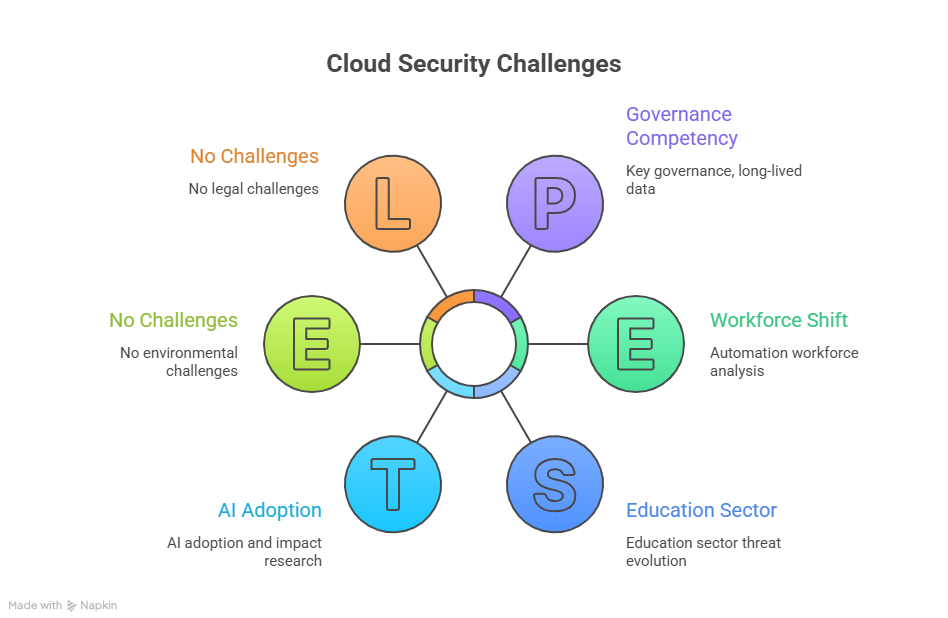
Automation is the only way to keep up with cloud velocity, but it’s also how mistakes scale. The winning pattern is automation with guardrails, not automation with blind trust. Use SOAR playbooks for deterministic actions: revoke compromised tokens, rotate keys, quarantine workloads, lock down risky storage policies. Use AI to compress investigation time: summarize timelines, cluster related events, and propose hypotheses. But don’t let AI “decide” containment without human review when business risk is high. Anchor your automation posture with the reality checks in AI adoption and impact research, and plan for the workforce shift described in automation workforce analysis.
Cloud also changes how phishing and credential theft play out. Credential replay, token abuse, and malicious OAuth grants can give attackers instant administrative reach. That’s why ITDR and SSPM rise to the top: they detect and control the identity bridges that bypass your network controls. Connect this to the tactics described in phishing prevention research and broaden your threat model with education sector threat evolution, because cloud-first orgs share similar identity and SaaS exposure patterns across industries.
Finally, the 2026–2030 window will force crypto agility thinking into cloud roadmaps. You don’t need to panic, but you do need a plan for key governance, long-lived data, and future cryptographic shifts. Treat this as a governance competency, not a vendor purchase. Build your long-term view using the strategic framing in quantum computing and cybersecurity and the complementary perspective on integrity and trust patterns in blockchain security research.
5. A Practical Cloud Security Roadmap for 2026–2030
If you want results, stop thinking in “tool deployments” and start thinking in measurable risk reduction milestones. In the first 30–60 days, your goal is to reduce your most likely breach paths: enforce MFA and conditional access for admins, remove standing privileges, implement CIEM recommendations for the top 20 risky roles, and fix the top 10 exploit-ready misconfigurations. Use posture findings only when they’re tied to attack paths. Then standardize logging and normalize data into your SIEM so cloud incidents aren’t a scavenger hunt. The strategic direction here aligns with next-gen SIEM focus and the evidence expectations in future audit evolution.
In the next 90–180 days, shift into “continuous control.” Put policy-as-code into CI pipelines so insecure configurations fail before they deploy. Add drift detection so “secure in code” doesn’t become “insecure in prod.” Implement DSPM to inventory sensitive data and shut down risky exposure paths. Add immutable backups for critical workloads to break ransomware leverage. Track progress using frameworks referenced in NIST adoption analysis, and tailor your compliance narrative using compliance trend reporting and the forward-looking view in regulatory trend forecasting.
From 2027 onward, the differentiator is resilience and validation. Run breach and attack simulations against cloud control planes. Measure detection coverage for identity abuse and data exfiltration, not just malware. Expand SSPM to govern SaaS integrations as aggressively as you govern production deploys. Mature your incident response with cloud-native forensics readiness so you can prove what happened and close it fast. If you need proof that these investments match market momentum, benchmark against the global market outlook and sector-specific pressures such as finance risk predictions and healthcare threat forecasts.
6. FAQs: Future of Cloud Security (2026–2030)
-
The biggest shift is that cloud security becomes identity-and-data centric, not network centric. Attackers increasingly succeed through token abuse, overprivileged roles, and risky SaaS integrations rather than “breaking in” through perimeter controls. That’s why ITDR, CIEM, SSPM, and DSPM rise in priority. The organizations that win will treat posture as continuous evidence, aligning with regulatory trend predictions and privacy regulation direction, while building detection maturity using next-gen SIEM approaches instead of relying on scattered alerts.
-
Prioritize by exploitability and blast radius, not raw severity. Start with attack paths that connect public exposure, weak identity controls, and sensitive data. Then assign ownership: platform teams fix baseline misconfig and guardrails, app teams fix workload and API issues, security engineers tune detections and playbooks. This is also where continuous compliance beats periodic reviews because drift is constant. Tie your prioritization logic to future audit expectations and measure progress using NIST adoption insights, so your backlog turns into demonstrable risk reduction.
-
Because SaaS is now a control plane for business operations. A compromised SaaS admin, a malicious OAuth grant, or a risky integration can expose data and grant persistence without touching your infrastructure. SSPM, CASB evolution, and ITDR reduce this risk by governing roles, tokens, and integrations as rigorously as you govern cloud IAM. The threat patterns also overlap with credential theft dynamics highlighted in phishing trend research and the broader impact trends seen in the data breach report. SaaS security becomes a core part of cloud security, not a side project.
-
Continuous compliance means controls are enforced and evidenced daily. Policies are encoded (policy-as-code), configurations are validated in CI, drift is detected post-deploy, and evidence trails are generated automatically for audits. Instead of scrambling before audits, you can show sustained control performance. This directly supports the direction described in compliance trend reporting and aligns with forward pressure in future compliance predictions. It also helps privacy alignment as regulations evolve, including the themes covered in GDPR evolution.
-
Both. AI will reduce workload where problems are language-heavy and pattern-based, like summarizing incident timelines, correlating events, and drafting remediation steps. But it introduces risk through data leakage, insecure integrations, and over-trusting automated decisions. The safest approach is AI-assisted analysis with human-approved containment, plus strong guardrails around data usage. Use the adoption context in AI impact research and align workforce planning with automation workforce forecasts, because your biggest risk becomes a skills gap, not lack of tools.
-
Cloud incident response must be playbook-driven and identity-focused. Your first containment actions often involve disabling tokens, rotating keys, tightening IAM policies, and freezing risky integrations, not “pulling network cables.” Build cross-cloud runbooks so multi-account incidents don’t become chaos. Improve forensics readiness so evidence capture is standardized, and telemetry is centralized for quick timelines. Mature this against the expectations described in future audit practice shifts and the detection modernization direction from next-gen SIEM planning. If ransomware is part of your threat model, align resilience planning with the state of ransomware analysis.
-
Prioritize skills that reduce time-to-control and time-to-containment: identity engineering (least privilege, token governance), detection engineering (cloud telemetry, SIEM correlation), DevSecOps enforcement (policy-as-code, CI guardrails), and incident readiness (forensics, playbooks, stakeholder coordination). The most valuable people are those who can translate controls into reliable operational outcomes. Use the competency roadmap in future skills for cybersecurity and calibrate specialization against role demand forecasting, because the market increasingly rewards depth in cloud identity, data security, and detection engineering.
