
Impact of Cybersecurity Certifications on Career Advancement: Original Survey Report
Cybersecurity certifications do not create career advancement on their own. They create leverage. They signal seriousness, reduce hiring uncertainty, accelerate trust in technical capability, and help employers slot candidates into roles faster when experience is still developing. But the real career impact depends on whether the certification matches the role, the employer, the market, and the skills behind it. That is the core finding behind this report-style analysis.
This article is written in an original survey-report format and grounded in current workforce and certification trend data. Recent industry research shows cybersecurity hiring demand remains strong, tech hiring still includes large volumes of cybersecurity roles, professionals continue pursuing certifications aggressively, and employers broadly view micro-credentials and certifications as application-strengthening signals. At the same time, salary and promotion gains are not automatic, which means certification strategy matters more than collecting badges.

1) Why cybersecurity certifications still influence career advancement
The biggest mistake candidates make is treating certifications like magic instead of force multipliers. A certification does not erase weak hands-on ability, poor communication, no portfolio, or a résumé that does not map to actual employer pain. What it does do is remove doubt faster. It tells hiring managers that you have at least committed to a body of knowledge, learned the language of the field, and cleared a recognized standard. In a market where employers still advertise large volumes of cybersecurity-related roles and where skills gaps remain persistent, that matters because certification can reduce friction at the screening stage.
That screening value is strongest when the certification aligns with a real job path. Entry-level candidates benefit when certifications help them look less risky than other beginners. Mid-career professionals benefit when certifications help them reposition into cloud, governance, security operations, or leadership-adjacent roles. Senior professionals benefit when certifications help formalize trust, especially in governance-heavy environments where frameworks, audit language, and policy depth matter. That is why career growth should never be planned around the certificate alone. It should connect directly to deeper capability in cybersecurity frameworks, stronger security audits, sharper vulnerability assessment techniques, and clearer cyber threat intelligence analysis.
The data also supports a more disciplined view of certification value. Pearson VUE’s 2025 report found that 84% of candidates were likely or very likely to pursue additional certifications in the next 12 months, while Coursera’s 2025 micro-credentials report says 96% of employers believe micro-credentials strengthen a candidate’s application. That does not prove every certificate leads to promotion, but it does prove credentials still influence how the market interprets readiness, intent, and skill development. For cybersecurity professionals competing in crowded applicant pools or trying to pivot into higher-value specialties, that signal still matters.
| Certification | Best Career Stage | Most Likely Advancement Effect | Where It Creates Real Leverage |
|---|---|---|---|
| ISC2 Certified in Cybersecurity (CC) | Entry level | Helps reduce beginner-risk perception | First cybersecurity role, internal transition, interview credibility |
| CompTIA Security+ | Entry level | Strengthens baseline employability | Analyst, support, junior security, defense contracting pathways |
| CompTIA CySA+ | Early career | Supports SOC and defensive specialization | Detection, triage, blue-team credibility |
| CompTIA PenTest+ | Early career | Improves offensive track positioning | Testing, assessment, red-team-adjacent growth |
| CompTIA CASP+ | Mid career | Signals advanced practitioner depth | Technical leadership without immediate management shift |
| ISC2 SSCP | Early career | Adds structured operations credibility | Admin-to-security transitions and foundational operations roles |
| ISC2 CISSP | Mid to senior career | Boosts promotion and leadership trust | Senior analyst, architect, manager, governance-heavy roles |
| ISC2 CCSP | Mid career | Accelerates cloud-security repositioning | Cloud governance, architecture, security engineering |
| ISC2 CGRC | Mid career | Strengthens compliance and risk pathways | GRC, audit, regulated-sector advancement |
| ISC2 HCISPP | Mid career | Supports healthcare-sector specialization | Privacy, healthcare compliance, sector-specific trust |
| CEH | Early to mid career | Improves visibility for offensive/security testing roles | HR screening, offensive positioning, training-market recognition |
| OSCP | Mid career | Creates strong technical differentiation | Hands-on offensive roles and serious practitioner credibility |
| OSWE | Mid career | Deepens application-security standing | Advanced web app testing and AppSec specialization |
| GIAC GSEC | Early career | Elevates general security competence perception | Broad foundational credibility with technical employers |
| GIAC GCIA | Mid career | Sharpens network defense specialization | Monitoring, IDS, network-centric detection roles |
| GIAC GCIH | Mid career | Strengthens incident response profile | SOC escalation, IR teams, hands-on defense roles |
| GIAC GPEN | Mid career | Improves offensive readiness signaling | Pen-testing and validation roles |
| GIAC GMON | Mid career | Supports modern detection and monitoring advancement | SOC modernization and telemetry-heavy teams |
| Microsoft SC-900 | Entry level | Improves cloud-security interview readiness | Beginners entering Microsoft security ecosystems |
| Microsoft SC-200 | Early career | Supports SOC and detection tooling advancement | Microsoft Sentinel and analyst-track growth |
| Microsoft AZ-500 | Mid career | Strengthens cloud security operations credibility | Azure-focused engineering and security administration |
| AWS Security – Specialty | Mid career | Improves cloud-role mobility | AWS security engineering and cloud governance |
| Google Professional Cloud Security Engineer | Mid career | Expands cloud specialization signal | GCP-centric security architecture and operations |
| Cisco CyberOps Associate | Entry to early career | Supports analyst-track entry | SOC onboarding and network-aware security roles |
| CISM | Senior career | Helps management-track progression | Security leadership, governance, stakeholder trust |
| CRISC | Mid to senior career | Improves risk and controls positioning | GRC, enterprise risk, audit-linked advancement |
2) What this report-style analysis shows across different career stages
At entry level, certifications matter most because employers are trying to answer a brutal question quickly: can this person become useful without excessive risk, supervision, or retraining? That is why beginner-friendly credentials often have outsized career impact relative to their technical depth. They do not prove mastery. They prove commitment, vocabulary, structure, and trainability. ISC2 says some CC holders in cybersecurity roles reported both salary increases and promotions within their first certification cycle, which supports the idea that even introductory credentials can produce movement when paired with the right opportunity.
For early-career professionals, the game changes. At that stage, certifications help less with mere entry and more with directional movement. A Security+ holder moving into blue-team work may see stronger results by adding CySA+ or a Microsoft operations-focused credential. Someone aiming for offensive work gains more from PenTest+, CEH, or a hands-on path like OSCP when that certification is backed by labs and proof of work. This is where broader career planning should connect with role-focused capability in incident response planning, SIEM strategy, firewall technologies, and intrusion detection deployment. The certificate opens the door faster, but the role fit determines whether the door stays open.
Mid-career professionals usually feel certification impact in two situations: specialization and trust expansion. Specialization means becoming more promotable because you are now easier to map to cloud security, GRC, IAM, AppSec, or incident response. Trust expansion means managers become more willing to place you in customer-facing, audit-facing, or leadership-adjacent situations because your certification lowers perceived risk. That is why cloud and governance credentials often matter so much in this band. They turn informal knowledge into formal credibility, especially when paired with deeper reading in future cloud security trends, future cybersecurity compliance, privacy regulations and cybersecurity, and future cybersecurity audit practices.
Senior-career professionals get a different kind of return. Here, certifications are less about proving that you can configure tools and more about proving that you can think at the level of risk, controls, architecture, regulation, and strategic tradeoffs. ISC2’s salary pages continue to position CISSP holders as strong earners based on workforce-study data, but the more important senior-career signal is not just salary level. It is eligibility for roles that require trust with boards, auditors, regulators, enterprise customers, and executive peers.
3) Which certifications tend to create different kinds of advancement
Not all advancement looks the same, and certification strategy falls apart when people use one metric for every goal. Some certifications are best for getting interviews. Some are best for promotions. Some are best for lateral pivots into stronger-paying specialties. Some are best for leadership credibility. Candidates who confuse these outcomes often feel disappointed even when the certification did what it was supposed to do.
Interview-generating certifications are usually broad, recognizable, and easy for recruiters to understand. Security+, ISC2 CC, CEH, and foundational cloud-security credentials often sit in this category. They may not produce dramatic compensation change by themselves, but they reduce screening friction. That matters in a market where employers continue to advertise high-demand roles for cybersecurity engineers, analysts, and adjacent positions.
Promotion-friendly certifications are different. They tend to be associated with broader responsibility, not just narrower skill. CISSP, CISM, CCSP, CRISC, and certain GIAC credentials often fit this pattern because they communicate either scope, governance fluency, architectural judgment, or advanced operational depth. Promotion decisions are rarely about passing an exam alone. They are about whether leadership believes you can handle more ambiguity, accountability, and cross-functional pressure. Certifications help when they reduce uncertainty around that judgment.
Pivot-oriented certifications create the most interesting career gains. A systems administrator can use cloud-security credentials to move into security engineering. A help desk professional can use Security+ or CC plus labs to enter analyst work. An analyst can use GRC-oriented certifications to move into audit, risk, or compliance roles. That is why certificate planning should align with long-horizon workforce changes around cybersecurity job market trends, future skills for cybersecurity professionals, specialized cybersecurity role demand, and the future of remote cybersecurity careers. The smartest certification is often the one that gets you into a better lane, not the one with the loudest brand.
4) Where certifications fail to advance careers
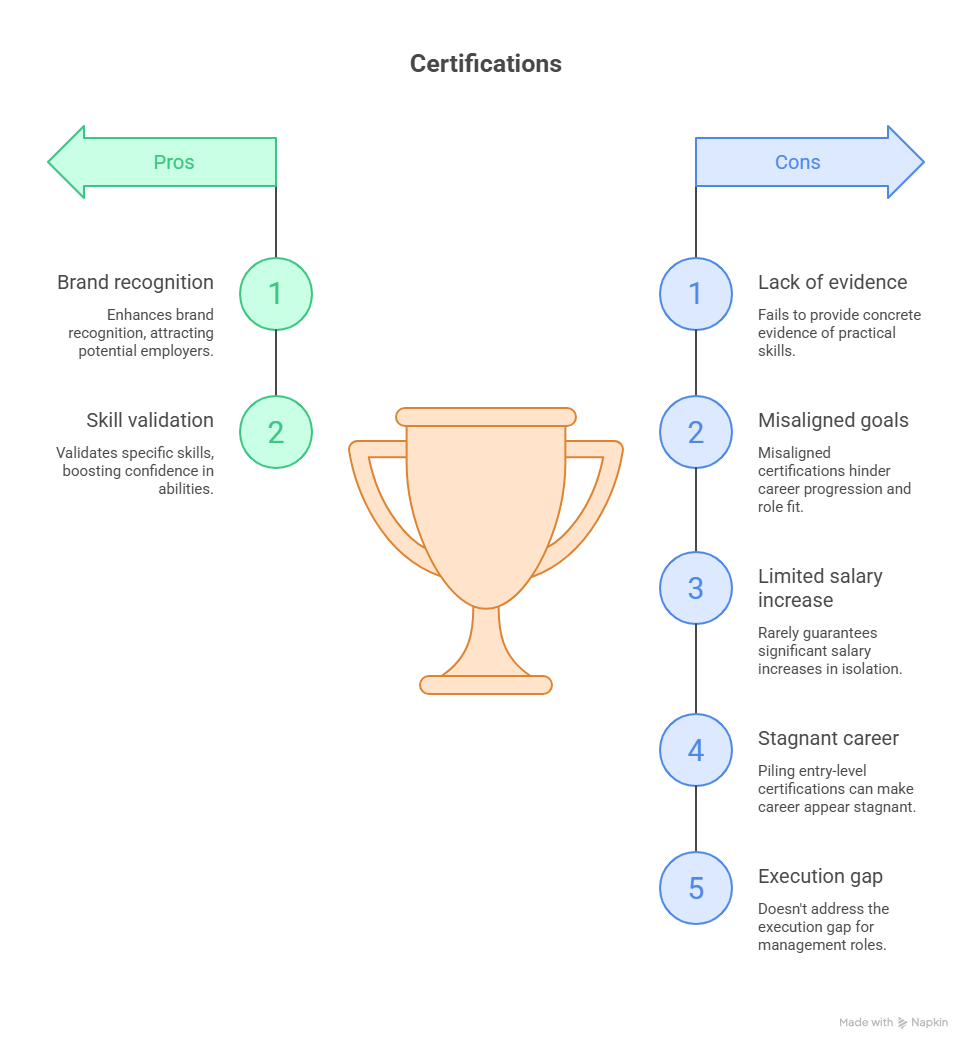
Certifications fail when they are used as substitutes for evidence. A hiring manager may notice your certification, but they still need proof that you can think, communicate, troubleshoot, document, prioritize, and work through ambiguity. That is why two candidates with the same credential can get radically different outcomes. One has labs, writeups, incident stories, ticket-based experience, and tool fluency. The other has a badge and nothing behind it. The market does not reward those two profiles equally.
They also fail when the credential is misaligned with the intended move. Someone pursuing management-oriented certifications too early may struggle because employers still see an execution gap. Someone piling up entry-level certifications deep into mid-career may look stagnant rather than ambitious. Someone choosing a highly recognizable certification without matching it to role demand may gain brand recognition but not actual mobility. This is where disciplined planning matters more than credential collecting. A stronger career strategy usually links the certification to adjacent proof points such as data loss prevention strategy, encryption standards knowledge, public key infrastructure understanding, and applied knowledge in ransomware detection and recovery.
The salary question also needs honesty. Industry studies show many professionals do not receive dramatic annual increases, and certification alone rarely guarantees a large raise. ISC2’s 2025 workforce study found 20% of participants got no salary increase over the prior year, while most saw only modest increases; that matters because it reinforces a painful truth candidates often ignore: the salary payoff frequently arrives through a better role, a stronger employer, or a higher-trust scope of work, not through the certificate in isolation.
5) How to turn a cybersecurity certification into real career acceleration
First, pair the certification with proof of applied competence. That can mean lab work, GitHub projects, detection logic examples, cloud hardening exercises, incident walkthroughs, audit mapping, threat reports, policy artifacts, or architecture notes. You need visible evidence that the credential changed what you can do, not just what you can list. Without that bridge, the certification helps you start conversations but not finish them.
Second, use the certification to retell your story. Many professionals undersell themselves because their résumé still describes old tasks instead of emerging value. If you earn a cloud or governance credential, your résumé and LinkedIn should start speaking in that language immediately. Your project bullets should map to access design, incident readiness, detection, compliance alignment, cloud controls, or risk reduction. That storytelling layer matters because certifications work best when they make your trajectory easier to understand. It is the same principle behind stronger career-path planning in how to become a cloud security engineer, how to become a cybersecurity auditor, how to become a cybersecurity instructor, and the career roadmap to becoming a cybersecurity curriculum developer.
Third, use the credential to enter better conversations. Ask for scope, not praise. Ask to shadow an incident. Ask to help with control reviews. Ask to participate in cloud-security cleanup. Ask to support audit preparation. Ask to own a small detection engineering project. Career acceleration comes when certifications create access to responsibility. If the credential does not change the work you touch, its long-term impact stays limited.
6) FAQs
-
Yes, but usually as part of a larger promotion case rather than as a standalone reason. Certifications help when they increase trust in your readiness for broader scope, especially in governance, cloud, leadership, and specialized operational roles. ISC2 has reported promotion outcomes for some certification holders, but the strongest effect usually appears when the certification is paired with real work evidence.
-
There is no universal winner, but CISSP remains one of the most durable long-term signals because of its broad recognition and link to senior-level trust. That said, cloud, governance, and deeply hands-on certifications can outperform it for specific career paths. The best certification is the one that aligns with your next role, not the one with the biggest reputation.
-
Yes. Entry-level certifications remain useful because they reduce employer uncertainty for beginners. They matter most when combined with labs, home projects, and role-relevant storytelling. Broad employer demand for cybersecurity skills continues to support that value.
-
No. Certifications can improve leverage, but salary growth often comes through role changes, specialization, expanded responsibility, or switching employers. Recent workforce data shows many cybersecurity professionals still saw only modest year-over-year pay increases.
-
Only if the certifications build a coherent story. Stacking random credentials often creates noise rather than momentum. A smaller number of well-chosen certifications tied to visible applied work usually creates more advancement than a large pile of disconnected badges.
-
Hands-on experience matters more in the long run, but certifications often help open the doors that lead to better experience. The strongest career strategy is not choosing between them. It is using certifications to make your experience legible, credible, and easier for employers to trust.
