
Security+ vs Google Cybersecurity Certificate: Cost, Difficulty, Jobs & Best Order
Security+ and the Google Cybersecurity Certificate can both strengthen an entry-level security profile, yet they solve different problems. Google offers a guided beginner path through Linux, SQL, Python, SIEM, incident response, and job preparation, while Security+ tests broader security knowledge through a recognized certification exam. For candidates trying to break into cybersecurity without IT experience, build practical hiring evidence, strengthen a cybersecurity resume, or reach SOC analyst jobs, choosing the right order can save months of scattered study.
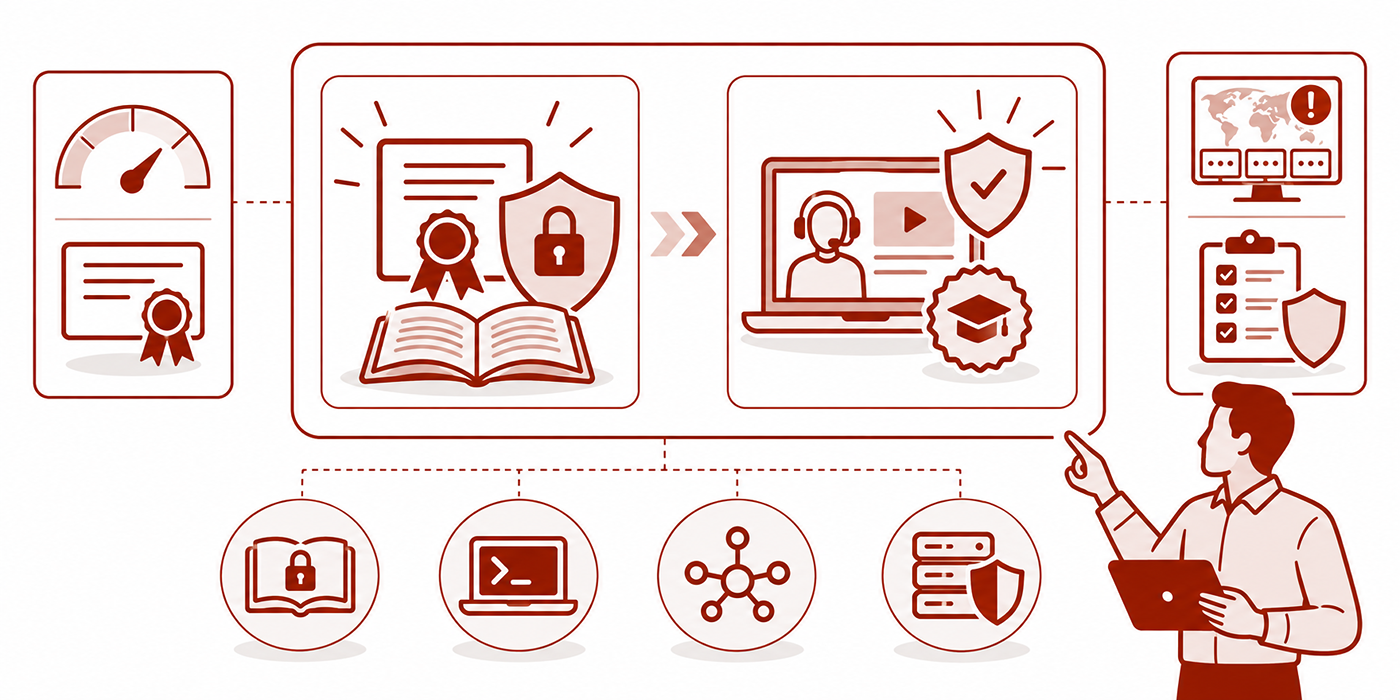
1. Security+ vs Google Cybersecurity Certificate: What Are You Actually Getting?
The Google Cybersecurity Professional Certificate is structured education. Coursera currently describes it as beginner-level, requiring no prior experience, with a self-paced schedule of roughly six months at seven hours per week. The curriculum covers risks and vulnerabilities, networks, Linux, SQL, Python, SIEM tools, incident response, intrusion detection, threat management, and job preparation. That breadth makes it useful for someone still developing the foundations behind a 12-month cybersecurity career roadmap, a SOC home lab, an entry-level security resume, or a stronger certification-and-lab strategy.
CompTIA Security+ is an exam-based professional certification. The current SY0-701 version tests general security concepts, threats and mitigations, security architecture, security operations, and security program management. The exam allows up to 90 questions in 90 minutes, contains multiple-choice and performance-based items, and requires a scaled score of 750 out of 900. Current 2026 references also continue to list SY0-701 as the active version. That makes Security+ more relevant to candidates concerned about employer filters, SOC hiring requirements, degree-versus-certification ROI, and competitive cybersecurity hiring.
The distinction matters because course completion and certification examination measure different things. Google leads you through learning activities and applied exercises. Security+ expects you to arrive prepared, pay for an exam attempt, and demonstrate enough knowledge to meet CompTIA's passing standard. Someone starting from scratch may find Google's structure easier to follow, while someone who already has IT experience may gain more from going directly toward Security+ and adding a hands-on home lab, project evidence, SOC-specific preparation, and targeted technical interview practice.
Cost also behaves differently. In the U.S. and Canada, Coursera currently lists the Google Cybersecurity Certificate at $49 per month after a seven-day trial, with most learners able to finish for under $300 if they complete it within six months. Pakistan's regional Google Career Certificate page currently lists $20 per month, illustrating how strongly pricing can vary by country. Security+ uses an exam-voucher model instead. Current 2026 pricing sources consistently report a U.S. list price of about $439 for one SY0-701 attempt, although academic and reseller pricing can reduce that figure. Candidates comparing bootcamps, degrees and certifications, Security+ employment outcomes, cybersecurity career ROI, and entry-level market competition should compare total learning cost rather than sticker price alone.
| Comparison Point | Google Cybersecurity Certificate | CompTIA Security+ | Career Impact |
|---|---|---|---|
| Credential type | Professional training certificate | Industry certification exam | They signal different types of achievement |
| Best audience | Complete beginners | Beginners with foundations or IT experience | Prior knowledge should influence order |
| Experience required | None | No formal prerequisite; experience recommended | Google offers a gentler starting point |
| Learning format | Self-paced guided curriculum | Exam; preparation chosen separately | Google provides the learning path itself |
| U.S./Canada direct cost | $49/month | Around $439 per standard exam attempt | Total cost depends on study speed and prep |
| Regional pricing | Varies substantially | Varies by country, academic status and seller | Check local checkout pricing |
| Typical learning timeline | Around 3–6 months | Depends entirely on background and study plan | Security+ can be faster for experienced learners |
| Final assessment | Course assessments and activities | Proctored certification exam | Security+ introduces higher exam-day stakes |
| Exam retake risk | Lower financial risk | Failed attempt can require another voucher | Budget matters more for Security+ |
| Employer recognition | Useful beginner training signal | Strong established certification signal | Security+ often carries more screening value |
| Security fundamentals | Strong beginner coverage | Broad exam coverage | Both build a useful baseline |
| Linux | Hands-on learning included | General knowledge expected | Google gives beginners more direct practice |
| SQL | Included | Minor relevance to exam | Google offers broader analyst tooling exposure |
| Python | Included for security automation | Conceptual scripting knowledge may help | Google gives structured beginner coding practice |
| SIEM exposure | Includes Chronicle and Splunk concepts/tools | Security monitoring concepts tested | Google can produce better early SOC context |
| Incident response | Guided exercises | Exam-domain knowledge | Labs should supplement either path |
| Network security | Beginner instruction | Broad tested knowledge | Security+ expects faster conceptual recall |
| Threats and vulnerabilities | Taught progressively | Major exam area | Google can prepare beginners for Security+ depth |
| Governance and risk | Introduced | Significant exam coverage | Security+ gives broader enterprise context |
| Cloud security | Foundational exposure | Included within architecture and operations | Both require deeper study for cloud roles |
| Hands-on portfolio material | Several activities can inspire projects | Must usually be built separately | Google gives beginners more raw project material |
| SOC job alignment | Strong beginner learning alignment | Strong foundational hiring signal | Combining skills and recognition is powerful |
| GRC relevance | Useful foundation | Broader governance coverage | Security+ may transfer more directly |
| IAM relevance | Basic identity concepts | IAM and access-control coverage | Both need specialized follow-up learning |
| Resume keyword value | Helpful | Often stronger | Vacancy wording should guide investment |
| Difficulty for complete beginners | Lower barrier | Higher preparation burden | Google can reduce initial overwhelm |
| Renewal | Course certificate remains on profile | Certification follows CompTIA renewal requirements | Long-term maintenance differs |
| Best for career changers | Excellent structured starting point | Excellent recognized baseline after foundations | Sequence can matter more than choosing one |
| Best next step afterward | Security+ plus home lab and applications | Labs, experience and role-specific skills | Credential stacking has diminishing returns |
| Core decision question | Do I still need structured foundations? | Do I need a stronger employer-recognized certification? | Identify the actual hiring gap first |
2. Cost and Difficulty: Which Path Gives Beginners Better Value?
Google's pricing model rewards speed. In the U.S. and Canada, six months at $49 per month works out to roughly $294 before taxes, while a learner finishing in three months would spend about $147. Coursera explicitly says most learners can finish the program for under $300, and Google's Pakistan page currently lists a substantially lower $20 monthly subscription. This creates a relatively low-risk entry point for people testing whether cybersecurity fits them, deciding between a bootcamp and certification route, building foundational practical skills, and preparing for a career change without previous IT experience.
Security+ carries more financial pressure because the exam voucher itself represents a significant one-time expense. Multiple 2026 pricing references report a current U.S. list price of $439 for a standard SY0-701 attempt, while academic pricing can be substantially lower for eligible students. Study materials can add anything from almost nothing with free resources to hundreds or thousands of dollars through official packages and bootcamps. That makes preparation quality particularly important for candidates already concerned about certification ROI, Security+ job outcomes, cybersecurity market saturation, and resume differentiation.
Difficulty also differs structurally. Google teaches concepts progressively, lets learners revisit content, and builds skills through exercises. Someone who has never used Linux can learn commands while moving through the course. Someone unfamiliar with SQL can build basic query familiarity before later modules depend on it. Coursera currently describes the certificate as beginner-level with no prior experience required. This structure works well for someone whose main challenge is the overwhelming amount of information behind SOC analyst careers, cybersecurity home labs, entry-level certification choices, and employer expectations.
Security+ demands more independent preparation. CompTIA recommends prior networking knowledge and roughly two years of security or systems-administration experience, although there is no formal experience prerequisite to sit SY0-701. A determined beginner can pass, yet the exam can punish fragmented memorization. Candidates need to connect threats, controls, identity, architecture, risk, operations, and incident response across scenario-style questions. That is why labs beside certifications, a beginner SOC environment, a proof-based resume, and a realistic entry-level job plan matter even before exam day.
The painful scenario is spending $439, passing Security+, and discovering that employers still ask, “What have you actually done?” The opposite problem occurs when someone completes Google's practical coursework and discovers that recruiters are filtering for a certification explicitly named in the vacancy. These are separate hiring bottlenecks. A thoughtful candidate evaluates employer filters, technical skill proof, SOC hiring criteria, and current job-market competition before deciding where the next dollar goes.
3. Jobs and Employer Recognition: Which Credential Helps More?
Google explicitly positions its certificate toward roles including cybersecurity analyst, security analyst, SOC analyst, information security analyst, IT security analyst, and cyber defense analyst. It also teaches Python, Linux, SQL, SIEM concepts, Splunk, Chronicle, and Suricata. Those are useful ingredients for someone building toward SOC analyst employment, a cybersecurity home lab, a technical portfolio, or a broader career-change roadmap.
Security+ typically provides stronger credential recognition because it functions as a widely established vendor-neutral certification rather than a course-completion certificate. It also appears across a wider variety of role families because its domains extend beyond SOC work into security architecture, IAM, risk, governance, operations, and incident response. Someone considering SOC versus GRC, IAM careers, cybersecurity auditing, risk management, or eventually security architecture therefore gains a credential with broader role portability.
Employer recognition still cannot substitute for evidence. An entry-level SOC manager may care that Security+ confirms broad foundational knowledge and then spend the interview asking how you would investigate repeated failed logins, suspicious PowerShell, phishing, or an endpoint alert. A candidate who has completed Google's exercises and built a SOC lab with SIEM evidence may have stronger practical stories. The strongest application combines recognized credentials with projects recruiters can verify, knowledge of what SOC managers ask for, and an understanding of why certification-only candidates get stuck.
The Google certificate also creates a direct bridge to Security+. Google states that its cybersecurity curriculum helps prepare graduates for the CompTIA Security+ exam and that graduates can access Security+ training and the exam at a discounted price. Completing both also creates a dual credential that can be shared with employers. This makes the two credentials complementary for someone who still needs foundational technical learning, stronger certification recognition, hands-on evidence, and a credible SOC resume.
A certificate should also match the role. Someone targeting GRC may gain more from Security+'s broad security and governance foundation followed by framework experience. Someone targeting IAM needs deeper identity, directories, SSO, MFA, and cloud-identity knowledge after either credential. Someone pursuing security automation can extract more from Google's Python exposure and then deepen scripting. Someone focused on SOC work should add SIEM, endpoint telemetry, investigations, and documentation regardless of which certificate comes first.
4. Best Order: Google Certificate First, Security+ First, or Only One?
For a complete beginner with little or no IT knowledge, Google first followed by Security+ is usually the most efficient sequence. Google gives you a structured environment for learning networking concepts, Linux, SQL, Python, SIEM, risk, threat detection, and incident response before you face the pressure of a proctored exam. Google also explicitly says the certificate helps prepare learners for Security+. Pair that route with a cybersecurity home lab, a project-focused resume, a realistic no-experience roadmap, and knowledge of SOC hiring expectations.
For someone who already works in help desk, networking, systems administration, cloud support, or technical operations, Security+ first can be more efficient. Existing troubleshooting, networking, identity, operating-system, and enterprise experience may already provide much of the context a complete beginner needs the Google program to develop. That candidate can direct study toward SY0-701, then build security-specific labs, translate previous work into a cybersecurity resume, target SOC analyst openings, and close gaps revealed by employer requirements.
For someone who has already completed the Google Cybersecurity Certificate, the next move usually involves Security+ or direct employment-focused skill building. Repeating another very broad beginner course can create diminishing returns. Review Security+ objectives, identify missing areas, build a hands-on SOC project, strengthen technical interview stories, and begin applying while preparing. This prevents the common trap where certificate accumulation replaces job-market testing and applicants discover too late that their real weakness is experience evidence.
For someone who already holds Security+, the Google certificate has lower marginal value unless substantial practical gaps remain. A Security+ holder who cannot use Linux comfortably, query a SIEM, write basic Python, interpret logs, or explain an investigation may still benefit from selected Google coursework. A stronger use of time may come from a complete SOC lab, role-specific hands-on projects, targeted SOC applications, or deeper specialization in IAM, GRC, or automation.
Candidates with a strong college cybersecurity degree should diagnose their hiring gap before buying either option. Graduates frequently possess theoretical knowledge while lacking practical evidence, which is one reason cybersecurity graduates still struggle to get jobs. Security+ may provide a recognizable credential when job descriptions request it. A home lab, project evidence, stronger technical interview performance, or actual IT experience may solve a larger problem than another introductory course.

5. How to Turn Either Credential Into Actual Job Evidence
The Google certificate gives learners many technical touchpoints, yet those exercises become more valuable when converted into portfolio artifacts. Build a Linux investigation note explaining commands used. Document a SQL query used to filter security data. Create a short Python script that parses a harmless log file. Write an incident report from a simulated alert. Explain how a SIEM query narrowed an investigation. Those artifacts strengthen a cybersecurity resume, reinforce hands-on hiring signals, support SOC job applications, and prepare you for technical interviews.
A Security+ holder needs to create that practical layer intentionally. Build a small Windows-and-SIEM environment, collect telemetry, investigate failed logons, observe process creation, create incident timelines, document false-positive reasoning, and explain escalation decisions. The beginner SOC home-lab approach is particularly useful because it transforms abstract Security+ topics into evidence. It also addresses the core weakness discussed in Security+ employment outcomes, certification-versus-lab comparisons, SOC hiring requirements, and entry-level market saturation.
Your resume should then connect credentials to demonstrated capability. “Google Cybersecurity Professional Certificate” and “CompTIA Security+” belong in the certification or education section. Project bullets should explain what you investigated, configured, queried, automated, or documented. A hiring manager gains far more information from “Built a Wazuh and Sysmon lab to investigate Windows authentication and process events” than from five lines of generic skills. That approach aligns with a resume recruiters can verify, a home lab built for employment, stronger SOC application evidence, and the practical expectations behind modern cybersecurity hiring.
Apply before completing a massive certification stack. If you get zero recruiter calls, inspect the resume, role targeting, location, experience requirements, and keyword alignment. If recruiters call and technical interviews fail, deepen networking, operating systems, logs, SIEM, and investigation practice. If technical rounds go well and offers remain scarce, improve communication, job targeting, and evidence of experience. This diagnostic approach works better than automatically buying another course and supports smarter decisions around cybersecurity market saturation, degree-versus-certification ROI, bootcamp alternatives, and career-change planning.
Candidates should also resist learning every security discipline simultaneously. A person targeting SOC work can prioritize Windows, networking, SIEM, endpoint telemetry, phishing, and incident response. Someone pursuing IAM should deepen identity, SSO, MFA, directories, and cloud access. Someone choosing GRC should deepen frameworks, controls, risk, evidence, and audit processes. Someone interested in cybersecurity automation should build Python, APIs, scripting, and workflow skills. The certificate creates the starting layer; specialization creates the career leverage.
6. FAQs About Security+ vs Google Cybersecurity Certificate
-
The Google Cybersecurity Certificate is designed specifically for beginners and requires no previous experience. Its structured curriculum introduces networks, Linux, SQL, Python, SIEM, threats, incident response, and job preparation over a self-paced program. That makes it especially useful before Security+ for someone following a no-experience cybersecurity roadmap, building a first SOC lab, preparing a beginner resume, or learning how certifications and practical skills should work together.
-
Security+ generally carries stronger certification recognition because it is an established vendor-neutral professional certification assessed through a proctored exam. The Google Cybersecurity Certificate still provides useful learning and a recognizable Google-backed credential, especially for entry-level candidates. Employer requirements vary by market, so candidates should inspect real vacancies while researching Security+ hiring filters, SOC employer expectations, cybersecurity job saturation, and resume evidence.
-
Current 2026 sources place the U.S. Security+ SY0-701 list price at around $439 for one standard attempt, with academic and reseller discounts sometimes available. Coursera currently charges $49 per month in the U.S. and Canada for the Google certificate after its trial, with most learners finishing for under $300. Regional Google pricing can be lower; Pakistan currently lists $20 per month. Compare those costs alongside degree ROI, bootcamp costs, hands-on lab value, and actual entry-level market conditions.
-
Google explicitly says its cybersecurity certificate helps prepare graduates for the CompTIA Security+ exam. Graduates can also access Security+ training and the exam at a discounted price, and completing both provides a dual credential. Candidates should still review the current Security+ objectives and fill remaining gaps through hands-on labs, a SOC home lab, technical interview preparation, and an active job-search strategy.
-
Google lists SOC analyst among the career paths its certificate prepares learners for and includes SIEM, incident response, Linux, Python, SQL, and intrusion-detection content. Hiring still depends on the full profile: IT fundamentals, projects, location, job requirements, interview performance, and competition. Strengthen the credential with a SOC analyst home lab, a proof-based resume, knowledge of SOC hiring expectations, and a realistic view of entry-level competition.
-
Security+ can improve recruiter recognition and validate broad security knowledge, while most hiring processes still evaluate practical skills, IT foundations, communication, projects, and previous experience. Candidates frequently hit problems when Security+ becomes their only hiring signal, which is why certifications need hands-on evidence, a strong home lab, and a resume recruiters can verify.
