
Career Roadmap: Digital Identity Management Specialist
Digital identity management is one of the most important career lanes in cybersecurity because every major breach eventually asks the same painful questions: who had access, why did they have it, what could they reach, and why was nobody alerted sooner? A Digital Identity Management Specialist protects users, accounts, privileges, applications, cloud services, and access workflows. This path connects directly with access control models, privileged access management solutions, cybersecurity compliance trends, and long-term cybersecurity job market growth.
1. Understand What a Digital Identity Management Specialist Actually Does
A Digital Identity Management Specialist designs, monitors, and improves the systems that decide who can access what inside an organization. The work covers identity lifecycle management, user provisioning, authentication, authorization, single sign-on, multi-factor authentication, privileged access, access reviews, role design, directory services, federation, identity governance, and identity-related incident response. This career sits close to cybersecurity compliance analyst roles, cybersecurity auditor careers, cloud security engineering, and security operations careers.
The role matters because identity is now the control plane for modern security. Employees use cloud applications, SaaS platforms, VPNs, customer portals, developer tools, admin consoles, data platforms, and AI-enabled systems from many locations and devices. Contractors, vendors, service accounts, APIs, automation scripts, and administrators often have access that outlives the business need. A weak identity program creates the exact conditions attackers love: stale accounts, shared credentials, excessive permissions, missing MFA, poor offboarding, weak password resets, unmanaged service accounts, and privileged access nobody can explain during an audit.
The strongest identity professionals think in risk chains. A new hire needs access fast, but the access has to match the job. A manager wants convenience, but approval workflows need evidence. A developer needs admin privileges, but those privileges need time limits, monitoring, and review. A terminated employee should lose access immediately, but offboarding often fails when HR, IT, cloud teams, and application owners use disconnected workflows. That is why identity work connects naturally with security audit best practices, NIST cybersecurity framework adoption, data loss prevention tools, and cybersecurity incident response.
2. Build the IAM, Security, Cloud, and Compliance Foundation
The first stage of this career is building a strong identity and access management foundation. Learn the vocabulary deeply: identity provider, directory, tenant, role, group, entitlement, policy, authentication, authorization, federation, SAML, OAuth, OpenID Connect, lifecycle management, provisioning, deprovisioning, single sign-on, multi-factor authentication, service account, privileged account, access certification, and segregation of duties. These terms become real when you connect them with access control models, PAM solutions, security frameworks, and security audit practices.
Start with IT fundamentals because identity teams often sit between help desk, infrastructure, security, HR, legal, compliance, and application owners. You should understand account creation, password resets, group memberships, ticketing workflows, directory sync, device enrollment, email systems, VPN access, shared drives, cloud applications, and endpoint security signals. A candidate coming from help desk or systems support can use the IT support to cybersecurity analyst roadmap, security analyst advancement guide, SOC analyst career guide, and cybersecurity analyst to engineer pathway to strengthen the operational base.
Cloud identity is essential. Modern organizations manage access across Microsoft, Google, AWS, Azure, SaaS platforms, developer environments, HR systems, ticketing systems, and business applications. The painful problem is permission sprawl. Teams grant broad roles to move quickly, forget temporary access, leave service accounts undocumented, and discover during incidents that nobody can explain which identity accessed which data. Study cloud security engineering, cloud security tools, future cloud security trends, and emerging cloud threats with an identity lens.
Compliance knowledge turns identity work into business value. Access controls affect audits, privacy obligations, financial reporting, customer trust, cyber insurance, vendor requirements, and regulatory readiness. Learn how to answer audit questions: who approved access, when was access reviewed, what changed, which users have privileged rights, which accounts are dormant, which terminated users still appear in systems, and where evidence is stored. This is where the cybersecurity compliance officer roadmap, cybersecurity auditor guide, future compliance trends, and GDPR cybersecurity guide become especially useful.
3. Build Identity Tools, Proof Assets, and Practical Workflow Skill
A Digital Identity Management Specialist needs proof that they can translate identity theory into working controls. Begin by building an identity lifecycle map. Show how a user moves from pre-hire to onboarding, department change, privilege request, periodic review, leave of absence, contractor expiration, and termination. Add the systems involved at every stage: HR platform, identity provider, ticketing system, directory, email, endpoint management, SaaS tools, cloud platforms, and PAM vault. This one project proves you understand why access errors happen between teams.
Next, build an access review sample. Create a fictional department with employees, roles, applications, sensitive data, privileged rights, and business justifications. Then identify excessive access, dormant users, shared accounts, missing owners, unclear approvals, and segregation-of-duties conflicts. This project connects directly with security audits, compliance trends, privacy regulation trends, and cybersecurity legislation impacts.
Build a privileged access management case study. Explain how an organization should identify admin accounts, vault shared credentials, enforce just-in-time access, record sessions, rotate secrets, monitor risky actions, and review privileged permissions. Connect the case study with the PAM solutions guide, insider threat prevention report, incident response report, and critical infrastructure cybersecurity report.
You should also build a monitoring and detection sample. Identity attacks often show up as impossible travel, repeated failed logins, MFA fatigue, suspicious password resets, new admin grants, inactive account usage, OAuth consent abuse, token misuse, and strange access from unmanaged devices. A simple SIEM-style identity alert pack can prove you understand operational visibility. Support that sample with the SIEM solutions directory, EDR tools guide, phishing attack trends, and threat intelligence analyst guide.
4. Choose Your Digital Identity Career Lane
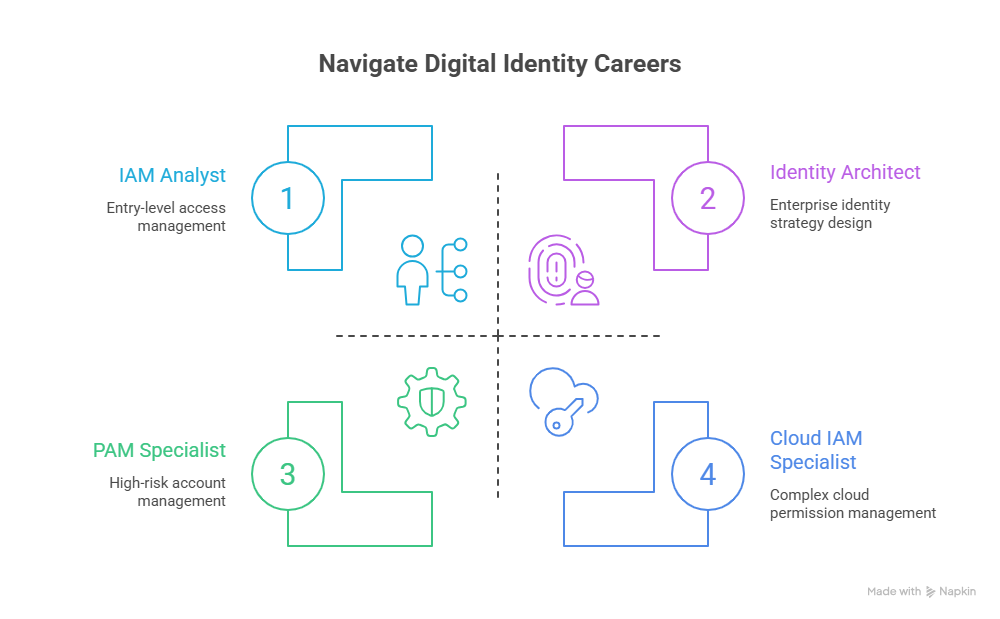
Digital identity work has several career lanes, and the right one depends on your background. IAM analyst roles focus on access requests, identity lifecycle workflows, MFA, SSO, user provisioning, access reviews, and troubleshooting. This is a strong entry route for people moving from help desk, systems administration, SOC operations, audit, or compliance. Use the IT support to cybersecurity guide, SOC analyst guide, cybersecurity certifications directory, and cybersecurity workforce shortage study to shape your early path.
PAM specialist roles focus on the highest-risk accounts in the organization. This lane fits people who enjoy admin access, server teams, cloud platforms, operational controls, and incident containment. The pain point is political as much as technical: administrators often resist extra friction, while auditors and security leaders demand tighter control. A strong PAM professional can balance speed, security, and evidence. Build this lane with the PAM solutions guide, insider threat report, ransomware threat analysis, and incident responder pathway.
Identity governance and administration roles are ideal for people who like workflows, approvals, access certifications, policy enforcement, and audit defensibility. This lane is especially valuable in finance, healthcare, government, education, retail, and enterprise environments with many applications. Connect it with the cybersecurity compliance officer roadmap, cybersecurity auditor guide, healthcare compliance report, and financial sector cybersecurity incidents analysis.
Cloud IAM specialist roles are growing because cloud environments create complex permission problems. These roles focus on cloud roles, resource policies, identity federation, workload identities, secrets, API access, logging, and least-privilege design. This lane pairs strongly with cloud security engineering, cloud security tools, future of cloud security, and next-gen SIEM technologies.
Identity security architecture becomes the advanced lane. Architects design enterprise identity strategy, Zero Trust access, authentication standards, privileged access programs, identity governance platforms, conditional access, and cross-cloud identity models. This path can lead toward chief security architect careers, cybersecurity program management, security leadership roles, and CISO career progression.
5. Apply Strategically, Build Experience, and Grow Into Senior Identity Roles
Your first target roles may include IAM analyst, access management analyst, identity governance analyst, PAM analyst, cloud IAM analyst, identity security analyst, GRC analyst with access review duties, SOC analyst with identity monitoring, or security operations analyst handling account-based incidents. Read job descriptions carefully for terms such as identity lifecycle, Active Directory, Entra ID, Okta, SSO, MFA, RBAC, provisioning, deprovisioning, access certification, PAM, privileged accounts, audit evidence, least privilege, conditional access, and cloud IAM.
Your résumé should prove identity outcomes. Replace “handled access requests” with “processed access requests using role-based approval workflows, business justification, and removal evidence.” Replace “worked with user accounts” with “supported onboarding, transfers, terminations, MFA enforcement, and access review cleanup across business applications.” Replace “helped with audits” with “prepared identity evidence showing approver, owner, entitlement, review date, and remediation action.” This phrasing connects with security audit best practices, compliance analyst careers, cybersecurity certifications impact, and salary growth for security certifications.
Build a portfolio that hiring managers can inspect quickly. Include an identity lifecycle diagram, access review worksheet, privileged access checklist, conditional access policy sample, identity incident response playbook, cloud IAM risk memo, and audit evidence pack. Add a short explanation of which pain point each asset solves: slow onboarding, excessive access, stale accounts, weak admin control, audit failure, contractor risk, privilege creep, or account takeover. These assets make you stronger for roles connected to cloud security, incident response, cybersecurity consulting, and security program management.
Long-term growth comes from moving beyond ticket handling into risk reduction. A junior identity professional processes access. A stronger specialist improves access models. A senior identity professional reduces privilege sprawl, automates reviews, strengthens MFA, improves PAM adoption, connects identity logs to detection, reduces audit findings, and helps leaders understand identity risk in business terms. Plan advancement through the global cybersecurity salary report, entry-level to CISO salary progression analysis, specialized cybersecurity roles forecast, and future cybersecurity skills guide.
6. FAQs About Becoming a Digital Identity Management Specialist
-
A Digital Identity Management Specialist manages how users, administrators, contractors, service accounts, and applications access company systems. Daily work can include onboarding users, enforcing MFA, managing SSO, reviewing access, supporting PAM, removing stale accounts, investigating suspicious logins, documenting approvals, and preparing audit evidence. The role connects strongly with access control models, PAM solutions, security audit practices, and cybersecurity compliance trends.
-
Digital identity management can be a strong path for beginners coming from IT support, help desk, systems administration, compliance, audit, or SOC work. The entry barrier is often lower than advanced penetration testing or security architecture, while the business value is high because every organization needs clean access control. Beginners can build toward IAM analyst or access management roles using the IT support to cybersecurity roadmap, SOC analyst guide, cybersecurity certifications directory, and future cybersecurity skills guide.
-
Start with identity lifecycle, RBAC, MFA, SSO, directory services, access requests, provisioning, deprovisioning, access reviews, privileged access, audit evidence, and cloud identity basics. Then add incident response, SIEM visibility, privacy requirements, and compliance frameworks. A strong learning path combines access control models, cybersecurity frameworks, cloud security engineering, and SIEM solutions.
-
Build practical identity assets that show you can solve real access problems. Strong projects include an identity lifecycle map, access review worksheet, privileged access checklist, conditional access policy sample, identity incident response playbook, cloud IAM risk memo, service-account inventory template, and audit evidence pack. These projects support applications for IAM, GRC, SOC, and cloud roles while connecting naturally with PAM solutions, security audit best practices, cloud threat analysis, and incident response careers.
-
Cloud security depends heavily on identity because cloud permissions decide who can create resources, access data, change configurations, manage keys, run workloads, and use APIs. Cloud IAM mistakes can expose storage, overprivileged service accounts, admin roles, automation scripts, and sensitive business systems. A cloud-focused identity specialist should study cloud security careers, cloud security tools, future cloud security trends, and network monitoring tools.
-
Useful certifications depend on your lane. Entry-level candidates can start with broad cybersecurity and cloud fundamentals. IAM-focused candidates should add identity, access management, cloud, audit, and governance credentials where available. PAM and cloud IAM roles benefit from security operations, cloud security, and risk-focused knowledge. Use the cybersecurity certifications directory, future certifications value analysis, certification career impact report, and salary growth analysis to choose credentials strategically.
