
SOC Analyst vs GRC for Beginners: Reddit Experiences on Entry Difficulty, Pay, Stress & Career Growth
SOC and GRC can both open long cybersecurity careers, yet they reward very different strengths. A beginner pursuing SOC analyst jobs is selling technical troubleshooting and investigation potential; someone pursuing a GRC career is selling risk reasoning, evidence quality, communication, and control knowledge. The harder decision involves entry barriers, realistic pay, daily stress, and the skills employers actually reward. Choosing by salary screenshots alone can send a beginner several years down the wrong track.
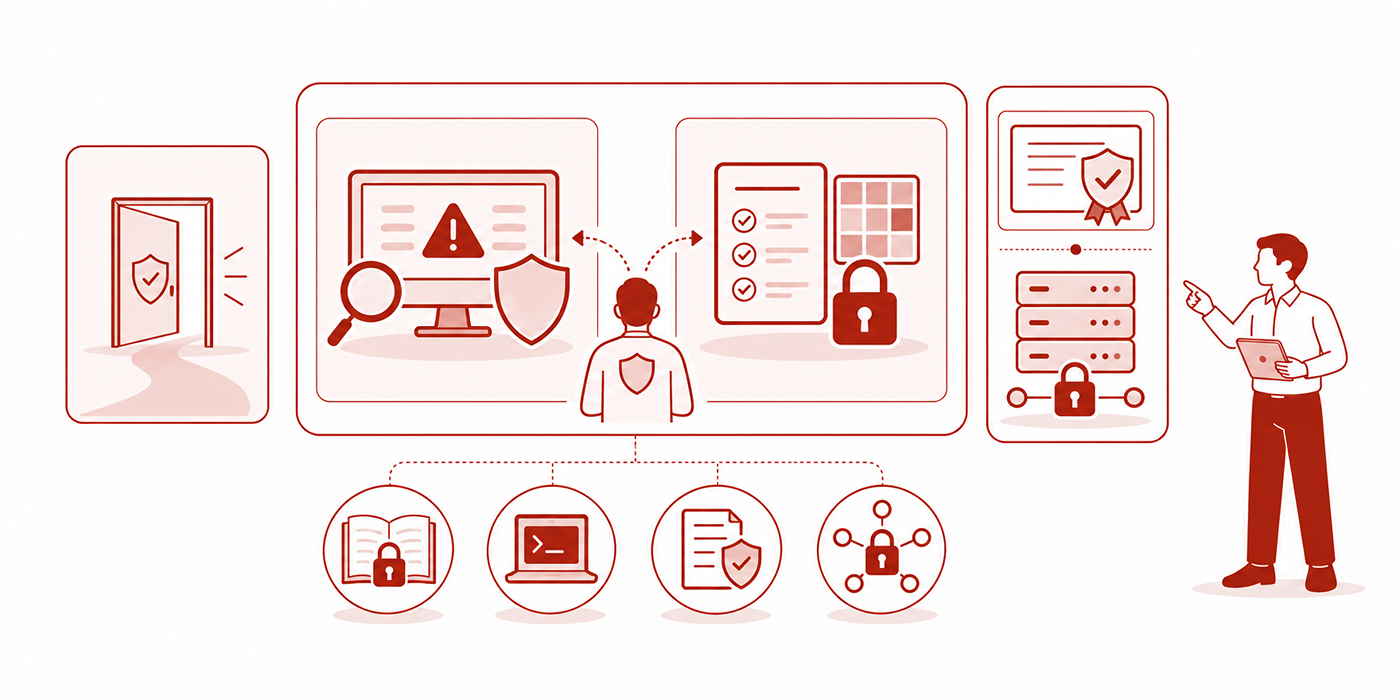
1. SOC Analyst vs GRC: What Are Beginners Actually Choosing Between?
The practical difference begins with the question each role answers.
A SOC analyst asks, “What is happening in our environment, is it malicious, and what should we do next?” The work commonly involves alerts, SIEM telemetry, endpoint events, authentication logs, network evidence, phishing investigations, threat intelligence, escalation, detection rules, and incident documentation. That is why candidates pursuing entry-level SOC work benefit from cybersecurity home labs, strong SOC hiring fundamentals, and the right certification-and-lab mix.
A GRC analyst asks, “Which security obligations and risks apply, how well are controls working, and what evidence supports that conclusion?” Depending on the organization, that can mean risk assessments, control testing, policy work, audit preparation, vendor reviews, compliance mapping, remediation tracking, access reviews, governance reporting, or regulatory analysis. The strongest beginner preparation therefore overlaps with GRC specialization, cybersecurity risk management, security auditing, cybersecurity policy, and regulatory security.
The difference becomes important because neither path is genuinely “easy entry-level cybersecurity.”
A June 2026 Reddit discussion from a final-year computer-science student comparing SOC and GRC produced an instructive answer: several professionals warned that the current entry market makes direct entry into either path uncertain. One commenter considered SOC somewhat easier for a CS graduate because technical coursework transfers naturally, while GRC can require institutional knowledge, business context, and enough systems understanding to assess whether controls make sense.
That distinction destroys one common misconception: less technical does not automatically mean easier to enter.
An inexperienced GRC applicant may understand ISO 27001, NIST terminology, risk matrices, and policies while still struggling to answer what evidence proves a privileged-access control works. An inexperienced SOC candidate may know Splunk commands while struggling to explain why a suspicious login matters. Both suffer from the same broader cybersecurity experience problem, which is why Security+ alone, a cybersecurity degree, or a bootcamp rarely resolves every hiring objection.
The strongest difference is therefore career fit.
SOC generally suits people who enjoy troubleshooting, evidence, technical ambiguity, fast feedback, live systems, and adversarial thinking. GRC generally suits people who enjoy structured analysis, writing, stakeholder interaction, controls, business processes, risk decisions, documentation, and interpreting requirements.
| Career Factor | SOC Analyst | GRC | What a Beginner Should Prove |
|---|---|---|---|
| Core purpose | Detect and investigate threats | Understand risk, controls and obligations | Explain why the work affects business risk |
| Technical intensity | Higher | Variable | Build systems fundamentals |
| Networking depth | Frequently important | Useful for evaluating controls | Understand DNS, TCP/IP, segmentation and access |
| Writing demand | Moderate | High | Write precise security conclusions |
| Stakeholder interaction | Moderate | Often high | Translate security into business language |
| Shift work risk | Can be significant in 24/7 SOCs | Usually lower | Ask about rota before accepting an offer |
| On-call exposure | Common in operations | Role-dependent | Clarify escalation responsibilities |
| Beginner portfolio | SIEM investigations and detections | Risk assessment and control evidence | Create verifiable portfolio evidence |
| Typical beginner mistake | Memorizing tools without fundamentals | Memorizing frameworks without understanding systems | Demonstrate applied reasoning |
| Good feeder experience | IT support, NOC, sysadmin | Audit, compliance, IT, privacy, operations | Use feeder roles strategically |
| Evidence employers value | Investigation decisions | Control and risk conclusions | Show the reasoning behind the answer |
| Incident exposure | High | Indirect to moderate | Connect incidents to controls and risk |
| Audit exposure | Usually limited | Often substantial | Learn cybersecurity assurance |
| Policy exposure | Limited | Common | Understand policy design |
| Compliance exposure | Low to moderate | High | Understand regulatory requirements |
| Risk analysis | Incident-focused | Central responsibility | Build risk-assessment skills |
| Identity crossover | Useful for investigations | Useful for controls and access reviews | Learn IAM fundamentals |
| Privacy crossover | Incident-response relevance | Strong governance overlap | Understand privacy risk |
| Automation exposure | Growing rapidly | Growing in evidence and compliance workflows | Learn security automation |
| AI pressure | High on repetitive L1 tasks | High on routine documentation | Build AI-security literacy |
| Stress source | Alerts, incidents, shifts, workload | Deadlines, audits, stakeholders, dependencies | Identify which stress type suits you |
| Early career growth | SOC L1 → L2 → detection/IR | Analyst → risk/compliance/audit specialist | Build transferable depth early |
| Technical exit routes | IR, detection, engineering, cloud | Possible with deliberate technical development | Protect optionality during first 2–3 years |
| Leadership exit routes | SOC manager, security operations leader | GRC manager, risk director, CISO track | Develop leadership breadth |
| Best personality fit | Investigative and technically curious | Structured, analytical and persuasive | Choose work you can sustain |
| Certifications alone | Insufficient | Insufficient | Combine credentials with evidence |
| Degree advantage | Helpful for systems foundations | Helpful for business and security foundations | Judge degree ROI by career stage |
| Best first project | End-to-end incident investigation | Control assessment with evidence and remediation | Produce interview-ready deliverables |
| Best long-term advantage | Deep understanding of threats and systems | Deep understanding of business risk and governance | Eventually develop both perspectives |
| Wrong reason to choose | “SOC sounds more like real cyber” | “GRC looks easier and pays more” | Choose from market reality and fit |
2. Is SOC or GRC Easier to Enter With No Experience?
For a technically inclined beginner, SOC often provides the more obvious portfolio route.
You can generate logs, investigate authentication events, configure a SIEM, analyze packets, build detections, document phishing cases, and create evidence that resembles junior operational work. A candidate following the SOC-with-no-experience pathway can combine home-lab evidence, SOC interview preparation, certifications and labs, and foundational IT experience.
The problem is applicant volume.
CyberSeek currently reports 514,359 U.S. cybersecurity job listings across its reporting period and says employers hire across starting, mid-career, and advanced positions. That broad demand should be interpreted carefully because the figure covers the whole cybersecurity market rather than SOC L1 vacancies alone. A beginner can therefore see impressive cybersecurity-demand numbers while still encountering hundreds of competitors for an accessible analyst opening.
ISACA's 2025 workforce research adds another uncomfortable detail: prior cybersecurity experience was cited by 60% of respondents as an important qualification factor, while 38% said entry-level cybersecurity hiring commonly took three to six months. This explains why candidates with cybersecurity degrees, Security+, and hands-on labs can still encounter the experience catch-22.
GRC has a different entry problem: simulated evidence can be harder to make credible.
Anyone can download a framework and create a risk register. Real GRC work requires understanding whether evidence proves a control exists and operates effectively, whether exceptions create meaningful risk, whether regulatory language applies to the business, and whether remediation is realistic. Those capabilities connect directly to cybersecurity auditing, risk management, security regulation, policy analysis, and privacy work.
A June 2026 Reddit career discussion described GRC as harder for a complete beginner to demonstrate convincingly because the work can require institutional and industry context. Another respondent said general IT experience could be valuable before either SOC or GRC.
That makes prior background unusually important.
A finance, accounting, internal-audit, legal, quality-assurance, compliance, privacy, or business-process professional may have a more natural route into GRC than into SOC. Someone already familiar with evidence, controls, audits, policies, regulated processes, and stakeholder communication can layer cybersecurity knowledge onto an existing professional foundation. The IT-auditor-to-cybersecurity-auditor path, privacy analyst path, regulatory specialist route, and risk-management pathway all exploit that advantage.
A computer-science graduate who likes operating systems, networking, logs, and troubleshooting may obtain more leverage from SOC preparation, security automation, AI security analysis, and hands-on technical projects.
For a beginner with no relevant background at all, apply beyond both labels. IT support, NOC, IAM support, junior audit, compliance operations, desktop support, MSP work, risk internships, technical support, and security internships can each solve a different part of the first-job problem.
3. SOC vs GRC Pay, Stress and Day-to-Day Work
Pay should be compared carefully because “SOC analyst” and “GRC analyst” cover wide ranges of geography, seniority, industry, company size, and responsibility.
The U.S. Bureau of Labor Statistics reports a $129,180 median annual wage for information security analysts in May 2025, with the lowest 10% below $75,090 and the highest 10% above $199,850. BLS projects employment in that occupational category to grow 21% from 2025 to 2035, with approximately 14,100 openings per year. Those numbers provide useful context for the broader profession, while SOC and GRC salaries should still be evaluated against actual job descriptions because GRC roles may appear under risk, compliance, audit, security analyst, assurance, or governance titles.
Reddit salary comparisons illustrate why one person's outcome should never become a universal rule.
A July 2026 SOC L1 analyst with roughly two years of experience reported earning substantially less than a same-age friend working in GRC and questioned whether to switch. A response argued that technical SOC experience could make the candidate more attractive later in GRC because they would understand the systems behind the controls. That is a valuable career lesson: a SOC foundation can later strengthen GRC work, risk analysis, auditing, and security leadership.
SOC stress tends to be operational
SOC stress can come from shift rotations, night work, large alert queues, repetitive investigations, incident surges, understaffing, false-positive fatigue, customer SLAs, and the knowledge that a missed signal could become a serious compromise. BLS notes that information security analysts may work more than 40 hours and can be on call outside normal business hours.
Recent Reddit discussions are particularly revealing. One August 2026 thread about job satisfaction drew multiple comments from professionals describing SOC work as exhausting or monotonous after enough time, while another 2026 SOC analyst described a 24/7 rotation involving day and night shifts as difficult to sustain.
That risk should shape how beginners evaluate SOC offers. Ask about alert volume, staffing ratios, shift rotation, night coverage, escalation rules, training, automation maturity, detection-engineering access, and internal progression before assuming every entry SOC job produces equal career value.
GRC stress tends to be dependency-driven
GRC can avoid some operational intensity while producing a different kind of frustration.
A GRC analyst might need evidence from engineering, infrastructure, HR, procurement, application owners, IAM, privacy, or finance. The deadline belongs to GRC while the evidence may belong to someone who has five other priorities. A professional describing GRC work at a bank said the most stressful part was depending on other teams to complete required work.
Audit deadlines, regulatory commitments, overdue controls, executives who dislike risk findings, incomplete evidence, policy exceptions, and third-party assessments can therefore create substantial pressure. Strong GRC professionals develop influence alongside risk-management judgment, audit capability, policy expertise, and regulatory knowledge.
The broader profession is stressful regardless of specialization. ISACA reported in 2025 that 66% of cybersecurity professionals considered their role more stressful than five years earlier, with high stress cited as a major attrition factor. ISC2 separately reported that 48% felt exhausted trying to keep current with threats and technology, while 47% often felt overwhelmed by workload.
A better question than “Which career is low stress?” is therefore: Which kind of pressure can you sustainably handle?
4. Which Path Has Better Career Growth: SOC or GRC?
Both can produce excellent career trajectories, while the type of capital you accumulate differs.
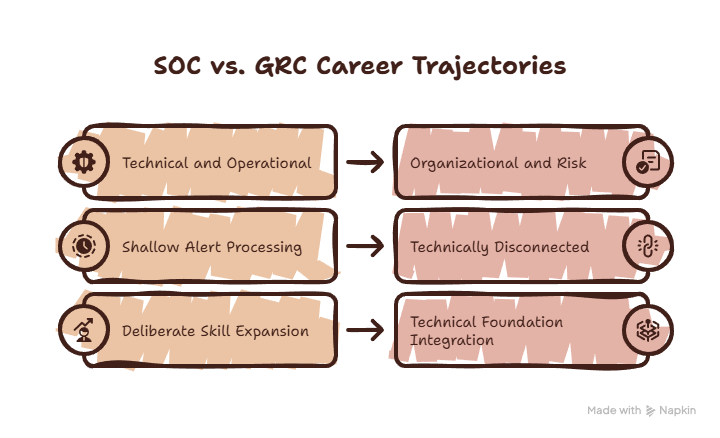
SOC builds technical and operational capital. A strong analyst can move into incident response, threat hunting, detection engineering, SIEM engineering, security automation, cloud security, security engineering, architecture, or management. Someone who combines SOC experience with automation engineering, AI security, identity expertise, and eventually security leadership can escape repetitive Tier 1 work quickly.
The career danger is staying too long in shallow alert processing.
If your second year looks exactly like your third year, with the same queues, same runbooks, same escalation permissions, and no detection, engineering, cloud, automation, incident ownership, or mentorship exposure, tenure can increase without equivalent market value. The solution is deliberate skill expansion through advanced SOC responsibilities, security automation, research capability, and broader cybersecurity leadership.
GRC builds organizational and risk capital.
A strong GRC analyst can progress into security risk, third-party risk, security assurance, audit, regulatory compliance, policy, privacy, governance management, security program leadership, director-level roles, and eventually CISO-track responsibilities. That makes GRC, cybersecurity risk, audit, regulatory security, and privacy powerful long-term combinations.
ISC2's 2025 workforce study found GRC among the major cybersecurity skill needs, cited by 27% of respondents, while risk assessment was cited by 29%. Professionals themselves placed GRC even higher as an in-demand skill area. This matters because organizations need people who can convert increasing technical complexity into defensible risk and governance decisions.
The GRC career danger is becoming technically disconnected.
An August 2026 Reddit post from someone with roughly 1.6 years in GRC attracted considerable attention because the poster felt trapped in documentation, compliance, and control testing and worried about insufficient technical depth for a move into SOC, cloud security, or threat detection. The concern is highly useful for beginners considering GRC careers: frameworks become much more valuable when supported by technical foundations, identity knowledge, cybersecurity risk skills, and understanding of actual security operations.
Career switching also becomes more expensive as specialization deepens. A 2025 Reddit discussion involving a graduate who started in GRC included advice that switching junior tracks during the first few years is more feasible than doing so after several years of specialization, when a move may require a pay or seniority reset.
That creates a strong beginner rule:
Protect optionality during your first two to three years.
A SOC analyst should learn risk, controls, compliance, privacy, and business communication. A GRC analyst should learn networking, IAM, cloud, logging, vulnerability management, and security architecture. This crossover knowledge supports later CISO-level progression, IT-to-security leadership, risk leadership, and sophisticated cybersecurity policy work.
5. A 90-Day Beginner Test to Decide Between SOC and GRC
Before spending six months chasing certifications, spend 90 days testing the actual work.
Days 1–30: Build one SOC case
Create a small Windows or Active Directory lab, generate authentication and endpoint events, ingest logs into a SIEM, simulate suspicious behavior, and investigate it. Follow the same evidence principles used in a strong cybersecurity home lab, SOC portfolio, SOC interview preparation, and certification-plus-lab strategy.
Your finished case should answer:
What triggered the investigation?
Which evidence did you collect?
What benign explanations did you test?
Which evidence changed your confidence?
What would you escalate?
What containment action would you recommend?
What detection improvement would you make afterward?
If that process energizes you more than completing the setup, SOC, detection, incident response, security automation, or AI security analysis deserves serious consideration.
Days 31–60: Build one GRC case
Choose a fictional SaaS organization. Define several critical assets and assess a narrow control area such as privileged access, third-party risk, vulnerability management, or incident response.
Map requirements to a framework, request fictional evidence, identify missing proof, assess residual risk, write findings, propose remediation, assign owners, and create a concise management summary. That mimics the reasoning required in GRC, risk management, cybersecurity auditing, policy analysis, and regulatory security.
A strong finding should avoid vague statements such as “MFA should be enabled.”
Write something closer to: administrative access to the production environment lacks consistently enforced MFA for two privileged account categories; review of the fictional identity configuration and access roster shows the control is only partially implemented; compromise could materially increase unauthorized privileged access; remediation should prioritize enforced MFA and removal of legacy authentication within a defined deadline.
That is GRC evidence rather than framework memorization.
Days 61–90: Test the hiring market
Build two résumé variants rather than sending one generic cybersecurity résumé everywhere.
The SOC version should prioritize networking, Windows/Linux, identity, SIEM, endpoint telemetry, incident investigation, scripting, SOC-ready evidence, and hands-on projects.
The GRC version should prioritize risk assessments, controls, audit evidence, policy, stakeholder communication, governance, risk knowledge, audit capability, and regulatory understanding.
Apply to direct security roles while preserving feeder options through the no-experience cybersecurity route. Track applications, screenings, interviews, technical failures, and final rounds separately.
The market will give you useful information.
No interviews across either track may signal résumé or experience problems. SOC interviews followed by technical rejection suggest a fundamentals gap. GRC interviews followed by rejection may reveal weak control reasoning, communication, or business context. Stronger response from one track gives you evidence about where your current profile has leverage.
Then choose deliberately.
A beginner who loves investigation can pursue SOC while learning risk. A strong communicator who enjoys structured analysis can pursue GRC while maintaining technical depth. Both profiles become stronger when they can understand the other's side of the security program.
6. FAQs About Choosing SOC Analyst vs GRC
-
GRC usually requires less hands-on security tooling, while employers may still expect enough technical and organizational knowledge to evaluate controls intelligently. SOC can be easier to demonstrate through hands-on labs, yet competition for entry-level SOC jobs is substantial. Prior audit, finance, compliance, privacy, legal, IT, or business-process experience can make the GRC route much more accessible, while technical IT experience strengthens SOC applications.
-
Either path can pay very well, and job scope matters more than the label. BLS reports a $129,180 median for the broader information-security-analyst occupation, while SOC and GRC positions appear across multiple titles and levels. Compare actual offers, industry, location, responsibility, bonuses, shift premiums, and advancement potential. A strong SOC career can progress into engineering and incident response, while GRC can progress into risk leadership, audit, governance, and executive security roles.
-
The stress profile is usually different. SOC can involve night shifts, high alert volumes, incident pressure, and on-call duties. GRC can involve audit deadlines, incomplete evidence, stakeholder resistance, regulatory commitments, and dependence on other teams. A Reddit GRC professional specifically identified cross-team dependency as a significant source of stress, while SOC discussions frequently mention shift and workload fatigue. Evaluate the specific employer alongside the career path.
-
Yes, and strong technical experience can become a major advantage. A former SOC analyst entering GRC can assess whether security controls make sense because they understand logs, identity, endpoints, incidents, networks, and operational reality. That foundation transfers particularly well into risk management, security audit, regulatory security, and eventually cybersecurity leadership.
-
Yes, especially early in the career, while deliberate technical practice is essential. Maintain networking, Windows/Linux, cloud, identity, vulnerability-management, logging, scripting, and home-lab skills alongside GRC experience. A recent Reddit example shows why waiting until technical confidence has deteriorated can make the transition feel much harder.
-
For SOC, prioritize credentials that strengthen security fundamentals and defensive analysis while pairing them with hands-on investigation evidence. For GRC, build security foundations first, then add credentials aligned with governance, audit, risk, privacy, or compliance as your target becomes clearer. The central principle from the degree-versus-certification comparison remains useful: obtain a credential because it removes a specific hiring or knowledge barrier, rather than accumulating certificates without evidence.
