
Security+ Alone in 2026: Reddit Job Outcomes, Employer Filters & What You Need to Add Before Applying
CompTIA Security+ can strengthen an entry-level application, satisfy certain certification filters, and establish credible security knowledge. Its value changes dramatically according to the evidence surrounding it. Reddit outcomes show newly certified applicants facing silence while candidates with IT experience, targeted projects, internal contacts, or clearance eligibility convert the same credential into interviews. This guide explains what Security+ proves, where applications still fail, and how to combine it with security analysis, incident response, identity management, or GRC experience before applying.
1. What Security+ Actually Proves to Employers in 2026
Security+ validates broad foundational knowledge across threats, vulnerabilities, architecture, operations, governance, risk, identity, cryptography, and incident response. The current SY0-701 objectives allocate 28% of the examination to security operations, 22% to threats and mitigations, 20% to security program management and oversight, 18% to security architecture, and 12% to general security concepts. That breadth supports an early security analyst pathway, cybersecurity risk career, privacy analyst role, or cybersecurity policy position.
The credential tells an employer that the candidate passed a standardized assessment covering important concepts and scenario-based questions. It does not independently show how the candidate investigates ambiguous evidence, works inside an enterprise environment, troubleshoots systems, writes tickets, handles users, prioritizes risk, or communicates during an incident. Those capabilities influence hiring across incident-response teams, cybersecurity audit functions, security automation roles, and digital identity operations.
CompTIA itself recommends at least two years of IT administration experience with a security focus, hands-on technical information-security exposure, and broad knowledge of security concepts for SY0-701. Candidates can pass earlier, although the recommendation reveals how the certification was designed: Security+ assesses security knowledge that becomes more useful when connected to operational context. The official Security+ exam objectives should therefore function as a lab-building checklist alongside an IT-to-cybersecurity transition, network-security pathway, risk-management roadmap, or regulatory security career.
Security+ also appears frequently around U.S. government and defense-contractor hiring. The current Department of Defense cyber workforce system is role-based under DoD Manual 8140.03, which replaced the older DoD 8570 model. The framework emphasizes demonstrated capability for a defined work role, with qualification routes potentially involving education, training, certification, or experience. Security+ can support qualification for relevant positions, while citizenship, clearance eligibility, location, contract requirements, and role-specific capabilities remain separate filters. The official DoD Cyber Workforce Framework explains this capability-based structure. Applicants should pair it with an incident responder pathway, cybersecurity audit career, security architecture roadmap, or cybersecurity program-management track.
The clearest way to understand Security+ is to separate four hiring functions. It can help an applicant pass a certification keyword filter. It can show commitment to a structured body of knowledge. It can provide vocabulary for technical interviews. It can also satisfy one qualification component for selected roles. The remaining application must still prove role fit. An employer recruiting for SOC analysis, GRC work, vulnerability research, or identity security evaluates different evidence after recognizing the certification.
2. What Reddit Job Outcomes Reveal About Security+ Alone
Reddit discussions provide personal experiences rather than statistically representative employment data. They still expose recurring combinations of credentials, experience, geography, expectations, and application strategy. The most common unsuccessful pattern involves passing Security+, listing it prominently, and applying immediately to SOC analyst, cybersecurity analyst, penetration tester, or security engineer positions with limited IT experience. These applicants possess relevant knowledge while competing against candidates who also bring support work, systems exposure, internships, labs, or referrals. A 2025 poster with no IT experience asked what roles would consider Security+ alone, illustrating the uncertainty that follows certification without a defined security analyst destination, incident-response pathway, GRC specialization, or identity career plan. The original Security+ discussion captures that problem.
Another recurring outcome involves candidates passing SY0-701 and receiving little response after applying to vaguely defined entry-level security roles. One poster reported passing with a score of 755 and receiving no responses, later emphasizing the importance of selecting a domain such as SOC, information security, or vulnerability assessment. The score establishes exam performance, while recruiters still need a reason to connect that candidate with their vacancy. A targeted portfolio tied to SOC investigations, vulnerability research, offensive security, or cybersecurity risk work gives the credential a hiring context. The Reddit job-search account provides the firsthand description.
A second outcome group uses Security+ to strengthen applications for broader IT positions. Help desk, field support, desktop support, junior systems support, NOC operations, technical support, and IAM operations can produce the troubleshooting and environment familiarity that security teams value. One Reddit discussion involving a candidate with zero experience and a newly passed Security+ repeatedly directed the applicant toward help desk and field technician work. That route can build evidence for a later IT-support-to-cybersecurity move, network-to-ethical-hacking transition, security automation role, or digital identity position. The Security+ career thread shows how community advice shifts according to experience.
Successful Reddit stories tend to contain an additional advantage that disappears from simplified “Security+ got me hired” headlines. One 2025 account described earning A+, Network+, and Security+, then obtaining a managed-service-provider role paying $71,000. The poster also referenced location in California and a six-month transition. The outcome involved a certification sequence, a receptive regional market, and an MSP entry point. Candidates can use that pattern to build toward security analysis, incident response, cybersecurity automation, or security architecture. The complete certification and job journey provides the surrounding facts.
Internal mobility produces another important success pattern. A healthcare employee reported holding Security+ and an AWS security credential, applying internally, and moving into an endpoint security analyst role. Existing organizational knowledge, a known work history, internal relationships, and familiarity with the employer likely reduced hiring uncertainty. Security+ strengthened a candidate whose reliability had already been observed. Employees in support, operations, audit, compliance, finance, clinical systems, or customer service can pursue similar movement into endpoint security analysis, cybersecurity privacy, security risk management, or regulatory cybersecurity. The internal-transition account demonstrates why context changes certification outcomes.
The practical conclusion is that Security+ works as an amplifier. It amplifies existing IT experience, a focused project, a relevant degree, clearance eligibility, an internal reputation, a referral, or a clearly aligned application. When none of those advantages exist, the credential becomes one line competing against many other candidates holding the same line. Applicants should therefore identify the missing amplifier before purchasing another certification. A deep incident-response project, GRC portfolio, identity-security case, or vulnerability assessment may produce greater marginal value than another general exam.
3. The Employer Filters Security+ Cannot Clear by Itself
The first filter is role eligibility. Employers may require citizenship, an existing clearance, clearance eligibility, work authorization, a particular location, shift availability, or access to a secure facility. A certification cannot compensate for a firm legal or contractual condition. Candidates interested in government-facing incident response, cybersecurity policy, security architecture, or cybersecurity program management should check these requirements before tailoring the application.
The second filter is previous responsibility. “One year of experience” often represents several underlying concerns: familiarity with tickets, users, deadlines, production systems, escalation, documentation, permissions, change control, and professional accountability. A candidate may satisfy these concerns through help desk, NOC, systems support, cloud support, IAM, audit assistance, fraud operations, internships, campus IT, or supervised technical work. Translate adjacent experience toward a security analyst role, cybersecurity auditor career, privacy analyst position, or identity-management pathway.
The third filter is technical depth. Security+ covers many domains, while a vacancy usually concentrates on a narrower set of tasks. A SOC role may prioritize Windows logs, Active Directory, endpoint telemetry, SIEM queries, networking, and escalation. A GRC role may prioritize control testing, evidence review, vendor risk, policy maintenance, and stakeholder communication. An IAM position may prioritize provisioning, access reviews, MFA, role design, and privileged accounts. Applicants should build depth around the target security operations role, GRC career, cybersecurity audit pathway, or digital identity specialization.
The fourth filter is demonstrated judgment. Hiring managers need to see how a candidate responds when evidence is incomplete. Can the applicant distinguish an indicator from proof? Can they identify affected assets, preserve evidence, rank risk, document assumptions, and recommend a safe next step? A screenshot-heavy home lab provides weak evidence of those decisions. A complete case file can strengthen applications for security analysis, vulnerability research, cybersecurity risk management, or privacy incident work.
The fifth filter is the résumé’s relevance. Security+ may help an applicant appear in a keyword search, although the remaining content determines whether the recruiter continues reading. A résumé filled with definitions, course names, and generic tool lists gives little evidence of contribution. Strong bullets identify the problem, action, scope, evidence, decision, and outcome. Separate résumé versions should support separate destinations such as SOC analyst, GRC specialist, cybersecurity auditor, or security automation engineer.
The sixth filter is assessment performance. ISC2’s 2025 hiring research surveyed 929 cybersecurity hiring managers across six countries and found that 84% of organizations used skills-based assessments or tests for entry- and junior-level applicants. The same study found strong employer interest in entry-level certifications and previous IT experience. A credential may create access to the assessment, while the assessment measures applied reasoning. Candidates should practice log analysis, access review, incident writing, vulnerability prioritization, and control evaluation for their intended incident-response role, risk career, audit position, or identity-security job. The ISC2 cybersecurity hiring study provides the detailed findings.
4. What You Should Add to Security+ Before Applying
Start by selecting one primary role. “Cybersecurity” is too broad to determine which evidence to build. Choose SOC analyst, junior security analyst, IAM analyst, GRC analyst, cybersecurity audit assistant, vulnerability-management analyst, or security-focused IT support. Collect 25–30 vacancies within your realistic geography and record repeated responsibilities. Use an established security analyst roadmap, GRC career pathway, cybersecurity auditor track, or identity-management guide to structure the analysis.
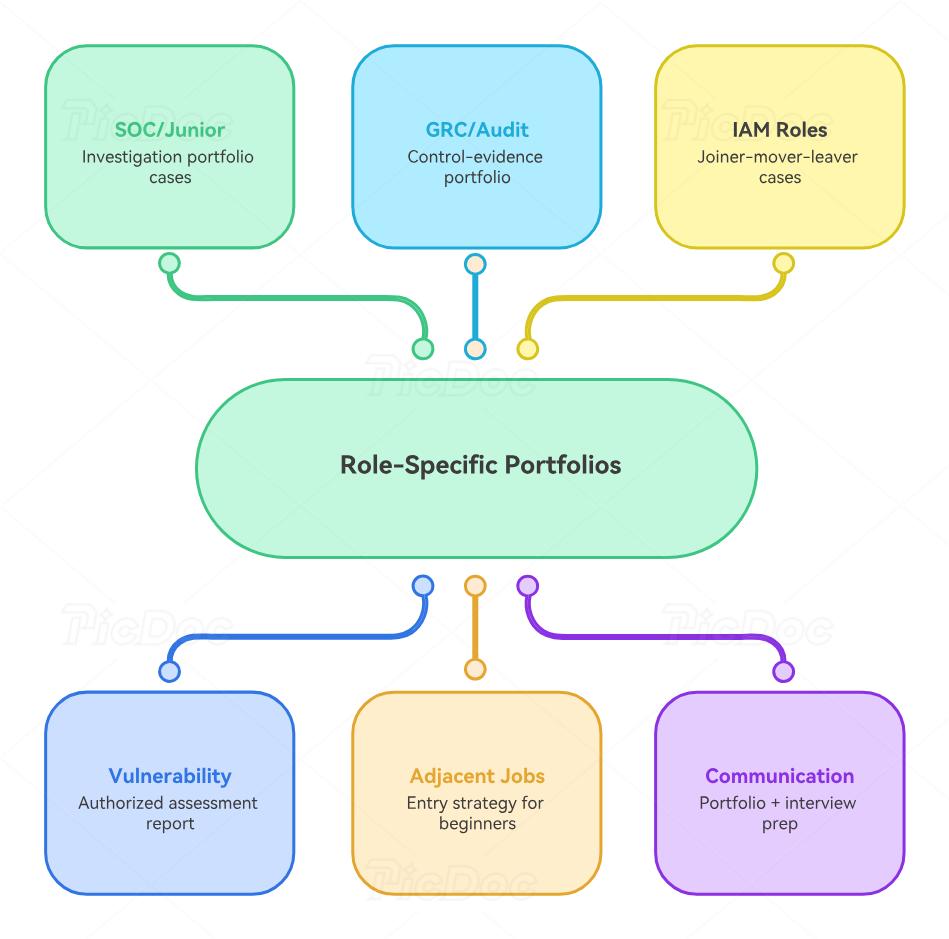
For SOC and junior security-analysis roles, add one investigation portfolio containing at least three cases. A suspicious-login case should include authentication logs, user context, source information, timeline, hypothesis, validation steps, severity, and escalation. A malware-style case should examine process behavior, persistence, connections, affected accounts, and containment. A network case should analyze packet or flow data and explain the conclusion. These artifacts create evidence for SOC analysis, incident response, cybersecurity research, and security automation.
For GRC, audit, policy, and privacy roles, add a control-evidence portfolio. Select a fictional small organization, identify its systems and sensitive data, map several requirements to controls, define evidence requests, test control design, record deficiencies, and recommend remediation. Include an exception process and residual-risk decision. This demonstrates skills beyond framework recognition and supports a GRC specialist application, cybersecurity audit career, privacy analyst role, or regulatory cybersecurity position.
For IAM roles, build a joiner-mover-leaver case. Create sample users, job roles, access groups, approval rules, MFA requirements, privileged-account restrictions, recertification schedules, and offboarding controls. Add one scenario involving excessive access and another involving an emergency exception. Explain who approves each action, which evidence is retained, and how access is verified. This portfolio connects Security+ concepts to a digital identity career, risk-management pathway, security policy role, or security architecture track.
For vulnerability-management and offensive-security roles, build an authorized assessment that prioritizes professional reporting. Define scope and rules of engagement, identify assets, record findings, validate exploitability safely, rank business risk, propose remediation, and specify retesting conditions. Raw scanner output provides limited hiring evidence. A concise report demonstrates judgment, restraint, and communication for a vulnerability researcher role, offensive security career, red-team pathway, or penetration-testing management track.
Candidates without workplace IT exposure should also add an adjacent-job strategy. Apply to help desk, desktop support, field technician, NOC, junior systems support, technical support, cloud support, IAM operations, fraud operations, audit assistance, and internships. Prioritize duties that build the same foundations required by the destination role. Password resets and account administration can develop toward identity security. Network troubleshooting can support ethical hacking. Ticket triage can support incident response. Evidence review can support cybersecurity audit.
Add communication evidence before sending applications. Every portfolio should contain a technical explanation, an executive summary, and a short résumé version. Prepare six interview stories covering troubleshooting, ambiguity, teamwork, conflict, failure, and learning. Practice explaining what is confirmed, what remains unknown, which evidence you would collect next, and when you would escalate. These habits support early security analyst work and later progression into cybersecurity program management, security product management, or senior security leadership.
5. A Practical Eight-Week Security+ Application Plan
During week one, choose the job family and analyze 30 vacancies. Record each role’s recurring tasks, tools, experience requirements, educational preferences, location rules, certifications, and eligibility conditions. Calculate how often every requirement appears. Build your plan around repeated demand instead of one unusually demanding advertisement. Select a security analysis pathway, GRC specialization, identity-security route, or cybersecurity audit career.
During weeks two and three, build one deep project directly tied to the most common responsibilities. Limit the scope enough to finish and document it properly. Analysts can investigate three connected alerts. GRC candidates can assess a vendor. IAM candidates can build an access lifecycle. Vulnerability candidates can create a prioritized remediation plan. The project should resemble work produced inside an incident-response team, risk function, privacy program, or offensive security engagement.
During week four, convert the project into five hiring assets: a concise README, a technical report, an executive summary, sanitized supporting evidence, and three résumé bullets. Explain the decisions and limitations rather than documenting every click. The recruiter should understand the problem and outcome within one minute, while a technical interviewer should find enough detail to challenge your reasoning. This format strengthens portfolios for cybersecurity research, security automation, cybersecurity data science, or security architecture.
During week five, create role-specific application materials. Put Security+ near the top when the vacancy requests it. Use the official certification name and avoid turning the résumé into an exam-objective inventory. Reorder skills and projects according to the vacancy. A SOC résumé should foreground investigation, logs, networking, endpoint behavior, and escalation. A GRC résumé should foreground requirements, controls, evidence, risk, and communication. Maintain separate versions for security analysis, GRC work, identity security, and cybersecurity audit.
During week six, practice skills assessments. Complete timed exercises using unfamiliar logs, access lists, vulnerabilities, policy scenarios, and incident updates. Speak through your process: clarify the objective, identify reliable evidence, develop hypotheses, test them, state confidence, explain impact, and recommend the safest next action. This structure applies to incident response, vulnerability management, risk analysis, and privacy investigations.
During weeks seven and eight, begin a measured application campaign. Apply in focused weekly batches across direct security roles and relevant adjacent positions. Track applications, recruiter screens, assessments, interviews, and offers separately. Zero screens point toward targeting, eligibility, résumé, geography, or evidence problems. Assessments without progression reveal applied-skill gaps. Late interviews without offers require stronger examples, communication, or comparative evidence. Use feedback to refine your analyst transition, GRC pathway, identity roadmap, or incident-response preparation.
Security+ should remain part of the strategy throughout this process. Place it where recruiters can find it, use its objectives to identify missing knowledge, and connect its concepts to the decisions shown in your projects. The credential becomes more persuasive when every surrounding section of the application answers a hiring question. That evidence-first approach can later support advancement into offensive security engineering, cybersecurity program management, chief security architecture, or executive security leadership.
6. Frequently Asked Questions
-
Security+ can help candidates reach interviews when the vacancy values the credential and the applicant also satisfies role, location, eligibility, and capability requirements. Outcomes improve when candidates add IT experience, a role-specific project, an internship, internal mobility, or relevant education. Build evidence around a security analyst career, incident-response pathway, GRC specialization, or identity-security role.
-
Consider junior security analyst, SOC analyst, IAM analyst, GRC analyst, cybersecurity audit assistant, vulnerability-management coordinator, security-focused help desk, desktop support, NOC, field technician, technical support, and junior systems roles. Read the actual duties because identical titles can represent different experience levels. Align applications with a security analysis roadmap, cybersecurity audit career, digital identity pathway, or risk-management track.
-
Choose according to the repeated requirements in your target vacancies and your current weaknesses. A+ may help candidates pursuing support positions who need stronger endpoint and troubleshooting foundations. Network+ may help candidates who struggle with routing, switching, ports, protocols, and network diagnosis. A deeper project or relevant employment can provide greater value when certification knowledge is already broad. Use an IT-support transition plan, network-security roadmap, incident-response pathway, or security automation guide to decide.
-
Security+ can support qualification for selected government and contractor positions, particularly where it appears among accepted credentials. Current DoD workforce policy uses role-based qualification and emphasizes capability. Applicants may still face citizenship, clearance, experience, education, location, and contract-specific requirements. Verify the exact work role and qualification route before applying for government incident response, security policy work, cybersecurity audit, or security program management.
-
Build the project that reproduces the decisions required by your primary target role. SOC candidates should investigate alerts. GRC candidates should test controls. IAM candidates should design an access lifecycle. Privacy candidates should map data and incident obligations. Vulnerability candidates should prioritize findings and document remediation. Align the deliverable with a security analyst position, GRC specialist career, privacy analyst role, or vulnerability research pathway.
-
Home labs count as applied evidence when they contain original decisions, troubleshooting, documentation, and clear results. Their value increases when the candidate modifies the environment, encounters failure, tests alternative explanations, and produces a professional work sample. Describe them accurately as projects or labs. Use them to support incident response, offensive security, security automation, or cybersecurity risk analysis.
