
Cybersecurity Bootcamp vs Degree vs Certification Path: Reddit Outcomes, Cost, Time & Hiring Reality
Cybersecurity education is sold as a choice between a fast bootcamp, a respected degree, and an affordable certification. Hiring works differently. Employers evaluate whether you understand systems, can perform the advertised work, and have credible evidence that survives an interview. Reddit outcomes reflect that gap: graduates with labs, internships, and prior IT experience progress; candidates who buy training without building proof often stall. This guide compares cost, time, screening value, and realistic outcomes so you can choose a cybersecurity career pathway that reduces career risk instead of merely adding another line to your résumé.

1. Cybersecurity Bootcamp vs Degree vs Certification: What Actually Wins Interviews?
There is no universal winner because the three routes purchase different assets. A degree provides broad computing knowledge, access to internships, alumni networks, and a credential that survives automated screening. A bootcamp purchases structure, deadlines, instructor access, and a compressed introduction to tools. A cybersecurity certification validates a defined knowledge domain. Each route still leaves the candidate responsible for proving they can investigate an alert, secure an identity workflow, explain business risk, and write a defensible incident record.
The strongest route therefore depends on the asset you already possess. A network administrator pursuing an ethical-hacking transition may need targeted labs and an offensive certification. An auditor entering a cybersecurity audit career already understands evidence and controls, so a four-year restart may have weak returns. A school leaver who wants long-term access to technical and management roles gains more from a degree, internships, and progressive certifications than from an expensive twelve-week promise.
The market contains opportunity alongside a severe entry bottleneck. The U.S. Bureau of Labor Statistics projects information-security analyst employment to grow 29% from 2024 to 2034, yet it also identifies a bachelor’s degree and related experience as the typical entry profile. Growth measures the occupation over a decade; it does not mean every beginner is ready for every vacancy. Candidates targeting security architecture, red-team operations, or cybersecurity leadership must treat those positions as destinations built through adjacent work.
Hiring managers usually need four signals: foundational knowledge, practical execution, communication, and trusted exposure to real systems. A degree can support the first and create access to the fourth through internships. A strong bootcamp can accelerate the first two. Certifications can clarify the first and help résumés pass specific filters. Your cybersecurity portfolio, IT employment, apprenticeship, volunteer assignment, or internal security project supplies the missing operational evidence. That is equally true for a GRC specialist pathway, a privacy analyst career, and a technical SOC route.
Cybersecurity Education Decision Matrix: 27 Candidate Profiles
| Starting Profile | Best Primary Route | Evidence to Add | Realistic First Target | Main Risk |
|---|---|---|---|---|
| School leaver | Degree | Internship + home lab | IT support or security internship | Graduating without experience |
| Unrelated bachelor’s graduate | Certification + structured labs | Technical portfolio | Help desk, IAM, or GRC | Expecting direct SOC entry |
| IT support technician | Certification | Security duties at work | Junior SOC or IAM analyst | Ignoring networking depth |
| Network administrator | Role-aligned certification | Detection or testing labs | Network security analyst | Overlooking reporting |
| System administrator | Certification + internal move | Hardening and incident records | Security operations analyst | Underselling existing work |
| Software developer | AppSec coursework/certification | Secure-code reviews | Product security associate | Learning tools without threat modeling |
| Cloud engineer | Cloud-security certification | Misconfiguration case studies | Cloud security engineer | Weak identity fundamentals |
| Accountant or auditor | GRC certification | Control-testing samples | Technology risk analyst | Forcing a technical route |
| Legal professional | Privacy/regulatory certificate | Data-flow and policy work | Privacy or compliance analyst | Ignoring security operations |
| Project manager | Certification + cyber projects | Risk and delivery artifacts | Security project coordinator | Claiming technical depth |
| Product manager | Targeted coursework | Secure-product decisions | Security product associate | Generic product portfolio |
| Military veteran | Certification + apprenticeship | Translated operational experience | SOC, governance, or federal role | Using unexplained military language |
| Career changer with savings | Accredited degree or selective bootcamp | Internship + portfolio | Security-adjacent role | Buying speed instead of access |
| Career changer with low budget | Self-study + certification | Public labs and IT work | Technical support | Studying without feedback |
| Working parent | Part-time certification path | One deep project | Internal security assignment | Unsustainable weekly load |
| Unemployed beginner | IT certification + paid IT role | Customer and system exposure | Help desk or MSP support | Waiting for a cyber title |
| Current university student | Degree + internship | Club, lab, competition | Security internship | Prioritizing grades alone |
| Associate-degree student | Degree + certification | Local employer placement | Support, networking, or SOC | Poor credit-transfer planning |
| Experienced manager | Executive/management certification | Security governance ownership | Security program manager | Treating cyber as generic IT |
| Data analyst | Security analytics training | Detection dataset project | Security data analyst | Weak infrastructure knowledge |
| Researcher or academic | Specialist degree/certification | Applied research output | Threat research assistant | Theory without operations |
| HR or identity-operations worker | IAM certification | Joiner-mover-leaver workflow | IAM administrator | Missing directory-service skills |
| Technical writer | Certification + domain portfolio | Runbooks and explainers | Security documentation role | Producing shallow summaries |
| Teacher or trainer | Certification + practical labs | Lesson and assessment design | Cybersecurity trainer | Teaching beyond competence |
| International applicant | Locally recognized credential | Work authorization + local network | Regional security-adjacent role | Assuming credentials transfer equally |
| Small-business IT generalist | Certification | Documented hardening outcomes | Security administrator | Failing to quantify scope |
| Bootcamp graduate | Experience bridge | IT role, apprenticeship, or internship | Support, IAM, or junior GRC | Buying another course |
2. What Reddit Outcomes Reveal—and What They Cannot Prove
Across cybersecurity and IT career communities, the recurring success story is a stack rather than a single credential: previous IT work, focused study, hands-on evidence, careful applications, and referrals. The recurring disappointment is also consistent: a candidate pays five figures, completes guided labs, applies only to remote security analyst jobs, and discovers that hundreds of applicants possess similar certificates plus production experience. Reddit is valuable for identifying these bootcamp failure patterns, although anonymous posts cannot establish placement rates or represent every labor market.
Three distinctions make the anecdotes useful. First, “entry level” often describes rank inside a security team rather than entry into technology. Security teams protect networks, endpoints, cloud accounts, applications, and business processes; employers favor candidates who have already supported at least one of those environments. A help-desk job can develop identity troubleshooting, ticket documentation, escalation judgment, and endpoint knowledge that later support a digital identity career, security analyst promotion, or cybersecurity automation path.
Second, successful degree stories commonly include internships, student security work, capture-the-flag practice, faculty referrals, or campus recruiting. The diploma helped the candidate enter hiring systems; the surrounding ecosystem created proof and access. Someone comparing degree prices should therefore evaluate internship participation, employer partnerships, operating-systems depth, networking courses, programming, cloud exposure, and graduate outcomes by role. A curriculum can support eventual work in AI security, blockchain security, or quantum security, while technical fundamentals remain the base for every specialization.
Third, bootcamp outcomes vary because “bootcamp” has no consistent hiring meaning. One program may include live instruction, graded investigations, employer projects, certification vouchers, career coaching, and transparent audited outcomes. Another may repackage recorded material, supply copy-along labs, and advertise salaries earned by experienced alumni. Before paying, request cohort-level completion, placement, job-title, salary, and time-to-placement data; ask whether “placed” includes internships, part-time work, existing employees, and roles unrelated to security. Speak privately with recent cybersecurity alumni whose starting backgrounds resemble yours.
Current hiring research also explains why candidates encounter irrational requirements. ISC2 reported in 2025 that 38% of surveyed hiring managers required CISA for entry-level roles and 34% expected CISSP, even though both credentials normally require years of relevant experience. The same research placed teamwork, problem-solving, and analytical thinking among the five most valued early-career skills. Applicants therefore need a strategy resilient to imperfect job descriptions: pursue appropriate entry credentials, document analytical security work, and use referrals or adjacent roles to reach teams whose expectations match the actual work.
Reddit’s harshest warnings are most relevant when a provider promises a direct jump from zero technical experience into high-paying penetration testing. Real penetration-testing management rests on years of scoping, testing, client communication, and remediation judgment. Vulnerability research demands deep systems knowledge, while security research analysis requires disciplined source evaluation. Training may start those journeys; employment follows when the candidate can show progressively relevant capability.
3. Cost, Time, Opportunity Cost & Employer Signal by Route
Bootcamp tuition commonly spans several thousand to well above $15,000, with full-time programs consuming three to six months and part-time formats lasting longer. The real cost includes foregone wages, financing charges, commuting, certification exams, software, and months of job searching. Calculate total education exposure as tuition plus interest plus lost income plus the cash required until a plausible first paycheck. A $12,000 program that removes six months of $3,000 monthly earnings creates at least $30,000 of exposure before financing or job-search delay.
Degrees have the widest cost distribution. Community college, in-state public tuition, employer-funded online study, and private residential programs create radically different totals. Degrees also carry opportunity value through internships, work-study, campus recruitment, transferable credits, and eligibility for graduate study. Compare net price after grants and employer support, graduation rate, debt, and the percentage of graduates entering relevant work. Readers in different markets should examine local recognition through guides for cybersecurity certification in the United States, cybersecurity training in Singapore, cybersecurity credentials in Malaysia, and cybersecurity career development in Pakistan.
Certifications usually offer the lowest direct cost and fastest feedback. They work best when aligned with a vacancy, current role, or demonstrable project. A foundational credential can support an IT-to-security move; an audit credential may strengthen a cybersecurity risk specialist; a governance credential can reinforce a policy analyst pathway. Collecting unrelated badges produces “alphabet soup” while leaving the interviewer’s core question unanswered: what can you do with this knowledge?
Time-to-completion also differs from time-to-employability. A twelve-week bootcamp may require another six months of labs and adjacent work. A certification can be earned in eight weeks while the experience it complements takes a year. A four-year student can become employable before graduation through internships. Measure each route against five milestones: first credible security project, first supervised system access, first relevant reference, first interview, and first paid security responsibility.
Employer signal is role-specific. Degrees remain powerful where applicant-tracking filters, regulated employers, graduate schemes, or future management roles favor formal education. Certifications carry greater weight when job descriptions request them or contracts use them as personnel requirements. Bootcamps gain strength from employer reputation and the quality of artifacts produced. For cybersecurity program management, security policy leadership, and a future chief privacy officer role, experience translating controls into decisions eventually outweighs the speed of the initial course.
Quick Poll: Which Risk Could Derail Your Cybersecurity Plan?
Choose the obstacle your education path must solve first.
4. How to Choose the Right Path for Your Background and Target Role
Start with a cybersecurity job target, then reverse-engineer twenty local vacancies. Record requested skills, years of experience, degrees, certifications, tools, business responsibilities, and recurring verbs. “Monitor” suggests operations; “assess” may indicate risk; “design” signals architecture; “coordinate” points toward programs. This prevents a common financial mistake: purchasing broad cybersecurity education before determining whether the desired work is regulatory specialization, privacy analysis, security product management, or offensive security testing.
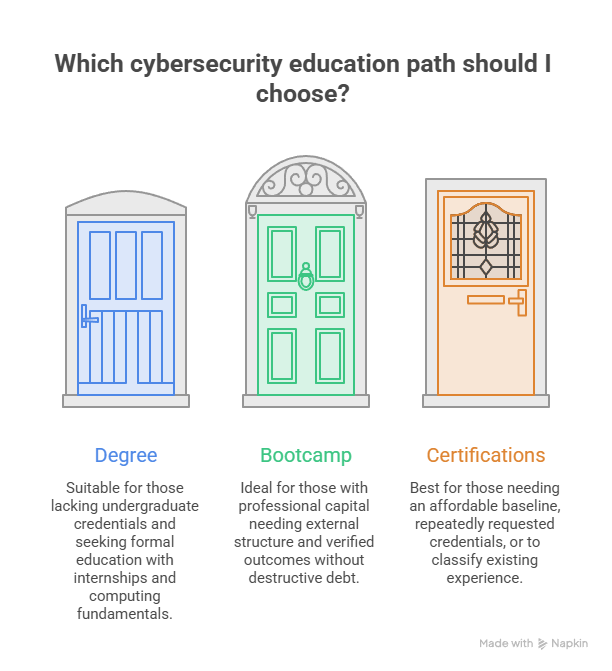
Choose a degree when you lack an undergraduate credential and can obtain formal education with manageable debt, especially if the program offers internships and sound computing fundamentals. Computer science, information technology, information systems, and cybersecurity degrees can all work. Examine course content rather than title. Programming, networking, operating systems, databases, cloud, statistics, writing, and business analysis preserve routes into security data science, cloud-adjacent automation, and security architecture. Pair the program with experience from the first year instead of waiting for graduation.
Choose a bootcamp when you already possess useful professional capital, need external structure, have verified the provider’s outcomes, and can absorb the full downside without destructive debt. A developer may use an application-security bootcamp to reorganize existing skills; an auditor may use a governance program to learn technical control evidence; an IT administrator may use an operations course to formalize detection work. The provider should grade original investigations, require written reports, expose students to ambiguous evidence, and offer continuing lab access. Recorded lectures and identical portfolio projects have limited signaling power.
Choose certifications when the target role repeatedly requests a credential, you need an affordable baseline, or you already have experience that recruiters fail to classify as security. Match the credential to the work: governance for a GRC career, audit for a cybersecurity auditor transition, identity training for IAM specialization, and practical offensive study for an ethical-hacking pathway. Study beyond the exam objectives so knowledge turns into decisions and artifacts.
Use a weighted education scorecard before enrolling. Give employability evidence and supervised experience 25% each, curriculum relevance 15%, verified outcomes 15%, total cost 10%, schedule sustainability 5%, and alumni access 5%. Score every option from one to five, multiply by the weights, and reject any provider that refuses outcome definitions or pressures you to finance immediately. Candidates in Ireland, Germany, South Africa, and Nigeria should weight local employer recognition and work authorization separately.
5. A Hiring-Ready Hybrid Roadmap That Reduces Education Risk
Months one and two should establish direction and baseline competence. Select one role family, analyze local postings, and diagnose gaps in networking, Linux, Windows, identity, cloud, scripting, governance, and communication. Build a small cybersecurity lab around the target. A SOC candidate can centralize endpoint and authentication logs, create detections, test benign events, and write escalation notes. A GRC candidate can scope a fictional organization, map controls, create an evidence request, record exceptions, and build a risk register. These artifacts support both a risk-management career and a policy-analysis route.
During months three and four, complete one aligned credential or rigorous course while improving the same project. Document assumptions, failed approaches, screenshots, findings, business impact, and remediation. Remove secrets and unsafe instructions before publishing. A portfolio should reveal judgment, not merely successful tool execution. Someone pursuing cybersecurity data science should explain dataset limits and false positives; an aspiring automation engineer should include error handling, logging, and rollback; a future vulnerability researcher must demonstrate responsible disclosure boundaries.
Months five through eight should create proximity to production. Ask your employer for access reviews, phishing-report triage, patch reporting, audit evidence, business-continuity testing, vulnerability remediation, or security-awareness metrics. If internal work is unavailable, pursue internships, apprenticeships, supervised nonprofit work, MSP support, technical support, or identity administration. Keep a private accomplishment log containing situation, action, scale, result, and evidence. That record becomes stronger interview material than generic claims about passion.
Begin professional cybersecurity networking before you feel ready. Speak with practitioners doing the exact job, ask which beginner tasks consume team capacity, and adapt your portfolio to those tasks. A person exploring cybersecurity training, bootcamp instruction, or security content education can publish a precise lesson or lab guide; technical candidates can request critique of investigation logic rather than asking strangers for jobs.
Months nine through twelve should run a measured application campaign. Tailor résumé bullets to evidence, apply to direct and adjacent roles, request referrals after genuine conversations, and track response rate by job family. Ten applications with zero screens may indicate targeting or résumé problems; interviews without advancement often reveal weak examples or technical depth. Adjust the failing stage. Keep pursuing security operations, identity management, technology risk, and technical support roles when they build the systems exposure your final target requires.
6. FAQs About Bootcamps, Degrees, Certifications & Cybersecurity Hiring
-
It can create structure, knowledge, and portfolio material, while the first offer usually depends on additional proof. Target providers with verifiable role-level outcomes and real employer access, then build an experience bridge through technical support, internships, apprenticeships, IAM, or supervised projects. A bootcamp promising immediate red-team employment or rapid penetration-testing leadership deserves intense scrutiny because those jobs depend on broad technical judgment.
-
The stronger program is the one with rigorous fundamentals, internships, employer recognition, acceptable debt, and high completion odds. Computer science often provides deeper programming and computational foundations; cybersecurity may provide earlier exposure to defense, governance, and digital forensics. Compare modules and graduate destinations. Either can lead toward security architecture, AI security analysis, or security product management when paired with relevant experience.
-
Usually one well-selected foundational certification is enough before the priority shifts toward labs, experience, communication, and applications. Add another credential when job-posting evidence supports it or when it validates a genuine specialization. Three overlapping beginner certificates rarely solve an experience gap. A candidate moving toward cybersecurity compliance, privacy work, or security auditing should select credentials that match those responsibilities.
-
Employers examine accreditation, institution, curriculum, experience, and interview performance. Online delivery can help working adults preserve income and apply learning immediately. Confirm institutional accreditation, transferability, total cost, proctored assessment quality, internship access, and whether the diploma differs from the campus version. Regional expectations also vary, so applicants should check employer patterns in markets such as New Zealand, Hong Kong, and the Philippines.
-
For someone already working in IT, the fastest route is often an internal security responsibility, one aligned certification, and a focused portfolio. For a complete beginner, an entry-level IT or security-adjacent job may create a faster credible path than repeatedly applying to SOC roles. Existing professionals can pivot through their domain: auditors toward cybersecurity audit, operations staff toward identity management, and project leaders toward cybersecurity program management.
-
Request the cohort size, graduation denominator, placement window, qualifying job titles, employment type, median salary, geographic scope, and independent audit method. Determine whether the provider excludes dropouts, counts pre-existing jobs, or labels technical support as cybersecurity placement. Contact several recent bootcamp graduates independently and compare their backgrounds with yours. Review the refund, income-share, arbitration, and financing terms with care. A percentage without definitions cannot support a five-figure decision.
