
Degree vs Certifications for Cybersecurity: Reddit Experiences, Hiring Manager Signals & ROI by Career Stage
A cybersecurity degree and a professional certification solve different career problems. One builds broad academic foundations, internship access, and long-term eligibility; the other validates a defined skill set quickly. Reddit career stories reveal successful—and expensive—versions of both routes. The strongest candidates connect either credential to evidence: a documented lab, measurable IT work, a security project, or an internal transition. Whether you want to become a GRC specialist, ethical hacker, privacy analyst, or security leader, return on investment depends on career stage, target role, hiring market, and the evidence already on your résumé.
1. What Reddit Experiences Reveal About Degrees, Certifications, and Cybersecurity Hiring
Cybersecurity discussions on Reddit usually divide into two camps: professionals who entered through a computer science, information technology, or cybersecurity degree, and career changers who used certifications to translate existing experience into security language. Reading those stories as universal career instructions creates bad decisions. They become useful when grouped by the applicant’s starting position, target role, location, and previous access to technical work.
A degree provides structured exposure to networking, operating systems, programming, databases, security principles, research, and technical writing. Its highest-value features often sit outside the lectures: internships, university recruiting, student security clubs, faculty referrals, capture-the-flag teams, and eligibility for graduate schemes. Those advantages can accelerate a student’s route into cybersecurity research analysis, AI security, cybersecurity data science, or quantum security analysis, where deeper computing, mathematics, and research skills carry substantial weight.
Certifications offer a narrower and faster signal. A networking certification can strengthen infrastructure fundamentals; Security+ can establish baseline security vocabulary; a cloud credential can align an applicant with a specific platform; and an audit or governance credential can support movement toward cybersecurity auditing, risk management, regulatory specialization, or cybersecurity policy analysis. The signal becomes credible when the certification matches the vacancy’s actual work.
One recurring Reddit frustration comes from applicants who collect several introductory certifications and receive few interviews. Their résumés answer “What have you studied?” while leaving “What have you secured, investigated, administered, assessed, or documented?” unresolved. A candidate targeting a SOC role needs evidence such as log investigation, alert triage, authentication analysis, escalation writing, and basic network reasoning. Someone pursuing a red-team career, penetration-testing leadership, or vulnerability research needs increasingly deeper proof of testing methodology, technical reporting, tool judgment, and responsible disclosure practices.
Another Reddit pattern comes from experienced IT professionals whose previous work already contains security. A network administrator may have configured firewalls, reviewed privileged access, segmented systems, investigated anomalies, managed patches, and supported incident recovery. For that candidate, a focused certification can relabel established capability and support an IT-to-ethical-hacking transition, advancement into security architecture, or movement toward cybersecurity automation engineering. Returning for another undergraduate degree would usually produce lower marginal value than converting existing work into security-focused accomplishments.
The reverse situation affects beginners with minimal technical exposure. A certification completed through memorization may create a résumé keyword while leaving the candidate unable to explain DNS, identity controls, network traffic, log sources, risk prioritization, or evidence handling. A well-designed degree can provide time and structure to develop those foundations. A lower-cost combination of community college study, certifications, IT employment, and labs can also create them. The route should be judged by the capabilities and opportunities it produces.
The labor market supports this layered interpretation. The U.S. Bureau of Labor Statistics identifies a bachelor’s degree as the typical education for information security analysts, while also recognizing entry through a high school diploma plus relevant training and certifications. It also reports that many analysts arrive from IT roles such as network and systems administration. Employment is projected to grow 29% from 2024 to 2034, although that growth does not eliminate screening barriers or guarantee a direct first job in security. BLS occupational data therefore supports multiple routes while emphasizing the value of related experience.
Degree vs Certifications: 28-Scenario Cybersecurity ROI Matrix
| Candidate Situation | Highest-ROI Priority | Hiring Signal Created | Evidence Required Alongside It |
|---|---|---|---|
| High-school graduate with no IT exposure | Degree or structured diploma plus one foundation certification | Learning capacity and baseline knowledge | Internship, help-desk work, labs, or volunteer IT support |
| Current university freshman | Degree, networking fundamentals, and campus involvement | Long-term technical development | Student projects and early internship applications |
| University junior approaching recruitment | Internship plus vacancy-aligned certification | Academic foundation with job readiness | One role-specific portfolio case study |
| Computer science graduate | Security specialization and practical evidence | Strong computing base | Secure coding, cloud, detection, or systems project |
| Cybersecurity graduate with no internship | Operational experience before another credential | Ability to work beyond coursework | IT support, SOC lab, audit project, or apprenticeship |
| Help-desk technician | Security or networking certification | Readiness for security-adjacent duties | Identity, phishing, endpoint, and escalation examples |
| Network administrator | Security specialization certification | Transferable infrastructure competence | Firewall, segmentation, VPN, and incident evidence |
| Systems administrator | Identity, cloud, or defensive certification | Security ownership of enterprise systems | Hardening, privileged access, patching, and logging results |
| Software developer entering AppSec | Application-security training and certification | Secure-development specialization | Threat model, code review, and remediation examples |
| Cloud engineer | Vendor cloud-security certification | Platform-specific security capability | IAM, logging, encryption, and policy-as-code project |
| Accountant entering cyber risk | GRC or audit credential | Transferable assurance competence | Control testing and risk-treatment case study |
| Law or policy graduate | Privacy, governance, or regulatory certification | Domain-to-cybersecurity alignment | Regulatory mapping and policy analysis sample |
| Healthcare compliance professional | Security privacy and risk credential | Sector-specific control awareness | Data-flow, access-review, and evidence-collection examples |
| Military professional with clearance | Role-mapped certification | Eligibility for regulated or defense work | Translated mission, systems, and leadership achievements |
| Career changer with unrelated degree | Technical foundation certification plus experience | Credible commitment to the transition | IT role, apprenticeship, or substantial lab portfolio |
| Career changer without a degree | Affordable certification stack and operational work | Evidence of current, relevant capability | Documented troubleshooting and security tasks |
| Applicant repeatedly blocked by degree filters | Accredited part-time degree | Long-term HR eligibility | Continued employment and measurable projects |
| Applicant reaching interviews and failing technical rounds | Hands-on development | Interview-level job competence | Scenario practice, labs, and concise technical explanations |
| SOC analyst seeking promotion | Intermediate defensive certification | Depth in detection and response | Improved rules, investigations, and response metrics |
| Junior penetration tester | Practical offensive certification | Assessment methodology and persistence | Sanitized reports and reproducible lab findings |
| Early-career GRC analyst | Framework or audit certification | Control and assurance fluency | Risk register, control map, and remediation tracking |
| Mid-career security engineer | Advanced specialization certification | Depth for senior technical responsibility | Architecture decisions and measurable risk reduction |
| Experienced professional targeting management | Leadership experience plus business education where needed | Budget, people, and strategy capability | Hiring, planning, metrics, and stakeholder outcomes |
| Manager seeking executive leadership | Executive education or relevant master’s degree | Enterprise governance and business breadth | Board communication and portfolio-level decisions |
| Consultant building buyer confidence | Recognized advanced certification | Client-facing assurance | Engagement results, references, and sector knowledge |
| Government applicant | Credential named in the vacancy framework | Contract or workforce-framework eligibility | Evidence mapped directly to required work roles |
| International applicant seeking mobility | Recognized degree plus portable certification | Immigration and employer comparability | Experience records and locally relevant competencies |
| Experienced specialist pursuing teaching | Instructional proof and relevant credentials | Subject authority and teaching readiness | Curriculum sample, workshops, and learner outcomes |
2. How Hiring Managers Interpret Each Credential Signal
Candidates frequently treat hiring as one decision. In practice, an application can pass through an applicant-tracking system, an HR or recruitment review, a technical manager, an assessment, and a panel interview. Each layer looks for different evidence. Understanding those layers explains why a degree can unlock one vacancy, a certification can unlock another, and either credential can lose value during technical questioning.
The degree signal: breadth, persistence, and institutional eligibility
A degree can satisfy an explicit HR requirement, support immigration or graduate-program eligibility, and reassure employers that the candidate completed sustained academic work. It becomes especially useful in large enterprises, government agencies, consulting firms, regulated sectors, and international markets where job architectures contain formal education requirements. Candidates comparing regional demand should examine how credentials operate in Singapore’s cybersecurity market, Malaysia, Hong Kong, Ireland, and Germany.
The degree’s weakness is signal ambiguity. Two graduates from the same program may have radically different technical ability. One may have completed internships, administered a student lab, written secure code, and investigated cloud logs. Another may have passed examinations without building operational fluency. A strong résumé translates education into observable outputs: “built,” “tested,” “analyzed,” “remediated,” “presented,” and “measured.” Course titles alone make the reviewer perform too much inference.
The subject also changes the signal. Computer science can communicate programming, algorithms, systems thinking, and abstraction. Information technology may communicate infrastructure, administration, networking, and business systems. Cybersecurity programs can provide earlier specialization in defense, governance, digital forensics, or secure design. Business, law, accounting, psychology, and communications degrees can create valuable domain leverage for privacy leadership, cybersecurity program management, policy direction, security product management, and security education.
The certification signal: relevance, currency, and targeted validation
A certification can show that an applicant understands a recognized body of knowledge or has passed a practical assessment. Recruiters may use certification names as search terms, customers may expect them from consultants, and regulated contracts may map them to designated work roles. The signal strengthens when the credential matches the job’s level and responsibilities.
A foundational credential can help an early applicant establish vocabulary and reduce perceived training risk. An advanced credential associated with experienced practitioners can support a senior candidate’s VP of security progression, chief security architect pathway, or IT-management-to-security-leadership move. A specialized credential becomes useful when it reinforces existing work in blockchain security engineering, digital identity management, security automation, or cybersecurity risk management.
Certification quantity is a weak substitute for role alignment. Six entry-level credentials can create a “perpetual learner” signal if the résumé contains no corresponding projects or operational responsibility. One relevant certification supported by three credible work examples usually produces a clearer professional story. Every credential should answer a defined question: Which vacancy requirement does this satisfy? Which capability does it validate? Which interview answer becomes stronger because I earned it?
The evidence signal: whether the candidate can reduce risk
The technical reviewer ultimately wants evidence that the applicant can perform safely. For a defensive analyst, that may involve explaining an investigation from initial alert through validation, scoping, evidence preservation, escalation, and recommended containment. For a GRC career, it may involve mapping a control, testing its operation, recording an exception, evaluating residual risk, and tracking remediation. For a privacy analyst role, it may involve tracing personal data, identifying lawful processing requirements, evaluating access, and communicating exposure to business owners.
ISC2’s 2025 hiring research found that 84% of surveyed organizations used skills-based assessments or tests for entry- and junior-level candidates. When respondents classified credentials as critical, certifications ranked at 47%, previous IT experience at 44%, and relevant education at 43%. The difference between those figures is narrow enough to discourage single-credential strategies. The same study found that teamwork, problem-solving, and analytical thinking ranked among the five most valued early-career skills. ISC2’s hiring findings reward candidates who combine credentials with demonstrable judgment and communication.
3. Degree vs Certification ROI at Every Cybersecurity Career Stage
Return on investment should include tuition or exam cost, study hours, income sacrificed, financing charges, renewal fees, internship access, promotion eligibility, salary growth, geographic portability, and the probability of finishing. A $500 certification that fails to change interview volume can have poor ROI. A costly degree that unlocks internships, a professional network, and decades of degree-filtered roles can produce excellent ROI. The decisive variable is the career bottleneck.
Starting from zero: prioritize foundations and access
Complete beginners need a route that creates technical foundations and proximity to real systems. A degree is attractive when the student can control debt, use career services, pursue internships early, and build projects alongside coursework. Those conditions make the education an employment platform. Treating university as four years of lectures wastes much of its potential return.
Certification-first candidates should build a sequence rather than a pile. Start with networking, operating systems, basic scripting, identity, and security concepts. Add a foundation credential after the underlying knowledge becomes usable. Then pursue work that exposes you to tickets, users, endpoints, directories, cloud services, permissions, or infrastructure. This pathway can support an eventual move into ethical hacking, red-team operations, defensive automation, identity security, or security research.
The pain point at this stage is uncertainty. Beginners spend heavily because they cannot distinguish career exploration from employer-recognized preparation. A low-cost lab, twenty informational interviews, and analysis of fifty local job descriptions can prevent a four-year or ten-certification mistake. Examine actual requirements in your market, including the pathways described for Pakistan, South Africa, Nigeria, Kenya, and New Zealand.
Students and recent graduates: turn education into evidence
A student already enrolled in a relevant degree usually gains greater return from internships, projects, networking, and one targeted certification than from accumulating multiple introductory credentials. The goal is to graduate with a degree plus evidence of workplace readiness. Useful outputs include a cloud security review, identity-access matrix, incident report, risk assessment, network diagram, vulnerability-remediation brief, or secure-development project.
Recent graduates with low response rates should diagnose the rejection stage. Zero interviews may indicate poor role targeting, weak résumé language, missing keywords, geographic limitations, or a lack of experience. Reaching interviews and failing technical rounds indicates a capability-expression problem. Another qualification addresses only some of those failures. A cybersecurity content portfolio, research analyst project, privacy assessment, policy analysis sample, or GRC evidence pack may close the gap more directly.
IT professionals transitioning into security: certify the overlap
IT professionals frequently underestimate how much security work they already perform. Access provisioning, backup validation, endpoint configuration, patch management, change control, network segmentation, vendor review, log analysis, and disaster recovery all contain security outcomes. The immediate task is to rewrite them in risk and control language.
A role-aligned certification can then make the transition legible. Network engineers can pursue defensive security or testing. Developers can move toward application security. Cloud administrators can specialize in cloud controls and identity. IT managers can build toward cybersecurity program leadership, security product management, security architecture, or executive security leadership. Their highest-return credential usually sharpens an established story.
Early-career security professionals: buy specialization
After one to three years of relevant experience, certification ROI often increases because the learner can connect concepts to incidents, architecture, controls, and organizational constraints. A defensive analyst can choose detection engineering, cloud security, forensics, or incident response. An assurance professional can deepen expertise through cybersecurity auditing, regulatory specialization, risk management, or privacy analysis.
A master’s degree can make sense when the target role explicitly values it, the employer provides tuition assistance, the program grants access to valuable recruiting networks, or the candidate needs deeper research and leadership development. Its ROI weakens when it delays relevant work, creates heavy debt, or repeats material the candidate already understands. Career stage converts the same qualification from a potential accelerator into a costly detour.
Mid-career specialists and leaders: solve the next-role gap
For senior practitioners, accomplishments dominate the hiring conversation. Employers expect examples of architecture decisions, incidents handled, controls improved, people developed, budgets managed, or risk reduced. Certifications may add client confidence, satisfy contract requirements, strengthen consulting credibility, or validate a new specialization. A degree may satisfy executive requirements or develop finance, strategy, governance, and organizational leadership.
Someone targeting penetration-testing management needs evidence of scoping, quality assurance, client communication, tester development, and remediation guidance. A future cybersecurity policy director needs policy ownership and stakeholder influence. A candidate pursuing chief privacy officer leadership needs enterprise governance, legal coordination, and executive communication. Credentials should fill precise credibility gaps around those responsibilities.
4. How to Choose Between a Degree, Certifications, or a Combined Route
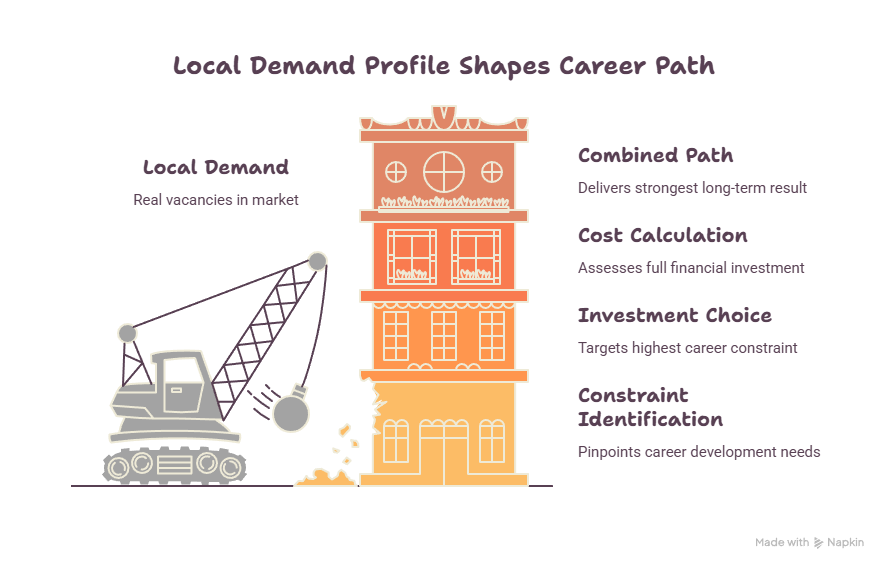
Begin with twenty to fifty real vacancies for one target role in one geographic market. Record required education, preferred education, named certifications, years of experience, technical skills, business skills, tools, industries, and responsibilities. Separate recurring requirements from employer wish lists. This exercise gives you a local demand profile rather than a career plan built from advertisements, influencer claims, or isolated Reddit success stories.
Geography can change the calculation substantially. Government contracting, immigration systems, employer maturity, educational norms, and local certification awareness all shape the value of a credential. Compare requirements across markets such as Texas, Virginia, Washington, Ohio, and Pennsylvania before copying advice from a professional working under different hiring rules.
Next, identify your current constraint:
Foundational constraint: You struggle to explain systems, networks, identity, cloud services, or basic security principles.
Eligibility constraint: Vacancies reject you before a recruiter can evaluate your experience.
keyword constraint: Job descriptions repeatedly name a credential missing from your résumé.
experience constraint: You understand concepts and lack evidence from real or realistic work.
specialization constraint: Your background is broad while the next role requires depth.
communication constraint: You possess relevant experience and explain it poorly.
network constraint: Few hiring professionals know your work or refer you to opportunities.
leadership constraint: Your next position requires budgeting, hiring, governance, strategy, and executive influence.
Choose the investment that attacks the highest constraint. A degree can address foundations, institutional access, and long-term eligibility. A certification can address a keyword, specialization, contract, or credibility requirement. A lab, project, apprenticeship, internal assignment, or adjacent IT job can address evidence. Mentoring, mock interviews, professional writing, and presentations can strengthen communication.
Then calculate full cost. For a degree, include tuition, fees, travel, equipment, interest, completion risk, and lost income. Subtract scholarships, employer reimbursement, internship earnings, and credits that can transfer. For a certification, include training, exam attempts, practice environments, renewal charges, continuing education, and study time. Compare these costs against realistic outcomes in Oregon, Tennessee, Utah, Wisconsin, or whichever market you intend to enter.
A combined path often delivers the strongest long-term result when sequenced carefully. A student can earn a degree, complete internships, and add one role-aligned certification near graduation. An employed professional can pursue a part-time degree while converting workplace duties into security achievements. A career changer can earn a foundation credential, enter technical support or assurance work, and revisit formal education after learning which barriers remain. Sequencing protects cash flow and generates evidence at each stage.
5. Build a Credential Plan That Produces Interview Evidence
A credential plan should end with artifacts and accomplishments rather than an exam date alone. Before enrolling, define the target vacancy, capability gap, evidence output, cost ceiling, completion date, and success metric. A useful certification objective might read: “Qualify for junior cloud-security roles, build an IAM review project, document three misconfiguration scenarios, and increase qualified interview invitations within six months.”
For technical roles, convert each learning domain into a small professional artifact. Networking study can produce a segmented architecture diagram and firewall-rule rationale. Identity study can produce an access-control matrix, joiner-mover-leaver workflow, and privileged-account review. Detection study can produce alert logic, sample telemetry, triage notes, and an escalation report. Offensive study can support a sanitized assessment report with scope, methodology, findings, evidence, severity reasoning, and remediation. These outputs strengthen preparation for vulnerability research, red-team operations, penetration-testing management, and security architecture.
For governance roles, create decision artifacts. Build a risk register containing assets, threats, vulnerabilities, existing controls, likelihood, impact, ownership, treatment, and residual risk. Map several controls to evidence. Draft an exception workflow. Analyze a privacy data flow. Compare a policy requirement with its operational procedure. These projects can demonstrate readiness for cybersecurity risk work, regulatory careers, security auditing, privacy analysis, and policy leadership.
Create a proof ledger throughout your studies. For every project or workplace task, record the problem, environment, constraints, action, result, and lesson. Remove confidential data and preserve measurable outcomes. This ledger becomes raw material for résumé bullets, interview stories, portfolio entries, promotion cases, and professional profiles. It also prevents the common interview failure where a capable candidate remembers responsibilities and forgets outcomes.
Use milestone reviews at 30, 60, and 90 days. Track applications submitted, applications meeting at least 70% of requirements, recruiter responses, first interviews, technical assessments, final interviews, and offers. If applications produce no interviews, revise targeting, résumé evidence, and networking. If interviews end during technical assessment, deepen practical capability. If final rounds repeatedly fail, examine communication, commercial judgment, and role fit. Each failure stage points toward a different intervention.
Apply a stop rule to credential collecting. Pause enrollment when the next qualification adds the same signal as the previous one. Redirect that money and time toward experience, portfolio evidence, professional relationships, or interview practice. Aspiring educators can build workshops through a cybersecurity trainer pathway or bootcamp instruction route. Technical specialists can deepen AI security, blockchain security, quantum security, or cybersecurity data science through demonstrable work.
The strongest plan produces a coherent sentence a hiring manager can believe: “I used this education to build these capabilities, applied them in these environments, achieved these outcomes, and am prepared to solve these problems in your role.” Every investment should strengthen one part of that sentence.
6. FAQs About Cybersecurity Degrees, Certifications, and Career ROI
-
Yes, especially through IT support, networking, systems administration, cloud operations, identity administration, compliance, military experience, apprenticeships, or internal transfers. Your résumé must provide credible evidence beyond exam completion. Show the systems you administered, incidents you investigated, controls you tested, risks you documented, or security improvements you delivered. Routes into digital identity management, GRC specialization, cybersecurity auditing, and ethical hacking reward different forms of adjacent experience.
-
The better choice depends on the curriculum and target role. Computer science often provides stronger depth in programming, algorithms, software design, and computing theory, which can support application security, AI security analysis, security automation engineering, and cybersecurity data science. A strong cybersecurity degree may provide earlier exposure to defense, governance, forensics, risk, and security operations. Compare actual modules, labs, internship outcomes, faculty expertise, employer relationships, and graduate destinations.
-
One foundation certification and one role-aligned credential are usually enough to begin testing the market. Additional certifications should follow evidence from job descriptions, recruiter feedback, technical assessments, or a newly selected specialization. The candidate’s next hours may generate greater return through a lab, internship, support role, risk project, or portfolio. Someone targeting red-team work needs different preparation from a future privacy analyst, program manager, or policy analyst.
-
A master’s degree can help when it provides internships, recruiting access, research depth, immigration value, a respected professional network, or eligibility for a defined role. Early-career candidates should compare it against the return from operational experience. Mid-career professionals may gain more value when the program supports movement into cybersecurity leadership, security program management, policy direction, or VP-level security responsibility.
-
A certification usually requires less time and money, giving it faster potential payback when one named credential blocks a promotion, contract, or career transition. A degree can create broader and longer-lasting value through internships, formal eligibility, professional networks, and geographic portability. Compare both routes using expected interview access, completion probability, total cost, time to benefit, and useful lifespan. Market context across Kuwait, Oman, Bahrain, and France may produce different conclusions.
-
Hiring managers care about relevance to their environment, customer obligations, role framework, and technical needs. Reddit can help identify credentials worth investigating, reveal recurring candidate mistakes, and expose differences between HR screening and technical evaluation. Validate every recommendation against local job descriptions and conversations with professionals who hire for your intended role. Advice from a U.S. defense contractor may have limited transferability to the Netherlands, Spain, the Philippines, or South Africa.
