
Cybersecurity Home Lab That Actually Helps You Get Hired: Reddit Projects, SIEM Evidence & Portfolio Deliverables
A cybersecurity home lab becomes career leverage when it produces evidence a hiring manager can inspect, question, and challenge. Installing Kali Linux, launching a SIEM, or completing guided exercises gives you practice; documenting investigations, detection logic, false-positive decisions, remediation, and measurable outcomes gives you interview material. That distinction matters whether you are pursuing a SOC-focused security analyst path, moving from network administration into cybersecurity, building toward red-team operations, or developing the foundations for security architecture.
The goal is simple: make your lab prove that you can observe a system, identify suspicious behavior, investigate competing explanations, make a defensible decision, and communicate what should happen next.
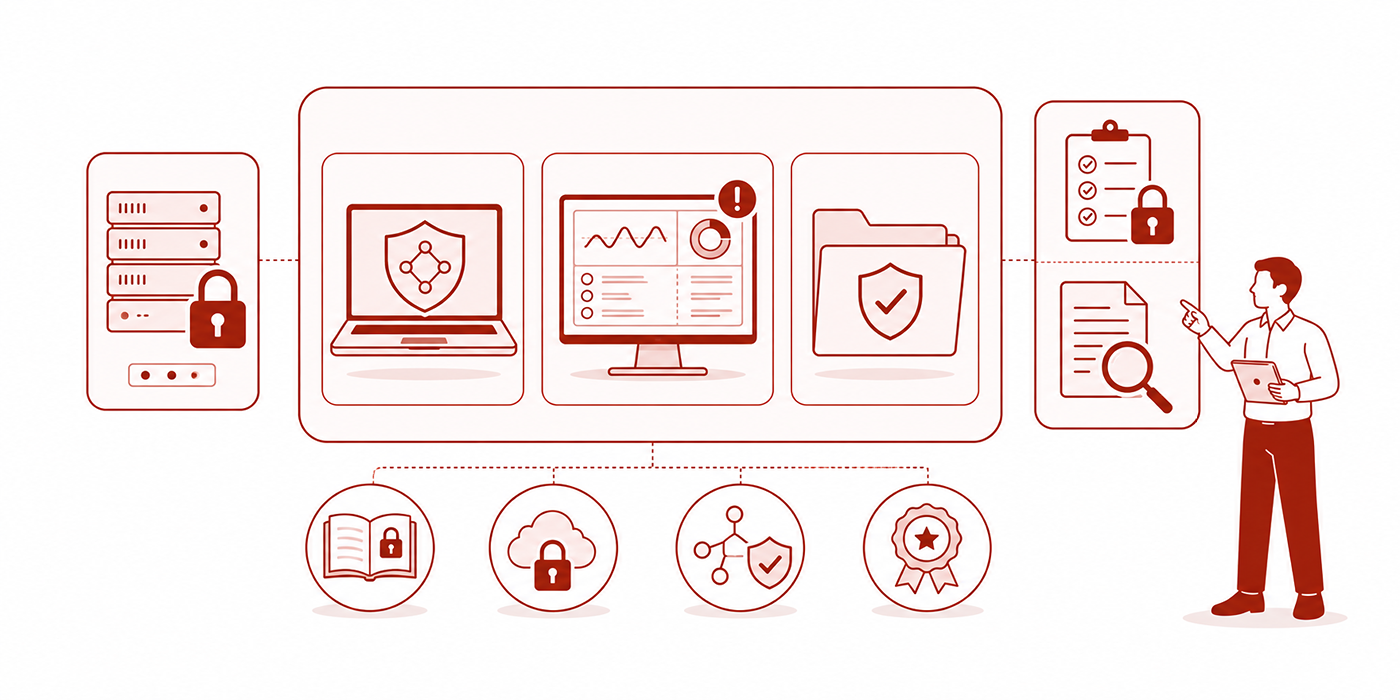
1. What Makes a Cybersecurity Home Lab Valuable to Hiring Managers?
A strong home lab should answer the question hiring managers eventually ask every early-career applicant: what can you actually do when something unexpected appears on the screen? That question becomes especially important for candidates entering cybersecurity without extensive professional experience, pursuing a cybersecurity certification pathway, transitioning from an IT auditing background, or targeting a future cybersecurity leadership role.
Current hiring research strongly supports building demonstrable capability. ISC2 reported that 84% of surveyed organizations use skills-based assessments or tests for entry- and junior-level cybersecurity applicants. The same research found that 90% of hiring managers would consider candidates whose primary qualification was previous IT experience and 89% would consider candidates primarily carrying an entry-level cybersecurity certification. Practical testing therefore remains part of the hiring funnel even when credentials help a résumé reach it.
A useful lab mirrors work performed in roles such as cybersecurity automation engineering, digital identity management, cybersecurity risk management, and governance, risk, and compliance. A SOC candidate should produce alerts, investigations, timelines, queries, incident notes, and escalation decisions. An aspiring vulnerability researcher should demonstrate reproducible findings, root-cause reasoning, validation, and remediation. Someone building toward penetration-testing management needs increasingly rigorous assessment methodology and reporting.
This is where many portfolios weaken. Screenshots showing a Splunk dashboard, Kali desktop, Active Directory console, or completed training badge prove that software was opened. Hiring evidence begins when the candidate can explain what telemetry was collected, which behavior generated it, what query surfaced it, why the alert mattered, which benign explanations were considered, how severity was determined, and what response would be justified. These are the habits that eventually support incident-analysis responsibilities, security architecture decisions, cybersecurity program management, and cybersecurity policy development.
Microsoft describes Sysmon as providing detailed telemetry around process creation, network connections, file activity, hashes, process relationships, and other endpoint behaviors that can be forwarded into a SIEM for analysis. That gives a beginner enough raw material to practice many of the same reasoning patterns required in SOC operations, identity investigations, cybersecurity research, and eventually AI-assisted security analysis.
The strongest portfolio therefore contains fewer shallow projects and more complete investigative loops. Build the environment, generate known activity, collect telemetry, detect the activity, investigate it, decide whether it represents a true positive, document the response, tune the rule, repeat the test, and explain what changed. That workflow creates transferable evidence for ethical hacking, red-team careers, cybersecurity audit, and security-management progression.
Cybersecurity Home Lab Hiring Matrix: 30 Projects, Evidence Types & Portfolio Deliverables
Choose projects according to the job you want and capture evidence that lets an interviewer reconstruct your reasoning.
| Lab Project | Skill It Proves | Evidence to Capture | Best Portfolio Deliverable |
|---|---|---|---|
| Windows + Sysmon telemetry baseline | Endpoint visibility | Normal process, network and logon activity | Baseline report + architecture diagram |
| Repeated failed-login detection | Authentication analysis | Failed logons, accounts, sources and time window | Detection rule + investigation worksheet |
| Password-spray simulation | Identity threat detection | Many accounts targeted from common source | Incident report + ATT&CK mapping |
| Suspicious PowerShell execution | Process investigation | Command line, parent process, user and destination | Process-tree analysis |
| Encoded command detection | Behavioral detection | Execution chain and decoded benign test payload | Detection logic + tuning notes |
| New local administrator creation | Privilege monitoring | Creator, new account, host and timestamp | Identity incident case |
| Unexpected group membership change | Active Directory monitoring | Group, actor, target account and authorization | Privilege-escalation investigation |
| Scheduled-task persistence test | Persistence detection | Task creation, binary path and initiating user | Detection engineering write-up |
| Windows service creation | Host behavior analysis | Service name, executable and parent activity | Alert investigation timeline |
| RDP logon monitoring | Remote-access analysis | Source, destination, user and logon type | Remote-access investigation |
| SSH authentication failures | Linux log analysis | Source IP, usernames and attempt frequency | Linux SOC case study |
| Network port-scan detection | Network telemetry analysis | Connection volume, ports and source host | PCAP + SIEM correlation report |
| Firewall deny-event analysis | Network defense | Blocked source, destination, protocol and rule | Firewall triage worksheet |
| DNS anomaly investigation | Network hunting | Query frequency, domain patterns and endpoint | Threat-hunting report |
| Web authentication attack simulation | Web-log investigation | Requests, response codes, user agent and source | Web incident case |
| Suspicious parent-child process detection | Endpoint analytics | Process ancestry and command-line context | Detection rule + explanation |
| File-integrity monitoring | Change detection | File path, hash, user and timestamp | Integrity-monitoring case study |
| Benign mass-file-change simulation | Impact detection | File-event burst, initiating process and affected path | Ransomware-style detection report |
| USB-device monitoring | Endpoint control analysis | Device identifiers, host, user and timing | Data-protection investigation |
| Credential-access behavior simulation | Credential-defense analysis | Relevant process telemetry and access pattern | ATT&CK-mapped incident report |
| Benign lateral-movement simulation | Cross-host correlation | Source host, destination, account and service activity | Multi-host investigation timeline |
| Cloud administrator-role change | Cloud IAM monitoring | Actor, role, resource and audit event | Cloud privilege case study |
| New cloud account or API credential | Cloud identity security | Creator, permissions, timestamp and source | IAM investigation report |
| Cloud storage exposure review | Misconfiguration analysis | Before/after permissions and risk explanation | Remediation case study |
| IOC enrichment workflow | Threat-intelligence handling | Indicator context, confidence and investigative use | Enrichment playbook |
| SIEM false-positive tuning | Detection optimization | Original rule, noisy events and revised conditions | Before/after tuning report |
| Alert severity calibration | Risk-based triage | Asset value, confidence, impact and evidence | Severity decision matrix |
| Incident timeline reconstruction | Forensic reasoning | Ordered endpoint, identity and network events | One-page incident timeline |
| Vulnerability-to-remediation project | Vulnerability management | Finding, validation, priority, fix and rescan | Remediation evidence pack |
| Security control validation | GRC + technical assurance | Control objective, technical test and evidence | Mini audit/control assessment |
2. How to Build a SIEM Home Lab That Produces Interview-Grade Evidence
A hiring-focused SIEM lab should contain enough infrastructure to create relationships between users, endpoints, network activity, alerts, and business context. A candidate preparing for security analyst progression gains more from a small environment they deeply understand than from an enormous environment copied from a tutorial. The same principle applies to candidates pursuing cybersecurity automation, digital identity specialization, cybersecurity data science, or AI security analysis.
A practical starter environment can contain one Windows endpoint, one Windows Server or domain controller, one Linux host, a SIEM, Sysmon or comparable endpoint telemetry, operating-system logs, and a segmented attack/testing machine. Add network telemetry after the endpoint pipeline works. Your objective is operational understanding: where the logs originate, how they are transported, what fields survive ingestion, how timestamps are normalized, how users and hosts are identified, and where evidence disappears when collection fails.
For a candidate building toward network-to-security transition, this architecture forces network knowledge into the investigation. For someone pursuing cybersecurity audit, it creates evidence that can be traced back to controls. For a future GRC specialist, it reveals why technical control evidence must be specific enough to withstand review. For an aspiring cybersecurity program manager, it exposes dependencies between tooling, visibility, process, ownership, and escalation.
The next layer is telemetry quality. Sysmon can record process creation, command lines, hashes, process relationships and optionally network connections, giving a lab candidate richer behavioral evidence than screenshots of generic Windows Event Viewer entries. Map selected simulations to MITRE ATT&CK so your write-ups use recognizable security language. MITRE describes ATT&CK as a knowledge base of adversary tactics and techniques derived from real-world observations, making it useful for organizing detection coverage and investigation narratives.
For example, an authentication project can simulate a controlled password-spraying pattern against lab-only accounts and analyze how the behavior differs from ordinary user mistakes. MITRE categorizes password spraying under T1110.003 and describes the technique as trying one or a small number of passwords across multiple accounts. That project can support a digital identity career path, strengthen SOC analyst evidence, demonstrate analytical discipline useful in cybersecurity risk management, and create technical context valuable for a future privacy analyst.
Your detection rule should then answer six questions: what behavior are we detecting, which fields prove it, how much activity creates suspicion, which legitimate activities can look similar, what additional evidence raises confidence, and what response becomes proportionate at each confidence level? That level of reasoning separates detection engineering from copying a query. It also builds habits relevant to vulnerability research, red-team operations, security architecture, and cybersecurity research analysis.
Finish every SIEM project by breaking your own detection. Change the threshold. Alter the time window. Generate legitimate activity that resembles the alert. Remove one telemetry source. Test whether your conclusion still holds. A candidate who can explain why a rule failed demonstrates more depth than someone who merely shows that an alert fired. That intellectual discipline is useful across penetration-testing leadership, cybersecurity policy analysis, regulatory cybersecurity, and senior security leadership.
3. Turn Every Lab Project Into Portfolio Evidence an Interviewer Can Evaluate
The portfolio should convert technical work into a reviewable decision record. Candidates pursuing ethical hacking, SOC analysis, cybersecurity research, or security automation benefit when an interviewer can understand the project without recreating the entire environment.
For each serious project, build seven artifacts:
Architecture diagram: show systems, trust boundaries, log sources, SIEM flow, and important identities.
Objective statement: define the security behavior you wanted to observe or detect.
Telemetry inventory: identify which log sources and fields were required.
Detection logic: show the query or rule and explain every meaningful condition.
Investigation record: document hypotheses, pivots, evidence, rejected explanations, and final assessment.
Response recommendation: state containment, escalation, remediation, and verification steps appropriate to the scenario.
Retest and tuning evidence: demonstrate how the detection behaved after changes.
That structure develops communication demanded in cybersecurity program management, evidence discipline relevant to cybersecurity auditing, analytical reasoning required in risk-management careers, and technical clarity expected from a future chief security architect.
Your incident report should read like something another analyst could inherit during a shift change. Include detection time, affected asset, user, observed behavior, evidence sources, initial hypothesis, investigative pivots, scope, ATT&CK mapping where useful, severity rationale, containment recommendation, remediation, and outstanding uncertainty. This makes your work relevant to security operations leadership, privacy investigations, GRC evidence collection, and cybersecurity policy work.
Screenshots should support the reasoning rather than substitute for it. Capture the alert, relevant raw events, process tree, authentication pattern, network evidence, and the final tuned rule. Then annotate the evidence in the surrounding explanation. A future penetration testing manager needs reporting discipline. A vulnerability researcher needs reproducibility. A cybersecurity certification trainer needs explanatory precision. A cybersecurity content educator needs to translate technical evidence without distorting it.
GitHub works best when each repository answers a narrow question. “Detecting Password Spraying in a Windows Domain” communicates more value than “Cybersecurity Home Lab Project 4.” “Reducing False Positives in a PowerShell Detection” immediately gives an interviewer something to challenge. “Correlating RDP Authentication With Endpoint Process Activity” demonstrates cross-source reasoning useful in digital identity security, SOC investigations, cybersecurity automation, and security architecture.
The final portfolio test is interview survivability. Ask yourself whether you can explain every query, screenshot, field, architecture decision, detection threshold, false-positive assumption, and response recommendation without opening your notes. Reddit discussions repeatedly expose this divide: a candidate can invest hundreds of hours in SIEM tooling and still face hiring filters if the work never becomes visible to the right reviewer. One detailed 2026 discussion described extensive Wazuh/ELK, Sysmon, ATT&CK mapping, adversary simulation, and incident-report work, while commenters still emphasized the difficulty of getting such evidence past initial HR screening.
Quick Poll: What Is Currently Stopping Your Home Lab From Helping You Get Hired?
Choose the bottleneck costing you the most interview credibility.
4. What Reddit Cybersecurity Advice Gets Right About Home Labs — and Where Candidates Misread It
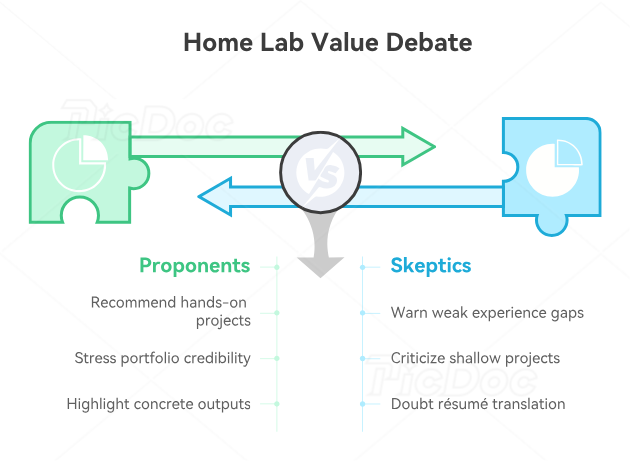
Recent Reddit career discussions contain two apparently competing messages. One group recommends home labs, SIEM deployments, attack simulations, GitHub documentation, Active Directory environments, and detection projects. Another group warns that ordinary home-lab work rarely compensates for weak professional experience or hiring filters. Both observations become useful when applied to the correct stage of the hiring process.
A 2026 Reddit discussion about home labs argued that portfolios can provide credibility when candidates lack production security exposure, while also emphasizing that the résumé must first survive HR screening before the portfolio becomes relevant. That distinction matters for candidates pursuing SOC analyst careers, cybersecurity audit transitions, digital identity roles, or an eventual cybersecurity management pathway.
Another Reddit mentorship discussion gave an even sharper distinction: casual experimentation can be difficult to translate into résumé value, while deeper independent research can produce meaningful outputs such as CVEs, bug-bounty results, conference presentations, or published research. That principle extends beyond vulnerability research careers. A blue-team candidate can create similarly concrete outcomes through high-quality detection rules, reproducible investigation reports, measurable alert tuning, documented control validation, or a useful automation tool supporting a cybersecurity automation career.
The mistake is measuring project quality by infrastructure complexity. A candidate with six virtual machines, multiple security platforms, a domain, firewall, IDS, SOAR platform, threat-intelligence feed, and cloud environment can still produce weak hiring evidence. A smaller project showing one difficult investigation from alert generation through containment can demonstrate stronger judgment for security analyst roles, stronger methodology for penetration-testing careers, stronger evidence handling for cybersecurity auditing, and stronger risk communication for a GRC specialist.
Recent Reddit portfolio examples also show where candidates naturally gravitate: SIEM attack simulation, web-application testing, Active Directory hardening, and Python security automation appear repeatedly. One 2026 candidate presented exactly that mixture while asking whether projects plus Security+ could overcome the absence of a degree and professional experience. The responses varied sharply, including a hiring-manager challenge asking what the candidate had produced that differentiated them from applicants with more credentials, degrees, or internships.
That question should shape your project selection. “I deployed Splunk” creates little differentiation because deployment instructions are widely available. “I designed a Windows authentication detection, generated controlled password-spray telemetry, measured false positives, added asset criticality, documented the investigative pivots, and retested the rule after tuning” gives an interviewer multiple areas to probe. The same transformation works for red-team projects, privacy analysis, cybersecurity risk projects, and cybersecurity regulatory work.
Treat Reddit as a source of market friction rather than a universal rulebook. Individual commenters have different countries, companies, experience levels, hiring authority, salary expectations, and tolerance for unconventional candidates. Your stronger strategy is to extract recurring problems—weak fundamentals, shallow projects, poor résumé translation, insufficient professional experience, unfocused certification chasing—and design evidence that directly addresses the problems relevant to your target ethical-hacking transition, security architecture path, cybersecurity research role, or security leadership trajectory.
5. How to Turn Home-Lab Evidence Into Résumé Bullets, Interview Answers & Hiring Leverage
Your lab creates value only when the employer can discover it at the correct stage. That means translating deep technical work into three different formats: a résumé signal for screening, a portfolio artifact for verification, and an interview story for evaluation. Candidates targeting SOC advancement, cybersecurity automation engineering, digital identity management, or vulnerability research should deliberately design all three.
A weak résumé bullet says: Built a SIEM home lab using Splunk and Sysmon.
A stronger version says: Built a Windows detection lab ingesting Sysmon and authentication telemetry; created and tested detections for suspicious PowerShell execution and repeated login failures; documented triage logic, false-positive conditions, and remediation recommendations.
That phrasing gives employers evidence of telemetry handling, detection logic, validation, investigation, and communication. It also maps naturally to security analyst work, cybersecurity research, risk-management responsibilities, and security architecture thinking.
Add numbers when they measure real work rather than decorate it. Useful metrics include number of log sources integrated, number of detection rules built, number of ATT&CK techniques tested, false-positive reduction after tuning, number of hosts correlated during an investigation, time required to reconstruct an incident, or number of vulnerabilities validated and remediated. These measurements strengthen evidence for cybersecurity program management, cybersecurity audit, GRC work, and cybersecurity policy careers.
During the interview, expect the project to be attacked constructively. An interviewer may ask why you chose a threshold, which legitimate activity could trigger the same rule, which log source you would trust most, how your investigation changes if one endpoint stops reporting, what would justify containment, how your method scales to 10,000 endpoints, or which evidence would change your conclusion. Those questions measure the reasoning that supports penetration-testing management, red-team operations, AI security analysis, and cybersecurity leadership.
Use the lab to expose your own weaknesses before an interviewer does. If you cannot explain TCP state, DNS resolution, Windows authentication, Active Directory relationships, Linux permissions, process ancestry, log timestamps, or basic scripting used by your project, return to the fundamentals. A sophisticated dashboard sitting on weak systems knowledge creates fragile interview performance. Strong foundations compound across network-to-security transitions, vulnerability research, security architecture, and cybersecurity automation.
Geography also changes how much leverage a portfolio creates. Degree expectations, certification filters, public-sector requirements, local cybersecurity maturity, and employer concentration vary substantially. Someone applying in Texas, Virginia, Singapore, Pakistan, or Germany should compare local job descriptions before deciding which projects deserve the most time.
The final objective is a proof stack. Your résumé tells the recruiter which capability exists. Your GitHub or portfolio proves the work was performed. Your incident report proves you can communicate. Your detection logic proves technical reasoning. Your architecture diagram proves systems understanding. Your interview explanation proves ownership. Certifications can then reinforce the foundation, while deeper specialization supports paths into cybersecurity policy leadership, cybersecurity product management, privacy leadership, and eventually senior security management.
6. FAQs About Cybersecurity Home Labs, SIEM Projects & Getting Hired
-
A complete SIEM investigation usually creates stronger SOC evidence than a large collection of disconnected tools. Build a small Windows environment, collect authentication and endpoint telemetry, generate controlled suspicious behavior, write a detection, investigate the alert, document false-positive possibilities, make an escalation decision, and retest after tuning. That workflow closely supports security analyst development, digital identity investigations, cybersecurity automation, and later security architecture work.
-
Tool choice carries less hiring value than demonstrated investigative depth. Employers can teach interface differences faster than they can teach strong reasoning. Choose one platform you can operate confidently, understand its ingestion pipeline, build searches, create alerts, investigate raw events, and explain how you would transfer the logic to another platform. This portability matters across SOC careers, cybersecurity research, cybersecurity data science, and AI security analysis.
-
Three strong projects generally give you more interview material than ten shallow ones. Select projects that collectively demonstrate different competencies: one detection/investigation project, one systems or identity project, and one project aligned directly with the target vacancy. A candidate moving toward ethical hacking might combine network investigation, web assessment, and Active Directory work. Someone targeting GRC could combine control validation, risk assessment, and evidence collection. A future privacy analyst can emphasize access monitoring, data handling, and incident documentation.
-
A lab can strengthen your candidacy by proving initiative, technical exposure, analytical thinking, and project ownership. Professional experience adds production scale, organizational constraints, teamwork, customer impact, change control, accountability, and exposure to imperfect real-world systems that a personal environment rarely reproduces. Use the lab to close specific evidence gaps while pursuing IT roles, internships, apprenticeships, volunteer technical work, or internal transitions. This combination strengthens routes into security analysis, cybersecurity auditing, risk management, and cybersecurity program management.
-
Publish the work that demonstrates judgment, originality, reproducibility, or meaningful improvement. Keep repositories clean, remove secrets and sensitive data, provide architecture context, explain your detection logic, document assumptions, and show results. Guided exercises can remain part of your learning history without occupying the most valuable space in your portfolio. Strong public work can support a vulnerability-research career, cybersecurity content and education, certification training, and cybersecurity research analysis.
-
Capture evidence that supports a decision: the triggering alert, relevant raw events, process relationships, authentication sequence, source and destination context, query logic, timeline, and the revised detection after tuning. The screenshot should make sense inside a written investigation rather than functioning as decoration. This evidence discipline supports SOC operations, cybersecurity audit, regulatory cybersecurity, and security-risk analysis.
