
Cybersecurity Certifications vs Hands-On Labs: Reddit Hiring Advice, Resume Signals & the Mix That Gets Interviews
Cybersecurity certifications can help a résumé survive its first screening, while hands-on labs give candidates something credible to discuss during technical interviews. Current hiring research and Reddit discussions point toward the same conclusion: employers respond best when recognized credentials, role-specific practice, clear documentation, and adjacent experience support one another. The strongest application presents a focused professional story. It shows what the candidate understands, what they have built or investigated, how they reached decisions, and how those capabilities match the advertised role.
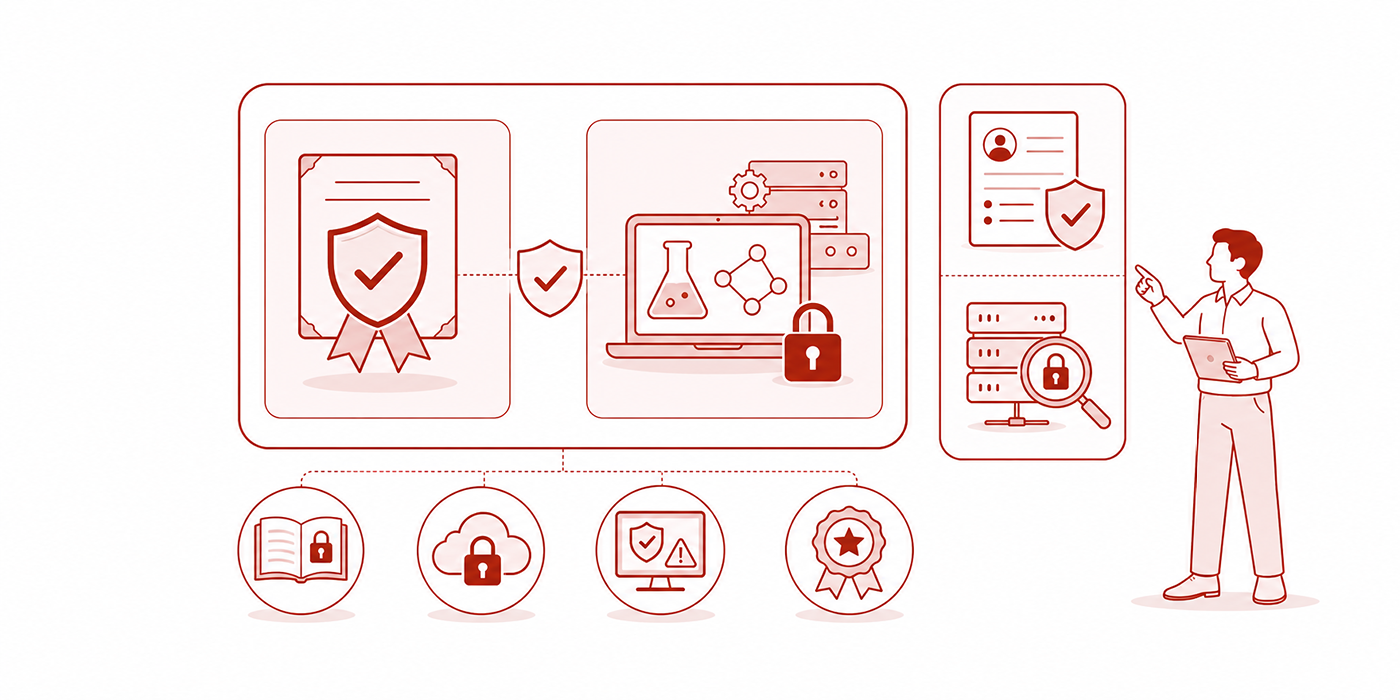
1. Cybersecurity Certifications vs Hands-On Labs: Which Gets More Interviews?
Certifications and labs influence different stages of the hiring process. A recognized credential can satisfy an HR filter, customer requirement, government-workforce condition, or hiring manager’s expectation of baseline knowledge. A candidate pursuing a cybersecurity analyst transition may use Security+ or an equivalent foundational credential to establish coverage of threats, controls, networking, identity, and risk.
A lab supplies a different signal. It can show whether the candidate can configure a system, interpret evidence, troubleshoot an unexpected result, document a finding, and explain the business consequence. Those capabilities become especially valuable across penetration-testing careers, red-team operations, security automation engineering, and vulnerability research.
The latest evidence supports a combined strategy. In ISC2’s 2025 hiring study, 47% of surveyed security managers considered certifications critical for entry-level hiring, compared with 44% for previous IT experience and 43% for relevant education. The same research found that 84% of organizations use a skills-based assessment or test for entry- and junior-level applicants. A credential may therefore improve access to the assessment, while applied competence determines how well the candidate performs once tested. ISC2’s cybersecurity hiring research provides the clearest answer to the cert-versus-lab debate: employers value the credential and frequently verify the underlying skill.
The résumé signals can be understood as a sequence:
Certification: “This candidate has studied an established body of knowledge.”
Lab: “This candidate has applied part of that knowledge.”
Documented artifact: “This candidate can explain the work and preserve useful evidence.”
Technical interview: “This candidate understands the choices, failures, and limitations.”
Professional experience: “This candidate has applied comparable judgment under real constraints.”
Candidates often overinvest in the first signal while leaving the remaining four weak. Someone targeting digital identity management gains more interview value from combining an identity-focused credential with a documented access-control lab. The project could demonstrate conditional access, role design, privileged accounts, joiner-mover-leaver workflows, and investigation of suspicious authentication.
The same principle applies to GRC careers, cybersecurity auditing, privacy analysis, and regulatory specialization. Hands-on work in these fields can include control testing, evidence validation, data mapping, risk scoring, policy exceptions, and remediation tracking. A virtual attack environment is only one form of practical cybersecurity experience.
Recent Reddit discussions add an important qualification. Hiring managers rarely care that a candidate owns a “home lab” as an isolated fact. They care about the understanding developed through it. One practitioner explained that a lab becomes valuable when the candidate can discuss how services were configured, which problems appeared, and how those problems were solved. Others warned that copying commands from a guided walkthrough becomes obvious during an interview. This distinction appears repeatedly in Reddit discussions about job-relevant home labs.
The winning mix is usually one relevant credential, two or three deep projects, strong foundational knowledge, and a résumé built around the target role. Advanced pathways such as security architecture, cybersecurity program management, security product management, and cybersecurity leadership require progressively stronger evidence of judgment, ownership, and organizational impact.
Cybersecurity Resume Signal Matrix: 28 Credentials, Labs and Proof Assets
| Resume Signal | What It Can Prove | What It Cannot Prove Alone | Best Supporting Evidence | Interview Value |
|---|---|---|---|---|
| Foundational certification | Baseline coverage of security concepts | Operational troubleshooting ability | One role-specific investigation | Good for early screening |
| Advanced certification | Broad professional knowledge | Experience at the implied seniority | Relevant employment outcomes | Strong when level-appropriate |
| Vendor certification | Knowledge of a specific platform | Transferable architectural judgment | Configured and tested environment | Strong for matching vacancies |
| Cloud certification | Cloud service and control familiarity | Secure deployment competence | Logged, hardened cloud workload | Strong with project evidence |
| Governance certification | Framework and assurance knowledge | Evidence-quality judgment | Completed control-testing workpaper | Strong for GRC roles |
| Guided training lab | Exposure to tools and procedures | Independent problem-solving | Modified scenario and reflection | Moderate |
| Independent home lab | Initiative and technical exploration | Production responsibility | Architecture, logs, failures and decisions | Good when explained clearly |
| SOC investigation | Alert triage and analytical reasoning | Live incident ownership | Timeline, queries and escalation note | Very strong for analyst roles |
| SIEM deployment | Telemetry collection and querying | Detection quality at scale | Data-source map and tuned alerts | Strong |
| Detection rule | Threat-to-telemetry translation | Reliable production performance | Test data and false-positive analysis | Very strong |
| Vulnerability assessment | Discovery and prioritization skills | Remediation ownership | Asset context and verified fixes | Strong |
| Penetration-test report | Testing and technical communication | Authorized production testing | Scope, evidence and remediation | Very strong for offensive roles |
| Threat model | Structured security reasoning | Control implementation ability | Architecture and mitigated abuse cases | Strong for AppSec |
| Secure-code review | Software vulnerability analysis | Development-team influence | Patch and regression test | Very strong for AppSec |
| Cloud-hardening project | IAM, logging and network controls | Enterprise cloud governance | Infrastructure as code and validation | Very strong |
| Identity-access project | Authentication and authorization skills | Enterprise lifecycle complexity | Role model and access-review evidence | Very strong for IAM |
| Incident-response exercise | Containment and investigation logic | Performance during a real crisis | Timeline and after-action report | Very strong |
| Automation script | Programming and workflow improvement | Reliability under production load | Tests, error handling and documentation | Strong |
| Control-testing workpaper | Audit and evidence analysis | Stakeholder negotiation | Sampling logic and finding rationale | Very strong for GRC |
| Risk assessment | Threat, impact and control analysis | Real risk acceptance authority | Treatment plan and residual risk | Strong |
| Privacy data map | Data-flow and privacy reasoning | Legal interpretation authority | Retention and rights workflow | Strong for privacy roles |
| Security policy portfolio | Governance writing and control intent | Operational effectiveness | Procedure and validation evidence | Moderate to strong |
| Open-source contribution | Collaboration and review discipline | Enterprise ownership | Merged contribution and discussion | Strong when relevant |
| Technical blog | Communication and conceptual depth | Execution under constraints | Reproducible technical artifact | Moderate |
| CTF achievement | Creative problem-solving | Professional reporting and scoping | Detailed write-up and remediation | Moderate for offensive roles |
| Internship | Workplace exposure and supervision | Independent ownership | Specific completed responsibilities | Very strong for beginners |
| Adjacent IT experience | Production systems and troubleshooting | Security-specialist depth | Security improvements within the role | Very strong |
| Professional reference | Reliability and collaborative behavior | Specific technical competence | Portfolio and verified outcomes | Strong near final selection |
2. What Reddit Hiring Managers Say About Certifications and Home Labs
Reddit’s career forums repeatedly describe certifications as filters rather than job guarantees. A foundational credential can move a candidate into the searchable pool, especially when a vacancy explicitly requests it. The credential becomes more persuasive when the résumé connects it to a cybersecurity analyst project, identity-security workflow, risk-management exercise, or cybersecurity audit sample.
One 2026 Reddit discussion summarized the market bluntly: certifications can help candidates reach interviews, while employers still expect troubleshooting ability, technical depth, and practical evidence. The same discussion emphasized that many cybersecurity positions build upon networking, system administration, cloud, development, or support experience. That advice aligns with ISC2’s workforce findings. In 2025, 56% of surveyed practitioners reported entering cybersecurity through IT experience. Only 6% identified certifications as their primary entry route. ISC2’s 2025 workforce study and the corresponding Reddit career discussion reveal why an IT-support transition can outperform a collection of disconnected credentials.
Reddit hiring managers also challenge shallow lab claims. “Built a home lab” provides no information about scope, complexity, decisions, or results. “Deployed Windows and Linux endpoints, forwarded authentication logs into a SIEM, simulated password spraying, wrote a detection query, and documented escalation criteria” creates a usable interview signal. The second version supports security-analysis progression, automation development, cybersecurity research, and eventual security-architecture work.
Context remains essential. An offensive-security lab has limited relevance to a privacy vacancy unless the candidate connects the testing to personal-data exposure, control failure, and remediation. A privacy analyst portfolio should emphasize data discovery, processing purposes, retention, access, third-party sharing, and rights requests. A regulatory specialist portfolio should demonstrate requirement mapping, evidence analysis, exceptions, and supervisory readiness. A policy analyst portfolio needs governance logic connected to operational controls.
The Reddit debate also reveals disagreement among hiring managers. Some value home labs heavily because they create richer technical conversations. Others give them little résumé weight because the claims are difficult to verify. Candidates can resolve that credibility gap through detailed documentation, reproducible steps, sanitized evidence, source files, test results, and honest limitations.
A credible lab entry should answer six questions:
What problem did the project address?
Which systems and data sources were involved?
What did the candidate personally configure?
Which failure or threat was tested?
What evidence supported the conclusion?
What would change in a production environment?
That structure can strengthen portfolios for AI security analysis, blockchain security engineering, quantum-security research, and cybersecurity data science. Specialized tools differ, while evidence, validation, and explanation remain consistent hiring signals.
3. How to Put Certifications and Labs on a Cybersecurity Resume
The certifications section should remain concise. Include the credential’s full name, issuing organization, completion date, and expiration date when applicable. Add an expected completion date only when exam preparation is active and the timeline is realistic. Candidates pursuing advanced cybersecurity management, security-program management, or cybersecurity leadership should prioritize credentials aligned with their present responsibility level.
Projects need more space because they carry the practical evidence. Give each major project a descriptive title, a one-line environment summary, and two or three outcome-focused bullets. Avoid presenting guided practice as professional employment. Use labels such as “Security Projects,” “Technical Projects,” “Selected Labs,” or “Applied Cybersecurity Work.”
A strong SOC project might read:
Endpoint Detection and Incident-Triage Lab
Deployed Windows and Linux endpoints, centralized authentication and process telemetry, investigated simulated credential-access activity, and produced a timestamped incident report. Built and tested three detection queries, documented false-positive conditions, and defined escalation criteria based on affected identity, asset criticality, and observed behavior.
This entry supports a cybersecurity analyst pathway, security-automation career, vulnerability-research direction, or cybersecurity research role. It also gives the interviewer several productive follow-up questions.
A GRC project might read:
Access-Control Audit and Risk-Treatment Exercise
Mapped eight access controls to organizational requirements, created an evidence request list, tested user provisioning and privileged-access samples, and documented two control gaps. Assigned risk owners, proposed remediation dates, and calculated residual risk after planned treatment.
That version demonstrates capabilities relevant to GRC specialization, cybersecurity risk management, cybersecurity auditing, and policy analysis.
Resume bullets should use accurate verbs such as configured, investigated, validated, mapped, tested, documented, automated, remediated, and presented. Words such as managed, led, secured, and architected imply broader ownership. Use them when the project genuinely supports that claim. Senior pathways toward chief security architecture, cybersecurity policy direction, chief privacy leadership, and VP-level security leadership require evidence of organizational consequences alongside technical output.
Keyword alignment also needs discipline. Mirror the vacancy’s terminology when your project genuinely used that capability. A résumé for digital identity management should surface IAM, MFA, RBAC, privileged access, identity lifecycle, and access review. A résumé for penetration testing should emphasize scoping, enumeration, exploitation, evidence, impact, remediation, and retesting. A red-team portfolio should explain objectives, assumptions, defensive visibility, and reporting quality.
Quick Poll: Which Resume Signal Is Missing From Your Cybersecurity Profile?
Choose the gap currently limiting your applications. Your selection reveals the highest-value next step.
Show My Best Next MoveYour priority: Select one credential repeatedly requested across your target vacancies. Use its curriculum to build a matching project while you study.
Your priority: Stop stacking credentials temporarily. Build one independent project that produces logs, decisions, failures, test results, and a concise work product.
Your priority: Rewrite every project around the security problem, your action, the evidence examined, and the outcome. Remove tool lists that provide no operating context.
Your priority: Rebuild one project without a walkthrough. Practice explaining assumptions, troubleshooting steps, limitations, and production changes aloud.
Your priority: Analyze 30 relevant vacancies and choose one primary role. Keep only the certifications, projects, and keywords that support that position.
4. The Certification-and-Lab Mix That Gets Interviews
For most early-career candidates, the efficient mix begins with one foundational certification tied to two substantial projects. Each project should resemble a responsibility found in current job descriptions. A candidate following the cybersecurity analyst route could combine foundational certification study with an endpoint investigation and an identity-alert investigation. Someone targeting GRC work could pair a relevant credential with a control audit and third-party risk assessment.
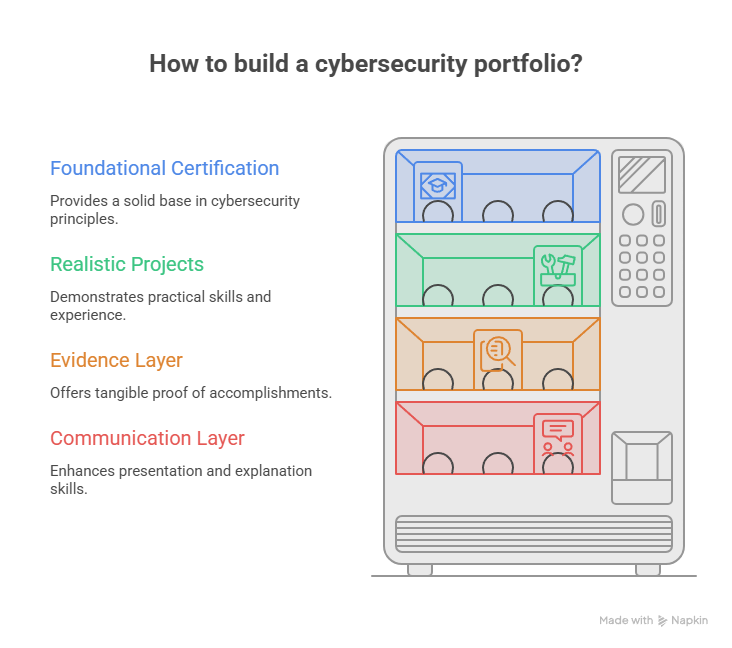
Use this four-layer portfolio model:
Knowledge layer: One recognized, role-appropriate certification.
Execution layer: Two independent projects that reproduce realistic responsibilities.
Evidence layer: Reports, diagrams, queries, code, workpapers, and test results.
Communication layer: A short business summary and a detailed technical explanation.
This model aligns closely with the NIST NICE Framework, which describes cybersecurity through tasks, knowledge, and skills. NIST’s research on performance-based assessment focuses on whether candidates can perform work-relevant tasks and transfer learning into a new context. That is the difference between completing a familiar walkthrough and responding to an unfamiliar failure. The NICE Framework can help candidates map projects to actual work, while NIST’s performance-assessment research explains why applied proof carries hiring value.
The optimal ratio changes by career stage. A complete beginner benefits from foundational structure and broad technical practice. An IT professional moving into security should emphasize existing production experience through an IT-to-cybersecurity transition, network-to-ethical-hacking pathway, or auditor-to-cybersecurity-auditor route. An experienced practitioner may need a specialized credential or targeted project to reposition toward AI security, digital identity, or cybersecurity automation.
Certification selection should follow vacancy evidence. Collect 30 job descriptions for one role and geography. Record every required and preferred certification, then calculate frequency. A credential appearing in 18 of 30 suitable vacancies deserves greater attention than an advanced certification mentioned twice. The same analysis should identify common tasks for a risk-management specialist, security policy analyst, privacy analyst, or cybersecurity regulatory specialist.
Every certification domain should produce a practical artifact. Network-security study can produce segmented architecture and firewall-validation evidence. Identity study can produce a role model and access review. Incident-response study can produce a timeline, containment decision, and after-action report. GRC study can produce a control matrix and exception log. This approach turns exam preparation into usable evidence for research analysis, security data science, blockchain security, or quantum-security analysis.
5. Common Mistakes That Weaken Certifications and Labs
Collecting overlapping beginner certifications creates diminishing returns. Three credentials covering similar fundamentals rarely outweigh one credential plus a serious project. Candidates planning to become a cybersecurity certification trainer, bootcamp instructor, or cybersecurity educator may benefit from broader credential coverage because teaching becomes part of the target work.
Choosing credentials above the target seniority can create an awkward signal. ISC2 found that some employers request experience-based certifications for entry-level positions even when candidates cannot yet satisfy the credential’s professional requirements. Thirty-eight percent of surveyed managers reported requiring CISA for entry-level roles, and approximately one-third expected CISSP. Candidates should still distinguish between passing an exam, holding a credential, and possessing the professional experience implied by it. ISC2’s hiring analysis documents this employer-candidate mismatch.
Copying guided labs word for word produces fragile knowledge. Interviewers can alter one condition and quickly discover whether the candidate understands the system. Add an unfamiliar log source, remove a required service, change a network route, create a false positive, or force an automation failure. Troubleshooting creates stronger evidence for security engineering, penetration testing, red-team operations, and automation engineering.
Building unrelated projects makes the résumé look busy and unfocused. A cloud-security applicant needs cloud IAM, logging, workload protection, and infrastructure-as-code evidence. A privacy specialist needs data-flow and governance work. A cybersecurity policy analyst needs control logic, stakeholder analysis, and implementation awareness. Relevance determines whether the project helps.
Listing tools without decisions creates shallow bullets. “Used Splunk, Wireshark, Nmap, Metasploit, Python, and Kali Linux” gives the reader a software inventory. Stronger bullets explain why each tool was used, which evidence it produced, how the candidate interpreted that evidence, and which action followed.
Hiding failures removes the most useful interview material. A failed deployment, noisy detection rule, broken parser, excessive permission, or incomplete risk assessment can demonstrate troubleshooting and professional honesty. Document the initial hypothesis, evidence gathered, correction made, and lesson transferred into the next design.
Technical capability also needs communication. ISC2’s 2025 workforce study found that hiring managers prioritized problem-solving, collaboration, communication, willingness to learn, and strategic thinking. Candidates pursuing cybersecurity program management, security product management, policy leadership, or VP-level security roles must show how evidence becomes a decision that other people can understand and act upon.
6. Frequently Asked Questions About Cybersecurity Certifications and Labs
-
A relevant certification can help a résumé pass HR, applicant-tracking, customer, or contract requirements. Interview probability rises when the same résumé also includes relevant experience, a focused project, measurable evidence, and role-aligned language.
A candidate targeting security analysis should pair foundational certification with alert-triage evidence. Someone pursuing GRC specialization should add control-testing and risk documentation.
-
Home labs represent applied learning. They carry less weight than authorized production responsibility because the candidate controls the environment, scope, timeline, and consequences. Their interview value can still be substantial when the work is independent, relevant, documented, and technically defensible.
A strong lab can support a penetration-testing portfolio, vulnerability-research portfolio, automation portfolio, or identity-security portfolio.
-
One relevant foundational certification is usually enough to begin applying and building projects. Additional credentials should address a specific vacancy requirement or capability gap.
A candidate can then specialize through cybersecurity risk management, privacy analysis, cybersecurity auditing, or AI security.
-
The best lab reproduces a responsibility found in the target job. Strong examples include an endpoint investigation, identity-access review, cloud-hardening project, detection-rule test, vulnerability-remediation report, threat model, control audit, or incident-response exercise.
Projects should align with the selected analyst pathway, red-team pathway, GRC pathway, or security-architecture pathway.
-
A guided lab deserves limited résumé space when it develops capabilities directly relevant to the vacancy. Improve its value by changing the scenario, introducing a failure, validating the output independently, and documenting what you learned.
Independent extensions create better evidence for cybersecurity research, security automation, blockchain security, and cybersecurity data science.
-
Place the section most relevant to the vacancy and strongest in evidence closer to the top. Candidates with limited experience may place certifications near the header and substantial projects immediately below the skills summary. Experienced professionals should usually prioritize employment outcomes.
Applicants pursuing cybersecurity program management, security product leadership, or cybersecurity leadership should lead with responsibility and results.
