
CCNA Before Cybersecurity? Reddit Career Advice on Networking Foundations, Job Access & Whether It’s Worth the Detour
A surprising number of people trying to break into cybersecurity without IT experience eventually hit the same wall: they can explain phishing, malware, SIEMs, and zero trust, yet struggle to explain what actually happens to a packet. That weakness matters when competing for SOC analyst jobs with no experience, building a cybersecurity home lab employers can verify, or proving the technical depth cybersecurity hiring managers actually want. CCNA can close that gap. The harder question is whether earning the entire certification moves your career forward fast enough to justify the detour.
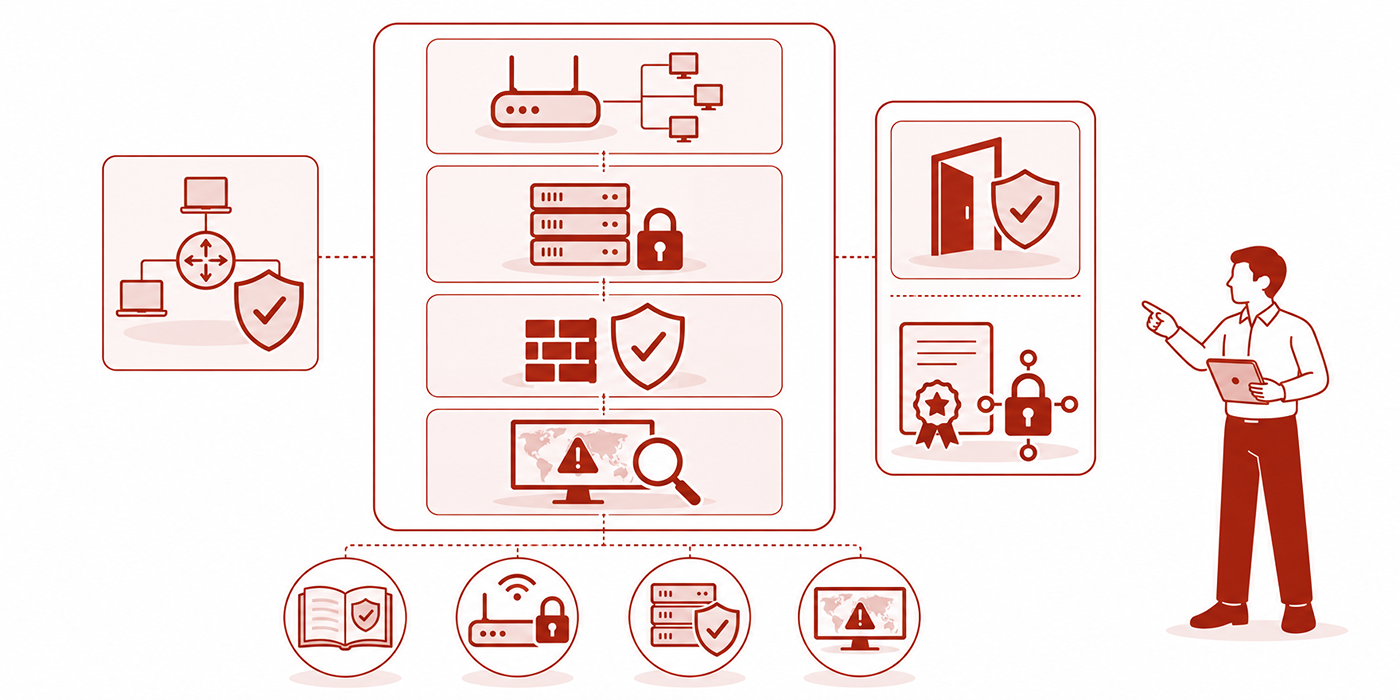
1. CCNA Before Cybersecurity: Why Networking Knowledge Keeps Coming Up on Reddit
Cybersecurity protects systems that communicate across networks. That single fact explains why networking knowledge remains valuable even when someone's intended job title contains no version of “network engineer.”
A SOC analyst interpreting an alert needs to distinguish source and destination IPs, private and public address space, TCP from UDP, expected ports from strange ones, internal from external traffic, and legitimate DNS behavior from suspicious resolution. An incident responder tracing lateral movement needs subnetting, routing, segmentation, DHCP, DNS, NAT, VLAN, and firewall context. A penetration tester needs to understand how traffic reaches targets. A cloud defender needs to reason through VPCs, subnets, route tables, security groups, load balancers, VPNs, and hybrid connectivity.
Those are exactly the weaknesses that become painful when someone builds a résumé around entry-level cybersecurity certifications without developing the knowledge required to investigate a real network. It is also why the strongest cybersecurity certification-and-lab strategy combines credentials with evidence, and why a no-experience cybersecurity résumé improves when it demonstrates configuration, troubleshooting, and investigation rather than listing acronyms.
Cisco's current CCNA exam covers network fundamentals, network access, IP connectivity, IP services, security fundamentals, and automation and programmability. The current 200-301 CCNA v1.1 exam lasts 120 minutes and has no formal prerequisite. Cisco has also announced that v1.1 testing ends on February 2, 2027, ahead of a CCNA v2.0 refresh that will increase emphasis on practical assessment, troubleshooting, security, and AI-related material.
That curriculum goes materially deeper into networking than an introductory security certification. You are expected to understand switching, VLANs, trunks, spanning tree, EtherChannel, IPv4 and IPv6, routing, OSPF, ACLs, NAT, DHCP, DNS, wireless concepts, device management, security controls, and automation. Cisco's official training also includes configuration and troubleshooting exercises around VLANs, inter-VLAN routing, static routes, OSPF, ACLs, NAT, port security, RADIUS, SNMP, and syslog.
That depth explains the strongest Reddit argument for CCNA: even people who never become network engineers frequently report that learning the material dramatically improves how they reason about infrastructure.
In a May 2026 discussion, commenters described CCNA as a strong demonstration of networking fundamentals, while one professional reported beginning in networking and later pivoting into cybersecurity and cloud. Another reported using CCNA knowledge to move from support toward stronger infrastructure opportunities. A June 2026 cybersecurity-career discussion similarly included experienced practitioners arguing that networking knowledge gives security professionals a stronger technical bedrock.
The qualification is important: learning CCNA material and needing the CCNA credential are separate decisions.
Someone pursuing SOC analyst work, network security, incident response, threat detection, or eventually security engineering can extract enormous value from the full curriculum. Someone pursuing GRC cybersecurity, cybersecurity policy, privacy analysis, or regulatory work may need networking literacy while gaining less career leverage from months of Cisco-specific configuration practice.
The mistake is asking, “Is CCNA good?”
The useful question is: which weakness in my career does CCNA solve?
If your problem is that you cannot interpret network traffic, understand segmentation, troubleshoot connectivity, or compete for infrastructure jobs that can lead into security, CCNA attacks the bottleneck directly. If your problem is that you have strong networking experience but no security evidence, another six months of networking study can become procrastination disguised as preparation.
That distinction matters even more in the 2026 cybersecurity job market, where candidates already lose time chasing credentials that fail to address the reasons they are being rejected. Understanding why cybersecurity graduates struggle to get hired, what constitutes verifiable cybersecurity project evidence, and how certifications compare with practical labs is therefore essential before committing to the exam.
CCNA-to-Cybersecurity: 30-Skill Career Leverage Matrix
| CCNA Skill | Cybersecurity Use | Most Relevant Roles | How Deep Should You Learn It? |
|---|---|---|---|
| OSI/TCP-IP models | Locate where communications and attacks occur | SOC, IR, pentesting | Master |
| IPv4 addressing | Identify hosts, scopes and traffic relationships | Almost every technical security role | Master |
| Subnetting | Understand segmentation and attack scope | SOC, cloud, network security, IR | Master practical subnetting |
| IPv6 | Analyze modern addressing and overlooked attack surfaces | SOC, network security, pentesting | Strong working knowledge |
| MAC addresses | Understand Layer 2 identity and local traffic | SOC, network security | Strong foundation |
| ARP | Understand local address resolution and spoofing | SOC, pentesting, network defense | Master behavior |
| TCP | Interpret connections, flags and session behavior | SOC, IR, pentesting | Master |
| UDP | Analyze connectionless services and unusual traffic | SOC, IR | Master |
| Ports and protocols | Identify expected versus suspicious services | Every blue-team role | Master common services |
| DNS | Investigate malware resolution, tunneling and infrastructure | SOC, threat hunting, IR | Master |
| DHCP | Trace endpoint addressing and investigate rogue services | SOC, network defense | Working knowledge |
| VLANs | Understand segmentation and lateral-movement boundaries | Network security, SOC, pentesting | Master concept and configuration |
| 802.1Q trunks | Understand traffic crossing VLAN infrastructure | Network security, pentesting | Strong working knowledge |
| Inter-VLAN routing | Understand how segmented networks communicate | Network security, SOC | Strong working knowledge |
| Static routing | Follow traffic paths and troubleshoot reachability | Network security, cloud security | Master fundamentals |
| OSPF | Understand enterprise dynamic routing | Network security engineering | Working knowledge for most security roles |
| Routing tables | Determine why traffic takes a specific path | SOC, cloud, network security | Master interpretation |
| ACLs | Understand traffic filtering and access boundaries | SOC, network security, cloud | Master |
| NAT/PAT | Correlate internal hosts with translated external traffic | SOC, IR, network security | Master concepts |
| Spanning Tree | Understand switched-network topology and failures | Network engineering/security | Moderate depth |
| EtherChannel | Understand aggregated links and enterprise topology | Network security engineering | Basic-to-moderate |
| Wireless fundamentals | Understand WLAN security and authentication | Security analyst, pentesting | Strong fundamentals |
| Port security | Understand Layer 2 access restrictions | Network defense | Strong working knowledge |
| AAA | Connect authentication, authorization and accounting to infrastructure | IAM, SOC, network security | Master concepts |
| RADIUS | Understand centralized network authentication | IAM, network security | Strong foundation |
| Syslog | Understand how infrastructure events reach monitoring platforms | SOC, SIEM, IR | Master practical use |
| SNMP | Understand monitoring telemetry and exposure risks | SOC, network defense | Working knowledge |
| SSH/device access | Understand secure administrative access | Infrastructure and security operations | Master fundamentals |
| APIs | Support security automation and modern infrastructure management | Security engineering, automation | Build practical familiarity |
| Automation concepts | Prepare for programmable infrastructure and security workflows | Cloud, SecOps, security engineering | Learn beyond exam memorization |
2. Which Cybersecurity Careers Benefit Most From CCNA?
The return on CCNA changes dramatically depending on where you are trying to go.
For SOC analysts, the value is high. SOC work is full of network telemetry: source IPs, destination IPs, ports, DNS requests, firewall events, proxy traffic, VPN connections, authentication logs, IDS alerts, and endpoint communications. Someone trying to become a SOC analyst without experience needs to understand those relationships quickly. Studying what SOC hiring managers want, creating SIEM-based portfolio evidence, and pairing that with CCNA-level networking creates a much stronger technical story than passing several introductory security exams.
For network security, CCNA is even more directly aligned. Firewalls, segmentation, VPNs, ACLs, routing, secure access, network telemetry, and architecture all depend on understanding the network underneath them. The progression from network support or NOC work into firewall administration and eventually security engineering is therefore logically coherent.
For penetration testing, networking knowledge is also valuable. Reconnaissance, service enumeration, pivoting, tunneling, segmentation, lateral movement, routing, and understanding reachable attack surfaces become easier when networking feels intuitive. Someone asking whether penetration testing is dying should focus less on tool memorization and more on durable infrastructure knowledge, particularly as offensive work intersects with cloud, identity, APIs, and modern enterprise networks.
For cloud security, CCNA is useful but incomplete. Subnets, routes, NAT, DNS, load balancing, VPN concepts, and traffic filtering transfer well to AWS, Azure, and Google Cloud. Cisco-specific command memorization transfers less directly. A cloud-focused candidate can therefore gain large value from CCNA networking fundamentals while eventually needing cloud-native identity, logging, configuration, architecture, and automation skills.
For IAM, networking knowledge provides context around authentication and system connectivity, particularly RADIUS, AAA, VPN access, and enterprise infrastructure. Someone moving toward a digital identity management career gains useful context, although identity platforms, directories, federation, SSO, OAuth/OIDC, privileged access, and lifecycle management will matter more than OSPF configuration.
For GRC, the calculus changes. A professional following a GRC specialist career path, cybersecurity risk management path, policy analyst route, or regulatory specialist career should understand networks well enough to assess controls intelligently. Passing CCNA can still help, but spending hundreds of additional hours perfecting routing configuration may deliver less leverage than learning NIST, ISO 27001, SOC 2, audit testing, vendor risk, cloud controls, and evidence assessment.
That is why “CCNA before cybersecurity” should never become a universal prerequisite.
The U.S. Bureau of Labor Statistics describes information security analysts as people who monitor networks, investigate breaches, check vulnerabilities, and help protect computer networks and systems. BLS also says many security analysts enter from related IT work, often including network and systems administration. This supports the career logic behind networking experience, while leaving room for other entry routes.
The strongest use case is someone who currently has weak networking knowledge plus weak professional IT experience.
The weaker use case is someone who already understands networks professionally and is delaying security applications because they believe one more credential will finally make them “ready.” That pattern is particularly dangerous in a market where graduates already struggle with hiring signals, candidates overestimate certification-only résumés, and applicants underestimate how much portfolio evidence recruiters can verify.
3. Can CCNA Actually Help You Get a Job Before Cybersecurity?
This is where CCNA can become more than a learning exercise.
One of the biggest entry-level cybersecurity problems is circular:
Security jobs want experience → beginners cannot get security experience → beginners apply to more security jobs → rejections continue.
A networking role can break that loop.
Cisco identifies entry-level network engineer, network administrator, network support technician, and help desk technician among roles suited to its CCNA training. In practice, job titles worth searching include NOC Technician, Network Support Technician, Network Operations Analyst, IT Support Specialist, Infrastructure Support Analyst, Junior Network Administrator, Network Technician, Junior Network Engineer, Field Network Technician, Technical Support Engineer, and some MSP support roles.
These positions can give future security applicants something their certification stack cannot: responsibility for real systems.
You may troubleshoot DNS failures, inspect packet paths, manage switches, work tickets, document incidents, escalate outages, maintain network devices, support VPNs, review firewall rules, investigate authentication problems, or interact with enterprise monitoring. That experience can later strengthen applications for SOC analyst positions, especially when combined with the kinds of security projects hiring managers can inspect.
This pathway also addresses a major problem highlighted by the cybersecurity job-market saturation discussion: a candidate with zero professional technology experience is competing against applicants who may already understand production environments, ticketing, troubleshooting, documentation, escalation, and operational responsibility.
Reddit experiences in 2026 show both the opportunity and the limitation.
One May discussion included a candidate who had moved from tier-two help desk and described CCNA as a strong selling point while emphasizing that it does not automatically produce a high-paying networking job. Another commenter reported landing a NOC position after earning CCNA despite coming from a non-IT academic background.
An August thread included someone who transitioned from a telecom/voice background after passing CCNA and said the networking knowledge remained valuable beyond the credential itself. The recurring advice was to combine CCNA with labs or experience rather than expecting the certificate to substitute for both.
That distinction should shape your application strategy.
A CCNA candidate with no lab evidence may know the exam.
A CCNA candidate who can show a Packet Tracer topology containing multiple VLANs, inter-VLAN routing, ACLs, DHCP, OSPF, NAT, logging, and troubleshooting documentation can demonstrate application.
A CCNA candidate who then feeds logs into a SIEM, captures packets with Wireshark, documents a port scan, detects abnormal DNS behavior, writes an incident report, and explains how segmentation would contain lateral movement has converted networking into cybersecurity evidence.
That is the bridge.
It follows the same proof principle behind building a cybersecurity home lab that helps you get hired, constructing a resume without security experience, choosing the right mix of certifications and hands-on labs, and understanding why Security+ by itself may fail to unlock employment.
The labor data also shows why the network-job detour should be treated strategically. BLS reports a 2025 U.S. median wage of $99,130 for network and computer systems administrators, while projecting employment in that specific occupational category to decline 4% from 2025 to 2035, with about 13,400 openings annually driven by replacement needs. BLS notes that automation, DevOps, outsourcing, and Network-as-a-Service are changing the occupation.
Meanwhile, information security analyst employment is projected to grow 21% between 2025 and 2035, with about 14,100 openings per year and a May 2025 median wage of $129,180. These statistics describe broad U.S. occupational categories rather than guaranteed outcomes for CCNA holders, but they reinforce a useful strategy: networking can be a foundation and access route, while security can remain the longer-term destination.
4. CCNA vs Network+ vs Security+: Which Should Come First?
These certifications solve different problems, so comparing them solely by perceived prestige produces bad career decisions.
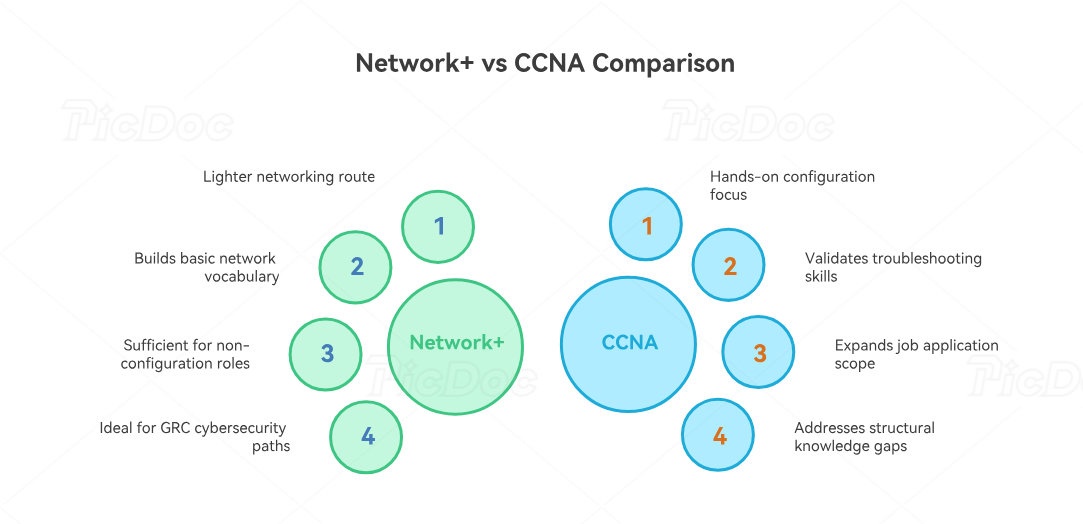
Network+ is generally the lighter networking route. Someone who wants networking literacy without committing deeply to Cisco-style routing and switching can use it to build vocabulary around addressing, protocols, infrastructure, troubleshooting, and network security concepts. For a candidate pursuing GRC cybersecurity, cybersecurity privacy, policy analysis, or another role where technical understanding matters more than network configuration, that level of depth may be sufficient.
CCNA makes more sense when you want networking knowledge that you can configure and troubleshoot. It carries particular leverage for candidates considering NOC, network support, junior infrastructure, SOC, network defense, cloud networking, security engineering, or offensive security. Reddit discussions in 2026 repeatedly distinguish those use cases: some commenters recommend the CCNA foundation strongly for SOC and network-security ambitions while suggesting that other security paths may get faster returns from more directly aligned study.
Security+ answers a different question. It establishes broad foundational cybersecurity coverage rather than networking depth. Candidates studying whether Security+ is enough for employment should understand that its usefulness rises when combined with genuine IT knowledge and hands-on evidence recruiters can inspect.
For someone starting nearly from zero and targeting SOC, one productive sequence is:
Networking fundamentals → practical networking labs → Security+ or equivalent security fundamentals → SIEM/security labs → targeted applications.
Whether “networking fundamentals” requires passing CCNA depends on job strategy.
If you want to apply simultaneously to NOC + networking + SOC jobs, earning CCNA can expand the set of positions for which your résumé makes sense.
If you already work in IT support or systems administration and understand networking well, spending months earning CCNA may produce less marginal value than building SOC investigation experience, understanding what SOC hiring managers demand, and creating portfolio deliverables from security labs.
If you have a cybersecurity degree but cannot explain subnetting, routing, NAT, VLANs, DNS, or TCP sessions, CCNA can address a structural weakness that another security credential will leave untouched. That is particularly relevant given the documented problem of cybersecurity graduates still struggling to find jobs.
The same principle applies when comparing a cybersecurity degree against certifications or deciding among a bootcamp, degree, and certification route. Ask what capability and job access the next investment buys.
A useful decision test is:
Choose full CCNA if three or more of these apply: you struggle with subnetting; you cannot confidently read routing tables; VLANs are fuzzy; packet captures overwhelm you; you want NOC/networking roles as fallback entry points; SOC is your target; network security interests you; cloud networking interests you; or you want infrastructure experience before specializing.
Study selected networking material without prioritizing the exam when your target role derives less hiring leverage from the credential itself.
That saves candidates from the certification treadmill that contributes to entry-level cybersecurity frustration and keeps learning tied to actual employability.
5. How to Use CCNA as a Cybersecurity Launchpad Without Losing a Year
The highest-value CCNA strategy for an aspiring security professional is to build networking knowledge and security evidence simultaneously.
Start with IP addressing and subnetting. Build several networks in Packet Tracer. Create user VLANs, server VLANs, management VLANs, and an intentionally isolated sensitive subnet. Configure inter-VLAN routing. Then explain which systems can communicate and why.
That turns subnetting into segmentation knowledge.
Next, configure ACLs that permit required services while blocking unnecessary flows. Document the business rule each ACL enforces. Capture what happens when traffic is permitted and denied.
That turns ACL configuration into access-control evidence.
Configure NAT and record how internal addresses appear externally. Then capture traffic in Wireshark and explain what a SOC analyst would see from inside versus outside the translation boundary.
That turns NAT into investigation knowledge.
Configure DNS, DHCP, SSH, syslog, NTP, and AAA concepts. Send available logs to a monitoring environment. Generate failed logins. Trigger a port scan. Run suspicious DNS queries in an isolated lab. Document the observable artifacts.
That turns infrastructure administration into SOC portfolio evidence.
Then create deliverables:
a logical network diagram;
an IP addressing plan;
a VLAN and segmentation table;
an ACL rule explanation;
packet-capture screenshots with interpretation;
a short troubleshooting report;
a simulated incident timeline;
a security-hardening checklist;
an executive explanation of the security risk;
a GitHub or portfolio README showing what you built and why.
These artifacts can be translated directly into a cybersecurity resume with no professional experience. They also address the core weakness in relying on certifications without hands-on labs.
A practical 12-week path could look like this:
Weeks 1-2: TCP/IP, Ethernet, IPv4, subnetting, ARP, TCP, UDP, DNS, DHCP. Spend more time explaining packet movement than memorizing definitions.
Weeks 3-4: Switching, VLANs, trunks, spanning tree, EtherChannel, inter-VLAN routing. Build multiple Packet Tracer environments and break them deliberately.
Weeks 5-6: Static routes, OSPF, routing tables, ACLs, NAT/PAT. Practice tracing a packet hop by hop.
Weeks 7-8: Wireless, device security, SSH, port security, AAA, syslog, SNMP, NTP, infrastructure security fundamentals.
Weeks 9-10: Automation, APIs, configuration review, troubleshooting, mixed-topic labs.
Weeks 11-12: Exam preparation plus security integration. Add Wireshark, SIEM logs, scanning, incident analysis, and documentation to existing network labs.
During that entire period, applications should continue where realistic. Someone trying to enter cybersecurity with no IT background can apply to NOC, support, infrastructure, and junior-networking positions while continuing to build toward SOC opportunities.
Do not create a six-month “study bunker” in which no one sees your work.
The 2026 Reddit discussions are useful here. One current system administrator considering whether to stop CCNA and switch to CySA+ described exactly the tradeoff many working candidates face: limited study time, a cybersecurity target, and concern about spending too long on networking. The right response to that situation depends on what is already strong. A systems administrator who routinely handles networking may require less CCNA preparation than a graduate whose security education never produced operational network fluency.
Build a stop condition before studying.
For example:
“I am pursuing CCNA because I cannot yet troubleshoot enterprise networking and I want both NOC and SOC job access. Once I can subnet reliably, interpret packet flows, configure VLANs and routing, troubleshoot ACL/NAT problems, complete three documented labs, and pass the exam, networking study stops being my primary focus.”
That prevents certification accumulation from replacing career execution.
The same discipline matters when evaluating AI's effect on entry-level cybersecurity. Automation may reduce the value of repetitive configuration, but it increases the value of people who understand what automated systems are changing, can validate outcomes, troubleshoot failures, and reason about infrastructure. Cisco itself is moving the next CCNA version toward more troubleshooting, practical assessment, security, and AI integration.
The durable asset is therefore deeper than the badge: you become harder to fool by the network.
That competence carries into SOC operations, penetration testing, security automation, AI security, and eventually security architecture.
6. FAQs About Taking CCNA Before Cybersecurity
-
CCNA is particularly valuable when weak networking knowledge is limiting your understanding of security or when you want NOC, network-support, or infrastructure jobs as realistic entry points. Cisco's current CCNA curriculum covers networking, IP connectivity, security fundamentals, and automation, giving it meaningful overlap with SOC, network defense, cloud, and offensive-security work.
The career payoff becomes stronger when CCNA sits beside practical cybersecurity labs, a proof-based cybersecurity résumé, and targeted preparation for what SOC employers actually ask for.
-
CCNA establishes networking knowledge rather than proving complete cybersecurity capability. A security employer may still expect familiarity with operating systems, logs, SIEMs, threats, vulnerabilities, identity, incident handling, and security tooling.
Candidates should therefore avoid the same trap discussed in analyses of Security+ as a standalone credential. Combine CCNA with security-focused project evidence and understand the role-specific expectations described in the SOC hiring-manager guide.
-
For someone with weak networking fundamentals targeting SOC or network security, beginning with networking can create a stronger base. For someone already comfortable with routing, switching, TCP/IP, DNS, ports, VLANs, and packet analysis, Security+ may close the more relevant gap.
The decision should follow the same logic used when comparing degrees and cybersecurity certifications or comparing bootcamps, degrees, and certifications: invest in the missing capability that appears repeatedly in your target vacancies.
-
It can be, especially when you need broad networking literacy and your target does not require deeper infrastructure configuration. CCNA becomes more compelling when you want NOC, network support, network security, SOC, or cloud-networking opportunities because its curriculum pushes further into configuring and troubleshooting networks.
Candidates targeting GRC, privacy, or cybersecurity policy may derive enough benefit from networking fundamentals without needing the same configuration depth.
-
This is one of its strongest strategic uses. Cisco training aligns with entry-level networking and support roles, and 2026 Reddit experiences include people reporting movement into NOC and networking work after earning the certification alongside practical knowledge.
That experience can later strengthen a no-experience cybersecurity transition because professional troubleshooting, network operations, ticketing, documentation, and production-system exposure answer several weaknesses that hurt applicants in the saturated entry-level cybersecurity market.
-
Yes. SOC investigations routinely involve IP addresses, ports, DNS, firewall logs, proxies, VPNs, TCP/UDP communication, segmentation, authentication, and packet movement. BLS explicitly lists monitoring organizational networks and investigating security breaches among core information-security-analyst duties.
Networking therefore strengthens both SOC interview readiness and the quality of a SOC-focused home lab.
