
Will AI Replace Entry-Level Cybersecurity Jobs? Reddit Reactions, Automation Trends & Skills That Become More Valuable
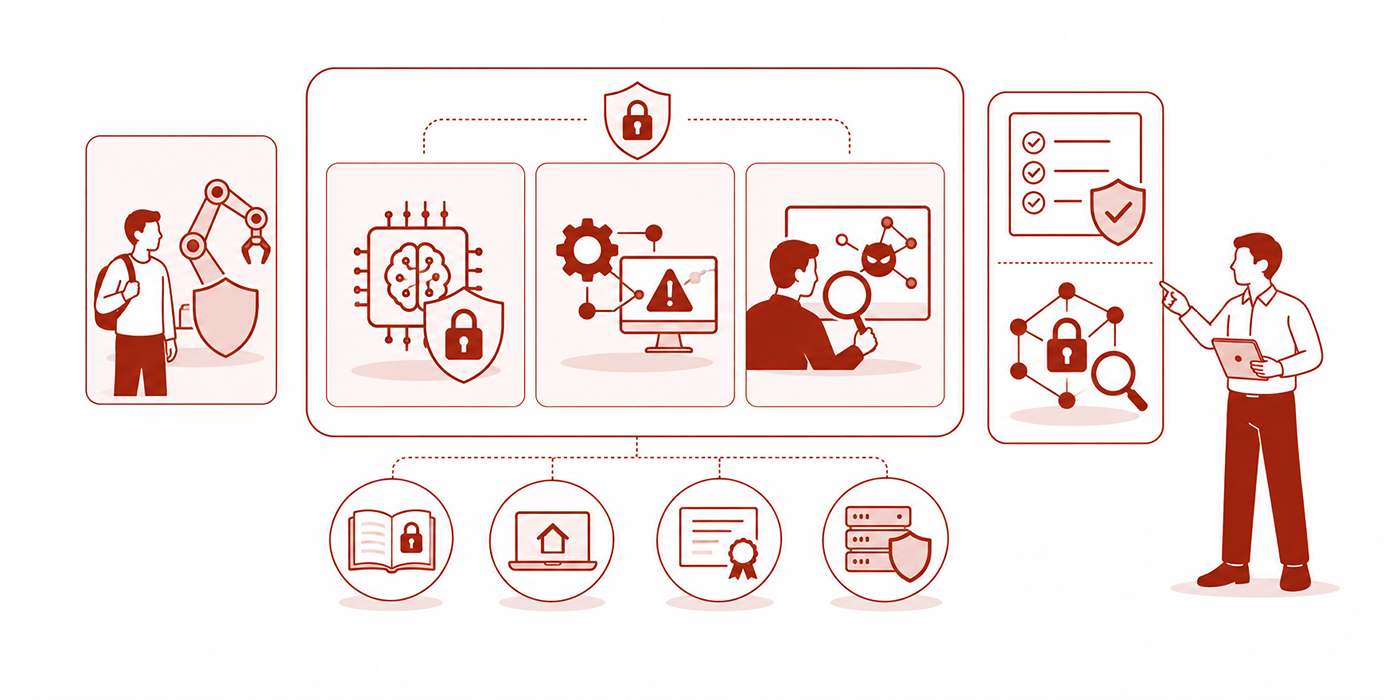
AI is already changing the work historically assigned to junior cybersecurity analysts. Alert enrichment, initial triage, log summarization, vulnerability prioritization, phishing review, and report drafting increasingly sit inside automated workflows. That creates genuine pressure on traditional Tier 1 roles while opening new routes around security automation, AI security analysis, SOC operations, and cybersecurity risk. The career question for beginners has therefore changed: which skills remain valuable when machines can perform more of the first-pass work?
1. Will AI Actually Replace Entry-Level Cybersecurity Jobs?
The clearest 2026 evidence says some entry-level cybersecurity work is already being automated, and the structure of junior roles is beginning to change.
ISC2 surveyed 856 cybersecurity professionals who actively use AI in May 2026. Fifty-six percent said AI had somewhat or significantly reduced the need for entry-level positions during the previous year. Another 19% reported little or no impact, 12% said AI had increased entry-level needs, and 13% remained unsure. At the same time, 53% believed AI was creating new types of entry-level cybersecurity roles.
That combination deserves more attention than either extreme prediction.
Traditional SOC analyst jobs have often given beginners repetitive work precisely because repetitive work is easier to supervise. Junior analysts review alerts, collect evidence, enrich indicators, query logs, classify phishing attempts, document findings, and escalate suspicious cases. Candidates preparing around SOC hiring requirements, hands-on security labs, and cybersecurity home-lab portfolios have traditionally trained for exactly this layer.
AI vendors are now targeting that layer aggressively.
Google Security Operations says its agentic SOC can autonomously handle alert triage, investigation, threat hunting, and detection engineering. Google claims one triage-and-investigation workflow can reduce a typical 30-minute manual analysis to around 60 seconds. Microsoft has introduced a Security Alert Triage Agent that reasons across evidence, identifies supported alerts as real attacks or false positives, and supplies explanations for analysts. CrowdStrike describes Charlotte AI as automating high-volume tasks including enrichment, alert triage, and routine investigation steps.
Those capabilities directly overlap with work historically performed by Tier 1 analysts.
The result can be a compression of the junior workload. A SOC that previously needed multiple people spending hours gathering context may require fewer analyst-hours when AI performs initial enrichment, correlation, summarization, and prioritization. Candidates already facing the cybersecurity experience barrier, graduate hiring problems, and a difficult 2026 cybersecurity job market therefore have a legitimate reason to rethink how they prepare.
Reddit anxiety reflects the same pressure. In a May 2026 r/cybersecurity discussion, a student pursuing a SOC career worried that companies were beginning to phase out junior analysts as AI handled more of the low-tier workload. Commenters generally expected lower-level analyst work to shrink faster than higher-judgment security work.
A separate September 2026 discussion from someone already working in a SOC raised an even more consequential possibility: companies may decide that a smaller group of experienced analysts equipped with better AI tooling can support workloads that previously required larger teams. The thread is anecdotal rather than proof of an industry-wide headcount trend, yet it captures the economic question executives will increasingly ask.
Cybersecurity demand itself remains substantial. CyberSeek currently shows 514,359 U.S. cybersecurity job listings across its reporting period, while approximately 10% explicitly reference AI skills. Employers continue hiring across starting, mid-career, and advanced positions. The opportunity therefore increasingly favors beginners who combine strong cybersecurity fundamentals, hands-on evidence, AI-security understanding, and evidence of judgment that survives beyond first-pass automation.
The greatest career risk is therefore being trained only for the tasks AI handles best.
| Junior Cybersecurity Task | AI Pressure | Human Skill That Gains Value | Best Evidence to Build |
|---|---|---|---|
| Basic alert enrichment | Very High | Context validation | SOC investigation proof |
| Routine phishing classification | Very High | Escalation judgment | Documented investigations |
| Log summarization | Very High | Knowing what evidence is missing | SOC-ready casework |
| Indicator enrichment | Very High | Threat-context interpretation | Security research skills |
| Writing incident summaries | Very High | Evidence validation | Defensible analyst reasoning |
| Basic vulnerability prioritization | High | Business-risk analysis | Risk-management capability |
| Repetitive SIEM querying | High | Query validation and hypothesis design | SIEM portfolio |
| Rule drafting | High | Detection logic evaluation | Automation engineering |
| IOC matching | High | Behavioral investigation | Threat research evidence |
| Ticket categorization | Very High | Escalation ownership | Real IT experience |
| Playbook execution | Very High | Exception handling | SOAR and automation skills |
| Basic malware explanation | High | Reverse-engineering judgment | Research depth |
| Configuration review | Medium-High | Architecture context | Systems fundamentals |
| Access-review assistance | High | Identity-risk decisions | IAM expertise |
| Compliance evidence collection | High | Control interpretation | GRC capability |
| Policy drafting | High | Governance judgment | Cybersecurity policy skills |
| Audit-document summarization | High | Assurance judgment | Cybersecurity auditing |
| Regulatory research summaries | High | Applicability analysis | Regulatory expertise |
| Privacy-document review | Medium-High | Data-flow and privacy judgment | Privacy analysis |
| Basic threat-intel briefs | High | Source evaluation | Research-analysis ability |
| Cloud-alert summarization | High | Cloud architecture reasoning | Broader technical depth |
| AI-generated remediation advice | High | Safe change validation | AI-security knowledge |
| Prompting security copilots | Medium | Prompt plus domain expertise | AI security practice |
| AI-output verification | Low | Critical thinking | Hands-on competence |
| Novel incident investigation | Medium | Hypothesis testing | Investigation depth |
| Incident containment approval | Low-Medium | Business-context judgment | Risk-based decisions |
| Stakeholder communication | Medium | Trust and explanation | Communication capability |
| Security architecture decisions | Low-Medium | Trade-off analysis | Broader security judgment |
| AI-system security testing | Growing Opportunity | Adversarial AI understanding | AI security specialization |
| Security automation design | Growing Opportunity | Engineering judgment | Automation portfolio |
2. Which Entry-Level Cybersecurity Tasks Are Being Automated Fastest?
The easiest work to automate has three characteristics: high volume, repeatable inputs, and relatively standardized outputs.
Alert enrichment fits perfectly. An analyst might previously open an IP address, examine threat-intelligence sources, retrieve user information, check endpoint history, correlate authentication events, review adjacent alerts, and summarize everything into a case. AI-enabled security platforms can increasingly collect and synthesize that information automatically. Candidates pursuing entry-level SOC roles therefore need deeper investigation capability alongside conventional SIEM lab experience, security certifications, and technical fundamentals.
Microsoft's current alert-triage agent illustrates this direction. It evaluates evidence across supported workloads, generates verdicts, and separates likely attacks from false positives. Microsoft also says its agentic phishing-triage approach identified 6.5 times more malicious alerts than analysts working alone in its testing. These are vendor-reported performance claims, yet they show where product investment is going.
Vulnerability management is moving similarly. AI can summarize weaknesses, connect CVEs with contextual information, rank remediation recommendations, and draft ticket content. Human value rises around whether a vulnerability is actually exploitable, what business process depends on the affected system, whether compensating controls exist, and which remediation creates the best reduction in exposure. Those capabilities overlap heavily with cybersecurity risk-management skills, GRC expertise, cybersecurity auditing, and regulatory security.
Documentation is another major target.
Incident summaries, audit evidence descriptions, policy drafts, executive briefs, ticket updates, detection explanations, and threat-intelligence summaries can all be generated quickly. A beginner whose primary value is “I can write the summary” faces more automation pressure than someone who can determine whether the summary is technically defensible.
That distinction matters across security policy careers, privacy analysis, cybersecurity research, and GRC roles. AI can draft language. Employers still require someone accountable for interpreting controls, validating evidence, resolving contradictions, and understanding organizational context.
Basic query creation is also changing. Microsoft Security Copilot can help generate or translate security queries and explain scripts, while modern platforms increasingly allow natural-language interaction with security telemetry. A junior candidate whose entire portfolio says “I know how to type several KQL or SPL queries” therefore needs additional depth. Build the ability to explain why a query works, what telemetry it depends on, where it can fail, which false positives it creates, and how you would validate its results.
The same principle applies to security automation engineering, AI security, and future cybersecurity data-science work. Generating code becomes cheaper. Understanding system behavior becomes more valuable.
There is also a hidden training problem.
Entry-level work historically develops senior analysts. Someone becomes good at incident response partly by reviewing hundreds of ordinary events, making mistakes in controlled environments, learning what normal behavior looks like, seeing false positives repeatedly, and gradually receiving harder investigations.
ISC2 found professionals almost evenly divided over whether AI has already reduced hands-on learning opportunities: 37% said it had, while 36% said it had not. Crucially, 62% said AI had not reduced the need for foundational cybersecurity skills.
Companies therefore face an apprenticeship problem: if automation removes much of the repetitive junior work, how do future senior analysts accumulate judgment?
That problem creates opportunity for candidates who proactively develop the experience employers can no longer assume junior jobs will teach.
3. What Reddit Cybersecurity Professionals Are Seeing in 2026
Reddit discussions contain three recurring camps.
The first camp expects fewer low-level SOC roles.
A May 2026 cybersecurity thread began with an aspiring SOC analyst worried about pursuing certifications while companies automated junior work. One of the highest-engagement responses argued that analyst roles would persist while low-tier analyst demand would fall. A June discussion similarly focused on automation of repetitive tasks, SOC work, compliance workflows, code review, and vulnerability analysis, with participants debating whether the result would be fewer junior positions or a reshaped career ladder.
That concern aligns with the ISC2 finding that 56% of AI-using cybersecurity professionals had already perceived reduced entry-level demand. Someone evaluating whether cybersecurity remains worth pursuing should therefore treat automation as a real career-planning variable alongside entry-level applicant competition, experience requirements, and employer skill expectations.
The second camp sees AI as force multiplication.
This group expects one analyst to process far more work because AI removes tedious collection and summarization. That view matches vendor positioning from Google, Microsoft, and CrowdStrike, whose products focus heavily on improving investigation speed while retaining human oversight for consequential decisions.
Force multiplication can still affect hiring. A company that previously needed ten analysts to process a workload may decide that six analysts using automation are sufficient. A different company may keep all ten and use the productivity gain to hunt more threats, improve detections, close vulnerabilities faster, and investigate cases that previously remained untouched.
The business response determines the headcount effect.
The third camp sees cybersecurity and AI converging into new specializations.
A July 2026 SOC Level 1 analyst on Reddit described studying agentic AI, RAG, MCP, LLMs, and security automation while deciding between conventional SOC progression and hybrid careers such as AI security engineer or security automation engineer. That route increasingly matches formal workforce signals. CyberSeek reports AI requirements in approximately 10% of current cybersecurity listings in its dataset. ISC2 found AI was the most pressing cybersecurity skills need in its 2025 workforce study, cited by 41% of respondents.
This makes AI security analyst careers, security automation engineering, cybersecurity data science, and cybersecurity research increasingly useful paths for technically ambitious entrants.
The larger Reddit discussion around entry-level hiring also reveals why AI cannot be examined in isolation.
A September 6, 2026 graduate described earning multiple certifications and building substantial labs involving Splunk, Active Directory, Nessus, Wireshark, Volatility, PowerShell, Entra ID, RBAC, and MFA while still struggling to gain traction with entry-level SOC, GRC, IAM, internship, and co-op applications. Another July discussion about the cybersecurity job market attracted hundreds of votes from applicants struggling to determine whether their problem was certifications, experience, projects, résumé quality, or market conditions.
AI therefore enters an already competitive entry market.
A candidate should respond by increasing evidence quality, expanding feeder-role strategies, improving the certification-and-lab mix, understanding degree-versus-certification ROI, and targeting the exact skills SOC employers value.
4. The Cybersecurity Skills That Become More Valuable as AI Improves
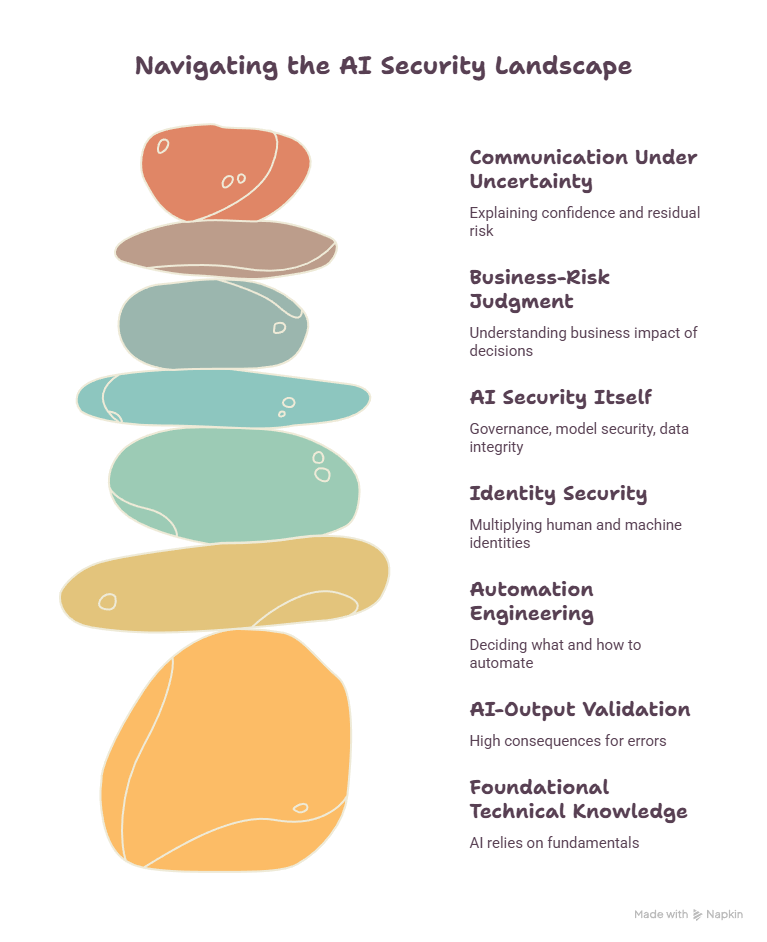
The first durable skill is foundational technical knowledge.
ISC2's 2026 AI research found 62% of respondents believed AI had not reduced the need for cybersecurity fundamentals. Networking, operating systems, identity, authentication, permissions, cloud architecture, HTTP, DNS, endpoints, logging, and basic scripting therefore become more important when AI is producing conclusions quickly. These fundamentals let analysts determine whether an AI recommendation makes sense.
Candidates following a no-experience cybersecurity roadmap, preparing for SOC analyst hiring, or building home-lab evidence should therefore resist the temptation to replace fundamentals with prompting.
The second skill is AI-output validation.
Security creates unusually high consequences for confident errors. ISC2 respondents expressed high concern about over-reliance on AI recommendations, rapidly scaled errors, reduced human judgment at critical decision points, unclear accountability, and difficulty explaining AI-influenced decisions.
A valuable analyst should be able to ask:
Which evidence supports this verdict?
Which telemetry was unavailable?
Could the model be confusing correlation with causation?
Did enrichment data come from a trustworthy source?
Could a benign administrative action produce the same indicators?
What would falsify the current hypothesis?
What is the impact of automatically containing this endpoint?
Which action requires human approval?
That reasoning raises the value of cybersecurity research skills, risk management, cybersecurity auditing, and AI security analysis.
The third skill is automation engineering.
If AI automates tasks, employers increasingly need people capable of deciding what should be automated, how the workflow should behave, which systems should connect, where approvals belong, and how failures should be handled.
Learn Python, REST APIs, JSON, Git, webhooks, orchestration concepts, SOAR playbooks, authentication, data parsing, logging, error handling, and basic cloud automation. Those skills support a direct move toward cybersecurity automation engineering, strengthen SOC analyst applications, and differentiate candidates whose portfolios contain only manually completed labs.
The fourth skill is identity security.
Human and machine identities are multiplying as AI agents gain access to data, tools, APIs, SaaS applications, and enterprise systems. Understanding RBAC, least privilege, OAuth, tokens, service accounts, privileged access, authentication flows, access reviews, and identity governance therefore creates strong crossover value. The digital identity management pathway, privacy analyst route, GRC pathway, and security risk career all gain from this foundation.
The fifth skill is AI security itself.
ISC2 reports that cybersecurity professionals increasingly need competence around AI governance, model security, data integrity, prompt engineering, AI risk, and security of AI-enabled systems. Its September 2026 guidance now maps AI topics across its certification portfolio and explicitly incorporates AI concepts into its entry-level Certified in Cybersecurity material.
Useful AI-security topics include prompt injection, sensitive-data leakage, model access control, RAG security, insecure agent permissions, model supply-chain risks, poisoned data, AI application threat modeling, shadow AI, AI governance, and monitoring autonomous actions. These areas directly strengthen candidates targeting AI security analyst careers, cybersecurity policy, regulatory security, and cybersecurity privacy.
The sixth skill is business-risk judgment.
An AI system can recommend isolating a server. A human analyst needs to understand whether that server supports payments, emergency care, manufacturing, identity infrastructure, payroll, or an internal test application. Response decisions depend on technical evidence and business consequences.
That raises the long-term value of cybersecurity risk management, GRC, policy analysis, regulatory expertise, and eventually cybersecurity leadership.
The seventh skill is communication under uncertainty.
AI can produce an executive-looking paragraph instantly. A strong analyst can explain the degree of confidence behind that paragraph, distinguish confirmed facts from hypotheses, communicate residual risk, and ask decision-makers for the specific action required.
ISC2's wider workforce research found AI adoption increasing demand for strategic mindsets, broader skill sets, and communication capability. In its 2025 study, 72% expected AI to create demand for more strategic cybersecurity skills, while 65% expected greater need for communication roles or skills.
Future-proofing therefore involves becoming the person who can evaluate, orchestrate, explain, and take responsibility for AI-assisted security decisions.
5. How to Build an AI-Resilient Cybersecurity Career From Zero
A beginner in 2026 should build a portfolio that proves they can work with AI and independently verify AI.
Start with networking, Windows, Linux, identity, logs, and cloud fundamentals. Candidates debating degrees versus certifications, bootcamps versus formal education, or certifications versus labs should treat these foundations as the substrate underneath every pathway.
Then build a realistic investigation environment.
Create an Active Directory lab. Generate authentication activity. Forward logs into a SIEM. Simulate password spraying or suspicious PowerShell. Create a detection. Allow an AI assistant to analyze the case. Then audit its answer.
Document where the AI was correct, what it missed, which evidence changed your conclusion, how you would tune the rule, and which containment action you would permit automatically. This produces far richer evidence than another “completed SOC lab” badge and strengthens the home-lab portfolio strategy, SOC hiring evidence, and first-job SOC pathway.
Your second project should involve automation.
Build a Python script or lightweight workflow that consumes a simulated alert, calls enrichment sources, structures the evidence, assigns confidence according to explicit rules, and produces a case record. Add logging, failure handling, rate-limit protection, and a manual approval gate before any destructive action.
That project gives you an entry point into security automation engineering, builds stronger technical evidence than another generic certificate, and creates a clear discussion topic when interviewers ask about AI-assisted security.
Your third project should involve AI security.
Build a small RAG or chatbot application around non-sensitive test data. Threat-model it. Test prompt injection. Examine whether permissions leak documents across roles. Log model interactions. Add access controls. Document likely abuse cases. Map risks to controls.
This demonstrates capabilities relevant to AI security analyst work, cybersecurity privacy, security policy, and regulatory security.
Your fourth project should test business judgment.
Take five vulnerabilities or incidents and rank them using asset criticality, exploitability, exposure, privileges, business dependency, available controls, remediation cost, and potential impact. Explain why a CVSS 9.8 issue might occasionally receive lower operational priority than a less severe vulnerability affecting a critical exposed asset.
That creates evidence relevant to cybersecurity risk management, GRC, cybersecurity auditing, and security leadership.
Apply broadly while building.
Someone with zero professional experience should consider IT support, NOC, IAM support, MSP roles, junior sysadmin work, cloud support, technical support engineering, GRC, IT audit, and security-adjacent operations alongside direct SOC applications. The realistic no-experience roadmap, IT-support-versus-degree decision, and current cybersecurity job-market analysis all support thinking beyond one narrowly defined job title.
Finally, avoid becoming an AI-dependent beginner.
During interviews, employers can probe your reasoning. If you cannot explain authentication, networking, permissions, logs, processes, detections, or incident logic without an assistant generating the explanation, your apparent productivity becomes fragile.
The strongest beginner can use AI to move faster while remaining capable of proving every important conclusion from underlying evidence.
That profile becomes more valuable as AI adoption accelerates.
6. FAQs About AI and Entry-Level Cybersecurity Jobs
-
Tier 1 SOC work faces substantial automation pressure because alert triage, enrichment, summarization, phishing review, and repetitive investigation are exactly the tasks vendors are automating. ISC2's July 2026 research found 56% of AI-using cybersecurity professionals perceived reduced need for entry-level roles over the previous year, while 53% also believed AI was creating new kinds of junior roles. Candidates should prepare for a narrower, more demanding version of entry-level SOC work by adding automation, AI-security knowledge, and stronger investigation evidence.
-
Cybersecurity continues to support a large labor market, with CyberSeek reporting more than 500,000 U.S. cybersecurity listings across its current reporting period. AI skills already appear explicitly in around 10% of those listings. Career value increasingly comes from choosing skills around current cybersecurity demand, AI security, risk management, and security automation.
-
Build networking, systems, identity, cloud, and security foundations first while learning AI tools alongside them. ISC2 found 62% of AI-using cybersecurity professionals believed AI had not reduced the need for foundational skills. Those foundations allow you to verify AI-generated security conclusions. The strongest preparation combines hands-on labs, SOC fundamentals, realistic entry routes, and AI literacy.
-
Prompting represents one layer of AI fluency. Higher-value security capability includes validating model conclusions, securing AI applications, designing safe automation, understanding identity and permissions, evaluating data integrity, recognizing prompt-injection risks, and deciding where human approval belongs. ISC2's current guidance highlights AI governance, model security, data integrity, AI risk, prompt engineering, and AI-system security as relevant competencies. Those skills connect directly to AI security careers, automation engineering, privacy, and GRC.
-
Strong opportunities are developing around AI security engineering, security automation, detection engineering, identity security, cloud security, AI governance, security architecture, threat modeling, GRC, risk management, privacy, and AI auditing. ISC2 reports AI as one of cybersecurity's leading skills needs, while 73% of respondents in its workforce research expected AI to create demand for more specialized cybersecurity skills. Relevant ACSMI paths include AI security analysis, cybersecurity automation, digital identity, and cybersecurity risk.
-
Include at least one investigation where an AI system produces a conclusion and you independently validate it using raw evidence. Add an automation project with approval gates and error handling, an AI application you threat-model and attack safely, and a risk-prioritization case that demonstrates business judgment. That portfolio creates stronger evidence than tutorial completion and aligns with home-lab hiring proof, SOC interview expectations, security automation, and AI security.
