
BTL1 vs Security+ for SOC Jobs: Reddit Experiences, Practical Skill Proof & Employer Recognition Compared
For aspiring SOC analysts, Security+ and Blue Team Level 1 solve different hiring problems. Security+ gives candidates broad cybersecurity vocabulary and stronger recruiter recognition, while BTL1 forces them to investigate phishing, logs, network traffic, SIEM data, and incidents. That distinction matters in a crowded cybersecurity job market, especially when SOC jobs demand experience, certifications compete with hands-on labs, and employers expect candidates to prove they can investigate rather than simply recognize security terminology.
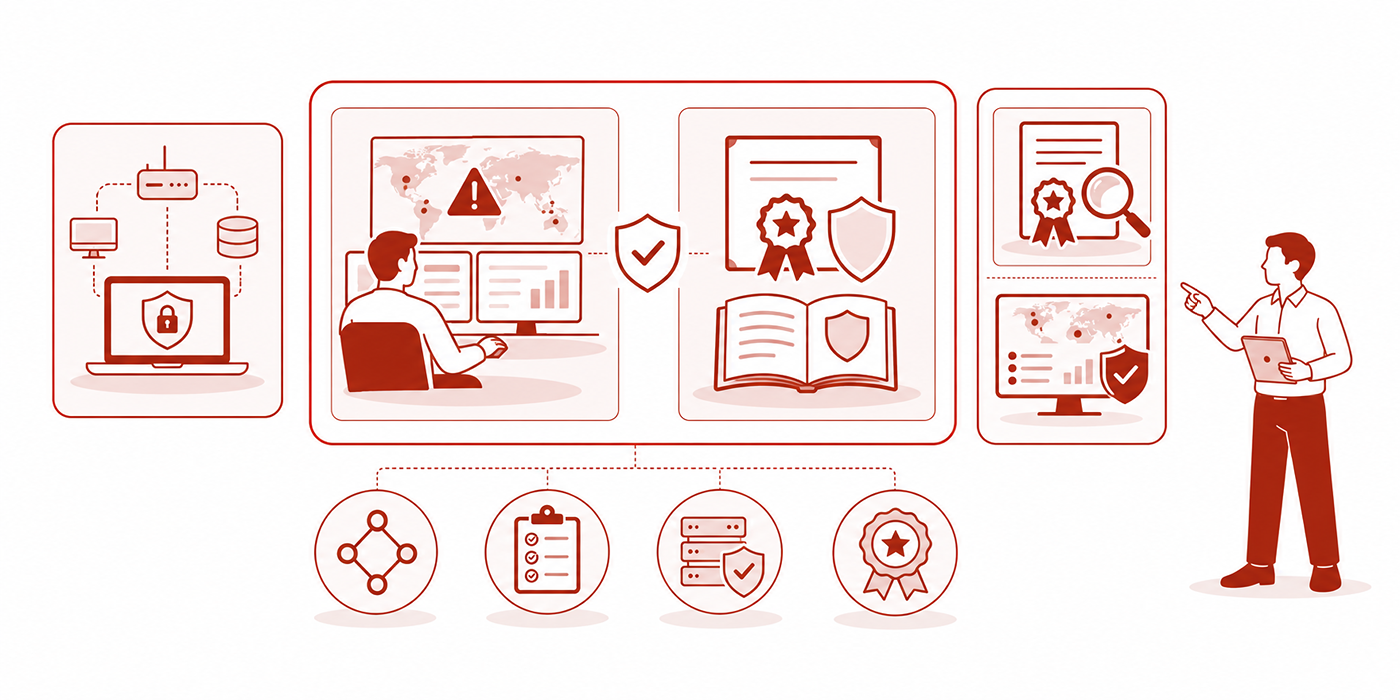
1. BTL1 vs Security+: The Difference That Actually Matters for SOC Hiring
The easiest way to understand this comparison is to separate getting recognized from proving operational ability.
Security+ has a large advantage in name recognition. It has been used for years as a general cybersecurity baseline, appears frequently in job descriptions, and gives recruiters an easily understood credential. That matters when an application first passes through HR rather than a SOC manager. Reddit discussions comparing the certifications repeatedly make this point. In a June 2025 cybersecurity discussion, several commenters favored Security+ specifically because employers actually listed it, while one commenter described it as a baseline qualification for junior analysts. Similar 2026 advice summarized the trade-off as using BTL1 for knowledge and Security+ for the HR checkbox.
That distinction becomes important for someone already struggling with a cybersecurity résumé without experience, evaluating whether Security+ alone is enough, wondering why cybersecurity graduates still face rejection, or researching what SOC hiring managers want. Recognition has practical value because a technically useful certification cannot help an application if the recruiter never understands what it represents.
BTL1 attacks the opposite weakness: operational proof.
Security Blue Team, now operating under Centri, describes BTL1 as a junior defensive certification designed around practical cyber defense. Its current curriculum includes phishing analysis, threat intelligence, digital forensics, SIEM investigation, incident response, Active Directory, networking, Splunk, Wireshark, Volatility, CyberChef, Sigma, PowerShell, and numerous forensic tools. The package currently includes more than 330 lessons and activities, 23 browser labs, and a 24-hour practical incident-response exam.
That makes BTL1 unusually aligned with the actual work candidates discuss when building a SOC analyst home lab, developing hands-on cybersecurity evidence, creating portfolio proof recruiters can verify, and preparing for entry-level SOC interviews.
The practical lesson is that these credentials optimize different stages of the hiring funnel. Security+ can improve discoverability and baseline credibility. BTL1 can strengthen technical interview performance and practical competence.
That is why asking “Which certification is better?” often produces conflicting Reddit answers. One commenter values recruiter filtering. Another values what happens when the candidate receives logs and must determine what happened. Both are discussing different bottlenecks.
Someone deciding whether cybersecurity is still worth entering, choosing a degree versus certifications, comparing a bootcamp with certification routes, or trying to break into cybersecurity without prior IT experience should therefore diagnose the missing signal before paying for either exam.
| Comparison Point | Security+ | BTL1 | What It Means for a SOC Candidate |
|---|---|---|---|
| Primary purpose | Broad cybersecurity foundation | Practical defensive-security capability | Different hiring problems require different signals |
| Recruiter recognition | Generally strong | Growing but less universal | Security+ may appear more frequently in keyword filters |
| SOC specialization | Broad security coverage | Strong SOC and blue-team emphasis | BTL1 maps more directly to analyst workflows |
| Exam style | Questions plus performance-based items | 24-hour practical incident-response exam | BTL1 requires sustained investigation |
| Security vocabulary | Strong breadth | Covered within blue-team context | Security+ helps build broad interview language |
| SIEM practice | Conceptual and scenario-based | Hands-on Splunk investigation | BTL1 offers stronger direct investigation evidence |
| Phishing analysis | Concept coverage | Dedicated practical coverage | Useful for common L1 SOC investigations |
| Network traffic analysis | Foundation-level understanding | Wireshark and investigative work | BTL1 gives candidates more investigative repetitions |
| Digital forensics | Broad concepts | Dedicated forensic tools and investigations | BTL1 develops deeper blue-team context |
| Threat intelligence | General security knowledge | Practical intelligence workflow | Relevant to enrichment and escalation |
| Incident response | Processes and decisions | Case-driven practical work | BTL1 builds investigation sequence awareness |
| Governance coverage | Stronger breadth | Secondary emphasis | Security+ transfers better outside pure SOC work |
| Risk concepts | Important exam component | Foundational coverage | Security+ supports broader security conversations |
| Cloud breadth | Broader general security coverage | Less central than defensive operations | Security+ transfers across more junior role types |
| Hands-on labs included | Depends on training package | Integrated browser labs | BTL1 bundles learning and practice together |
| Tool exposure | Vendor-neutral concepts | Multiple defensive tools | BTL1 creates stronger tool-based interview stories |
| Splunk | SIEM concepts | Hands-on Splunk usage | Valuable when SOC vacancies mention Splunk |
| Wireshark | Networking concepts | Practical packet analysis | Builds network-investigation confidence |
| Windows artifacts | General endpoint knowledge | Forensic artifact analysis | More directly useful during investigations |
| PowerShell exposure | Security relevance | Used within defensive content | Useful for Windows-heavy SOC environments |
| Best HR signal | Often stronger | More variable by employer | Check actual vacancy data before spending |
| Best practical-learning signal | Moderate | Strong | BTL1 helps close the theory-to-operations gap |
| Value outside SOC | Broad | More defensive-security focused | Security+ preserves wider career optionality |
| Beginner suitability | Designed for foundational security knowledge | Targeted at roughly 0–2 years experience | Both can fit beginners with the right foundation |
| Portfolio potential | Requires separate lab work | Training naturally generates investigation experience | Document the work rather than listing only the badge |
| Interview usefulness | Broad conceptual answers | Concrete investigation examples | Combining both signals can strengthen interviews |
| Credential maintenance | CompTIA continuing-education cycle applies | Current BTL1 credential is awarded for life | Long-term maintenance differs materially |
| Best question before buying | Do target employers request Security+? | Do I need practical SOC investigation skills? | Buy against a demonstrated gap |
2. What Reddit Experiences Reveal About Security+ Employer Recognition
Reddit's strongest argument for Security+ rarely centers on technical superiority. It centers on market visibility.
A 2026 thread asking whether someone should start with BTL1 or Security+ produced a particularly useful answer: search a year's worth of relevant SOC vacancies in your actual region and count how many mention each credential. Another commenter framed Security+ as the HR signal and BTL1 as the knowledge-building option. That advice is far more useful than blindly following a generic certification tier list.
A candidate pursuing SOC analyst jobs without experience faces multiple gates. The résumé must survive recruiter filtering. The candidate must then demonstrate the technical skills hiring managers expect, compete against people with degrees and certifications, and distinguish themselves in a saturated cybersecurity applicant pool.
Security+ addresses the first part well because recruiters know the name.
The June 2025 Reddit discussion is revealing. One commenter said jobs actually list Security+ as required or preferred. Another described it as a baseline qualification for junior analysts. A third advised pairing it with relevant technical experience. That final qualification matters. Someone who interprets recognition as a guarantee can end up becoming the person described in discussions about Security+ failing to generate interviews, graduates struggling to find cybersecurity jobs, or applicants discovering that certifications need hands-on proof.
Recognition helps the résumé reach human eyes. The technical interview still evaluates the person behind the credential.
Security+ also has broader portability. Its syllabus spans threats, architecture, operations, vulnerability management, identity, governance, risk, security controls, and incident-response concepts. That makes it useful for someone who may ultimately move away from SOC work toward IAM, GRC, cybersecurity auditing, risk management, or security architecture.
That breadth creates a strategic advantage for candidates whose exact specialization remains uncertain. Someone still deciding between SOC and GRC, evaluating whether penetration testing remains attractive, considering AI security, or exploring cybersecurity automation benefits from a credential understood across several security functions.
The pain point appears when candidates spend months preparing for Security+, pass it, apply to fifty SOC roles, and discover that they still cannot explain a suspicious PowerShell process, interpret authentication logs, analyze a phishing header, pivot through SIEM events, or construct an incident timeline.
That is where BTL1 becomes much more interesting.
3. Where BTL1 Gives SOC Candidates Practical Skill Proof Security+ Cannot Fully Replicate
BTL1's strongest value comes from repetition inside realistic defensive workflows.
The current curriculum explicitly covers phishing analysis, threat intelligence, digital forensics, SIEM, and incident response. Candidates work with Splunk, Wireshark, CyberChef, VirusTotal, Volatility, Event Viewer, Autopsy, KAPE, MISP, OpenCTI, TheHive, Sigma, and other tools. Centri positions it for students, IT personnel, security analysts, incident responders, threat-intelligence analysts, and forensic analysts with roughly zero to two years of experience.
That structure matters for someone building a cybersecurity home lab that employers can evaluate, trying to produce resume evidence recruiters can verify, learning what SOC interviewers actually test, or trying to enter cybersecurity without IT experience.
A good SOC interview can expose shallow learning quickly.
Consider a phishing question. Memorizing SPF, DKIM, DMARC, URL reputation, and attachment terminology gives you vocabulary. Investigating a phishing case forces you to determine sender legitimacy, inspect headers, decode suspicious content, examine infrastructure, understand payload behavior, connect evidence, assess impact, and recommend containment. The second experience gives you a story to tell.
The same applies to SIEM work. A candidate can define SIEM perfectly and still struggle when handed thousands of events. Practical training teaches the analyst to start with a hypothesis, identify useful fields, narrow the time window, pivot through users and hosts, distinguish normal activity from suspicious activity, reconstruct a sequence, and document findings. Those are precisely the capabilities candidates need when progressing beyond basic SOC entry knowledge, dealing with alert fatigue, developing security automation skills, or preparing for deeper cybersecurity research work.
Reddit discussions recognize that difference. In a 2025 Security+ versus BTL1 thread, commenters repeatedly described Security+ as better recognized while describing BTL1 as stronger for hands-on validation. A May 2026 discussion about certifications for obtaining a SOC role similarly characterized BTL1 as investigation-focused and practical. One respondent specifically highlighted incident response and actual threat analysis as its strengths.
A recent August 2026 discussion also shows how the conversation has evolved. A Security+ holder considering BTL1 received advice that the next gap after foundational certification is often end-to-end casework. Another commenter said BTL1 was useful for hands-on learners while discussing newer alternatives as well.
This reveals the central problem with certification collecting: candidates can accumulate credentials faster than they accumulate investigative judgment.
Someone following a degree-versus-certification strategy, considering bootcamp training, evaluating Security+ as a standalone signal, or confronting graduate hiring problems needs to ask a harder question:
Can I walk an interviewer through what I would actually investigate?
A BTL1 candidate should exploit that advantage aggressively. Do not leave the practical work trapped inside the course. Convert it into interview-ready evidence. Explain a phishing investigation. Show how you built a timeline. Describe what changed your hypothesis. Explain which logs mattered. Discuss false positives. Document a forensic workflow. Demonstrate how you would escalate a case.
That transforms BTL1 from a badge into proof.
4. Which Certification Should You Take First for a SOC Analyst Job?
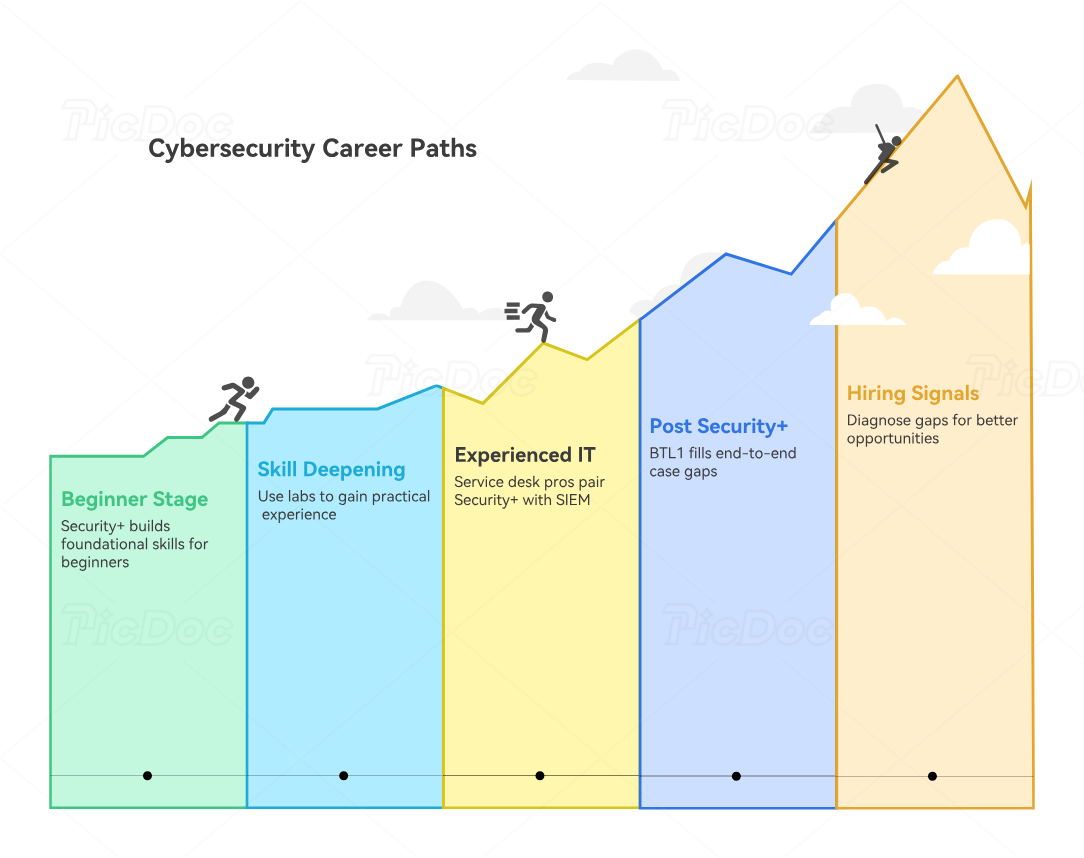
For many complete beginners, Security+ first creates the cleaner sequence.
That sequence makes sense when the candidate still needs broad security foundations and recruiter recognition. Learn networking, operating systems, authentication, common attacks, defensive controls, incident-response concepts, vulnerability management, cloud basics, and security governance. Security+ gives structure to those domains while creating a credential recruiters already recognize.
This is particularly useful for someone making a career change without IT experience, comparing certifications with college degrees, questioning whether cybersecurity remains worth pursuing, or trying to navigate entry-level job competition.
Then comes the critical second stage: turn breadth into operational depth.
That can mean BTL1, a strong SOC home lab, CyberDefenders, Blue Team Labs Online, TryHackMe SOC paths, LetsDefend, a SIEM project, or another credible source of investigation repetitions. The exact platform matters less than whether you can produce evidence.
For someone who already has significant IT experience, the sequence can change.
A service-desk technician with five years of Active Directory, endpoint troubleshooting, account access, networking, ticket escalation, and enterprise support may already possess much of the foundation recruiters hope Security+ represents. The June 2025 Reddit poster comparing Security+ with BTL1 had exactly that kind of background: five years in service desk and an intention to move into SOC work. The responses still leaned toward Security+ because of hiring recognition, while acknowledging BTL1's practical strength.
That candidate could reasonably pair relevant IT experience with Security+ and immediately start building SIEM investigation evidence, rather than spending another year collecting introductory credentials. The same principle applies to applicants studying what employers expect, strengthening a cybersecurity résumé, or deciding whether certification accumulation has stopped producing returns.
A third category deserves special attention: the candidate who already holds Security+.
For this person, repeating another broad beginner curriculum often produces diminishing returns. BTL1 becomes more attractive because it changes the type of evidence the candidate can offer. An August 2026 Reddit discussion from someone who had recently passed Security+ and was considering BTL1 drew exactly this response: after Security+, the missing element is often working a case from beginning to end.
That is a much sharper career-development principle than “collect the next cert.”
You should be able to map every learning investment to a missing hiring signal:
No recruiter callbacks → improve recognition, résumé alignment, and experience keywords.
Recruiter calls but no technical passes → improve labs, investigations, networking, Windows, SIEM, and incident-response reasoning.
Technical interviews go well but offers fail → improve communication, interview stories, role targeting, and competitive differentiation.
Candidates who understand that diagnostic logic make better decisions across Security+ and labs, bootcamps and degrees, SOC and GRC careers, and even decisions about whether to move toward IAM or security automation.
5. How to Turn Either Certification Into Proof That Gets SOC Interviews
The certification line on your résumé occupies perhaps one inch of space. The value comes from everything you can build around it.
A Security+ holder should deliberately compensate for the credential's broad nature with a SOC evidence portfolio.
Build a small environment containing Windows endpoints, a SIEM, authentication logs, endpoint telemetry, and controlled attack activity. Generate failed logins. Simulate suspicious PowerShell. Create a malicious file event. Trigger an unusual account action. Investigate the resulting evidence. Then document the timeline, data sources, queries, hypothesis, conclusion, and remediation.
That turns “CompTIA Security+” into a fuller candidate profile built around home-lab evidence, a project-focused cybersecurity résumé, the skills SOC managers actually evaluate, and the practical evidence required in a competitive cybersecurity market.
A BTL1 holder should resist another common mistake: writing only “Blue Team Level 1” under Certifications.
The real value is the work behind it.
Your résumé can describe experience with phishing analysis, Splunk investigations, network traffic analysis, digital forensics, incident response, threat intelligence, and case documentation. Describe outcomes and methods carefully without pretending lab work was professional employment.
For example:
Analyzed simulated security incidents using Splunk, Wireshark, Windows artifacts, threat-intelligence sources, and forensic tools to reconstruct attacker activity and document response actions.
That statement gives an interviewer something concrete to explore. It also aligns more naturally with SOC analyst hiring requirements, portfolio-driven hiring proof, résumé evidence recruiters can validate, and the broader argument for hands-on labs beside certifications.
The next layer is interview preparation.
Prepare at least five technical stories:
A phishing investigation. Explain headers, URLs, reputation checks, payload analysis, affected users, and containment.
A suspicious authentication investigation. Discuss user context, timestamps, source IPs, device information, geographic anomalies, MFA events, and escalation.
A malware or endpoint investigation. Explain process trees, hashes, persistence, command lines, network connections, and evidence collection.
A network investigation. Walk through packet analysis, protocols, suspicious connections, and what made the behavior abnormal.
A SIEM investigation. Show how you moved from an alert to supporting events, entities, timestamps, and a defensible conclusion.
Those stories help candidates answer technical questions far more effectively than repeating textbook definitions. They also prepare them for the actual pressures discussed in cybersecurity burnout and alert fatigue, where analysts must prioritize signals amid noise, and for future progression into automation engineering, security architecture, cybersecurity program management, or senior security leadership.
The strongest candidate profile therefore combines four layers:
recognized foundation + practical investigation + documented evidence + relevant IT experience.
Each layer compensates for weaknesses in the others.
Security+ plus zero practical work can look theoretical.
BTL1 plus zero recruiter recognition in a particular market can struggle at the screening stage.
Labs without fundamental understanding can produce cargo-cult tool usage.
Experience described badly can disappear inside a weak résumé.
Candidates should therefore think in systems, just as they would when evaluating cybersecurity career ROI, degree and certification combinations, entry barriers without IT experience, or the effect of AI on junior cybersecurity work.
6. FAQs About BTL1 vs Security+ for SOC Analyst Jobs
-
BTL1 provides substantially more direct defensive practice. Its current training includes phishing analysis, threat intelligence, digital forensics, Splunk, Wireshark, SIEM investigation, incident response, Windows artifacts, and a 24-hour practical exam. That structure aligns closely with a SOC analyst home lab, hands-on hiring evidence, SOC interview preparation, and the practical requirements behind entry-level SOC roles.
-
Reddit discussions consistently report stronger Security+ visibility in job postings and HR screening, particularly for junior roles. A June 2025 discussion included commenters describing Security+ as both commonly requested and a baseline qualification for junior analysts. Candidates should still verify their local market by searching actual vacancies. Recognition becomes especially relevant when addressing cybersecurity market saturation, a resume with limited experience, graduate hiring problems, and entry-level employer filters.
-
Security+ creates a strong sequence for candidates who still need broad security fundamentals and a widely understood credential. Add hands-on SOC work immediately rather than postponing practical learning until after the exam. Candidates can then use BTL1 or a substantial SOC home lab to deepen investigation skills. This approach also fits the broader 12-month cybersecurity entry roadmap, certification-versus-lab strategy, and degree-versus-certification decision.
-
For a SOC-focused candidate, the combination addresses two distinct gaps: Security+ adds broad foundational recognition, while BTL1 adds practical defensive depth. A 2026 Reddit discussion involving a recent Security+ holder highlighted end-to-end casework as the major next skill gap. Candidates should still compare that investment with building a strong cybersecurity home lab, developing a project-based résumé, strengthening SOC interview skills, and applying aggressively rather than waiting for a perfect certification stack.
-
A certification can strengthen an application, while the hiring decision usually depends on a larger evidence stack: previous IT work, networking knowledge, Windows/Linux familiarity, troubleshooting, SIEM exposure, practical investigations, communication, résumé quality, and interview performance. Reddit discussions repeatedly warn against expecting a single credential to create a job automatically. Candidates facing entry-level competition, graduate rejection, resume problems, or weak practical evidence should strengthen the entire profile.
-
BTL1 can provide stronger material for practical interview questions because candidates repeatedly work through defensive investigations. The advantage appears when the candidate can explain how they investigated rather than merely saying they completed the certification. Security+ remains useful for questions testing broad knowledge across controls, architecture, incident response, risk, identity, and security operations. Candidates should therefore prepare using SOC hiring-manager expectations, home-lab investigation evidence, portfolio-focused resumes, and the realities of SOC analyst entry routes.
