
How to Become a Cybersecurity Privacy Analyst
Cybersecurity privacy analysts are becoming essential because organizations now collect more personal data than their security teams can confidently trace, classify, protect, and justify. This career sits at the intersection of privacy regulations, cyber controls, risk documentation, vendor review, breach readiness, and business process design. If you are moving from IT support, compliance, audit, SOC, GRC, legal operations, or data governance, this pathway gives you a practical route into a role where security judgment must translate into privacy evidence.
1. What a Cybersecurity Privacy Analyst Actually Does
A cybersecurity privacy analyst helps an organization prove that personal data is collected, stored, shared, accessed, retained, and deleted in a controlled way. The role matters because privacy failures rarely begin with one dramatic breach. They usually begin with small operational gaps: a team launches a form without a retention rule, a vendor receives customer data without a completed risk review, an internal dashboard exposes more personal information than required, or a cloud tool keeps data longer than the business can defend. That is where a privacy analyst creates leverage.
The job blends the risk discipline of a cybersecurity compliance analyst, the control mindset of a cybersecurity auditor, and the regulatory awareness found in privacy regulations and cybersecurity trends. You are expected to understand how personal data flows through systems, how cyber controls protect that data, and how privacy obligations turn into documented procedures. A strong analyst can look at a product workflow, identify where customer data enters, name the risk, map the control, request evidence, and explain the business consequence in plain language.
The painful part for beginners is that “privacy” sounds abstract until hiring managers ask for concrete artifacts. They may ask whether you have helped with a data inventory, vendor privacy review, data protection impact assessment, access review, breach notification workflow, retention schedule, consent review, or control mapping exercise. Reading about GDPR cybersecurity compliance helps, but your real advantage comes from showing how a privacy obligation becomes a practical task. That is why the smartest path is to build proof around data mapping, risk assessment, incident response, cloud governance, and audit-ready documentation.
Privacy analysts also need security context. If you cannot explain how endpoint protection, SIEM logging, identity controls, encryption, DLP, vulnerability management, and cloud configuration affect personal data exposure, your analysis stays too shallow. Study the operational side through resources like endpoint detection and response tools, best SIEM solutions, data loss prevention software, and cloud security tools so your privacy recommendations connect to real technical safeguards.
| Readiness Area | What You Must Understand | Portfolio Proof to Build | Best ACSMI Resource to Strengthen It |
|---|---|---|---|
| Data Inventory | Where personal data lives, who owns it, why it is collected, and which systems process it. | Create a sample personal-data inventory for HR, sales, and customer support workflows. | privacy regulations and cybersecurity trends |
| Data Flow Mapping | How personal data moves between users, applications, vendors, cloud tools, and reporting systems. | Draw a data-flow map showing collection, processing, transfer, storage, and deletion points. | cloud security tools directory |
| GDPR Concepts | Lawful basis, data subject rights, minimization, retention, processor obligations, and breach timing. | Write a GDPR control checklist for a SaaS customer onboarding workflow. | GDPR cybersecurity best practices |
| NIST Alignment | How privacy controls can connect with identify, protect, detect, respond, and recover functions. | Map privacy risks to a simplified NIST-based control register. | NIST cybersecurity framework adoption |
| Risk Assessment | How likelihood, impact, data sensitivity, threat exposure, and control maturity shape privacy risk. | Create a risk register with inherent risk, control rating, residual risk, and owner. | cybersecurity compliance trends |
| DPIA / PIA Support | How to evaluate high-risk data processing before a tool, feature, or vendor goes live. | Draft a sample privacy impact assessment for an employee monitoring tool. | certifications and career advancement |
| Vendor Privacy Review | How third parties process, store, transfer, secure, retain, and delete personal data. | Build a vendor questionnaire focused on data categories, subprocessors, encryption, and breach notice. | cybersecurity firms for financial services |
| Access Control | How least privilege, RBAC, MFA, joiner-mover-leaver workflows, and privileged access reduce exposure. | Document an access review process for systems containing customer data. | access control models |
| Data Loss Prevention | How DLP tools monitor, block, alert, and report risky movement of sensitive information. | Write sample DLP policy logic for customer records, payroll files, and exported reports. | DLP software directory |
| Incident Response | How privacy analysis changes when personal data may have been accessed, exposed, or exfiltrated. | Create a breach triage checklist covering data type, affected users, timing, evidence, and escalation. | incident responder pathway |
| Security Logging | Which logs help prove unauthorized access, suspicious exports, privilege misuse, and breach scope. | Build an evidence checklist for investigating unusual access to personal data. | best SIEM solutions |
| Endpoint Protection | How endpoint compromise can expose regulated files, browser sessions, credentials, and local downloads. | Write a privacy risk note explaining why endpoint telemetry matters during data exposure review. | state of endpoint security |
| Email Security | How phishing, misdelivery, mailbox compromise, and insecure attachments create privacy incidents. | Create a mailbox compromise privacy impact checklist. | email security solutions |
| Cloud Governance | How storage buckets, SaaS permissions, API integrations, and cloud logs affect privacy exposure. | Produce a cloud privacy review checklist for a new SaaS integration. | future of cloud security |
| Vulnerability Context | How a technical weakness becomes a privacy issue when it touches personal or sensitive data. | Prioritize five sample vulnerabilities by data sensitivity and exploitability. | vulnerability assessment techniques |
| Audit Evidence | How screenshots, tickets, policies, approvals, logs, and review records support privacy assurance. | Create an audit evidence folder structure for access, vendor, retention, and incident controls. | security audit best practices |
| Healthcare Privacy | How HIPAA-facing environments require extra care around patient data, minimum necessary access, and audit trails. | Draft a healthcare privacy risk scenario for a patient portal vendor. | healthcare compliance and HIPAA |
| Financial Data Privacy | How financial institutions manage customer information, account data, fraud logs, and third-party exposure. | Build a financial data control matrix for customer onboarding and fraud review. | financial sector cybersecurity incidents |
| AI and Privacy | How model training, prompt logs, automated decisions, and shadow AI tools create privacy risks. | Write an AI privacy intake form for teams adopting a new AI tool. | AI in cybersecurity adoption |
| Ransomware Privacy Impact | How ransomware becomes a privacy crisis when attackers access, publish, or threaten regulated data. | Create a ransomware privacy impact timeline for notification decision support. | state of ransomware |
| Phishing Risk | How credential theft creates personal-data access, mailbox exposure, and secondary fraud risk. | Draft a phishing privacy incident triage worksheet. | phishing attacks trend report |
| Education Sector Privacy | How student records, LMS systems, parent portals, and third-party edtech tools change privacy obligations. | Create a student data vendor review checklist. | cybersecurity threats in education |
| Small Business Privacy | How lean teams manage consent, vendor risk, access, backups, and breach response with limited resources. | Write a lightweight privacy control plan for a 50-person company. | cybersecurity legislation for SMBs |
| Policy Writing | How to convert privacy requirements into usable procedures teams can follow during real work. | Draft a one-page data retention and deletion procedure. | cybersecurity frameworks |
| Metrics and Reporting | How to report privacy risk using findings, overdue actions, vendor status, training completion, and incident trends. | Create a monthly privacy risk dashboard outline for leadership. | cybersecurity market report |
| Career Positioning | How to translate compliance, SOC, IT, audit, or legal operations experience into privacy analyst language. | Rewrite your resume bullets around data protection outcomes, control evidence, and risk reduction. | IT support to cybersecurity analyst |
| Certification Planning | Which certifications help prove privacy, security, governance, audit, cloud, or incident response capability. | Create a 12-month certification roadmap matched to your current background. | cybersecurity certifications directory |
| Leadership Growth | How privacy analyst work can grow into privacy engineering, GRC leadership, security management, or CPO paths. | Map your next three roles from analyst to privacy/security leadership. | chief privacy officer career path |
| Interview Readiness | How to answer scenario questions about data exposure, vendor risk, product launches, and executive reporting. | Prepare five STAR stories around privacy risk, evidence, escalation, and remediation. | cybersecurity job market trends |
| Long-Term Differentiation | How to become the person who can bridge legal, security, product, data, and executive teams. | Build a portfolio case study showing end-to-end privacy risk handling. | future cybersecurity skills |
2. Skills, Frameworks, and Knowledge Areas You Need
Start with privacy fundamentals, then attach every concept to an operational security control. You should know personal data categories, sensitive data categories, data subject rights, consent, lawful basis, retention, purpose limitation, vendor processor obligations, cross-border transfer concerns, breach notification triggers, and privacy-by-design principles. Then connect those ideas to access control, encryption, DLP, endpoint security, SIEM monitoring, cloud configuration, vulnerability management, and incident response. This blend is what separates a serious privacy analyst from someone who only memorized definitions.
A strong beginner should study cybersecurity frameworks like NIST, ISO, and COBIT, because frameworks give structure to messy privacy problems. A privacy request might begin as a legal question, but the fix often lives in asset inventory, identity governance, logging, endpoint visibility, or vendor due diligence. If you understand access control models, vulnerability assessment techniques, security audits, and cybersecurity compliance trends, your privacy recommendations sound practical instead of theoretical.
The next skill is evidence thinking. Many candidates say they understand privacy, but they freeze when asked what proof an auditor, regulator, customer, or internal risk committee would need. For example, a retention policy has limited value unless there is evidence that systems actually delete, archive, or anonymize data on schedule. A vendor security questionnaire has limited value unless the organization reviews subprocessors, contract terms, encryption, access, breach notification timelines, and data return obligations. A breach playbook has limited value unless incident responders know when to involve privacy, legal, communications, customer support, and executives.
You also need writing skill. Privacy analysts write risk summaries, DPIA findings, vendor review notes, incident timelines, control gap statements, remediation tickets, policy updates, and leadership reports. Your writing must be precise enough for auditors and simple enough for product teams. Reading cybersecurity auditor career guidance, cybersecurity compliance officer roadmaps, and privacy regulation predictions helps you learn how control language, business risk, and regulatory language work together.
3. The Step-by-Step Career Path to Cybersecurity Privacy Analyst
Your first step is to choose your entry angle. IT support candidates should position themselves around access, endpoint security, asset inventory, and user data exposure. SOC candidates should emphasize incident triage, logs, phishing investigations, suspicious access, and breach scoping. Audit and compliance candidates should emphasize evidence collection, control testing, gap tracking, and policy review. Legal operations or data governance candidates should emphasize data mapping, records, consent, retention, vendor review, and documentation. Each background can work if you translate past experience into privacy outcomes.
For a technical entry route, build from IT support to cybersecurity analyst, then add privacy specialization through cybersecurity compliance analyst, cybersecurity auditor, and cybersecurity compliance officer skills. For a risk-focused route, study vendor risk, incident response, data governance, policy writing, and regulatory mapping. For a future leadership route, understand how this work can grow toward chief privacy officer, cybersecurity policy director, or cybersecurity leadership.
Your second step is to build a portfolio that proves you can perform the job before someone hires you. Create a sample data inventory for a fictional SaaS company. Build a vendor privacy assessment. Draft a breach triage checklist. Map privacy risks to NIST or ISO control families. Write a DPIA for an AI hiring tool, a patient portal, or a customer analytics platform. Create a DLP policy concept for payroll records and customer exports. Build a monthly privacy risk dashboard. These artifacts give hiring managers something stronger than “I am interested in privacy.”
Your third step is certification planning. Entry-level candidates can begin with foundational cybersecurity credentials and free training from the cybersecurity courses and resources directory, then use the cybersecurity certifications directory to compare options. If your target role leans audit or GRC, choose credentials that support governance, control testing, and risk language. If your target role leans incident privacy, build strength through incident responder career skills, SIEM solution knowledge, and phishing prevention strategy.
Quick Poll: What Is Blocking Your Move Into Cybersecurity Privacy?
Choose the gap that feels most real right now, because your next learning step should match the obstacle slowing your career down.
4. How to Build Job-Ready Experience Without Already Having the Job
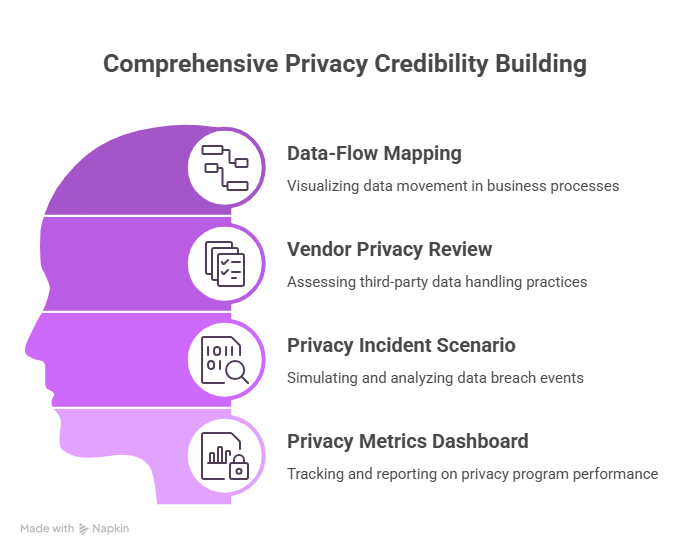
The fastest way to become credible is to practice the actual documents privacy analysts touch. Start with a data-flow map. Pick a realistic business process such as newsletter signup, employee onboarding, patient appointment booking, online checkout, or customer support ticketing. Identify the data collected, the system that captures it, the business owner, the storage location, the vendors involved, the access groups, the retention period, the deletion trigger, and the security controls. Then write a one-page risk summary. This single exercise teaches more than passive reading because it forces you to see how privacy breaks inside workflows.
Next, build a vendor privacy review. Choose a fictional SaaS tool that processes customer data. Ask what data the vendor receives, where it is hosted, whether subprocessors are used, how data is encrypted, how access is controlled, how incidents are reported, how data is deleted, and what audit evidence exists. Pair this with research into third-party cybersecurity firms, cloud security tools, privileged access management solutions, and network monitoring tools so your questions sound grounded.
Then build a privacy incident scenario. Imagine an employee clicked a phishing link, attackers accessed the mailbox, and customer records may have been exposed through attachments. Your job is to define what evidence matters: login logs, mailbox rules, forwarding settings, attachment names, customer categories, access timestamps, export activity, endpoint alerts, SIEM detections, and containment actions. Connect the scenario to phishing attacks analysis, incident response effectiveness, email security solutions, and data breach mitigation.
Finally, create a privacy metrics dashboard. Include open DPIAs, overdue vendor reviews, high-risk processing activities, access review exceptions, unresolved deletion requests, policy exceptions, training completion, privacy incidents, and remediation aging. This proves you understand how privacy programs are managed over time. Hiring teams value candidates who can move from task execution to operational visibility, especially when the role supports leadership reports, audits, regulatory readiness, or customer security questionnaires.
5. Resume, Interview, and Career Growth Strategy
Your resume should speak in outcomes, controls, evidence, and risk reduction. Replace vague bullets such as “helped with compliance” with sharper claims such as “mapped customer data flows across five SaaS tools, identified undocumented vendor transfers, and created remediation tickets for access and retention gaps.” Replace “worked on policies” with “updated data handling procedures to align collection purpose, retention schedule, access ownership, and evidence review.” Replace “supported security team” with “analyzed mailbox compromise evidence to support privacy impact assessment and breach escalation decision-making.”
Align every resume section with the role you want. A privacy analyst resume should highlight data mapping, risk assessments, DPIAs, vendor reviews, access reviews, incident triage, audit evidence, policy writing, regulatory mapping, and stakeholder communication. Use ACSMI career resources such as cybersecurity analyst advancement, security analyst to cybersecurity engineer, cybersecurity compliance analyst, and cybersecurity auditor roles to frame your experience in language employers already recognize.
Interview preparation should focus on scenarios. Expect questions such as: “A product team wants to launch a new analytics feature; what privacy questions do you ask?” “A vendor reports a security incident; what evidence do you request?” “A customer asks for deletion; how do you confirm completion across systems?” “A phishing incident may have exposed personal data; how do you support the impact assessment?” “A department wants broad access to customer exports; how do you evaluate the request?” The best answers show sequence: identify the data, understand the purpose, assess risk, check controls, collect evidence, escalate correctly, document decisions, and track remediation.
Your long-term career path can branch in several directions. If you enjoy controls and audits, move toward GRC, security audit, or compliance leadership through cybersecurity compliance officer and cybersecurity auditor pathways. If you enjoy incident work, grow toward privacy incident response with support from incident responder career skills and threat intelligence analyst training. If you enjoy strategy, policy, and executive risk, build toward chief privacy officer, cybersecurity policy director, or VP of security.
The biggest career mistake is staying too general. Privacy analyst roles reward people who can translate ambiguity into an evidence-backed decision. When a business team wants to move fast, your value comes from making the safe path clear. When legal needs facts, your value comes from finding system-level evidence. When security detects a possible exposure, your value comes from understanding data sensitivity and regulatory consequences. When executives ask whether the organization is ready, your value comes from showing measurable control maturity instead of vague reassurance.
6. FAQs About Becoming a Cybersecurity Privacy Analyst
-
The strongest backgrounds are cybersecurity compliance, IT audit, data governance, SOC operations, IT support, legal operations, vendor risk, and security administration. Each path brings a different advantage. SOC experience helps with incident evidence. Audit experience helps with control testing. IT support helps with access and systems knowledge. Legal operations helps with documentation and regulatory language. A candidate coming from IT support to cybersecurity, cybersecurity compliance, or security auditing can become competitive by adding privacy-specific portfolio proof.
-
You need enough technical fluency to understand how personal data is protected, monitored, accessed, transferred, exposed, and deleted. You should understand IAM, MFA, RBAC, encryption, DLP, SIEM, endpoint protection, cloud permissions, vulnerability management, and incident response. Deep engineering skills help in privacy engineering roles, but analyst roles place heavier emphasis on risk analysis, documentation, stakeholder communication, control mapping, and evidence review. Studying SIEM tools, DLP software, and cloud security tools will make your analysis much stronger.
-
Useful certification paths depend on your starting point. Beginners often start with cybersecurity foundations, then add privacy, audit, risk, or compliance credentials. A GRC-focused candidate should prioritize control frameworks and audit evidence. A technical candidate should add cloud, incident response, or security operations credibility. Use a structured comparison like the top cybersecurity certifications directory, the cybersecurity certifications career impact report, and the future cybersecurity certifications analysis before choosing.
-
Build artifacts that mirror real job tasks: a data inventory, data-flow map, vendor privacy review, DPIA, access review checklist, breach triage worksheet, retention procedure, privacy risk register, control mapping spreadsheet, and executive dashboard. Each artifact should show your ability to identify data, define risk, connect controls, request evidence, and recommend remediation. You can strengthen those artifacts with ideas from NIST framework adoption, GDPR compliance challenges, and cybersecurity compliance trends.
-
Use your incident triage, log review, phishing investigation, SIEM, endpoint, and containment experience as your bridge. Then learn how security events become privacy questions: what data was accessed, whose data was involved, whether the data was sensitive, whether exfiltration occurred, what evidence proves scope, and who must be notified internally. SOC candidates can stand out by studying SOC analyst career paths, SOC analyst to manager progression, and cybersecurity incident response reporting.
-
Translate your existing experience into privacy outcomes. Control testing becomes privacy control assurance. Evidence collection becomes audit-ready privacy proof. Policy review becomes data handling governance. Risk registers become privacy risk tracking. Vendor assessment becomes processor and third-party privacy review. Strengthen your technical language through cybersecurity frameworks, cybersecurity audit processes, cybersecurity compliance officer guidance, and cybersecurity auditor career planning.
