
Cybersecurity Interview Labs and Technical Tests: Reddit Experiences, Common Tasks & How to Prepare for SOC Roles
Cybersecurity interviews increasingly force candidates to prove that résumé knowledge survives contact with a real alert. For anyone pursuing a first SOC analyst job, this changes preparation completely. Memorizing definitions helps with screening questions, while practical rounds expose whether you can investigate logs, prioritize evidence, explain uncertainty, and make defensible decisions. The strongest preparation combines the expectations of SOC hiring managers, hands-on cybersecurity labs, and targeted certification knowledge.
1. Cybersecurity Technical Interviews Test How You Think When the Evidence Is Incomplete
The most useful way to understand a SOC technical assessment is to stop treating it like another certification exam. A certification often asks whether you recognize the right concept. A practical interview may hand you an alert, log file, email header, packet capture, endpoint event, or vague incident description and ask what you would do next. That distinction explains why someone can have Security+ on a résumé, finish a cybersecurity degree, and still struggle during the live-investigation portion of a hiring process.
A May 2026 Reddit discussion among cybersecurity hiring managers described technical assessments as a way to see whether the candidate can actually perform the work claimed on the résumé and how effectively the person operates under pressure. Another participant specifically connected practical output with résumé credibility. That should matter to candidates worried about the cybersecurity experience catch-22, because a strong practical assessment can provide evidence that coursework and home-lab projects have produced usable analyst skills.
The assessment may deliberately contain ambiguity. A March 2026 SOC candidate reported being unable to complete an exercise because the supplied data contained incorrect dates and times. A mature response to broken evidence is valuable: identify the inconsistency, explain what conclusion cannot safely be made, state what additional information you would request, and continue investigating whatever remains trustworthy. That same analytical discipline separates credible SOC interview proof from rehearsed answers and supports longer-term careers in cybersecurity risk management.
Pressure itself can become the hidden test. In July 2026, a first-time SOC L1 candidate described knowing the technical concepts yet feeling that their answers deteriorated once interview pressure arrived. This is why preparing for entry-level cybersecurity hiring should include spoken investigation practice. You need to verbalize how you validate an alert, choose data sources, scope affected assets, distinguish a false positive from malicious behavior, contain risk, preserve evidence, and escalate.
Microsoft's July 2026 Security Operations Analyst framework provides a useful reality check. The role now centers on managing the security operations environment, responding to incidents, threat hunting, KQL, Defender XDR, Sentinel, endpoint investigations, compromised identities, detection rules, and multi-stage attacks. Candidates building SOC analyst readiness should therefore practice actions that resemble these workflows rather than spending every study hour memorizing vocabulary.
| Possible Interview Task | What the Interviewer Is Testing | Evidence You Should Examine | Strong Preparation Exercise |
|---|---|---|---|
| Investigate failed logins | Authentication triage | Source IP, username, timing, device, success after failures | Analyze Windows 4625 and 4624 sequences |
| Identify password spraying | Pattern recognition | One source, many accounts, low attempts per account | Build a SIEM query for distributed failed logins |
| Investigate impossible travel | Identity analysis | IP, geography, VPN use, device ID, session history | Compare malicious and legitimate travel scenarios |
| Analyze a phishing email | Email-security reasoning | Headers, URLs, sender domain, SPF, DKIM, DMARC, attachments | Write a complete phishing triage report |
| Inspect a suspicious URL | IOC handling | Domain age, redirect chain, reputation, DNS context | Investigate safe historical URL samples |
| Review malware alert | Endpoint triage | Process tree, hash, parent process, user, network connections | Analyze a simulated EDR detection |
| Analyze PowerShell activity | Living-off-the-land detection | Command line, encoded data, parent process, user context | Compare normal admin PowerShell with suspicious execution |
| Interpret a process tree | Endpoint reasoning | Parent-child relationships and execution context | Practice explaining why one process chain is abnormal |
| Review Windows Event Logs | Host investigation | Logons, processes, account changes, audit events | Build a small event-ID reference from actual logs |
| Review Linux auth logs | Linux fundamentals | SSH attempts, sudo activity, users, timestamps | Investigate failed SSH activity in a VM |
| Search SIEM data | Query construction | Relevant fields, time range, host, user, IP | Write KQL or SPL queries from investigative questions |
| Reduce a noisy alert set | Prioritization | Severity, asset value, context, prevalence, confidence | Rank 10 alerts and defend the order |
| Identify a false positive | Analytical restraint | Business context, baseline behavior, corroborating telemetry | Practice proving why benign activity is benign |
| Analyze network traffic | Networking depth | Source/destination, protocol, ports, timing, payload metadata | Investigate PCAPs using Wireshark |
| Explain TCP handshake | Networking fundamentals | SYN, SYN-ACK, ACK | Trace a real connection in Wireshark |
| Investigate suspicious DNS | Network-threat reasoning | Queries, frequency, domain, endpoint, response IP | Find anomalous DNS patterns in sample logs |
| Investigate outbound beaconing | Command-and-control recognition | Regular intervals, destination, volume, endpoint process | Graph connection intervals and identify periodicity |
| Analyze firewall logs | Traffic-control understanding | Source, destination, port, action, rule, direction | Explain permitted and denied connection examples |
| Triage ransomware alert | Incident-response judgment | Process activity, lateral movement, affected systems, file changes | Talk through containment priorities under time pressure |
| Investigate account takeover | Identity incident response | Sign-ins, MFA, mailbox rules, tokens, devices | Create an account-compromise playbook |
| Prioritize five incidents | Risk judgment | Impact, confidence, asset criticality, attack stage | Rank scenarios and explain trade-offs aloud |
| Map behavior to ATT&CK | Threat-framework application | Observed behavior rather than tool name | Map five lab incidents to tactics and techniques |
| Write an incident ticket | Documentation quality | Facts, scope, actions, evidence, unresolved questions | Condense a 30-minute investigation into one clear ticket |
| Deliver verbal escalation | Communication | Severity, affected asset, evidence, next action | Give a 60-second analyst-to-L2 handoff |
| Interpret vulnerability data | Risk prioritization | CVE, exploitability, exposure, asset importance | Rank vulnerabilities using context beyond CVSS |
| Write simple PowerShell/Python | Automation fundamentals | Input, parsing, logic, output, errors | Parse indicators or logs from a text file |
| Use command-line tools | Operational fluency | Processes, network connections, DNS, files | Practice basic Windows and Linux investigation commands |
| Investigate without full context | Question quality | Missing logs, timestamps, baseline, asset ownership | Practice stating assumptions and requesting evidence |
| Create a containment plan | Operational risk awareness | Threat confidence, business impact, blast radius | Compare isolate-now versus investigate-first scenarios |
| Present findings to a panel | Reasoning under scrutiny | Evidence chain, assumptions, confidence and recommendation | Record yourself explaining a lab in five minutes |
2. These Are the SOC Interview Tasks Candidates Keep Encountering
Log analysis is the highest-value preparation target
Recent Reddit advice for SOC L1 interviews repeatedly returns to logs. A March 2026 discussion recommended understanding TCP/IP, DNS, ICMP, ARP, HTTP/HTTPS, ransomware and denial-of-service investigation, while another contributor emphasized working directly with logs and Windows Event IDs. That aligns closely with the technical proof SOC hiring managers want, the value of a serious cybersecurity home lab, and the broader argument for combining certifications with practical skills.
Do more than memorize that Windows Event ID 4624 represents a successful logon and 4625 a failed logon. Microsoft includes both in the Windows security-event sets commonly sent to Sentinel and also highlights process creation event 4688 among useful security telemetry. A technically stronger candidate can inspect the account, source, logon pattern, host, process context, timestamp sequence, and surrounding activity. That depth helps close the practical gap frequently discussed in why cybersecurity graduates struggle to get jobs and how candidates can enter cybersecurity without prior IT experience.
Phishing tests are really evidence-correlation tests
A phishing exercise may ask whether an email is malicious, yet the interviewer often cares more about how you reach the conclusion. Check sender identity, return path, authentication results, URLs, attachment type, domain similarity, urgency, recipient behavior, post-delivery clicks, endpoint telemetry, and whether the same message reached additional users. This is the kind of investigation logic that makes a SOC portfolio project credible and gives candidates with Security+ knowledge something concrete to discuss during entry-level SOC interviews.
A May 2026 Reddit SOC L1 discussion specifically highlighted phishing investigation, DMARC, DKIM, SPF, SIEM, EDR/XDR, MITRE ATT&CK, password spraying, common protocols, Windows events, incident response and root-cause analysis as preparation areas. The lesson is useful for anyone deciding between another certification and more lab time: you should be able to combine several concepts inside one investigation instead of explaining each in isolation.
Network questions increasingly become scenarios
Interviewers may still ask about ports, TCP versus UDP, DNS, DHCP, ARP, HTTP, HTTPS, SSH, SMTP, and the TCP handshake. Yet practical rounds can turn that knowledge into evidence. You might receive a PCAP and need to identify suspicious connections, DNS queries, repeated callbacks, unusual ports, or data movement. Older SOC interview reports also describe questions involving packet captures, prioritizing multiple incidents, phishing headers, event locations on Windows and Linux, and basic network behavior.
Candidates who struggle here often study security tooling before becoming comfortable with the systems generating the telemetry. Building networking fundamentals is particularly important for people following a direct-to-cybersecurity path, people comparing bootcamps, degrees and certifications, and graduates trying to solve the experience problem in cybersecurity hiring.
SIEM queries reveal whether you can turn a question into evidence
A practical interviewer may ask: “Find all failed authentication attempts from this IP,” “Show processes spawned by PowerShell,” or “Determine whether this IOC appears on other hosts.” You may use SPL, KQL, another query language, or a simplified interface. Syntax matters less than converting the investigative question into the correct fields, filters, time range, pivots, and correlations.
Microsoft currently makes KQL, threat hunting, detection engineering, Sentinel investigations and incident response central to its Security Operations Analyst role definition. Splunk's SOC training similarly emphasizes investigations, analyst queues, findings, threat hunting and structured response workflows. Those are strong preparation targets for someone building a SOC analyst home lab, assessing whether cybersecurity remains worth pursuing in 2026, or strengthening the practical side of a degree-versus-certification profile.
3. Use a Repeatable Investigation Framework During Every Technical Test
A candidate can know hundreds of security concepts and still fail because their investigation becomes chaotic. The solution is a reusable structure that works across phishing, malware, identity, network and endpoint scenarios.
First, define the alert precisely. State what allegedly happened, which user or asset is involved, when it occurred, and which detection generated the alert. Avoid immediately declaring an incident. This habit demonstrates the same analytical discipline needed in SOC analyst work, cybersecurity risk analysis, and eventually senior security leadership.
Second, validate the evidence. Ask which telemetry supports the alert. An impossible-travel alert might need authentication logs, device information, VPN context and identity history. A malware alert needs process data, hash reputation, parent-child relationships, network connections and endpoint context. Candidates who make this evidence-first thinking visible tend to present stronger interview proof than candidates who merely list tools.
Third, establish scope. Determine whether the IOC, account, process, domain, file or behavior exists elsewhere. Search other hosts, users, mailboxes, IP addresses or time windows. This is where SIEM proficiency becomes operationally valuable. Microsoft's current SOC framework explicitly includes investigating compromised identities, endpoint evidence, multi-stage attacks and relationships among entities. Building those pivots into hands-on lab investigations produces much stronger career evidence than simply completing another guided room.
Fourth, classify confidence and impact separately. You might have high confidence that malware executed on a disposable test workstation and lower business impact, while a suspicious sign-in to a privileged administrator account may have incomplete evidence yet potentially severe impact. This distinction demonstrates mature reasoning and transfers into GRC work, cybersecurity policy analysis, and security risk management.
Fifth, choose containment proportionately. “Isolate everything” is rarely an impressive universal answer. Explain why the evidence justifies disabling an account, isolating an endpoint, blocking an IOC, revoking sessions, resetting credentials, removing a message, or escalating to L2/IR. A strong response also acknowledges business impact. This is one reason practical cybersecurity skills matter alongside credential signals.
Sixth, document what remains unknown. Strong analysts distinguish fact, inference and assumption. If timestamps are inconsistent, say so. If endpoint telemetry is missing, identify it. If the IP belongs to a corporate VPN, explain how that changes your hypothesis. An interviewer may be more impressed by disciplined uncertainty than an unjustified “malicious” verdict.
MITRE ATT&CK can then help you describe observed attacker behavior. MITRE currently organizes Enterprise ATT&CK around adversary objectives such as initial access, execution, persistence, credential access, discovery, lateral movement, command and control, exfiltration and impact. Use ATT&CK after identifying behavior. That produces much stronger reasoning than forcing a technique ID onto every suspicious event.
4. Prepare for SOC Technical Interviews With Deliberate Labs, Not Random Labs
A productive preparation lab begins with a hiring question. “Can I investigate suspicious authentication?” is useful. “Can I complete another beginner room?” is too vague. Candidates trying to build cybersecurity experience without a job should select exercises that produce the exact behaviors required in SOC hiring, then preserve the results as portfolio evidence.
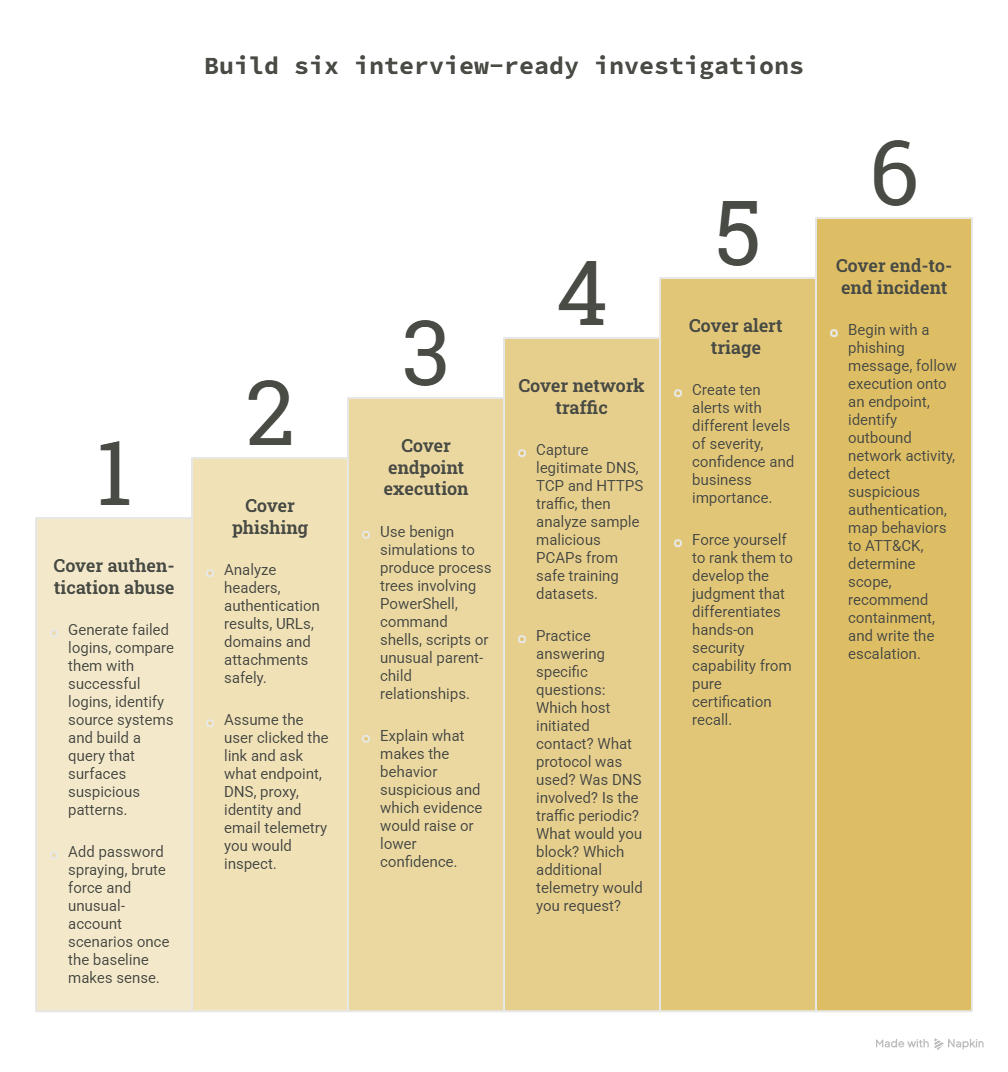
Build six interview-ready investigations
Your first investigation should cover authentication abuse. Generate failed logins, compare them with successful logins, identify source systems and build a query that surfaces suspicious patterns. Add password spraying, brute force and unusual-account scenarios once the baseline makes sense. This project strengthens both SOC readiness and future digital identity security skills.
Your second should cover phishing. Analyze headers, authentication results, URLs, domains and attachments safely. Then extend the incident: assume the user clicked the link and ask what endpoint, DNS, proxy, identity and email telemetry you would inspect. That extra step distinguishes a candidate who can label phishing from someone who can investigate an incident.
Your third should cover endpoint execution. Use benign simulations to produce process trees involving PowerShell, command shells, scripts or unusual parent-child relationships. Explain what makes the behavior suspicious and which evidence would raise or lower confidence. This provides stronger proof than merely mentioning EDR on a résumé and aligns naturally with security automation and AI security analysis.
Your fourth should cover network traffic. Capture legitimate DNS, TCP and HTTPS traffic, then analyze sample malicious PCAPs from safe training datasets. Practice answering specific questions: Which host initiated contact? What protocol was used? Was DNS involved? Is the traffic periodic? What would you block? Which additional telemetry would you request? Networking depth makes candidates far more convincing when discussing entry-level SOC jobs.
Your fifth should cover alert triage and false positives. Create ten alerts with different levels of severity, confidence and business importance. Force yourself to rank them. Recent Reddit SOC interview advice specifically highlighted triage and distinguishing legitimate behavior from a real incident. This exercise develops the judgment that differentiates hands-on security capability from pure certification recall.
Your sixth should be an end-to-end incident. Begin with a phishing message, follow execution onto an endpoint, identify outbound network activity, detect suspicious authentication, map behaviors to ATT&CK, determine scope, recommend containment, and write the escalation. Microsoft's current training path explicitly emphasizes investigations, detections and threat hunting in Sentinel. Completing this kind of investigation makes your home-lab portfolio useful during interviews rather than decorative.
Practice the explanation as aggressively as the technology
Record yourself solving a scenario. Give yourself five minutes to explain the alert, evidence, hypothesis, pivots, conclusion, containment and escalation. Watch the recording and remove filler. If your answer jumps from tool to tool without a clear investigation sequence, repeat it.
This matters because real candidates report knowing the concepts and still struggling to express them under interview pressure. Applicants already worried about cybersecurity hiring barriers often respond by studying more theory. Spoken practice can provide a much higher return when the knowledge gap has already closed.
5. How to Perform During the Technical Test Without Sabotaging a Good Investigation
Begin by narrating your objective. “I want to determine whether this alert represents malicious activity, identify affected entities, and understand whether the behavior extends beyond the original host” instantly gives the interviewer a framework for your actions. This is especially useful for candidates transitioning through help desk or other entry IT experience, because structured troubleshooting is already a transferable strength.
Ask questions when context is missing. Which timezone are these logs using? Is this address internal or external? Is this account privileged? Is the endpoint a server or workstation? Does the organization use a VPN that could explain geography? Is this application normally executed by this user population? Clarifying questions demonstrate investigative discipline. They also protect you from confidently solving a problem built on a faulty assumption.
Do not hide uncertainty. Say what you know, what you suspect and what evidence would discriminate between the two. “This behavior is consistent with password spraying because one source is attempting authentication across many accounts, although I would confirm the time distribution and successful follow-on logins before classifying it” is stronger than instantly shouting “brute force.”
Prioritize pivots. Technical tests may be time-boxed specifically to prevent exhaustive investigation. Search the highest-value evidence first. A suspected compromised account makes identity activity and successful authentication more useful than spending ten minutes researching an unrelated low-confidence IP reputation result. This prioritization ability becomes increasingly important when moving from entry SOC work toward senior security analysis.
Keep documentation while you investigate. Record timestamps, entities, findings and open questions. If the panel asks for your conclusion, you should be able to reconstruct the event chronologically without relying on memory. The same habit transfers into cybersecurity auditing, GRC work, cybersecurity policy roles, and regulatory security careers.
Be ready for the assessment itself to vary dramatically. Reddit reports include live blue-team exercises involving PCAPs and other analysis, take-home incident-response exercises containing noisy logs, written reports, and technical challenges designed partly to observe problem-solving rather than tool familiarity. A May 2026 SOC internship discussion also suggested MSSP interviews may use simulated alerts to observe live triage. This variation makes role-specific fundamentals more durable than attempting to discover the employer's exact questions.
Finally, inspect the job description before the interview and reverse-engineer the test. A current SOC listing reviewed in 2026 includes log and network-traffic analysis, false-positive identification, SIEM and EDR configuration, security-event investigation, firewall work, threat intelligence and reporting. If the vacancy repeatedly mentions Sentinel, Defender, Windows and identity, your last week of preparation should resemble that stack. If it mentions Splunk, CrowdStrike and network telemetry, adjust accordingly. This focused preparation gives far more leverage than another broad review of generic cybersecurity certification material.
6. FAQs About Cybersecurity Interview Labs and SOC Technical Tests
-
There is no universal test, although alert triage, log analysis, networking fundamentals, phishing investigation, SIEM concepts and incident-response scenarios appear repeatedly across candidate experiences. Recent 2026 Reddit discussions mention fake-alert triage, TCP/IP and protocol questions, Windows logs, SIEM querying, phishing, malware and escalation thinking.
Prepare around the actual work described in SOC hiring-manager expectations, then use a cybersecurity home lab to reproduce those tasks.
-
Know high-value events and understand what they mean operationally. Successful and failed authentication events such as 4624 and 4625, process creation such as 4688, account changes and other common security events are useful starting points. Microsoft explicitly includes these events in Sentinel-oriented Windows security collections.
The interviewer gains more information from your ability to investigate an event than from perfect numerical recall. Use your home-lab investigations to make important IDs familiar through repeated use.
-
You should be able to translate straightforward investigative questions into searches: filter by IP, user, hostname, process, event type and time; summarize patterns; expand the time range; and pivot to related entities. Microsoft's current Security Operations Analyst requirements explicitly include KQL-based hunting and Sentinel investigations. Splunk also offers SOC-focused investigation and threat-hunting training.
For a junior role, logical query construction generally creates more value than memorizing obscure syntax. This is precisely where hands-on labs strengthen certifications.
-
Explain your reasoning, identify the evidence you have already validated, state where you are blocked, and describe the next data source or documentation you would consult. Never fabricate certainty.
A technical assessment can expose imperfect data or unfamiliar tooling. One 2026 candidate even reported incorrect dates and times in the supplied assessment dataset. Handling that professionally can demonstrate more analyst maturity than forcing an unsupported answer.
-
Yes, when the lab produced genuine investigation experience. Saying “I used Splunk” is weak. Explaining how you ingested Windows telemetry, generated failed authentications, wrote a query, detected a suspicious pattern, validated the alert, scoped affected accounts and documented containment gives the interviewer something concrete to evaluate.
That is why a hiring-oriented cybersecurity home lab can help candidates pursuing SOC jobs without professional security experience.
-
Study networking until you can apply it. Know common protocols and ports, TCP versus UDP, DNS resolution, HTTP/HTTPS, basic routing, firewall behavior and the TCP handshake. Then analyze real traffic so those concepts become evidence rather than trivia.
Recent SOC interview discussions still repeatedly mention TCP/IP, DNS, ARP, ICMP, HTTP/HTTPS and common ports. This foundation is especially important for candidates entering through a bootcamp or certification route without extensive infrastructure experience.
