
How Many Cybersecurity Certifications Is Too Many? Reddit ‘Cert Collector’ Warnings + a Better Skill-Stack Strategy
Cybersecurity certifications become expensive distractions when the next credential adds less career value than the experience, projects, or specialization you could have built with the same time. A coherent stack can strengthen a path into ethical hacking, GRC, security automation, or digital identity. Trouble starts when the résumé becomes credential-rich and evidence-poor: twelve acronyms, little production exposure, shallow technical explanations, and no clear role those certifications collectively support.
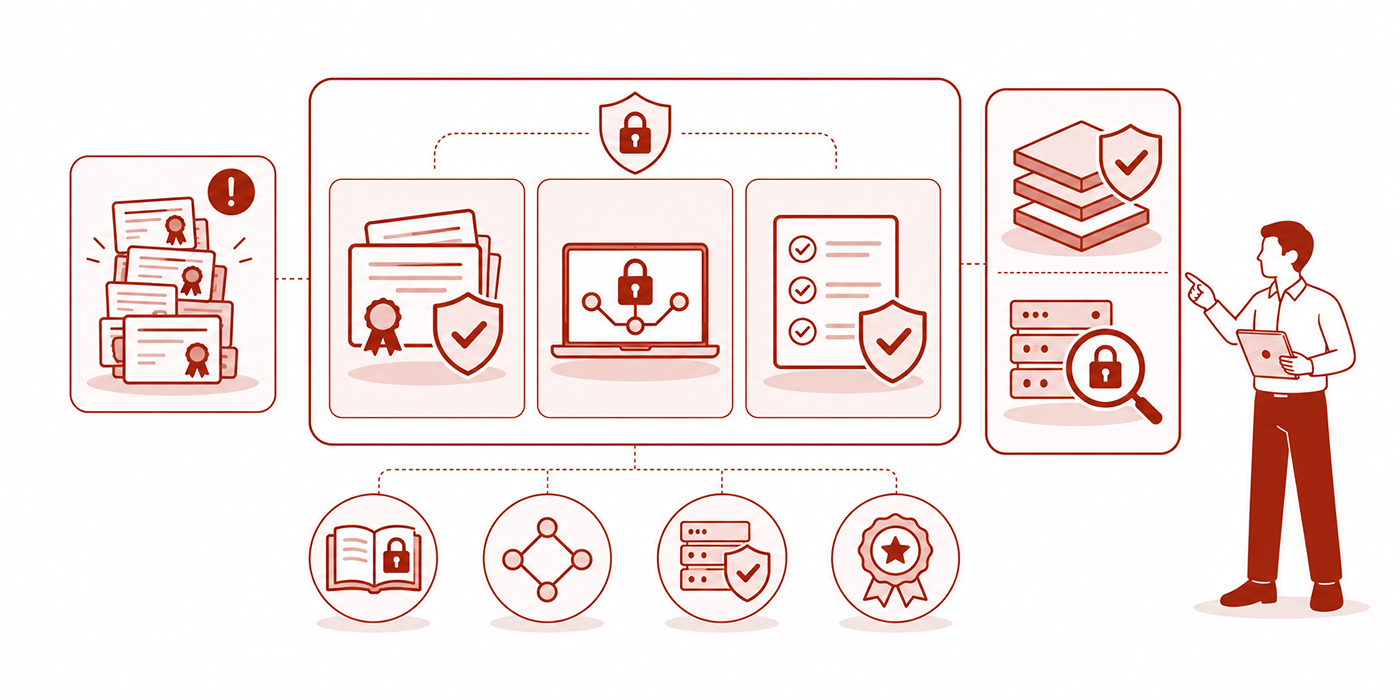
1. How Many Cybersecurity Certifications Is Actually Too Many in 2026?
The useful threshold comes from diminishing career return rather than a fixed certification count. Three certificates can already be excessive when they cover overlapping fundamentals and consume every available learning hour. Eight can make sense for an experienced practitioner whose credentials document genuine progression across security analysis, risk management, security architecture, and cybersecurity leadership. The decisive question is whether each credential explains a capability employers actually need from you.
That distinction matters because certifications still carry legitimate hiring value. ISC2's 2025 study of 929 cybersecurity hiring managers found that 47% considered certifications critical, compared with 44% for previous IT experience and 43% for relevant education. It also found that 89% would consider an early-career candidate whose primary qualification was an entry-level cybersecurity certification. Yet 84% of surveyed organizations used skills-based tests or assessments. The market therefore rewards credentials while simultaneously testing whether the knowledge survives contact with a real problem. Someone preparing for penetration testing management, red-team operations, vulnerability research, or AI security analysis should treat that second signal seriously.
Reddit's “cert collector” warning captures the résumé-level version of this problem. In a long-running CompTIA discussion, one commenter described a friend with many certifications whose interviewer concluded that the stack proved exam-taking ability while leaving actual job capability unproven. Another discussion advised career professionals to pursue certifications that complement current experience or deliberately support an upskill rather than accumulating unrelated credentials. These experiences are anecdotal, though their underlying message aligns closely with current skills-based hiring research. The same principle applies whether your target is cybersecurity auditing, privacy analysis, cybersecurity regulation, or security policy.
The warning remains current in 2026. A September 2026 Reddit discussion asked which certifications actually mattered after a professor warned about accumulating too many similar CompTIA credentials. Responses pushed the applicant toward experience and demonstrable analysis. A separate September discussion about certifications that genuinely moved careers forward produced a more useful formula: credentials created the strongest progression when they aligned tightly with an intended role and growing experience in that same domain. That is precisely how someone should approach cybersecurity program management, security product management, policy leadership, or eventual VP of Security progression.
Use this practical stopping rule: pursue the next certification only when you can name the specific hiring barrier, skill gap, contract requirement, promotion requirement, or specialization signal it is designed to solve. Pause the certification treadmill when your reasoning becomes “it might look good,” “everyone online has it,” or “I have already started collecting this vendor's exams.” That freed capacity can produce a stronger security research portfolio, deeper cybersecurity data analysis, practical security automation, or credible identity-management experience.
| Certification / Credential | Best Strategic Use | When Another Cert Adds Little | Proof to Build Beside It |
|---|---|---|---|
| 1. ISC2 CC | Foundational security signal for career starters | Once stronger role-specific evidence dominates the résumé | Home lab, ticket analysis, basic incident write-up |
| 2. CompTIA Security+ | Broad baseline and roles explicitly requesting it | When the next goal requires specialization instead of more fundamentals | Security-analysis evidence |
| 3. CompTIA A+ | Early IT/support foundation | After substantial systems experience makes the signal redundant | Endpoint troubleshooting and ticket evidence |
| 4. CompTIA Network+ | Networking foundation before security specialization | After deeper networking credentials or professional network experience | Network-to-security investigations |
| 5. CompTIA CySA+ | Early blue-team and analyst specialization | When practical SOC evidence becomes the larger missing signal | SIEM investigations and incident reports |
| 6. CompTIA PenTest+ | Structured offensive-security foundation | When the target employer wants deeper practical offensive proof | Red-team lab evidence |
| 7. CompTIA SecurityX | Advanced practitioner-level security breadth | When management, architecture, or a deep specialty is now the target | Architecture decisions |
| 8. CompTIA Linux+ | Linux operating-system competence | Once daily Linux administration already demonstrates greater depth | Hardening, logging, permissions and scripting |
| 9. CompTIA Cloud+ | Vendor-neutral cloud infrastructure grounding | When a target role clearly favors a specific cloud ecosystem | Cloud IAM, logging and security architecture |
| 10. CCNA | Networking depth with broad infrastructure relevance | When your target is outside network-heavy work and networking proof is already strong | Network-security application |
| 11. CCNA Cybersecurity | Security monitoring, analysis and response | When another broad SOC credential would repeat the same signal | Alert triage and incident-response cases |
| 12. Microsoft SC-200 | Microsoft-centric security operations | When Sentinel/Defender proof is still missing | KQL hunting, Defender investigations, detection work |
| 13. AWS Security specialty credential | AWS-focused security roles | When you cannot yet demonstrate secure AWS implementation | IAM, logging, network and workload security |
| 14. ISC2 SSCP | Operational security practice | When another foundational credential would add heavy overlap | Access control, operations and incident evidence |
| 15. CISSP | Experienced security practitioner and leadership signal | When the next role demands a concrete technical or management specialty | Leadership and security-program evidence |
| 16. CCSP | Experienced cloud-security specialization | When cloud architecture experience is the real gap | Cloud architecture decisions |
| 17. ISC2 CGRC | Governance, risk and compliance specialization | When framework application and evidence collection remain weak | GRC work samples |
| 18. CISM | Experienced security-management path | When leadership responsibilities have yet to catch up with the credential | Program-management evidence |
| 19. CISA | Audit, control and assurance roles | When practical audit participation is the larger deficiency | Cybersecurity audit evidence |
| 20. CRISC | Technology risk specialization | When you lack risk assessments tied to actual business decisions | Risk-management cases |
| 21. CDPSE | Privacy engineering and data protection | When the target role needs practical privacy implementation | Privacy-analysis evidence |
| 22. OSCP / OSCP+ | Practical offensive-security credibility | When additional offensive certificates merely repeat exploitation fundamentals | Penetration-test reports and methodology |
| 23. OSEP | Advanced offensive-security specialization | When professional red-team exposure is still the main missing asset | Advanced red-team evidence |
| 24. OSWE | Web application exploitation specialization | When secure-code and application-analysis experience remains thin | Manual application-security research |
| 25. GIAC incident-response credential | Deep incident handling and enterprise response | When incident ownership is absent from your work history | Timelines, containment rationale and post-incident analysis |
| 26. GIAC network-analysis credential | Network detection and analysis depth | When packet and network telemetry experience is shallow | Traffic-analysis investigations |
| 27. AI-security specialty credential | Focused pivot from an existing security discipline into AI security | When core security engineering, risk, or testing foundations are missing | AI-security project evidence |
| 28. Blockchain-security credential | Specialized distributed-ledger security work | When the specialization has no connection to target vacancies | Blockchain-security engineering proof |
| 29. Privacy / regulatory specialty credential | Compliance-heavy security and privacy roles | When another credential would duplicate governance knowledge | Regulatory-analysis evidence |
| 30. Training / instructor credential | Security education and workforce-development roles | When teaching ability has never been demonstrated | Instructional portfolio and learner outcomes |
2. The ‘Cert Collector’ Red Flags Reddit Keeps Warning About
The first red flag is credential seniority outrunning career seniority. CISSP currently requires five years of cumulative paid experience across at least two CISSP domains, subject to the permitted one-year waiver route; candidates who pass before satisfying the experience requirement can pursue Associate of ISC2 status while gaining the required experience. CISM likewise requires five years of professional information-security management experience across at least three of its four domains before certification. A candidate pursuing security leadership, cybersecurity program management, security architecture, or VP-level progression therefore gains maximum value when the credential reflects work already developing underneath it.
This mismatch can become especially painful during interviews. A résumé may imply advanced risk management, GRC competence, cybersecurity auditing, or privacy expertise, prompting an interviewer to ask advanced scenario questions. If the candidate can define every term from the exam guide yet cannot explain a risk acceptance decision, control failure, audit exception, incident trade-off, or stakeholder conflict, the certification has raised the interview bar faster than the underlying experience can support.
The second red flag is horizontal duplication. Security+, CC, SSCP, and other foundational security credentials can each serve legitimate purposes, although accumulating several introductory signals often produces smaller incremental value than moving into a specialization. The same issue appears when someone pursues every available introductory cloud, penetration-testing, SOC, and governance credential simultaneously. Their résumé points toward red-team operations, GRC, AI security, and security data science without developing enough depth to make any one target convincing.
A June 2026 Reddit thread illustrates the behavior clearly: an Azure learner with AZ-900 and AZ-104 said they lacked a long-term roadmap and wanted to collect as many Microsoft certifications as possible. Responses questioned the collection-first strategy, while one commenter who acknowledged having many credentials explained that the meaningful ones related to professional work or genuine personal focus. This distinction should guide candidates considering digital identity management, security automation engineering, cybersecurity research, or blockchain security: specialization should emerge from a career hypothesis.
The third red flag is certification velocity with no corresponding proof velocity. Completing five certifications in 16 months can be entirely defensible when the candidate is enrolled in structured technical training that includes hands-on work, as one highly discussed July 2026 CompTIA post demonstrated. Five certificates earned while producing zero projects, zero work examples, zero lab documentation, and zero improved interview performance tell a different story. Someone learning toward ethical hacking, penetration testing, vulnerability research, or red-team operations should expect practical output to grow alongside credential count.
The fourth red flag is using another exam to avoid a harder career bottleneck. Studying has structure: syllabus, book, practice tests, score, pass. Building experience is messier. It involves requesting stretch work, publishing imperfect projects, troubleshooting systems without an answer key, applying for roles, failing interviews, networking with practitioners, and documenting complex outcomes. The comfort of certification study can become a hiding place. ISC2's 2025 workforce research found that IT remained the most common pathway into cybersecurity, accounting for 56% of respondents, while only 6% identified cybersecurity certifications as their entry pathway. That should influence anyone building toward security leadership, security architecture, risk leadership, or policy direction.
3. Build a Skill Stack Instead of a Certification Stack
A high-return cybersecurity stack has four layers: foundation, role depth, environment depth, and proof. Foundation covers the systems beneath security: networking, operating systems, identity, basic cloud, scripting, and core security concepts. Role depth then concentrates on the work you actually want, such as red-team operations, GRC specialization, cybersecurity auditing, or privacy analysis. Environment depth develops familiarity with the platforms employers use. Proof demonstrates that you can combine the first three under realistic constraints.
For an early-career SOC candidate, a sensible stack might contain one foundational credential, networking competence, a blue-team-oriented credential, SIEM query capability, Windows and Linux telemetry analysis, and four documented investigations. Microsoft's SC-200 currently focuses on managing a security-operations environment, responding to incidents, threat hunting, Defender XDR, Sentinel, Entra ID, and KQL-driven work. Microsoft explicitly recommends hands-on experience before taking the exam. That makes the credential much more valuable when paired with security analyst development, identity-management skills, security automation, and cybersecurity research discipline.
For offensive security, build around networking, Linux, Windows internals, Active Directory, web fundamentals, scripting, exploitation methodology, reporting, and one practical credential appropriate to the target market. Then invest the next several hundred hours into the capabilities employers will probe: enumeration, privilege escalation, pivoting, attack-path reasoning, manual testing, evidence collection, and report writing. This creates a coherent progression from network administration into ethical hacking, toward red-team operations, deeper vulnerability research, and eventually penetration-testing management.
For governance careers, the stack should look completely different. Build control-framework literacy, risk assessment, evidence collection, policy writing, audit remediation, third-party risk, stakeholder communication, and regulatory interpretation. Then choose credentials whose level matches your experience. CISA currently requires five years of professional information-systems auditing, control, or security experience for certification, while CISM requires the corresponding management experience described earlier. Those requirements make practical exposure central for someone targeting cybersecurity auditing, regulatory specialization, policy analysis, or risk management.
For cloud security, select a cloud ecosystem based on actual job demand, develop IAM, logging, networking, key management, workload security, security architecture, and incident-response competence, then add a credential that validates that environment. CCSP is designed for experienced practitioners and currently requires five years of cumulative IT experience, including three years in cybersecurity and one year across CCSP domains, subject to its permitted substitution pathways. Someone pursuing security architecture, security product management, cybersecurity automation, or AI security engineering needs architecture and implementation evidence alongside the badge.
For experienced professionals, the model becomes anchor credential + strategic specialization + current proof. A CISSP holder moving toward cloud architecture may gain more from CCSP plus an actual cloud-security program than from three unrelated foundational exams. A CISA holder moving into management may have a coherent reason to pursue CISM after accumulating the relevant experience. A senior analyst moving toward VP of Security may gain more from budgeting, hiring, executive communication, and cybersecurity program management than from another technical baseline certification. A future chief privacy officer needs privacy governance and organizational influence. A future policy director needs policy outcomes and regulatory judgment.
4. Which Certifications Should You Remove From Your Résumé, Keep Active, or Let Expire?
Your certification history and your application résumé serve different purposes. Maintain a complete credential record for yourself. Curate the résumé around the target role. Someone applying for red-team work gains little from letting an outdated introductory credential consume the same visual space as practical offensive evidence. A candidate pursuing GRC should prioritize credentials and experience that reinforce governance. A privacy analyst should foreground privacy, risk, regulation, and data-protection signals. A candidate pursuing security automation needs the résumé to emphasize engineering and operational outcomes.
Use three buckets. Primary credentials directly strengthen the role and deserve résumé space. Supporting credentials provide useful adjacent evidence and can remain when space permits. Historical credentials have been superseded, expired, or become irrelevant to the current target; these can leave the résumé while remaining on a longer professional profile where appropriate. This approach works for careers moving into cybersecurity research, security data science, blockchain security, and quantum security analysis because each target requires a different signal hierarchy.
Reddit discussions on excessive certification counts often reach the same résumé-curation conclusion. In one widely discussed thread, experienced commenters recommended eventually stripping away credentials that no longer add useful information at the applicant's career level. Another commenter suggested keeping certifications when they remain helpful for the target role and being able to explain how the knowledge is actively applied. This is particularly relevant for someone moving from IT management into security leadership, from analyst work toward VP of Security, into cybersecurity program management, or toward security product management.
Maintenance burden should also influence the portfolio. ISC2 members holding credentials such as CISSP, CCSP, SSCP, CGRC, CSSLP and its concentrations currently pay one annual maintenance fee of $135 regardless of how many qualifying ISC2 certifications they hold; maintenance also requires applicable CPEs. ISACA's CISM currently requires at least 20 CPE hours annually and 120 over each three-year reporting period, with qualifying activities potentially counting across multiple ISACA certifications when they satisfy each credential's requirements. Professionals balancing GRC work, cybersecurity auditing, risk management, and privacy responsibilities should calculate this administrative load before adding credentials across several organizations.
Vendor renewal cycles can produce additional hidden work. Microsoft's current role-based Security Operations Analyst certification has a 12-month renewal frequency, with eligible holders able to renew through Microsoft's online assessment process. OffSec's current policy distinguishes between credentials that remain valid indefinitely and newer designations such as OSCP+ that expire after three years and require an applicable renewal path to retain the “+” designation. Its CPE pathway for expiring certifications involves 120 credits over three years plus annual coverage requirements. Those details matter to professionals building long careers in penetration testing, red teaming, vulnerability research, and security architecture.
Evaluate every active certification annually with five questions: Did employers ask for it? Does it still reinforce my target role? Do I use the underlying knowledge? Does it unlock a requirement or meaningful opportunity? Is maintaining it a better investment than deepening a higher-value skill? A credential that repeatedly fails this audit deserves lower priority. A credential that continues to unlock contracts, satisfy client requirements, strengthen regulatory work, support policy responsibilities, reinforce cybersecurity leadership, or document an active technical specialization can remain highly valuable years after it was earned.

5. A Better 12-Month Cybersecurity Skill-Stack Strategy
Months 1–2: choose the job before choosing the certification. Collect 30–50 current postings for one narrow target: SOC analyst, cloud-security engineer, GRC analyst, IAM analyst, penetration tester, vulnerability analyst, security engineer, or another specific role. Count recurring skills, technologies, certifications, experience thresholds, and responsibilities. Then compare them against your current evidence. Someone choosing digital identity should see very different gaps from someone pursuing red-team work, cybersecurity policy, or AI security.
Months 3–4: earn one credential only when the market audit justifies it. Define the certification's job before starting. It may overcome an HR filter, create structured foundational learning, satisfy a contractual requirement, validate a specialization, or support a promotion. A May 2026 Reddit career post from an industry practitioner strongly advised candidates to avoid expensive self-funded training unless it addressed a specific opportunity; that recommendation represents one practitioner's view, yet the opportunity-cost logic is useful. Apply the same discipline to cybersecurity training careers, bootcamp instruction, security education, and research analysis.
Months 5–7: turn the syllabus into evidence. For every major exam domain, create something an interviewer can interrogate. A SOC candidate can produce alert investigations, KQL queries, incident tickets, timelines, and detection logic. A penetration tester can produce scoped test reports and remediation explanations. A GRC specialist can build a risk register, evidence map, control-gap assessment, and remediation plan. A privacy analyst can build data-flow analyses and privacy-risk cases. A security automation engineer can automate enrichment, parsing, or evidence collection.
Months 8–9: obtain production-adjacent experience. Ask for security responsibilities inside your existing job. Volunteer for IAM reviews, vulnerability remediation, security-ticket triage, audit evidence, patch validation, log review, cloud permissions, endpoint configuration, or incident documentation. ISC2's 2025 workforce study found that 36% of respondents entered cybersecurity by taking on security responsibilities while already in IT, making this internal-expansion route a major real-world pathway. These experiences can support transitions into cybersecurity auditing, risk management, security program management, and security leadership.
Months 10–11: measure hiring conversion. Track 40–60 well-targeted applications. A certification strategy should eventually affect something measurable: recruiter screens, technical interviews, role eligibility, promotion conversations, or demonstrated competence. If résumé submissions receive almost no response, investigate targeting, experience signals, résumé positioning, location constraints, or role seniority. If interviews arrive and technical rounds fail, redirect time toward the exact weak capabilities exposed by those interviews. Another general certification may have lower value than deeper cybersecurity analysis, security research, technical automation, or network-security competence.
Month 12: run the next-certification test. Give the proposed credential one point for each of these conditions: it appears repeatedly in target postings; it closes a documented technical gap; it aligns with your existing experience; it advances your chosen specialization; and you already have a plan to apply its knowledge. Four or five points justify serious consideration. Two or three points demand more research. Zero or one should redirect your next quarter toward practical work. This scorecard keeps a future security architect, cybersecurity product manager, policy director, or chief privacy officer focused on career leverage rather than badge count.
The 2026 market makes this discipline especially important because employer needs are becoming more specialized. ISC2's latest workforce research reports hiring-manager demand across cloud security, AI, security engineering, security analysis, and risk assessment, while problem solving, collaboration, communication, willingness to learn, and strategic thinking remain major nontechnical priorities. A résumé engineered around AI security, security data science, digital identity, and automation engineering needs demonstrable depth in whichever one actually matches the target job.
6. FAQs About Having Too Many Cybersecurity Certifications
-
Five can form a coherent stack when they were earned through a structured program, cover complementary fundamentals, and sit beside practical work. A July 2026 Reddit poster described earning Security+, Server+, A+, Network+, and CySA+ through a trade-school program combining instruction and hands-on learning, demonstrating one legitimate context for rapid accumulation. The stronger test is whether the candidate can demonstrate the networking, endpoint, analysis, and security knowledge those credentials imply through security analysis, network-security work, automation projects, and security research.
-
Relevance and proof determine how the stack is interpreted. Current ISC2 research confirms that certifications matter strongly in early-career hiring while 84% of organizations also use skills assessments. The risky profile carries advanced or overlapping credentials without being able to defend the underlying knowledge during interviews. A coherent progression supporting GRC, cybersecurity auditing, penetration testing, or security architecture sends a much clearer professional signal.
-
Build the sequence around a role. Security+ can establish a broad baseline; CySA+ aligns more naturally with defensive analysis; PenTest+ moves toward offensive testing; SecurityX sits at an advanced practitioner level. Pursuing all of them rapidly can spread attention across different objectives. A SOC-focused candidate could spend that same time strengthening security analysis, identity investigations, security automation, and research skills, while an offensive candidate can concentrate on red-team depth.
-
Prioritize résumé relevance and the requirements of the jobs you are targeting. CISSP currently represents an experience-backed credential requiring five years of qualifying paid work subject to its permitted waiver, so several beginner certifications may communicate relatively little additional information once your work history and senior credential establish those fundamentals. Keep lower-level certifications when they satisfy a specific employer, regulatory, or client requirement. This becomes increasingly important for security leadership, program management, security architecture, and VP-level roles.
-
Passing the CISSP exam before meeting the required experience can lead to Associate of ISC2 status, with up to six years to accumulate the experience required for CISSP. Whether that is your highest-return move depends on the roles available to you today. An early-career candidate whose bottleneck is hands-on capability may gain more immediate leverage from operational experience in security analysis, digital identity, network security, or security automation.
-
Use the imbalance in your current profile to set the ratio. Someone with zero recognizable security credential may reasonably invest in one foundational certification. Someone with four certifications and no defensible project should push the majority of new learning time toward applied work. Build artifacts aligned with vulnerability research, AI security, cybersecurity data science, or privacy analysis according to the target role. The goal is an evidence portfolio whose depth grows whenever the credential portfolio grows.
