
Guide to Career Growth from Senior Security Analyst to VP of Security
Security careers often stall at the senior analyst level because technical strength alone stops being enough. Moving toward director and VP-level leadership requires a different kind of credibility: cross-functional influence, risk ownership, budget awareness, strategic communication, and the ability to turn security effort into business resilience. That shift is difficult because most analysts are trained to find problems, while executives are paid to prioritize, sequence, fund, and absorb them.
The climb from senior security analyst to VP of Security is not one jump. It is a staged transition from operator to owner, from individual contributor to organizational force, and from technical depth to security leadership with measurable business impact.
1. Understand the Real Difference Between Senior Analyst, Manager, Director, and VP of Security
A lot of ambitious professionals delay their own growth because they misunderstand what leadership levels actually own. A senior security analyst is often trusted for investigation quality, technical judgment, escalation, and high-value execution. A manager begins to own workflow, team consistency, prioritization, and delivery pressure. A director usually owns functions, roadmaps, staffing logic, governance, and executive-facing outcomes. A VP of Security operates at the level of enterprise alignment, investment decisions, operating model design, organizational risk posture, and leadership across multiple security domains.
That distinction matters because career growth is not just about doing harder technical work. It is about becoming useful at a broader altitude. Reading ACSMI’s roadmap on how to become a cybersecurity manager, the pathway for advancing from security manager to director of cybersecurity, the guide to chief information security officer growth, and the analysis of entry-level to CISO salary progression helps frame how security leadership expands with each rung.
The senior analyst who wants to keep moving has to stop measuring value only through technical correctness. At leadership levels, value is increasingly judged through decision quality, clarity under pressure, team leverage, stakeholder trust, and the ability to reduce security drag while still improving control maturity. That requires understanding how security audits, cybersecurity frameworks, compliance trends, incident response execution, and SIEM operations interact at an organizational level.
One painful truth sits at the center of this transition: the skills that made you respected as an analyst can become incomplete at leadership level if they are not paired with influence. A senior analyst earns trust by being right. A VP earns trust by making the organization more capable.
2. Master the Senior Analyst Stage Before Trying to Escape It
The smartest way out of the senior analyst tier is to become unusually strong inside it first. Many professionals try to leap too early, which creates a reputation problem. Leadership teams promote people they already trust with ambiguity, escalation, and operational judgment. That trust usually begins when a senior analyst becomes the person who can stabilize complicated incidents, improve noisy processes, and communicate what matters without theatrics.
At this level, the right growth strategy combines technical sharpness with visible business maturity. That means getting stronger in endpoint detection and response, SIEM tuning and visibility, incident response development and execution, cyber threat intelligence collection and analysis, and ransomware detection, response, and recovery. It also means understanding broader context through ACSMI’s reporting on the state of ransomware, phishing attack trends, data breach risk by industry, and cloud environment threats.
The professionals who rise fastest here usually do five things consistently. They make incident handling clearer. They improve documentation. They mentor weaker analysts. They escalate with context rather than panic. They connect technical work to control gaps and business exposure. This is why studying how to become a SOC analyst, the path from SOC analyst to SOC manager, the guide to a senior cybersecurity analyst career pathway, and the roadmap from security analyst to cybersecurity engineer is useful even for leadership-minded professionals. Those paths reveal where technical authority becomes organizational leverage.
One of the biggest pain points at this stage is invisibility. Strong analysts often do excellent work that never becomes promotion evidence because it is not framed as leadership behavior. If you improved false-positive handling, built a better escalation standard, shortened incident triage time, or coached junior staff into stronger performance, that is leadership material already. It has to be documented, presented, and made legible.
3. Transition From Technical Depth to Management and Functional Ownership
The move from senior analyst to manager or functional lead is where many careers either accelerate or flatten. The flattening happens when someone stays known only for technical rescue work. The acceleration happens when they start owning systems, people, and recurring outcomes. Management readiness is visible long before the title shows up. It appears in how you run meetings, resolve conflict, sequence work, clarify priorities, and protect team focus from constant reactive churn.
This is the phase where broader operational literacy becomes essential. You need to understand how vulnerability assessment techniques and tools affect remediation backlogs, how access control models shape identity decisions, how firewall technologies and intrusion detection systems change coverage assumptions, how DLP strategies and tools create rollout friction, and how PAM solutions affect both risk reduction and user resistance.
This is also the right moment to deepen governance understanding. Leaders above analyst level are pulled into audit closure, control design, evidence preparation, and risk conversations constantly. ACSMI’s material on cybersecurity frameworks like NIST, ISO, and COBIT, NIST framework adoption, GDPR and cybersecurity compliance challenges, healthcare compliance reporting, and future regulatory trends helps create the kind of judgment that separates operational leaders from purely technical specialists.
At this stage, the promotion question shifts. Leadership no longer asks, “Can this person handle the work?” It starts asking, “Can this person help others handle the work better?” That is a deeper threshold.
Quick Poll: What Is the Hardest Part of Moving Beyond Senior Security Analyst?
Choose the barrier that feels most real. The right growth plan depends on the friction point.
4. Grow From Manager to Director by Owning Programs, Priorities, and People
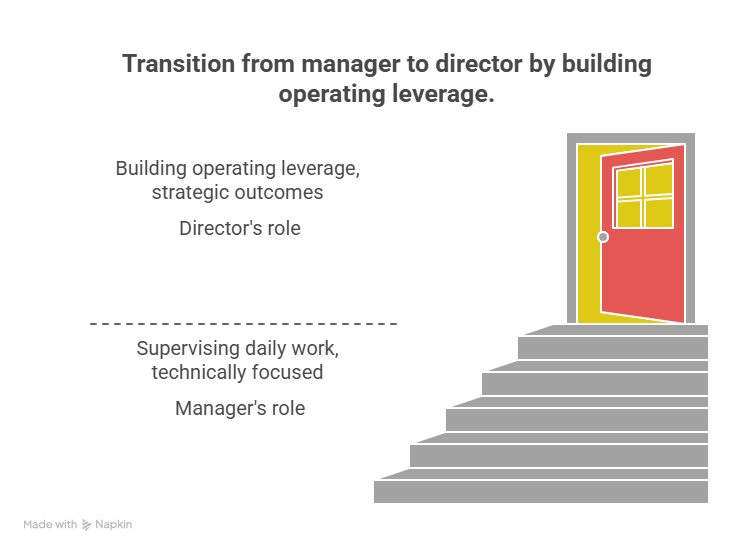
The shift from manager to director is less about supervising daily work and more about building operating leverage. Directors own outcomes that continue even when they are not in the room. They structure programs, resolve cross-functional friction, handle senior stakeholders, and make sure security work is organized around risk and business reality rather than internal preference.
To become credible at this level, a security leader needs broader fluency across functions. They should understand the strategic implications of cloud security tools, application security tooling, network monitoring and security tools, email security solutions, and security awareness platforms. They also need strong program instincts, which is why ACSMI’s cybersecurity program manager career guide, the roadmap for a cybersecurity compliance officer, and the guide to a cybersecurity auditor role are relevant reads for technical leaders too.
A director-level candidate should be able to answer harder questions than before. Which initiatives actually reduce enterprise exposure? Which tools are creating overlap? Which risks deserve executive attention now versus later? Which teams are underbuilt for the threat model? Which metrics are honest enough to guide funding decisions? That is where broader market and workforce data can help sharpen judgment. ACSMI’s reports on the global cybersecurity salary report, the cybersecurity workforce shortage, remote versus on-site cybersecurity salaries, and job market trends and salary predictions help leaders think about staffing, retention, and role design more realistically.
One of the hardest pain points in this phase is identity shift. Many strong managers are still emotionally attached to being the smartest technical solver in the room. Directors need a different ego structure. Their value increasingly comes from building systems, hiring well, assigning well, and making other people more effective.
5. Earn VP of Security Credibility Through Enterprise Thinking
VP-level security leadership is where technical respect, organizational leadership, and business fluency have to coexist. A VP of Security is not simply a director with a bigger calendar. This role usually owns multi-domain strategy, capability investment, major security programs, executive communication, staffing architecture, vendor direction, governance posture, and a security operating model that can withstand both incidents and scrutiny.
Getting there requires a visible record of cross-domain impact. A future VP should have meaningful exposure to operational security, engineering coordination, compliance pressure, audit response, metrics design, roadmap sequencing, and budget-linked prioritization. They should be able to speak intelligently about managed security service providers, top cybersecurity consulting firms, best cybersecurity solutions for SMBs, healthcare cybersecurity providers, and financial services cybersecurity firms. That market awareness matters because VPs often influence build-versus-buy decisions and partner strategy.
They also need future-facing judgment. A VP cannot only defend the current posture. They must prepare the next one. That is why ACSMI’s forward-looking work on AI-powered cyberattacks, deepfake cybersecurity threats, future cloud security trends, next-generation SIEM technologies, and future skills for cybersecurity professionals is strategically useful. Senior leaders need a point of view on where capabilities should grow before weakness becomes visible in a crisis.
This is also where certifications and résumé lines become secondary to leadership evidence. At VP level, the decisive signals are different: stronger managers under you, clearer roadmaps, sharper executive trust, cleaner audit outcomes, better incident readiness, better use of budget, and a security function that people across the business can work with instead of work around.
6. FAQs
-
There is no fixed timeline because organization size, industry, opportunity, and scope vary widely. Still, the journey usually involves at least a few distinct phases: senior analyst credibility, team or functional management, director-level ownership, and then enterprise leadership readiness. ACSMI’s salary progression from entry-level to CISO and the guide to CISO-track growth help frame the longer arc.
-
Some people do make unusual jumps, especially in fast-growing environments. Most sustainable growth still passes through real management or functional ownership first. The missing skills are usually people development, prioritization, stakeholder management, and program leadership. ACSMI’s roadmap on how to become a cybersecurity manager is a practical bridge.
-
They stay trapped inside technical hero mode. That can earn praise, but it does not automatically build promotion leverage. Leadership signals come from process improvement, better communication, mentorship, clearer escalation, and visible ownership of recurring outcomes. The path from SOC analyst to SOC manager and the guide to a senior cybersecurity analyst career path both reflect that shift.
-
The right certifications depend on the gap you are trying to close. Some professionals need broader security credibility. Others need leadership or governance proof. ACSMI’s directory of top cybersecurity certifications, the report on certification impact on career advancement, and the analysis of salary growth by certification are better guides than chasing prestige blindly.
-
Treat communication as a leadership discipline, not a personality trait. Practice summarizing incidents, roadmaps, risks, and tradeoffs in plain language. Volunteer for updates that force you to translate complexity. Learn from cybersecurity program management, compliance officer, and managerial career guides because those roles depend heavily on translation.
-
That can lead to CISO-track roles, broader enterprise risk leadership, security strategy leadership, or operating roles with larger business scope. The next move depends on whether your strongest edge is executive communication, technical strategy, governance leadership, or organizational design. ACSMI’s roadmap to CISO is the most natural next step from there.
