
From SOC Analyst to CISO: Reddit Career Stories, Skill Jumps, Management Gaps & When Certifications Stop Being Enough
A SOC analyst can spend years becoming excellent at alerts, investigations, threat detection, and incident response, yet the road to CISO eventually demands a different operating system. Progress toward cybersecurity leadership increasingly depends on business risk, budgets, hiring, executive communication, governance, and organizational influence. The professionals who successfully move from security analysis into management learn when deeper technical expertise creates leverage, when risk-management capability becomes essential, and when another certification stops solving the career problem in front of them.
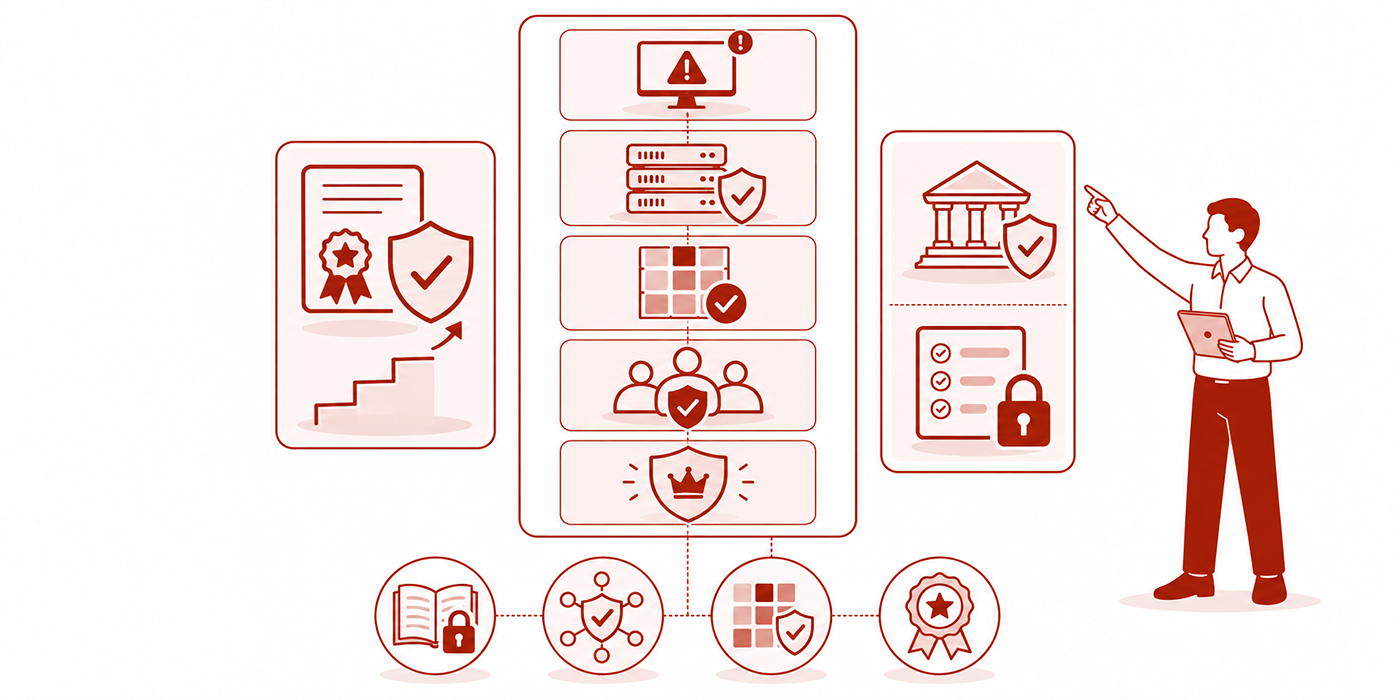
1. The SOC Analyst-to-CISO Path Is a Series of Career Reinventions
The simplest career diagram looks deceptively clean:
SOC Analyst → Senior Analyst → Lead → Security Manager → Director/VP → CISO
Real careers rarely progress that neatly. A professional might move from a SOC into incident response, security automation, architecture, cybersecurity risk management, consulting, GRC, or cloud security before gaining responsibility for people and programs. Another may become a SOC manager early and discover that managing performance, staffing, conflict, priorities, and budgets feels completely different from being the strongest investigator in the room.
That distinction matters because every major promotion changes the definition of good performance.
An entry-level analyst wins by accurately triaging alerts, understanding logs, following procedures, recognizing suspicious behavior, and escalating correctly. The skills described in what SOC hiring managers want remain foundational, while hands-on lab evidence becomes less important once production experience begins generating stronger proof.
A senior analyst is expected to interpret ambiguity. They investigate harder incidents, improve detection logic, mentor junior analysts, understand attacker behavior, reduce false positives, and connect technical events to business consequences. This is where a career begins shifting from “Can you perform the task?” toward “Can others rely on your judgment?”
A lead or manager faces another jump. Their output increasingly comes through other people. Suddenly, excellent Splunk queries do little to solve an underperforming employee, an exhausted overnight shift, a weak escalation process, an impossible hiring request, or disagreement with infrastructure teams. The transition described in the senior-security-analyst-to-VP pathway requires delegation, prioritization, coaching, stakeholder management, operational metrics, and the ability to explain why security work deserves resources.
Reddit provides a useful warning about treating management as an automatic promotion. A SOC manager described accepting the role because it appeared to be the natural next rung, then realizing that they missed hands-on detection engineering, threat hunting, and investigations and did not enjoy managing people. Their attempts to return to senior analyst work also created awkward questions from prospective employers about why they wanted to move backward in title.
That experience exposes a career decision many ambitious analysts avoid asking:
Do you actually want to manage, or do you simply want more pay, influence, and progression?
Technical career ceilings have expanded. Senior engineers, architects, detection engineers, cybersecurity research analysts, AI security analysts, cybersecurity data scientists, and specialized consultants can become highly senior without spending most of their week managing employees.
Someone who genuinely wants CISO-level responsibility needs broader ambitions. A CISO must understand enough technology to challenge assumptions while developing strong command of security policy, regulatory requirements, cybersecurity auditing, privacy considerations, resilience, third-party risk, financial trade-offs, staffing, executive politics, and organizational priorities.
Current workforce research reinforces the importance of that wider skill set. ISC2's 2025 study found that hiring managers ranked problem-solving, collaboration, communication, willingness to learn, and strategic thinking among their strongest hiring priorities. The same research found that critical skills shortages have become a more pressing concern for many organizations than headcount alone.
The road to CISO therefore involves repeated reinvention. Technical credibility earns the early promotions. Organizational capability increasingly determines the later ones.
| Career Situation | Skill Jump That Matters Most | Evidence to Build | Common Career Trap |
|---|---|---|---|
| SOC Analyst I | Reliable alert triage | Investigation and escalation proof | Collecting tools without mastering fundamentals |
| SOC Analyst II | Independent investigations | Detection and SIEM evidence | Remaining dependent on runbooks |
| Senior SOC Analyst | Judgment under ambiguity | Leadership-ready analyst experience | Becoming the person who fixes everything personally |
| Detection Engineer | Scalable detection design | Automation capability | Optimizing detections without business context |
| Incident Responder | Crisis coordination | Risk-based decision evidence | Treating every incident as purely technical |
| Threat Hunter | Hypothesis-driven investigation | Research capability | Producing interesting findings without operational impact |
| SOC Team Lead | Delegation and coaching | Team-leadership outcomes | Continuing to behave like the senior individual contributor |
| First-Time Security Manager | People management | Management credibility | Micromanaging technical work |
| SOC Manager | Operational management | Reduced MTTR, stronger coverage, better analyst development | Measuring success by ticket volume alone |
| Security Engineering Manager | Technical prioritization through others | Engineering and automation outcomes | Trying to remain the strongest engineer on every project |
| IAM Manager | Identity governance | Identity-program maturity | Treating IAM as account administration |
| GRC Manager | Control-to-business translation | GRC program ownership | Producing compliance paperwork without risk reduction |
| Risk Manager | Quantified prioritization | Enterprise risk evidence | Using risk registers as storage rather than decision tools |
| Security Audit Manager | Assurance and executive reporting | Audit leadership | Reporting deficiencies without influencing remediation |
| Privacy/Security Manager | Data-risk governance | Privacy-risk capability | Separating privacy from architecture and security decisions |
| Security Program Manager | Cross-functional execution | Program and product thinking | Tracking projects without owning outcomes |
| Security Manager Seeking Director | Strategy and portfolio ownership | Multi-team leadership | Presenting operational achievements as strategic leadership |
| Security Director | Budget and organizational influence | Executive-facing security leadership | Speaking to executives in technical detail |
| Director Managing Managers | Leadership-system design | Succession, accountability and operating-model improvements | Bypassing managers and managing their staff directly |
| Director Owning GRC | Enterprise governance | Regulatory and governance leadership | Equating compliance with security |
| Director Owning Operations | Resilience and service design | Measurable program performance | Remaining consumed by daily incidents |
| VP of Security | Enterprise alignment | VP-level organizational impact | Running security as an isolated technical function |
| Deputy CISO | Executive operating judgment | Board-ready reporting and enterprise prioritization | Waiting for the CISO to make every difficult decision |
| First-Time CISO Candidate | Business-security integration | Executive leadership evidence | Leading with certifications instead of business outcomes |
| Technical CISO Candidate | Finance, risk and influence | Risk-management credibility | Trying to prove technical superiority |
| GRC-Heavy CISO Candidate | Technical oversight | Governance plus technical fluency | Failing to challenge engineering assumptions |
| CISO in a Small Company | Breadth and execution | Practical control improvements | Confusing title seniority with program maturity |
| CISO in a Large Enterprise | Influence at scale | Business-aligned portfolio decisions | Operating too deep in implementation detail |
| CISO Seeking Board Credibility | Risk narrative and financial framing | Governance and policy influence | Reporting tool metrics without decision context |
| Experienced CISO | Enterprise stewardship | Cross-functional executive breadth | Allowing the security program to depend on one leader |
2. The Biggest Skill Jumps Happen Before the Job Title Changes
People often prepare for promotion after receiving a new title. Stronger career progression reverses the sequence: demonstrate the next-level capability before the vacancy appears.
Consider the jump from analyst to senior analyst. At the analyst level, being technically correct matters enormously. At the senior level, judgment becomes the differentiator. You need to know when an alert that technically meets escalation criteria is harmless, when a weak signal deserves immediate attention, how multiple low-severity events combine into a meaningful pattern, and how to explain conclusions without overstating certainty.
That same progression appears in security research, automation engineering, digital identity management, and AI security. Seniority comes from making better decisions around complex systems, not merely knowing more commands.
The jump from senior analyst to lead introduces leverage. Your value begins including how much better the team performs because you are there.
A lead who personally closes every hard case can accidentally keep junior analysts weak. A stronger lead converts difficult incidents into learning systems, improves runbooks, performs high-quality reviews, transfers investigative reasoning, and develops analysts who can eventually operate independently. That capability becomes vital for someone targeting security management or the broader analyst-to-VP trajectory.
The manager jump changes the scoreboard again.
You are now responsible for hiring quality, retention, shift design, performance management, analyst development, prioritization, stakeholder satisfaction, vendor relationships, and operational consistency. ISC2 reported that cybersecurity leaders often receive limited management training despite responsibilities extending into hiring, procedures, budgets, risk assessment, and incident management.
That management gap can be brutal for technically gifted employees because technical environments reward individual expertise. Management rewards the ability to produce results without personally doing most of the work.
A Reddit user with seven years of security experience, CISSP, other certifications, and a bachelor's degree recently asked how to enter management because available openings demanded previous management experience. A response highlighted internal promotion as an especially realistic route to the first management role.
This creates a second cybersecurity experience catch-22: first-time managers need management experience before employers will hire them as managers.
You solve it by accumulating managerial evidence before obtaining the title. Lead an incident retrospective. Mentor junior staff. Coordinate a security improvement across departments. Own an on-call process. Interview candidates. Develop a runbook. Lead vendor evaluation. Present metrics. Run a tabletop exercise. Build a quarterly roadmap. Manage a project budget.
These actions create evidence relevant to cybersecurity product management, risk management, security policy work, and eventually executive cybersecurity leadership.
The director jump is even larger. Directors increasingly manage portfolios rather than tasks. They decide which risks receive funding, which initiatives get delayed, which capabilities should be built internally, which should be outsourced, how teams should be structured, and what executives need to understand.
One Reddit discussion about cybersecurity directors captured an important complication: titles vary dramatically with company size. A director in one organization may remain highly hands-on, while a director elsewhere may manage several managers and rarely touch operational tooling.
That is why career planning by title alone fails.
Track scope instead:
How many people depend on your decisions?
How many security domains do you influence?
Do you control budget?
Do you hire?
Do you manage managers?
Do executives rely on your risk assessments?
Do you own policy?
Do you determine priorities?
Are you accountable for outcomes during serious incidents?
Those questions predict CISO readiness far better than whether your business card says “Manager,” “Director,” or “VP.”
3. The Management Gaps That Stop Strong Analysts From Becoming Strong Leaders
Technical professionals often assume their biggest management weakness will be finance or executive presentations. Several harder gaps usually appear first.
The first is delegation.
An experienced analyst sees an inefficient investigation and thinks, “I can finish this in 20 minutes.” A manager doing that repeatedly becomes the team's most expensive analyst and prevents others from growing. Leadership requires transferring judgment, accepting that competent employees may solve problems differently, and intervening only where risk warrants intervention.
The second gap is performance management.
Firewalls are easier than underperformance because firewalls do not become defensive when receiving feedback. Managers must establish expectations, document problems, coach improvement, reward strong performance, handle conflict, and sometimes make difficult personnel decisions. None of this is taught by SOC technical preparation, cybersecurity home labs, or highly technical automation training.
The third gap is business translation.
“Critical vulnerability” may describe technical severity while saying very little about business priority. A vulnerability on an isolated test system can demand less executive attention than a moderate weakness affecting a revenue-producing platform with sensitive customer data.
This is where experience in cybersecurity risk management, GRC, security auditing, regulatory security, and cybersecurity policy becomes disproportionately valuable.
ISACA's 2025 research found soft skills were the most commonly reported cybersecurity skills gap, cited by 59% of respondents. Critical thinking, communication, and problem-solving were among the leading soft skills identified.
The fourth gap is financial judgment.
A manager needs to know the price of a control and the price of leaving the risk untreated. A director needs to defend headcount against competing business investments. A CISO may need to explain why spending another $800,000 on security provides weaker risk reduction than investing $300,000 in identity modernization and $500,000 in resilience.
The CISO therefore needs more than a security wish list. They need a capital-allocation argument.
The fifth gap is political intelligence.
Security cannot simply announce that every risk must be fixed. Business units have revenue targets, deadlines, regulatory obligations, customer commitments, staffing constraints, and competing priorities. Effective leaders understand where resistance comes from and design workable controls around reality.
That ability supports careers in privacy leadership, security regulation, cybersecurity product management, and broader IT-to-cybersecurity leadership.
The sixth gap is developing leaders beneath you.
A manager who personally owns every critical relationship, presentation, incident, and decision creates organizational fragility. Director-level readiness becomes visible when team leads and managers can operate effectively without constant intervention.
That is one of the hidden differences between managing a team and building a security organization.
4. When Cybersecurity Certifications Stop Being Enough
Certifications can remain useful throughout a cybersecurity career. Their marginal career value changes dramatically as experience accumulates.
Early in a career, a certification may supply vocabulary, foundational structure, recruiter recognition, and evidence of deliberate learning. That is why candidates comparing certifications with hands-on labs or determining whether Security+ alone creates enough leverage should evaluate credentials against the hiring barrier they are trying to remove.
At senior levels, experience can outweigh the incremental signal of another badge.
A particularly timely Reddit discussion from August 2026 asked experienced professionals how CISSP had affected their careers. One VP-level commenter described certifications as progressively less important once substantial career experience and senior roles had accumulated, while acknowledging CISSP's continuing use as an HR screening credential.
That distinction is crucial.
Credential utility and career-development utility are different.
A CISSP, CISM, CRISC, or another leadership-oriented credential may help satisfy a job posting, structure a body of knowledge, strengthen credibility with stakeholders, or survive automated screening. Yet passing the exam cannot prove that you can:
resolve conflict between two strong managers;
defend a multimillion-dollar security budget;
explain cyber risk to a skeptical CFO;
terminate an underperforming employee appropriately;
build a three-year security strategy;
decide which risks the organization should accept;
recover credibility after a failed security initiative;
negotiate ownership with engineering;
lead through a serious breach;
convince executives to fund resilience;
develop a successor;
build trust with legal, audit, privacy, and the board.
Those competencies are accumulated through scope and responsibility.
A professional with six certifications who cannot describe a difficult personnel decision is underprepared for management. A manager with ten credentials who has never owned budget is underprepared for many director roles. A director who has never translated cybersecurity risk, regulatory obligations, audit findings, and privacy exposure into executive decisions may struggle in a genuine enterprise CISO position regardless of credential count.
Reddit career discussions repeatedly expose this transition point. One experienced professional with roughly eleven years across network security, IAM, cloud security, engineering, architecture, assurance, and risk management asked what additional training or certification would prepare them for leadership and eventually CISO work. The question itself illustrates what happens once technical breadth is already strong: the career problem increasingly becomes one of leadership development and organizational scope.
Another poster described helping build an MSSP capability, establishing a small SOC, hiring GRC staff, and reaching information-security management, yet felt they had skipped important steps because the company lacked mature risk-management practices and senior security mentorship.
That is the point where experience quality becomes more important than experience duration.
Ten years in one narrow environment may produce less CISO readiness than seven years across incident response, identity security, GRC, cloud, architecture, leadership, budgeting, and security policy.
Before pursuing another certification, ask:
Which executive-level capability will this credential allow me to demonstrate that my current experience cannot?
When the answer is vague, redirect some of that learning effort toward responsibility.

5. Build CISO Readiness Before Anyone Gives You the CISO Title
A future CISO should deliberately collect business problems, not merely security technologies.
The first category is people responsibility.
Move from mentoring one junior analyst to leading a project team, then managing direct reports, then developing other managers. Learn recruiting, compensation discussions, performance reviews, difficult feedback, succession planning, capacity management, and retention. Cybersecurity workforce research continues to highlight staffing pressure, burnout, and skills shortages, which means leadership quality directly affects security capability. ISC2's 2025 study found 59% of respondents reported critical or significant skills needs, while many also reported workload and advancement concerns.
The second category is budget ownership.
Ask to participate in vendor selection. Understand licensing models. Learn cost forecasting. Compare internal staffing against managed services. Calculate implementation overhead rather than focusing only on purchase price. A leader transitioning through IT management into cybersecurity leadership should eventually be able to explain security investment in business terms.
The third category is risk acceptance.
A mature leader learns that some vulnerabilities remain open deliberately because remediation costs exceed expected loss or because another control sufficiently reduces exposure. Experience in cybersecurity risk management, GRC specialization, security auditing, and regulatory analysis teaches the difference between identifying a problem and helping the organization make a defensible decision.
The fourth category is executive communication.
Practice presenting one security problem in four versions: 60 seconds for a CEO, five minutes for an executive committee, 20 minutes for a technical leader, and a detailed written analysis for specialists.
Each version should answer:
What happened? What could it cost us? How likely is it? What are our options? What do you recommend? What decision do you need?
That structure is far more useful at CISO level than walking senior leadership through SIEM screenshots.
The fifth category is cross-functional governance.
Work closely with legal, privacy, internal audit, finance, HR, engineering, infrastructure, procurement, and operations. Understanding cybersecurity privacy work, cybersecurity policy, regulatory security, and eventual privacy leadership gives future CISOs a broader view of enterprise decisions.
The sixth category is crisis leadership.
During a major incident, the senior security leader may have incomplete information, exhausted responders, legal risk, executive pressure, customer consequences, and journalists or regulators waiting for answers. Technical expertise helps them ask better questions. Leadership determines whether the organization makes disciplined decisions under uncertainty.
The seventh category is strategy.
A three-year security roadmap should connect company growth, technology architecture, threat exposure, regulatory obligations, talent capacity, resilience requirements, and acceptable risk. This is the gap between managing cybersecurity activities and leading a cybersecurity function.
The final category is organizational durability.
Strong CISOs create programs capable of functioning after they leave. They develop leaders, establish decision systems, clarify ownership, improve governance, create repeatable metrics, and remove unnecessary dependencies on individual expertise. Someone progressing through the senior analyst-to-VP path should measure career growth increasingly by organizational capability created rather than incidents personally solved.
A useful promotion test is simple:
For your next target role, can you show three examples where you already produced outcomes at that scope?
If you want to become a manager, show team outcomes.
If you want to become a director, show multi-team, strategic, financial, and stakeholder outcomes.
If you want to become a CISO, show enterprise risk decisions, executive influence, organizational leadership, and measurable security-program improvement.
That evidence creates considerably more leverage than simply saying you are “ready for more responsibility.”
6. FAQs About Moving From SOC Analyst to CISO
-
There is no universal timeline because CISO titles represent dramatically different scope across organizations. A small-company CISO may personally own tooling and operational work, while an enterprise CISO can manage multiple directors, large budgets, regulatory relationships, and board reporting. Career planning should therefore emphasize responsibility rather than an arbitrary year count. Build progression through SOC expertise, security leadership, risk management, and increasingly broad VP-level security ownership.
-
A SOC manager role is one valuable route because it develops people management, operational ownership, incident leadership, and resource planning. CISO candidates also emerge from GRC, architecture, engineering, risk management, consulting, security auditing, privacy, and broader IT leadership. The important requirement is eventually developing sufficient technical understanding, business judgment, people leadership, governance capability, and enterprise scope.
-
Yes. A January 2026 Reddit discussion involved a security-risk manager being considered for a CISO role despite never having worked directly as an analyst or operated SIEM, SOAR, DLP, or IAM tools. The concern was technical depth rather than absence of leadership potential. A GRC-oriented candidate should build enough technical fluency to challenge assumptions, evaluate architecture and understand operational consequences while leveraging strengths in governance, risk, policy, and regulatory security.
-
CISSP can strengthen credibility and satisfy employer filters, especially when a posting explicitly requests it. Management hiring still requires evidence of leadership. Build experience mentoring employees, owning projects, interviewing candidates, coordinating incidents, setting priorities, resolving conflicts, managing vendors, and presenting outcomes. A useful strategy is to combine credential signals with the management capabilities described in the cybersecurity leadership transition and the broader analyst-to-VP roadmap.
-
Continue when a credential closes a specific knowledge gap, unlocks a target specialization, or repeatedly appears in desirable job requirements. A senior analyst targeting security automation, AI security, identity management, or another deep technical track may gain substantial value. Someone targeting management should compare the value of another exam against obtaining budget, people, project, risk, and stakeholder responsibility.
-
They continue measuring personal value through technical output. Managers create leverage through people, priorities, processes, decision quality, and organizational capability. Solving every difficult investigation yourself may feel productive while weakening delegation and succession. Future leaders should gradually shift from “How much did I personally accomplish?” toward “What did my team become capable of accomplishing because I led it well?”
