
Critical Infrastructure Cybersecurity Report: Original Threat Assessment (2026-2027)
Critical infrastructure security has entered a more dangerous phase because attackers no longer need to “break everything” to create national-scale damage. They only need to disrupt one fragile dependency: remote access into an OT environment, a third-party support channel, an exposed edge device, a credential path into identity infrastructure, or a ransomware foothold that stalls operations long enough to create real-world consequences. Public evidence still supports the urgency. The FBI’s 2024 IC3 Annual Report says ransomware remained the most pervasive threat to critical infrastructure, and complaints involving critical infrastructure rose 9% from 2023.
This ACSMI report uses that public threat environment as the base and builds an original 2026-2027 threat assessment model around what matters most now: operational disruption, OT exposure, identity misuse, third-party risk, weak segmentation, and delayed recovery readiness. Teams already studying the future of cloud security, next-gen SIEM capabilities, ransomware detection, response, and recovery, and cyber threat intelligence collection and analysis are already looking at the right pieces. The challenge is connecting those pieces into a model that protects infrastructure where downtime is not just expensive, but socially disruptive. CISA’s cross-sector guidance is explicit that baseline cyber practices with known risk-reduction value should apply broadly across critical infrastructure.
1. Why critical infrastructure is becoming harder to defend
The first mistake organizations make is assuming critical infrastructure cyber risk is mainly an “ICS problem.” It is not. It is a convergence problem. Most modern infrastructure environments now operate across IT, cloud, remote vendor access, identity systems, legacy OT, unmanaged assets, and business applications that were never designed to share risk this tightly. Fortinet’s 2025 OT research says the traditional IT/OT air gap is largely gone, and organizations with higher OT maturity report fewer incidents and faster recovery. That matters because critical infrastructure attackers increasingly win through interconnectedness, not pure technical brilliance.
The second mistake is treating disruption risk as secondary to data risk. In critical infrastructure, disruption is often the main story. IBM’s 2024 industrial-sector analysis says the average total cost of a data breach in the industrial sector was USD 5.56 million, an 18% increase from 2023. That figure matters, but even it can understate operational pain when the true business damage includes downtime, missed service obligations, safety exposure, cascading supplier effects, and loss of public trust.
The third mistake is underestimating how often attackers exploit known weaknesses and external dependencies instead of some mythical zero-day-only path. Verizon’s 2025 DBIR says third-party involvement in breaches doubled to 30% and exploitation of vulnerabilities surged by 34%. In critical infrastructure, that is a brutal warning. Many operators still have thin visibility into vendor pathways, external maintenance channels, inherited software weaknesses, and aging edge systems. That is why vulnerability assessment techniques and tools, firewall technologies and configurations, intrusion detection systems deployment, and access control models need to be treated as live operational controls, not checklist language.
| Threat Scenario | What It Looks Like | Most Likely Entry Path | Primary Exposure | Operational Impact | Best First Control |
|---|---|---|---|---|---|
| Ransomware in industrial operations | IT foothold spreads toward production systems | Phishing, exposed remote access, vulnerable edge devices | Downtime, recovery cost | Production stoppage | Segmentation + offline recovery testing |
| Compromised vendor remote access | Trusted third party enters OT-support path | Weak MFA, shared credentials | Lateral movement | Plant disruption | PAM + just-in-time vendor access |
| Identity infrastructure compromise | Attackers abuse admin roles and federation paths | Stolen credentials, token abuse | Broad privilege escalation | Cross-environment control loss | Tiered admin isolation |
| Internet-exposed HMI or engineering workstation | Critical OT asset reachable from unsafe zone | Misconfiguration | Direct OT manipulation | Unsafe operations | Asset discovery + exposure elimination |
| Exploitation of known ICS vulnerabilities | Adversaries target unpatched industrial products | Lagging patch / compensating control gaps | Device compromise | Process instability | Risk-based patching + network controls |
| Third-party software weakness | Supplier or service provider becomes breach path | Inherited trust | Supply-chain exposure | Broad multi-site risk | Vendor review + least privilege |
| Remote maintenance abuse | Support channel used outside approved windows | Weak monitoring | Undetected persistence | Extended dwell time | Recorded sessions + access approval workflow |
| Flat IT-to-OT network path | Adversary pivots into operations after IT compromise | Poor segmentation | OT lateral movement | Service interruption | Zone-based segmentation |
| Data historian compromise | Manipulated operational telemetry | Weak access governance | Decision integrity loss | Bad operator decisions | Integrity monitoring |
| Unmanaged field devices | Assets not visible in inventory or monitoring | Asset sprawl | Blind spots | Delayed detection | Passive asset discovery |
| Shared OT admin accounts | Multiple engineers use one credential | Legacy convenience | No attribution | Weak investigations | Named identities + vaulting |
| Weak backup isolation | Recovery systems are reachable during attack | Poor architecture | Recovery failure | Prolonged outage | Immutable offline backups |
| Engineering laptop compromise | Portable trusted device carries malware into OT | Endpoint weakness | Trusted-path abuse | Tooling disruption | Hardened dedicated engineering endpoints |
| Cloud-connected industrial analytics compromise | Operational data and alerts routed through insecure cloud link | API weakness, token theft | Visibility manipulation | Response delays | API governance + key rotation |
| Insider misuse in critical environment | Employee or contractor abuses legitimate access | Privilege creep | Sabotage, theft, concealment | Operational degradation | Behavior monitoring + access reviews |
| DDoS against critical service portals | Citizen or customer access channels collapse | Botnets, opportunistic disruption | Service availability | Public-facing outages | Resilient edge protection |
| Pro-Russia hacktivist disruption | Opportunistic attacks against visible infrastructure | Internet-facing weaknesses | Reputational and service disruption | Short-notice incidents | Exposure reduction + threat-informed hardening |
| Legacy OS in OT enclave | Unsupported systems still run critical processes | Operational inertia | Known exploitability | Higher compromise likelihood | Isolation + compensating controls |
| Poor logging in OT change activity | Critical modifications occur without traceability | Weak governance | Blind investigations | Slower containment | Immutable audit trails |
| Unsafe portable media use | USB-based transfer into industrial zones | Operational workaround | Malware introduction | Localized compromise | Media controls + scanning |
| Misconfigured wireless or edge gateways | Perimeter device opens hidden route inward | Configuration drift | Remote exploitation | Expanded attack surface | Continuous config review |
| Compromised MSP tooling | Managed service channel becomes attack multiplier | Third-party compromise | Multi-tenant spread | Cross-site disruption | Third-party monitoring + separation |
| Poor incident escalation between IT and OT | Signals exist but teams do not coordinate fast enough | Siloed response model | Containment delays | Longer outage window | Joint playbooks |
| Single points of admin failure | One privileged account or server controls too much | Architecture weakness | Concentrated blast radius | Wide control loss | Admin tiering + redundancy |
| Weak security in energy/utility telemetry chains | Monitoring or reporting data altered or delayed | Protocol trust assumptions | Situational awareness loss | Control errors | Protocol-aware monitoring |
| Recovery plan not tested under live constraints | Backups exist but restoration fails in practice | Paper-only preparedness | False confidence | Extended downtime | Operational recovery drills |
2. Original 2026-2027 ACSMI threat assessment: what deserves the most attention
Our original ACSMI view for 2026-2027 is that critical infrastructure risk should be ranked by operational consequence plus exploit practicality, not just by CVSS score or headline volume. Under that model, five threat clusters deserve top priority.
First is ransomware and extortion with operational spillover. The FBI says ransomware remains the most pervasive threat to critical infrastructure, and Verizon’s 2025 DBIR says ransomware was linked to 75% of system-intrusion breaches in the report. That combination matters because system intrusion is often the bridge from IT compromise into higher-value operational targets. Ransomware recovery planning, endpoint security modernization, virtual private networks security limitations, and best managed security service providers all intersect here.
Second is OT exposure created by IT/OT convergence. Fortinet’s OT findings say interconnectedness has made formerly isolated environments more vulnerable. That means critical infrastructure leaders should stop asking whether IT and OT are converged and start asking where convergence is least controlled. Cloud security tools, network monitoring and security tools, Zero Trust future trends, and best cybersecurity solutions for manufacturing and industrial firms all become relevant because the weak point is often the bridge, not the core asset.
Third is third-party and supply-chain compromise. Verizon’s finding that third-party involvement doubled to 30% should alarm any infrastructure operator relying on MSPs, OEMs, field-service vendors, telemetry platforms, or managed connectivity. Cybersecurity solutions for small businesses, top cybersecurity companies worldwide, best cybersecurity companies for energy and utilities, and security audits best practices matter here because supplier trust must be tested, bounded, and continuously reviewed.
3. The real weak spots: where critical infrastructure defenders still lose
The most common losing pattern is not “we had no tools.” It is “we had tools, but control design was thin where the attack path was most realistic.” CISA’s Cross-Sector Cybersecurity Performance Goals were built specifically around common, high-impact threats and adversary tactics, and CISA’s 2025 adoption reporting says analysis drew on exposure across 7,791 critical infrastructure organizations. That is important because it reinforces that the gap is often not theoretical. It is visible at scale.
One weak spot is identity and privileged access. Shared accounts, weak MFA implementation for vendors, standing admin rights, and poor separation between enterprise and operational administration keep creating avoidable blast radius. Another is recovery realism. Many operators still talk about backups without being able to prove clean restoration under pressure. A third is asset visibility. You cannot protect assets you do not know about, and passive OT discovery remains stronger than assumptions. A fourth is joint incident handling. IT may detect the intrusion while OT understands the consequence, but if those teams still escalate through different clocks, attackers get more time than they deserve.
That is why defenders need to connect PAM strategies, SIEM design, incident response execution, DLP strategies, and the next generation of cybersecurity standards into one operating model. The point is not to buy more tools. The point is to make the likely path harder, louder, and easier to recover from.
4. What critical infrastructure organizations should do in 2026-2027
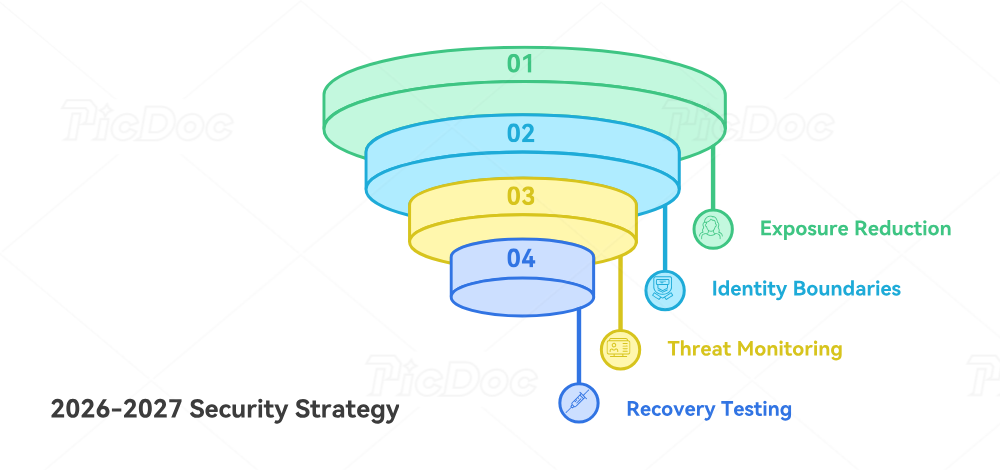
The right strategy for 2026-2027 is not “boil the ocean.” It is to harden the handful of control domains that cut the most risk across multiple scenarios. Start with exposure reduction. Remove internet-facing administration where possible, review remote access pathways, and identify all unmanaged or legacy assets touching critical processes. CISA’s ICS guidance continues to emphasize insights into vulnerabilities and practical recommendations for strengthening OT environments, and its frequent ICS advisories show how regularly industrial products and deployments need attention.
Then strengthen identity and trust boundaries. Vendor access should be time-bound, recorded, and isolated. Privileged access should be vaulted, segmented, and attributable. Admin tiers should not collapse into one convenience layer. From there, improve threat-informed monitoring. OT-aware logging, anomaly detection for remote sessions, and change visibility for engineering actions matter more than generic dashboards with no process context. This is where cloud security engineering, SOC analyst development, SOC manager progression, and cybersecurity manager pathways all intersect with infrastructure reality.
Finally, test recovery and decision-making, not just tooling. CISA’s resilience resources and infrastructure planning playbook reinforce that resilience is not only prevention; it is also the ability to execute through disruption. Recovery drills should answer uncomfortable questions: Can you rebuild trusted access? Can you restore safely? Can operations continue in degraded mode? Can legal, executive, and technical teams make aligned decisions quickly enough?
5. Market outlook: where the threat landscape is headed next
For 2026-2027, the most important trend is that critical infrastructure attacks will continue to reward adversaries who exploit practical asymmetry. They do not need perfect access everywhere. They need one weak vendor, one forgotten remote service, one fragile recovery plan, or one overprivileged identity. That is why recent FBI/IC3 alerts still emphasize ransomware groups targeting critical infrastructure and opportunistic disruptive activity against visible infrastructure environments.
The second trend is that governance pressure will rise alongside technical risk. Infrastructure operators will face more pressure to show not just that they bought tools, but that they can demonstrate baseline controls, segmentation logic, recovery readiness, and leadership accountability. CISA’s CPG 2.0 reporting and assessment training point in exactly that direction: fewer vague aspirations, more attestable goals with proven risk-reduction value.
The third trend is that the premium cybersecurity skill in this space will be operationally literate defense. People who can bridge cybersecurity compliance, critical-sector security strategy in energy and utilities, manufacturing sector cyber risk, and government/public-sector security trends into decisions that reduce real disruption will become far more valuable than professionals who only describe threats abstractly. The infrastructure winner in 2027 will not be the organization with the most cyber vocabulary. It will be the one that narrows attack paths, shrinks trust, recovers fast, and proves that resilience under stress.
6. FAQs
-
There is no single threat, but ransomware with operational spillover remains one of the clearest priorities. The FBI’s 2024 IC3 report says ransomware was again the most pervasive threat to critical infrastructure, and Verizon’s 2025 DBIR ties ransomware to 75% of system-intrusion breaches.
-
Because the connection points create attack opportunities. Fortinet’s 2025 OT research says the traditional air gap is largely gone, so weak segmentation, inherited identity trust, and poorly monitored remote access matter far more than before.
-
Very important. Verizon reported that third-party involvement in breaches doubled to 30% in the 2025 DBIR. Infrastructure environments often rely heavily on vendors, MSPs, OEMs, and support providers, which makes external trust a core security issue rather than a side issue.
-
Start with internet exposure, remote access, privileged identity design, segmentation, and recovery testing. Those controls reduce risk across multiple scenarios instead of improving only one niche use case. CISA’s cross-sector goals are built around exactly that kind of broad risk-reduction value.
-
Yes. In critical infrastructure, the inability to restore safely can be just as damaging as the initial compromise. IBM’s industrial-sector cost data and CISA’s resilience guidance both support the idea that resilience has to include restoration, not just detection.
-
A strong program has complete asset visibility, hardened and monitored remote access, strict privileged identity control, strong IT/OT segmentation, tested recovery pathways, and joint IT/OT incident playbooks. It also maps those controls to business consequence rather than treating them as generic cyber hygiene.
