
Access Control Models: DAC, MAC, and RBAC Explained
Access control is where “security policy” becomes real—or quietly fails. If your org has ever been hit by a lateral-movement incident, a cloud privilege escalation, or a silent data exfiltration, odds are the root cause wasn’t “no firewall.” It was authorization drift: stale permissions, unclear ownership, and inconsistent enforcement across identity, apps, and data. This guide breaks down DAC, MAC, and RBAC in a way you can apply: what each model truly enforces, where it breaks in modern environments, and how to combine them into an audit-ready strategy aligned with zero trust innovations, cloud realities, and compliance pressure.
1. What access control really protects
Access control isn’t “who can log in.” It’s the decision engine that answers: Can this subject do this action on this object, right now, under these conditions? When that engine is weak, attackers don’t need to “break in” loudly—they walk through legitimate pathways.
Here’s why DAC/MAC/RBAC matter beyond theory:
Authorization is the blast-radius dial. Mis-scoped permissions turn a single compromised account into a multi-system breach—especially in SaaS and cloud identity ecosystems where sessions and tokens are currency (see top 10 threats predicted by 2030 and the identity angle in AI-powered cyberattacks).
Most organizations fail at “permission lifecycle.” They grant access quickly and remove it slowly—leaving zombie access behind after role changes, vendor offboarding, and project pivots (a recurring pain point in future cybersecurity audit practices and future of cybersecurity compliance).
Cloud multiplies mistakes. One over-broad IAM policy can become organization-wide persistence. If you’re building toward cloud roles, map this to cloud security engineer and the larger shift in the future of cloud security.
If you want access control that survives audits and real attackers, you need to understand what DAC, MAC, and RBAC are actually optimizing for—and what they inevitably trade away.
2. How DAC, MAC, and RBAC behave in real environments
The fastest way to choose the right model is to stop asking “Which is best?” and start asking what failure you can tolerate.
DAC in practice: the “collaboration tax”
DAC is perfect for fast-moving teams—until you try to answer:
Who has access to this sensitive dataset right now?
Who granted it, and why?
Is that access still required?
If you can’t answer those in minutes, you have an exposure window. And attackers love exposure windows because they’re quiet. Token theft and session hijacking don’t require admin rights if the underlying data is shared broadly—connect that threat reality to AI-driven cybersecurity tools and the bigger shift described in future skills for professionals.
High-value DAC guardrails (what actually works):
Default-deny sharing (make sharing a deliberate act, not the default state).
Time-bounded grants (access expires unless renewed).
Owner + manager approval for sensitive objects.
Automated stale-access cleanup tied to HR identity lifecycle.
If you’re doing cloud, build this thinking into the IAM patterns discussed in cloud security engineer and the forward-looking risks in future of cloud security.
MAC in practice: the “policy must be true” model
MAC shines when your organization can commit to:
A real data classification scheme (not “we have labels” in a slide deck).
Enforcement that can’t be bypassed by convenience.
Consistent policy interpretation across systems.
MAC’s pain point is that it exposes messy organizational realities. If your data owners can’t agree on classification, MAC will feel “too strict” because it’s forcing a decision you avoided.
Practical MAC wins:
Regulated data with strict disclosure constraints.
Compartmented projects (M&A, legal, sensitive R&D).
OT/critical systems where a mistake becomes physical impact (connect to sector predictions like energy & utilities cybersecurity).
MAC’s best friend is clear auditing and evidence—align this with future audit practices and evolving expectations in cybersecurity standards.
RBAC in practice: role design is the whole game
RBAC doesn’t fail because the concept is weak. It fails because role engineering is treated like a one-time setup, not a living system.
RBAC red flags you should treat as incident precursors:
“Temporary” admin roles that never get removed.
Dozens of near-duplicate roles (“Analyst-2”, “Analyst-2b”, “Analyst-2-old”).
People requesting roles instead of requesting tasks (“I need Admin” instead of “I need to restart service X for incident Y”).
Roles that include both read and destructive permissions “for convenience.”
High-value RBAC practices:
Build roles around tasks and workflows, not titles.
Use tiered roles (view, operate, administer) with approvals for elevation.
Enforce separation of duties intentionally (especially around finance, identity, and deployment pipelines).
Review roles continuously using telemetry—this is where SIEM and next-gen SIEM matter because “role usage evidence” is far stronger than “we think it’s fine.”
3. Where each model fits today
You’ll get the best results by mapping models to asset types and operational constraints.
1) Workforce apps & SaaS: RBAC-first, DAC with guardrails
For collaboration platforms, ticketing, CRM, and internal apps, RBAC is usually the anchor because you need consistency across teams. But DAC sneaks in via sharing features. Treat DAC as a controlled escape hatch, not the primary model.
If you’re planning for long-term changes in identity and workforce patterns, connect this to remote cybersecurity careers and the job evolution described in job market trends.
2) Data platforms: MAC where disclosure risk is existential
For sensitive data lakes, analytics environments, patient/financial records, and regulated datasets, MAC principles (mandatory policy, labeling, and restricted flows) are what prevent “authorized exfiltration.”
This matters even more as industry regulation tightens—see privacy regulations trends and forward shifts like GDPR 2.0 evolution.
3) Infrastructure & cloud: RBAC + policy controls, plus ruthless privilege hygiene
Infrastructure access is where “one role” can equal total compromise. Make privileged access time-bound and observable. If your threat model includes ransomware and extortion, remember: privilege is the lever attackers use to disable backups, push payloads, and destroy recovery paths (tie to ransomware detection, response, and recovery and future threat evolution like next ransomware evolution).
Also don’t confuse network access with authorization. A VPN is transport, not a permission model—see VPN security benefits and limitations and enforce RBAC/MAC at the application and data layer.
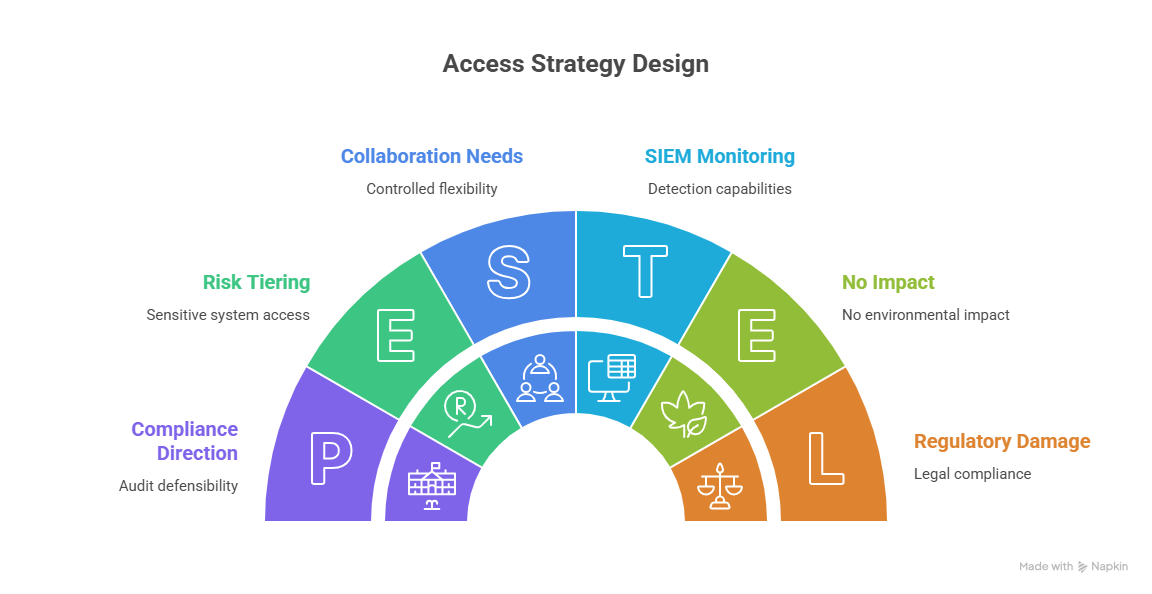
4. How to design an access strategy that won’t collapse
Most organizations don’t “choose a model.” They accidentally run all three poorly. The high-performing approach is to deliberately layer them:
Step 1: Decide what must be mandatory (MAC thinking)
Start with your irreversible risks:
What data cannot be broadly shared under any circumstances?
Where does a single mistake create legal/regulatory damage?
Which systems must enforce policy even if the user tries to “work around it”?
That’s MAC territory. Even if you don’t deploy full MLS controls, you can adopt MAC principles: mandatory classification, mandatory policy checks, mandatory guardrails.
Tie this to compliance direction and audit defensibility in future compliance trends and the standards trajectory in next-gen cybersecurity standards.
Step 2: Build role truth (RBAC as your operational backbone)
Your RBAC system should answer:
Which roles exist, and what business functions do they represent?
Which permissions are in each role, and why?
Who approves role membership, and how often is it reviewed?
High-value RBAC deliverables (this is what mature programs actually maintain):
A role catalog with descriptions, owners, and risk tiering.
Tiered roles for sensitive systems (read vs operate vs administer).
Separation-of-duties constraints baked into role design.
An exception process that forces time bounds and evidence.
If your SOC operates on tiering and escalation, RBAC should mirror that workflow (see SOC analyst pathway and the operational mindset behind SOC analyst 2025 guide).
Step 3: Allow discretionary sharing only with guardrails (DAC as controlled flexibility)
DAC should exist because collaboration is real—but it should never be “uncontrolled freedom.” The best DAC guardrails are:
Expiration by default (access fades unless renewed).
Sensitive-object sharing requires approvals (owner + manager, or owner + security).
Sharing is observable (alerts for high-risk sharing patterns).
Periodic attestations where owners must re-justify access.
This is where modern security “governance” intersects with detection capabilities. Don’t treat access reviews as paperwork—treat them as a detection surface you can monitor via SIEM and evolve toward next-gen SIEM.
Step 4: Assume identity threats and design for containment
Your access model is only as strong as:
Session/token protection
MFA integrity
Privileged account workflow discipline
Identity-centric threat growth is a recurring theme in the predictions ecosystem—link your strategy thinking to top threats by 2030 and the system-level risk in AI-powered cyberattacks.
5. How to test and audit access controls like a pro
Most access control programs fail audits for one reason: they can’t prove their controls are real. You need evidence that’s precise, repeatable, and tied to decisions.
1) Test with “permission truth” questions
Ask questions your systems must answer fast:
Who can access this object and through which path (direct grant vs role vs group)?
Which permissions are unused and should be removed?
Which roles provide overlapping or conflicting privileges?
Which users have privileged access outside defined workflows?
If your program can’t answer those, you’re operating on assumptions—and assumptions are where attackers hide.
2) Measure drift (the silent killer)
Authorization drift happens when:
People change jobs but keep old roles.
“Temporary” access never expires.
Teams duplicate roles instead of refactoring.
SaaS apps create their own parallel permission universes.
Your drift controls:
Joiner/mover/leaver automation
Quarterly (or risk-based) access attestations
Role usage telemetry (to remove dead permissions)
Change control for role modifications
This aligns naturally with the governance trends discussed in future cybersecurity audit practices and regulatory momentum in privacy regulation trends.
3) Treat privileged access as an incident surface
Standing admin privileges are an attacker’s favorite gift. Your audit-ready posture includes:
Just-in-time elevation (time boxed)
Approval workflows (who approved, why)
Session logging/recording for privileged actions
Break-glass accounts with strong monitoring
Ransomware operators and intrusion crews love privileged pathways because they can disable defenses and kill recovery—anchor your program to operational reality in ransomware response and the predicted attacker evolution in next ransomware evolution.
4) Use technical controls that reinforce policy
Access models don’t live only in IAM consoles. They’re reinforced by:
Strong cryptographic trust patterns (PKI, encryption standards)
Network segmentation and enforcement points (firewall technologies)
The goal is simple: make it hard to “accidentally” be over-permissioned—and easy to detect when it happens.
6. FAQs
-
Start with failure impact and scale. If a single disclosure event is catastrophic, prioritize MAC principles and mandatory policy enforcement. If you need consistent access across large teams, RBAC is the backbone. If collaboration speed is critical, DAC can exist—but only with expiry, approvals, and reviews. For broader strategic alignment, connect this to zero trust innovations because zero trust assumes authorization must be continuously defensible.
-
Because many orgs implement RBAC as labels on top of messy permissions. If roles aren’t engineered around tasks, reviewed, and measured for usage, they become permission dumpsters. Mature RBAC requires governance and telemetry, which pairs naturally with SIEM and modernization trends like next-gen SIEM.
-
Not anymore. Full MLS implementations are common in high-security contexts, but MAC principles (mandatory classification, mandatory policy checks, restricted flows) are increasingly relevant for regulated industries and sensitive datasets—especially as privacy and compliance expectations tighten (see privacy regulations trends and GDPR 2.0 evolution).
-
You don’t stop it with policy statements—you stop it with mechanics: time-bounded access, role tiers, a real exception process, and joiner/mover/leaver automation. Then you measure drift and remove unused permissions. This approach also strengthens your audit posture as described in future audit practices.
-
Confusing convenience with safety. Over-broad IAM policies, shared admin roles, and “just in case” permissions create organization-wide blast radius. Fix it by designing RBAC for cloud tasks, enforcing just-in-time elevation, and auditing policies like code. For bigger context, pair this with cloud security engineer and the strategic direction in future of cloud security.
-
Demonstrate that you can translate models into operational controls: role engineering, SoD design, privileged workflows, audit evidence, and incident containment impact. If you’re aiming at audit/compliance paths, align this with cybersecurity auditor roles and compliance officer roadmap. If you’re SOC-focused, map access control to containment and response workflows via SOC analyst guide.
