
Cybersecurity Portfolio Projects: 25 Projects Recruiters Can Actually Evaluate
A cybersecurity portfolio becomes valuable when a recruiter can inspect what you built, what problem you solved, what evidence you produced, and how you reasoned through the result. That is the difference between another GitHub full of copied tutorials and a portfolio that strengthens a cybersecurity résumé with no experience, supports a SOC analyst application, improves your home-lab credibility, and proves more than another entry-level certificate ever could.
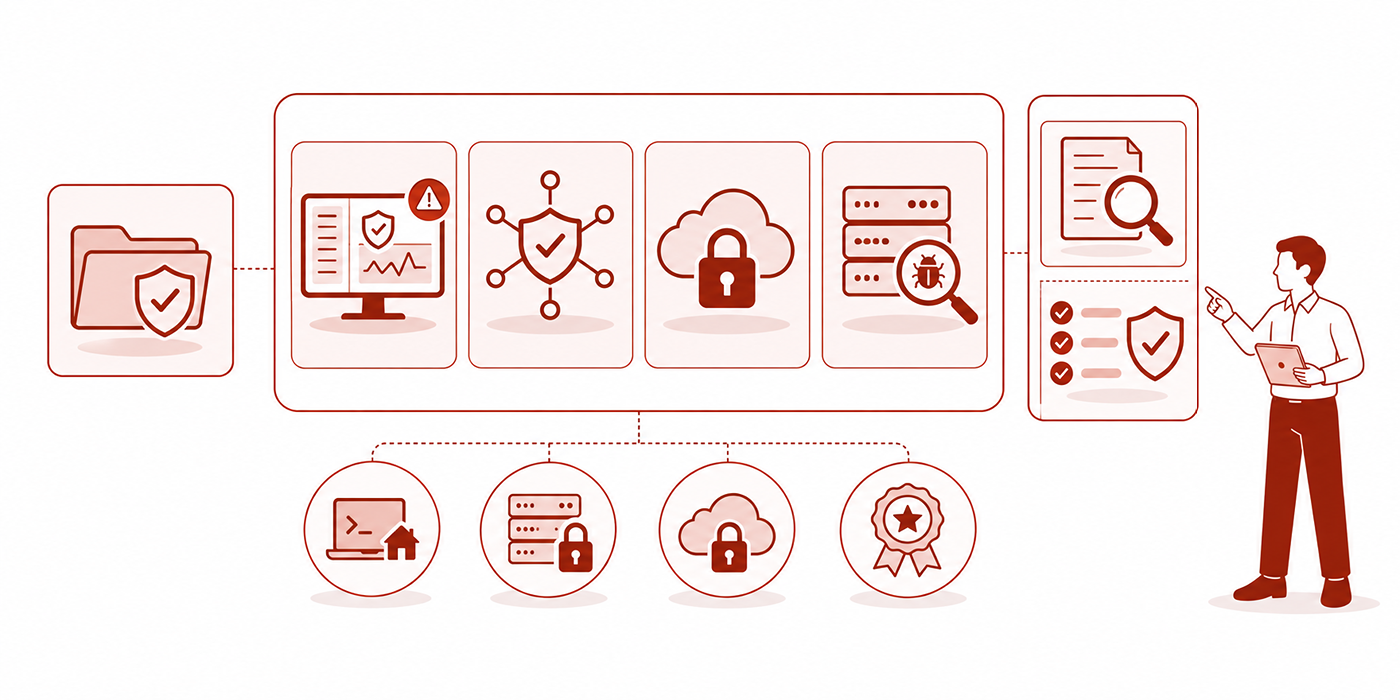
1. What Makes a Cybersecurity Portfolio Project Recruiter-Evaluable?
The biggest portfolio mistake is building something technically impressive that an employer cannot quickly understand.
A hiring manager rarely has time to reconstruct your intention from a repository containing screenshots, random scripts, and a README that says “home lab.” Your project needs a clear problem statement, environment, methodology, evidence, decision, and outcome. That structure turns practice into something useful for SOC hiring managers, gives substance to a cybersecurity resume, and closes the gap between certifications and hands-on labs.
A strong portfolio artifact answers six questions immediately:
What problem were you solving?
“Detect suspicious PowerShell activity across Windows endpoints” is better than “Splunk project.”
What environment did you build?
Document operating systems, cloud services, SIEM, network topology, endpoint tooling, logging sources, and relevant assumptions.
What did you actually do?
Show configurations, detection logic, queries, scripts, policies, packet captures, incident notes, remediation steps, or architecture diagrams.
What evidence proves it worked?
Include logs, screenshots, before-and-after comparisons, alert output, query results, test cases, or remediation validation.
What did you learn or change?
This matters because employers evaluating entry-level cybersecurity candidates care about reasoning, especially when applicants face heavy job-market competition.
Can someone reproduce it?
A project becomes more credible when the README includes prerequisites, architecture, deployment steps, test scenarios, known limitations, and expected outputs.
The strongest portfolios also show progression. A beginner project can identify a phishing email. A better one extracts indicators, validates infrastructure, correlates endpoint activity, writes a detection, and produces an incident report. A stronger project turns the detection into reusable logic, documents false positives, and explains how it would scale.
That progression reflects the same difference between Security+ alone and deeper evidence, between cybersecurity graduates struggling for interviews and candidates who can demonstrate execution, and between a general portfolio and one designed around actual SOC hiring expectations.
| Project | Best For | Recruiter Can Evaluate | Must-Have Deliverable |
|---|---|---|---|
| 1. Windows Event Log Investigation | SOC | Log analysis and investigative reasoning | Incident timeline + findings |
| 2. SIEM Detection Engineering Lab | SOC / Detection | Query writing and alert logic | Detection rule + false-positive analysis |
| 3. Phishing Investigation Case | SOC | Email analysis and IOC handling | Case report + indicators |
| 4. Brute-Force Detection Project | SOC | Authentication-event correlation | Detection logic + test evidence |
| 5. Ransomware Behavior Simulation | Blue Team | Behavior-based detection | Telemetry + containment plan |
| 6. Threat Hunting Workbook | Threat Hunting | Hypothesis-led investigation | Hunt hypothesis + queries + conclusions |
| 7. MITRE ATT&CK Detection Mapping | SOC / Detection | Coverage analysis | Mapped controls + detection gaps |
| 8. Packet Analysis Investigation | SOC / Network Security | Networking fundamentals | PCAP notes + reconstructed activity |
| 9. Active Directory Attack-and-Detect Lab | SOC / Pentesting | AD understanding | Attack path + detection evidence |
| 10. Vulnerability Management Program | Security Analyst | Prioritization and remediation | Risk-ranked remediation plan |
| 11. AWS Secure Architecture Build | Cloud Security | Cloud architecture judgment | Diagram + security controls |
| 12. Azure IAM Hardening Project | Cloud / IAM | Identity-security skill | Access model + hardening evidence |
| 13. Cloud Logging & Alerting Pipeline | Cloud / SOC | Telemetry design | Architecture + test alert |
| 14. Terraform Security Guardrails | Cloud / DevSecOps | IaC and automation | Terraform repo + policy checks |
| 15. Secrets Management Project | Cloud / DevSecOps | Credential-handling maturity | Secrets workflow + validation |
| 16. CI/CD Security Pipeline | DevSecOps | Software supply-chain security | Pipeline controls + failed test examples |
| 17. Web Application Pentest | Pentesting | Testing methodology | Professional pentest report |
| 18. Active Directory Pentest Report | Pentesting | Privilege escalation understanding | Attack chain + remediation |
| 19. Detection Rule From Offensive Test | Purple Team | Attack-to-defense translation | Attack proof + detection rule |
| 20. GRC Risk Assessment | GRC | Risk analysis | Risk register + treatment plan |
| 21. NIST Control Mapping Exercise | GRC / Audit | Framework fluency | Control matrix + identified gaps |
| 22. Third-Party Risk Assessment | GRC | Vendor-risk reasoning | Assessment + remediation requirements |
| 23. Incident Response Playbook | SOC / GRC | Operational planning | Role-based playbook + escalation tree |
| 24. Security Automation Script | Engineering | Coding and operational thinking | Script + test data + documented impact |
| 25. Security Architecture Review | Engineering / Architecture | Design judgment | Architecture diagram + threat model |
2. 25 Cybersecurity Portfolio Projects Worth Building
1. Windows Event Log Investigation
Create a Windows machine, generate authentication and process activity, collect logs, then investigate one suspicious sequence. Your portfolio should include the event IDs reviewed, the hypothesis you started with, what evidence confirmed or disproved it, and the final incident timeline.
This project directly strengthens a SOC-focused portfolio, prepares you for SOC analyst interviews, improves a no-experience cybersecurity résumé, and adds practical depth beyond entry-level certifications.
2. SIEM Detection Engineering Lab
Ingest Windows or Linux logs into Splunk, Elastic, Sentinel, or another SIEM. Write at least three detections, test them, document expected benign behavior, and explain tuning decisions.
The deliverable should include the detection query, attack behavior, false positives, severity logic, and recommended analyst response. That demonstrates more value than a generic SIEM screenshot and supports progression toward security automation, SOC analyst work, and eventually security engineering.
3. Phishing Investigation Case
Build a safe phishing-analysis case using a sample email. Examine sender headers, URLs, attachment metadata, authentication results, domain context, and endpoint implications.
Produce an analyst-style report showing triage, evidence, indicators, risk, containment, and user-impact recommendations. Candidates interested in SOC careers, hands-on hiring proof, and improving recruiter-verifiable evidence gain much more from a complete case than from listing “phishing analysis” as a skill.
4. Brute-Force Detection Project
Simulate failed logins in a controlled lab, collect the relevant authentication logs, and build detection logic around threshold, source, account, and timing patterns.
Then improve it. Distinguish password spraying from repeated attempts against one account. Explain why naive thresholds create noise. Document how identity-focused detections connect to digital identity security, cloud security progression, and stronger SOC investigations.
5. Ransomware Behavior Simulation
Use a safe simulator rather than actual malware. Generate file modifications, suspicious process behavior, or simulated encryption activity and collect endpoint telemetry.
Show the attack chain, telemetry, detection logic, containment strategy, and gaps. This demonstrates incident reasoning and supports SOC portfolio development, security automation, AI-security-adjacent monitoring, and technical security architecture.
6. Threat Hunting Workbook
Pick a hypothesis such as “an attacker may use encoded PowerShell commands to evade normal monitoring.” Define required data sources, write hunt queries, inspect results, document anomalies, and identify coverage gaps.
The recruiter can evaluate your reasoning process rather than simply whether you found something. This is useful for candidates moving beyond entry-level SOC roles and trying to differentiate themselves in a competitive cyber job market.
7. MITRE ATT&CK Detection Mapping
Take an existing lab environment and map your available detections to ATT&CK techniques. Identify blind spots and propose additional telemetry.
The valuable part is the coverage analysis, not coloring a matrix. Explain why specific data sources are required and what attacker behavior remains invisible. This bridges SOC operations, security engineering, and eventual security architecture responsibilities.
8. Packet Analysis Investigation
Capture legitimate traffic in your lab, introduce one suspicious event, and reconstruct what happened using Wireshark.
Document conversations, protocols, DNS lookups, TCP behavior, relevant endpoints, and why the traffic is suspicious. Candidates whose networking skills remain weak after Security+ can use this to demonstrate practical understanding useful in SOC analysis, pentesting, and cloud security.
9. Active Directory Attack-and-Detect Lab
Build a small AD environment with users, groups, and common misconfigurations. Simulate safe attack techniques and observe what logs or endpoint telemetry expose them.
The strongest output contains an attack path, affected objects, detections, mitigation, and post-remediation validation. That one project can support SOC hiring, pentesting progression, IAM specialization, and a stronger cybersecurity portfolio.
10. Vulnerability Management Program
Scanning a machine with Nessus or OpenVAS is too shallow by itself.
Instead, build a mini vulnerability-management workflow: asset inventory, scan, validation, risk prioritization, remediation owner, remediation deadline, exception logic, rescan, and closure evidence.
This demonstrates decision-making and connects naturally with cybersecurity risk management, GRC work, IT audit, and security analyst responsibilities.
11. AWS Secure Architecture Build
Build a small AWS environment containing public and private components. Apply IAM least privilege, logging, encryption, network segmentation, and secure storage.
Your portfolio should contain the architecture diagram, threat assumptions, major controls, one intentional misconfiguration, remediation steps, and validation. This creates evidence for cloud security careers, cybersecurity automation engineering, security architecture, and advanced risk-management work.
12. Azure IAM Hardening Project
Create users, groups, roles, conditional-access logic, privileged identities, and access-review scenarios in a test Azure environment.
Document the original risk, permission model, hardening action, and validation. Identity is one of the clearest bridges between digital identity specialization, cloud security, GRC controls, and security architecture.
13. Cloud Logging and Alerting Pipeline
Centralize audit logs from a cloud environment, normalize what matters, and build alerts around one or two high-risk actions.
Show where logs originate, where they are stored, how long they remain available, what event triggers the alert, and how an analyst should respond. This creates a strong bridge between SOC work, cloud security, automation engineering, and security architecture.
14. Terraform Security Guardrails
Create a small Terraform deployment and add controls preventing insecure resources.
Examples include disallowing public storage, enforcing encryption, requiring tags, or preventing unrestricted security groups. Your portfolio becomes much stronger when it contains deliberately failing and passing examples.
This demonstrates scalable security engineering relevant to cybersecurity automation, cloud security, AI security infrastructure, and future architecture roles.
15. Secrets Management Project
Create a simple application that initially stores credentials insecurely, then redesign the workflow using an appropriate secrets-management solution.
Show the bad state, threat, improved design, access controls, rotation plan, and validation. Recruiters can evaluate whether you understand credential exposure, access boundaries, and operational security.
16. CI/CD Security Pipeline
Build a small application pipeline and add automated security checks.
You might include dependency scanning, secrets detection, static analysis, container scanning, or policy enforcement. Show what causes the pipeline to fail and how developers receive useful remediation information.
This is valuable for security automation careers, cybersecurity product work, AI security, and technical architecture progression.
17. Web Application Pentest
Use a deliberately vulnerable training application and test it systematically.
The recruiter-visible deliverable should be a professional report with scope, methodology, findings, severity, reproduction steps, business impact, evidence, and remediation. Candidates interested in pentesting careers, hands-on skills, and stronger portfolio evidence should prioritize the report as much as exploitation.
18. Active Directory Pentest Report
Perform a controlled assessment of a deliberately vulnerable AD lab.
Map privilege relationships, identify misconfigurations, validate exploitable paths, and then propose remediation. The strongest version includes attack-path reduction after remediation.
19. Purple-Team Detection Project
Perform one safe offensive technique, capture the generated telemetry, write a detection, test it, tune it, and document the entire chain.
This is one of the highest-value portfolio formats because it demonstrates both attacker thinking and defensive engineering. It supports pentesting progression, SOC advancement, security automation, and security architecture.
20. GRC Risk Assessment
Create a realistic fictional organization and perform a structured risk assessment.
Identify assets, threats, vulnerabilities, likelihood, impact, existing controls, residual risk, treatment, ownership, and due dates. Candidates pursuing GRC cybersecurity careers, risk management, policy analysis, or regulatory specialization can use this to prove they can turn frameworks into decisions.
21. NIST Control Mapping Exercise
Take a small environment and map selected controls against its real state.
Document implemented, partially implemented, missing, and compensating controls. Add evidence requirements and remediation priorities.
This is significantly stronger than simply listing “NIST knowledge” and supports GRC specialization, cybersecurity auditing, regulatory work, and policy careers.
22. Third-Party Risk Assessment
Create a fictional SaaS vendor handling sensitive business data.
Assess authentication, encryption, incident-response obligations, data retention, subprocessors, backup, access controls, vulnerability management, and contractual risks.
The final package should include a questionnaire, identified risks, required remediation, residual-risk decision, and escalation path. This demonstrates practical GRC capability, risk management, privacy analysis, and regulatory understanding.
23. Incident Response Playbook
Choose a scenario such as ransomware, credential compromise, cloud access-key exposure, or business-email compromise.
Write detection criteria, triage steps, containment actions, evidence-preservation requirements, escalation points, communications, recovery checks, and post-incident actions.
That demonstrates structured thinking valuable in SOC roles, security program management, GRC, and security leadership.
24. Security Automation Script
Automate one repetitive security task.
Examples include parsing indicators, enriching alerts, checking suspicious domains, normalizing logs, generating incident tickets, validating cloud configurations, or auditing access.
Document the manual problem, script logic, test data, error handling, output, and measurable time saved. This creates direct evidence for cybersecurity automation engineering, cloud security, SOC progression, and security engineering.
25. Security Architecture Review
Design a fictional application or review an existing lab architecture.
Identify assets, trust boundaries, authentication flows, data stores, administrative paths, dependencies, external services, major threats, and recommended controls.
Include a diagram, threat model, priority findings, tradeoffs, and revised design. This is particularly valuable for candidates developing toward security architecture, cybersecurity product management, security leadership, and risk management.
3. How to Package Projects So Recruiters Can Evaluate Them in Minutes
The project itself is only half the job. Packaging determines whether anyone can evaluate it.
Every portfolio project should begin with a one-screen executive summary containing:
problem;
environment;
tools;
skills demonstrated;
result;
link to evidence.
This lets a recruiter understand relevance immediately.
Then provide a technical README with architecture, methodology, test data, screenshots, findings, limitations, and lessons learned. That structure is especially important for candidates competing without extensive employment history through a cybersecurity resume, SOC portfolio, or certification-plus-lab strategy.
Your repository should also contain actual artifacts.
For SOC projects:
SIEM queries;
screenshots;
event logs;
incident notes;
alert logic;
timelines;
remediation.
For cloud projects:
architecture diagram;
IAM policy;
Terraform;
configuration evidence;
before/after state;
logging output;
threat model.
For pentesting:
scope;
methodology;
sanitized evidence;
finding severity;
reproduction;
remediation;
executive summary.
For GRC:
risk register;
control matrix;
evidence requirements;
remediation plan;
ownership;
residual-risk decision.
These artifacts support several adjacent career paths including SOC analysis, GRC cybersecurity, automation engineering, and security architecture.
Use a consistent project structure:
1. Problem
What security question are you answering?
2. Environment
What did you build?
3. Threat or requirement
What are you protecting against?
4. Method
What steps did you perform?
5. Evidence
What proves the result?
6. Analysis
What does the evidence mean?
7. Remediation or outcome
What changed?
8. Limitations
What would be different in production?
9. Next iteration
What would you improve?
This structure helps employers evaluate your judgment, which is especially important when graduates face rejection, Security+ alone fails to differentiate applicants, and entry-level cyber competition makes generic portfolios easy to ignore.
4. Build a Portfolio Around the Job You Want, Not Around Random Cybersecurity Tools
The strongest portfolio is role-aligned.
A candidate targeting SOC roles should avoid spending months producing unrelated GRC templates, blockchain experiments, and cloud diagrams while lacking a single complete incident investigation. Build projects around what SOC hiring managers actually want, what entry-level SOC applicants must prove, and what turns a cybersecurity home lab into hiring evidence.
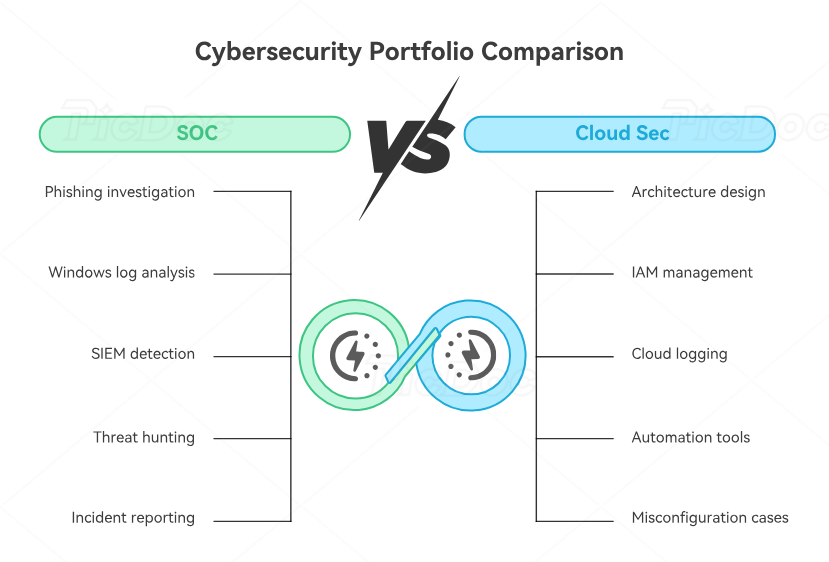
A strong SOC portfolio could contain:
phishing investigation;
Windows log investigation;
SIEM detection;
threat hunt;
incident report.
That is enough to create a coherent story: “I know how to triage, investigate, detect, document, and improve defensive coverage.”
A cloud-security portfolio should show architecture, IAM, logging, automation, and remediation. Pair an AWS or Azure security build with Terraform, cloud logging, identity hardening, and one misconfiguration case. That helps candidates move toward digital identity careers, security automation, AI security infrastructure, and security architecture.
A pentesting portfolio should show methodology and reporting, because exploitation alone is incomplete. Build a web application assessment, Active Directory test, network analysis case, and purple-team project. This also protects against the problem discussed in whether penetration testing is changing: commodity scanning creates weaker differentiation than deep testing, reporting, remediation, and defender-aware thinking.
A GRC portfolio should contain a risk assessment, control map, third-party review, policy recommendation, and remediation tracker. This proves capability relevant to GRC careers, risk management, regulatory specialization, IT audit, and privacy analysis.
A security-engineering portfolio should demonstrate repeatability and scale.
Build:
automated detections;
security APIs;
Terraform guardrails;
CI/CD controls;
cloud logging pipelines;
secrets management;
configuration auditing;
security architecture.
These projects create stronger evidence for cybersecurity automation engineering, security architecture, cybersecurity product management, and eventual security leadership.
The goal is coherence.
When a recruiter opens your portfolio, they should understand what kind of cybersecurity professional you are trying to become within minutes.
5. How to Turn Portfolio Projects Into Interviews and Stronger Resume Bullets
A portfolio creates value only when it enters the hiring process.
Your résumé should link to the strongest projects directly and describe them as work performed, not as course participation.
Weak:
Completed Splunk home lab.
Stronger:
Built a Windows-to-SIEM lab, created detections for repeated authentication failures and suspicious PowerShell activity, tested alert logic against simulated events, and documented false-positive tuning and analyst response steps.
That wording exposes the difference between a candidate who watched a tutorial and one who understands the workflow described in SOC hiring expectations, hands-on lab strategy, and a recruiter-verifiable cybersecurity résumé.
For a cloud project, replace:
AWS security project.
with:
Designed a segmented AWS lab using least-privilege IAM, centralized logging, encrypted storage, and restricted network access; intentionally introduced and remediated a public-storage misconfiguration and documented validation evidence.
For GRC:
NIST project.
becomes:
Assessed a fictional SaaS environment against selected NIST controls, documented implementation gaps, created remediation owners and priorities, and tracked residual risk in a structured risk register.
These bullets strengthen candidates exploring GRC specialization, risk management, cloud security, and automation engineering.
The interview strategy matters too.
For every project, prepare a 90-second explanation:
Problem: what you wanted to solve.
Environment: what you built.
Action: what you did.
Evidence: how you verified it.
Failure: what did not work initially.
Improvement: what you changed.
Production caveat: what would need to change in a real enterprise.
The failure component is especially valuable. Recruiters learn more from “my first detection generated too many false positives, so I added X and Y conditions” than from a perfectly polished story where nothing went wrong.
That demonstrates troubleshooting.
Applicants facing cybersecurity market saturation, graduate rejection, and no-experience entry barriers need exactly that kind of evidence.
Avoid filling GitHub with 40 shallow repositories. Five coherent, well-documented projects usually communicate far more than dozens of unfinished exercises.
Your portfolio homepage can present each project with:
project title;
target role;
problem solved;
tools;
one-sentence result;
evidence link;
repository;
report PDF;
architecture image.
Then order projects according to the job you are applying for.
For SOC applications, put SIEM, phishing, Windows, incident response, and threat hunting first.
For cloud security, move IAM, Terraform, logging, and architecture to the top.
For GRC, lead with risk assessments, control mappings, vendor assessments, and incident playbooks.
For pentesting, prioritize reports, exploit methodology, AD, web testing, and purple-team work.
That targeted presentation gives your portfolio the same role-specific focus that should exist in a strong cybersecurity résumé, a SOC application strategy, and a deliberate certification pathway.
6. FAQs About Cybersecurity Portfolio Projects
-
Start with three to five strong, role-aligned projects that employers can actually evaluate. A candidate targeting SOC analyst jobs can gain more from five complete investigations than 25 unrelated repositories. Each project should support your cybersecurity résumé, strengthen your home-lab evidence, and demonstrate skills relevant to actual hiring expectations.
-
A complete phishing or authentication investigation is an excellent starting point because it can demonstrate logs, analysis, evidence, remediation, and communication without requiring a huge environment. Follow it with a SIEM detection and a packet-analysis case. These projects complement Security+, support a no-experience cybersecurity route, and create practical evidence beyond certification-only learning.
-
You can reference meaningful lab work, although the stronger evidence is what you produced from it. A completed room or machine tells an employer less than a sanitized report explaining methodology, findings, attack path, remediation, and defensive detection opportunities. Candidates interested in pentesting careers, SOC work, and hands-on evidence should turn platform exercises into artifacts.
-
Some will, some will not, which is why the résumé needs to communicate project value even before anyone clicks. Your project title and bullet should explain the problem, tools, action, and outcome. Then GitHub provides deeper proof for reviewers who want it. This helps candidates facing cybersecurity hiring competition, graduate rejection patterns, and weak résumé evidence.
-
A strong SOC portfolio should include a SIEM detection, phishing investigation, Windows event-log case, threat-hunting exercise, and incident-response report. Add packet analysis or Active Directory detection if possible. These directly support the skills described in SOC hiring-manager expectations, SOC entry pathways, cybersecurity home labs, and security automation progression.
-
Build projects around IAM, logging, network segmentation, encryption, secrets, infrastructure as code, and remediation. A strong portfolio can include an AWS architecture build, Azure IAM hardening project, Terraform guardrails, and cloud logging pipeline. These create evidence for digital identity specialization, cybersecurity automation, AI security, and security architecture.
