
Cybersecurity Career Change at 30+: Reddit Success Stories, Age Concerns, Salary Reset & Transferable Skills
Changing careers after 30 creates a different cybersecurity problem from starting at 21. You may have rent, dependents, a respectable salary, and a decade of professional experience that you cannot afford to throw away. Recent Reddit discussions show people wrestling with exactly that trade-off while trying to break into cybersecurity without IT experience, survive a competitive cybersecurity job market, choose between degrees and certifications, and figure out whether cybersecurity is still worth pursuing. The strongest career changers treat their previous experience as usable capital and build a transition around it.
1. Is 30+ Too Late for Cybersecurity? What Reddit Stories Actually Show
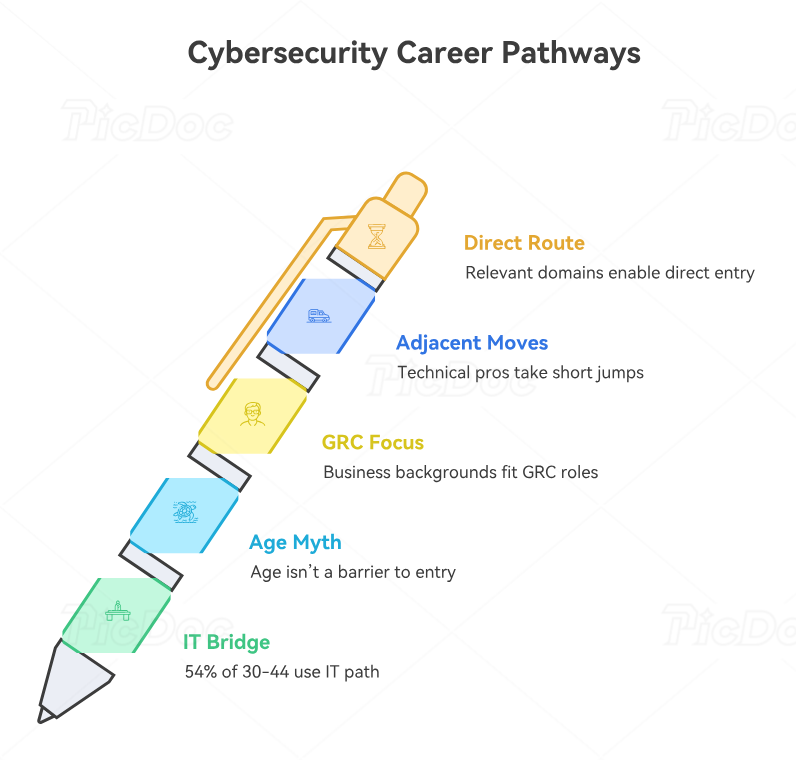
Thirty is a very ordinary age inside today's cybersecurity workforce. ISC2's 2025 workforce study surveyed more than 16,000 cybersecurity professionals and found substantial representation across the 30–44, 45–59, and 60+ age groups. It also found that 54% of respondents aged 30–44 entered through an IT pathway, while other participants came through non-IT professional experience, certifications, self-teaching, apprenticeships, military service, and education. That matters for anyone evaluating a career change into cybersecurity, building a cybersecurity resume without experience, choosing certifications versus hands-on labs, or researching SOC analyst entry routes.
Reddit success stories reinforce the point while adding an important dose of realism. One well-known account describes a person who switched into IT in their 30s, started in Tier 1 help desk, progressed through Tier 2 and cybersecurity analyst work, and then accepted a six-figure cloud-security role in under two years. The poster also described intensive study and several cloud certifications, so the timeline should be treated as an individual outcome rather than a normal expectation. The broader lesson fits closely with the value of a credible home lab, a strong certification-and-lab mix, targeted SOC hiring evidence, and a realistic degree-versus-certification strategy.
Another Reddit thread involved a 35-year-old restarting after years in telecommunications. A commenter reported getting an IT support job at 39 with an A+ certification and moving into a junior systems-administrator role six months later. The advice in that thread emphasized using existing telecom experience rather than pretending the candidate was beginning life from zero. That same logic helps professionals entering IAM, GRC, cybersecurity auditing, or risk management, where previous operational or business experience can become directly relevant.
Age concerns become more complicated in the 40s, particularly when someone also lacks professional IT experience. A September 2026 Reddit discussion from a 43-year-old hospitality manager in Australia produced warnings from commenters about age discrimination, the difficulty of a double transition through general IT and then cybersecurity, and the financial impact of spending several years in junior roles. Yet the same thread also included a UK commenter who said they entered cybersecurity in their 30s without previous IT experience through part-time postgraduate study and had progressed into cyber threat intelligence six years later. For a mid-career candidate, the useful question becomes how much existing experience can be translated into security-relevant evidence, governance expertise, policy work, or security program management.
The greatest mistake is assuming that turning 30 erased the previous decade. A salesperson understands discovery and stakeholder resistance. An accountant understands controls and evidence. A project manager understands dependencies and escalation. A teacher understands communication and curriculum. A nurse understands high-stakes processes, privacy, and documentation. A software developer understands applications, code, APIs, and engineering trade-offs. Those capabilities can support security architecture, cybersecurity product management, privacy analysis, and security leadership once technical gaps are filled.
| Previous Background | Transferable Skill | Cybersecurity Fit | Technical Gap to Close |
|---|---|---|---|
| IT Help Desk | Troubleshooting, ticket handling, user support | SOC, IAM, endpoint security | SIEM, incident analysis, security tooling |
| Systems Administration | Windows/Linux, identity, permissions | Security engineering, IAM, cloud security | Threat detection and security architecture |
| Network Engineering | TCP/IP, routing, firewalls, troubleshooting | Network security, SOC, cloud security | SIEM and endpoint telemetry |
| Software Development | Code, APIs, SDLC, debugging | AppSec, DevSecOps, product security | Threat modeling and secure-design frameworks |
| Cloud Engineering | IAM, infrastructure, automation | Cloud security engineering | Security controls and threat detection |
| Accounting | Controls, evidence, reconciliation | GRC, audit, compliance | Security frameworks and IT controls |
| Internal Audit | Control testing and evidence evaluation | Cyber audit, GRC, risk | Technical security-control context |
| Finance | Risk, controls, regulated processes | Cyber risk, fraud, governance | Infrastructure and security fundamentals |
| Legal | Regulation, interpretation, evidence | Privacy, GRC, policy, compliance | Security technologies and controls |
| Compliance | Frameworks, evidence, remediation tracking | GRC and regulatory cybersecurity | Cyber frameworks and technical validation |
| Project Management | Dependencies, risk, delivery | Security program management | Security-domain literacy |
| Product Management | Roadmaps, stakeholders, prioritization | Security product management | Security architecture and market knowledge |
| Sales | Discovery, persuasion, customer communication | Security consulting, pre-sales, awareness | Technical depth and security fundamentals |
| Recruiting | Interviewing, role analysis, communication | Security program, awareness, governance | Security controls and technology |
| Hospitality Management | Incident handling, leadership, customer pressure | SOC operations, program coordination | IT foundations and security tools |
| Retail Management | Operations, loss prevention, people management | Security operations, awareness, risk | Networking, systems, security controls |
| Military | Procedures, discipline, incident response | SOC, threat intelligence, security operations | Commercial tools and enterprise environments |
| Law Enforcement | Investigation, evidence, interviewing | DFIR, cybercrime, threat intelligence | Digital forensics and systems knowledge |
| Teaching | Communication, curriculum, assessment | Security awareness, training, GRC | Security foundations and technical examples |
| Technical Writing | Documentation and complex explanation | Policy, awareness, security documentation | Hands-on security context |
| Healthcare | Privacy, regulated workflows, documentation | Healthcare security, privacy, GRC | IT security fundamentals |
| Pharmaceuticals | Regulation, validation, risk | GRC, third-party risk, compliance | Cyber controls and infrastructure |
| Manufacturing | Process control and operational risk | OT/ICS security | Industrial networking and cyber defense |
| Electrical Engineering | Systems thinking and diagnostics | Embedded, IoT, OT security | Enterprise security concepts |
| Telecommunications | Networks, infrastructure, troubleshooting | Network security, SOC, engineering | Security operations and attack techniques |
| Data Analysis | Queries, pattern recognition, reporting | Threat hunting, detection engineering | Security telemetry and threat behavior |
| Business Analysis | Requirements, processes, stakeholder translation | GRC, IAM, security programs | Technical security foundations |
| HR | Lifecycle processes and policy | IAM governance, insider risk, awareness | Identity technologies and access controls |
| Operations Management | SOPs, metrics, escalation, capacity | SOC management, security programs | Cybersecurity operational knowledge |
| Entrepreneurship | Ownership, prioritization, customer risk | Consulting, product security, leadership | Formal security depth and enterprise scale |
2. The Salary Reset: How Much Should a Mid-Career Switcher Be Willing to Give Up?
Salary is where a career change after 30 becomes financially dangerous if the planning is weak. A person earning $80,000 in operations or finance may discover that the easiest technical entry point pays far less. Someone already supporting a family can rarely absorb the same financial experiment as a 22-year-old living with parents. That reality should shape decisions about cybersecurity bootcamps, certification ROI, entry-level SOC roles, and the broader question of whether cybersecurity still makes economic sense.
Current U.S. Bureau of Labor Statistics data can easily create unrealistic expectations when stripped of context. Information security analysts had a median annual wage of $129,180 in May 2025, and BLS projects 21% employment growth from 2025 to 2035. The same page reports that the lowest 10% earned below $75,090 and notes that some information security analysts work more than 40 hours or remain on call outside normal business hours. These figures describe the U.S. occupation as a whole; they do not represent guaranteed entry-level pay for a career changer. Candidates considering SOC work, IAM careers, GRC specialization, or cybersecurity auditing should benchmark the exact role and city they are targeting.
Reddit shows how painful the entry-level reset can become. In a 2025 thread, a NOC analyst earning $33 per hour received a cybersecurity analyst offer at $23 per hour, creating a roughly 30% hourly-pay reduction. The poster's motivation was gaining direct cybersecurity experience and improving future mobility. Commenters pushed the person to consider lifestyle impact, future progression, management, culture, and working conditions alongside title. That same framework should guide someone comparing hands-on experience with certifications, trying to make a Security+ credential pay off, considering SOC experience, or moving toward cloud and automation work.
There are also examples where a temporary step backward created later mobility. In a Reddit discussion about taking career steps backward, one commenter described leaving an assistant-manager position at a financial institution for a lower-paid help-desk supervisory role, then moving into business analysis and eventually information security. The value came from changing the person's experience trajectory. That is the reason a targeted bridge role can outperform another generic credential for candidates building a cybersecurity resume, a hireable home lab, a route into digital identity, or experience relevant to risk and governance.
A useful salary-reset calculation has four numbers: income lost during the transition, months you can absorb the difference, skills the lower-paid job will add, and the next role that experience unlocks. A $10,000 reduction for a role exposing you to SIEM, cloud, incident response, IAM, or audit ownership may have a clearer progression path than a $5,000 reduction into generic technical support with little advancement. Career changers should apply the same precision when comparing degree pathways, bootcamps, Security+ outcomes, and cybersecurity specialization options.
A recent 2026 Belgium discussion captures the fear clearly. A 30-year-old retraining from administrative and event work estimated that establishing a cybersecurity career could require one to three years and potentially lower earnings at first. The person's motivation was long-term income growth, while commenters cautioned that the transition and current market could be difficult. This is exactly why a career changer should avoid planning around unusually fast salary stories seen online. Build the plan around conservative entry pay, realistic job-market conditions, genuine employer requirements, verified resume evidence, and the role-specific skills employers actually reward.
3. Transferable Skills Can Shorten the Transition When You Use Them Correctly
A mid-career transition works best when the destination role rewards something you already know.
A former auditor entering cybersecurity auditing can build on control testing, evidence, sampling, remediation tracking, and stakeholder interviews. A compliance professional entering GRC may already understand frameworks, exceptions, regulators, and policy enforcement. A project manager can leverage sequencing, dependencies, risk registers, communication, and executive reporting toward cybersecurity program management. A privacy professional can move toward cybersecurity privacy analysis by adding security-control and technology depth.
Technical backgrounds can create even shorter bridges. Systems administrators already understand servers, permissions, patching, identity, and troubleshooting, making IAM, security engineering, and cloud security logical destinations. Network engineers already understand traffic, protocols, firewalls, and troubleshooting, which supports SOC investigation work, security automation, and eventually security architecture. Developers can leverage code, APIs, debugging, and SDLC experience toward application security, product security, and AI security work.
Nontechnical backgrounds also create leverage when translated precisely. A salesperson understands discovery and objections, which helps security consulting and vendor-facing roles. A teacher can explain complex concepts, valuable in cybersecurity training, awareness, policy, and documentation. A writer can move toward cybersecurity content and education. Operations managers understand process failures, metrics, capacity, ownership, and escalation, all useful in security program roles and eventual cybersecurity leadership.
This is where older candidates can sometimes create a stronger interview story than younger applicants with only academic knowledge. Employers still need technical competence, and hands-on labs, portfolio projects, certifications, and technical interview preparation remain important. Years of professional judgment become much more valuable once the candidate can connect them to a security problem.
The resume should make that connection explicit. “Managed 12 employees” is weak for a cyber pivot. “Managed escalation, access procedures, operational incidents, and compliance processes across a 12-person team” gives a security hiring manager more usable information. “Worked in finance” says little. “Performed control reconciliation, investigated exceptions, maintained audit evidence, and supported regulated processes” can connect naturally to cyber risk, cyber audit, regulatory cybersecurity, and policy analysis.
4. The Most Realistic Cybersecurity Entry Routes After 30
For someone with zero professional technology experience, general IT can provide the cleanest technical bridge. Help desk, desktop support, NOC, application support, junior system administration, and cloud support can teach networking, identity, endpoint management, troubleshooting, tickets, enterprise tools, and escalation. ISC2's 2025 research found IT remains the most common pathway into cybersecurity overall, including 54% of respondents aged 30–44. That aligns with the experience-first approach behind SOC career routes, home-lab projects, hands-on hiring proof, and Security+ plus additional experience.
A Reddit thread from a 30-year-old hospitality worker who had completed a cybersecurity diploma and several certifications illustrates the problem well. The poster still lacked direct IT experience, while several commenters recommended help desk or support engineering as the missing professional layer. One commenter who had switched to IT at 35 directly challenged the idea that 30 represented an age problem. This is why a career changer should distinguish an age concern from an evidence problem when improving a cybersecurity resume, selecting certifications, preparing for SOC interviews, and assessing job-market saturation.
Career changers with business-heavy backgrounds should also examine GRC, risk, audit, privacy, and policy instead of assuming every cyber career begins in a SOC. Someone with audit, legal, regulatory, finance, policy, documentation, vendor-management, or compliance experience may already possess half of the professional skill stack for a GRC specialist role, cybersecurity risk management, cybersecurity policy analysis, regulatory cybersecurity, or privacy analysis.
Candidates with technical backgrounds should target the shortest adjacent move. A sysadmin can move toward IAM, security engineering, or cloud security. A developer can build toward application security. A network engineer can add SIEM, security monitoring, firewall management, and threat detection. A data professional can explore threat hunting or cybersecurity data science. An automation-heavy engineer can progress toward cybersecurity automation, while AI practitioners can specialize in AI security.
The direct-to-cybersecurity route still exists, especially where the candidate's previous domain is highly relevant. A finance professional entering cyber risk at a bank, healthcare worker joining healthcare compliance, auditor moving into IT audit, or developer entering AppSec can preserve far more seniority than someone making a completely unrelated jump. This is where understanding graduate hiring failures, building portfolio evidence, selecting role-relevant certifications, and creating a focused resume matters more than collecting broad credentials.
A June 2026 Reddit career-switch post illustrates this nuance. The poster had spent ten years in sales but had also run a computer-trading and IT-services business, learned networking, Linux, Windows Server, web development, and AWS, and completed CTF work. Calling that person a pure beginner would erase relevant experience. Their stronger strategy is to package existing technical and commercial work alongside security projects, resume evidence, a targeted certification strategy, and a specialization such as security engineering.
5. A Practical 12-Month Cybersecurity Career-Change Plan for Adults With Existing Careers
The first month should be spent choosing a role family, because cybersecurity is too broad for a career changer to study everything. Decide whether your strongest bridge leads toward SOC, IAM, GRC, audit, cloud security, AppSec, risk, privacy, or another specific area. Compare SOC with GRC, investigate IAM career paths, study cybersecurity risk roles, and research penetration-testing careers before committing hundreds of hours.
During months two and three, build the technical floor your target requires. SOC candidates need networking, Windows/Linux, logging, authentication, SIEM concepts, and basic scripting. IAM candidates need directories, identity lifecycle, SSO, MFA, federation, and cloud identity. GRC candidates need security fundamentals, frameworks, risk, controls, evidence, and business processes. Cloud-security candidates need cloud architecture, IAM, networking, logging, and automation. Use this period to fill gaps behind your chosen cybersecurity career route, certification strategy, SOC hiring expectations, and home-lab roadmap.
Months four through six should produce proof. A SOC candidate can investigate phishing, malicious PowerShell, suspicious authentication, or endpoint events. An IAM candidate can document a joiner-mover-leaver workflow and SSO integration. A GRC candidate can map controls against a fictional organization, perform a risk assessment, and create remediation evidence. An audit candidate can build a control-testing workbook and evidence package. Every project should include the problem, environment, methodology, screenshots or evidence, findings, and recommendations. That strengthens a no-experience resume, hands-on hiring signal, cybersecurity home lab, and overall response to employer experience filters.
Months seven through nine should focus on market testing rather than endless preparation. Apply before feeling fully ready. Track which applications get recruiter calls, which reach technical interviews, and where rejection occurs. Zero recruiter calls suggests a targeting or resume problem. Recruiter calls followed by technical failures suggest a knowledge or practical gap. Strong interviews without offers may point toward competition, communication, compensation, or role-fit issues. This diagnostic process is more useful than automatically earning another certificate. It directly supports decisions around job-market saturation, resume optimization, certification ROI, and entry-level hiring expectations.
Months ten through twelve should refine the transition around real employer feedback. If employers repeatedly request networking, study networking. If they want Microsoft identity, deepen Entra and IAM skills. If GRC interviews expose framework weaknesses, deepen risk management and regulatory knowledge. If SOC interviews expose weak investigations, build more SIEM evidence and review SOC hiring criteria.
Adults also need to manage studying differently. Twenty focused hours every week may be impossible with work and children. Seven to ten consistent hours can still compound meaningfully across a year when every hour serves the same target role. Avoid simultaneously chasing A+, Network+, Security+, CCNA, AWS, Azure, Python, Linux, pentesting, SIEM, cloud, and GRC. The resulting profile can become shallow everywhere. Choose one foundation, one role-relevant credential where useful, one substantial project stream, and an active application strategy. That disciplined approach aligns better with Security+ outcomes, certification-versus-lab evidence, career-change roadmaps, and cybersecurity market reality.
6. FAQs About Changing Careers Into Cybersecurity After 30
-
Thirty is well within the normal working-age range represented in the cybersecurity workforce. ISC2's 2025 study included substantial numbers of professionals aged 30–44 and older, with multiple pathways into the field. Career changers should focus on creating relevant experience through IT roles, home labs, role-specific certifications, and a resume that makes transferable skills visible.
-
A transition at 40+ can require a longer runway when the person also needs to build basic IT experience. A September 2026 Reddit discussion involving a 43-year-old career changer included commenters warning about age discrimination, junior-role salary pressure, and the time required for an IT-to-cybersecurity transition. The same discussion included an example of someone who had transitioned successfully in their 30s without previous IT experience. Someone in this position should investigate adjacent paths such as GRC, cybersecurity policy, privacy, and program management when previous professional experience aligns.
-
Some career changers do. The size depends on current income, location, target role, and how much previous experience carries over. One 2025 Reddit poster considered moving from a $33-per-hour NOC role to a $23-per-hour cybersecurity analyst position, while another discussion described a person taking a lower-paid IT role before later progressing into information security. Calculate the transition alongside certification costs, bootcamp ROI, market competition, and the quality of the experience the role will provide.
-
IT support, systems administration, networking, development, cloud engineering, audit, compliance, finance, legal, project management, risk, healthcare, telecommunications, and data analysis can all create useful bridges. The best destination depends on the experience already present. Audit can align with cybersecurity auditing, compliance with GRC, sysadmin work with IAM, project management with cybersecurity program management, and technical automation with security automation engineering.
-
Help desk can be valuable when the candidate lacks enterprise IT experience and needs exposure to users, endpoints, directories, permissions, ticketing, troubleshooting, and escalation. Several Reddit career-change discussions recommend IT support as a bridge, and ISC2's workforce research shows IT remains the dominant entry pathway overall. Candidates with strong adjacent experience may have other routes through GRC, IAM, cybersecurity auditing, or specialized risk roles.
-
Certifications can validate knowledge and improve recruiter visibility, while practical evidence and relevant experience still matter heavily. Career changers frequently run into the same problem described in discussions about Security+ alone, certifications versus labs, graduate hiring gaps, and SOC employer expectations. Pair a credential with projects, technical practice, networking, and active applications.
