
Becoming a Cybersecurity Product Manager: Detailed Career Roadmap
Cybersecurity product management is where market pressure, customer pain, risk reality, and engineering tradeoffs collide. A strong cybersecurity product manager understands why buyers fear ransomware response gaps, how a SOC analyst triages noisy alerts, why cloud security changes product requirements, and how cybersecurity certifications support credibility. This roadmap shows how to build technical trust, product judgment, portfolio proof, and promotion-ready positioning.
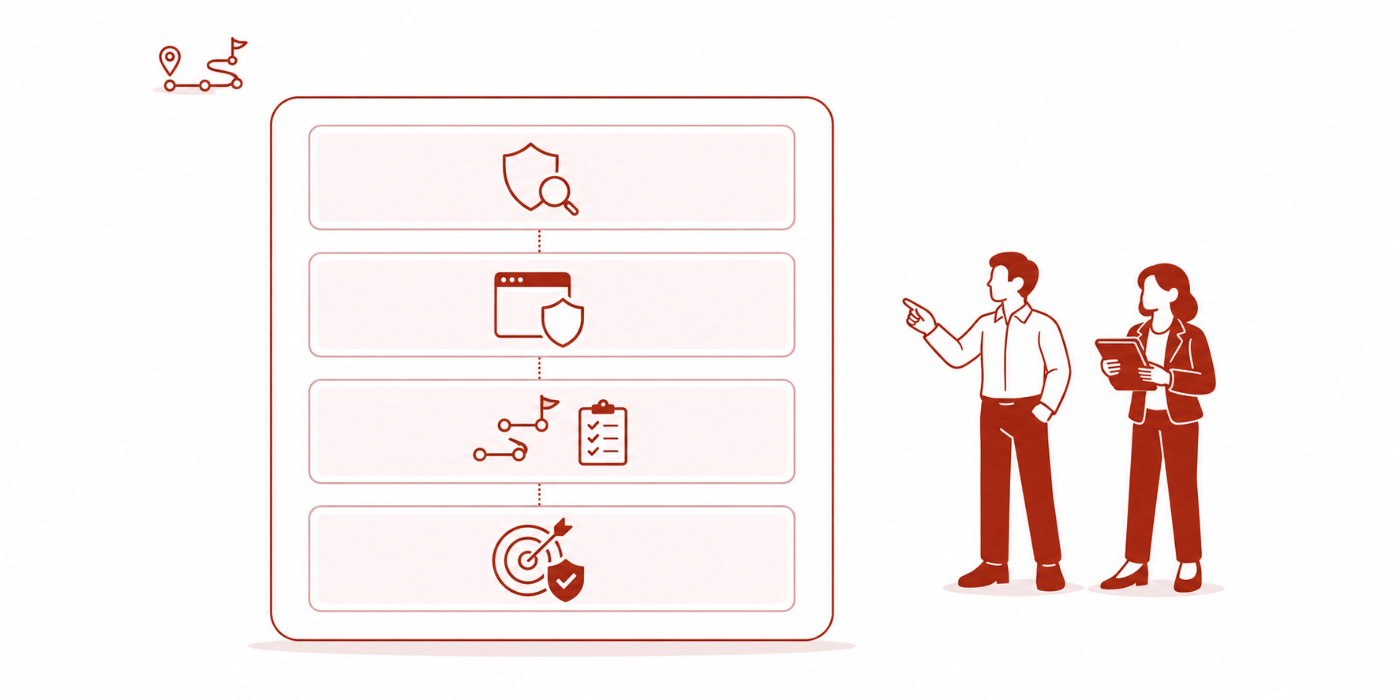
1. Understand the Cybersecurity Product Manager Role Before You Chase the Title
A cybersecurity product manager owns the business and user logic behind a security product. That product may be a SIEM platform, endpoint detection and response tool, email security solution, cloud security platform, or privileged access management product. The role demands a rare mix: enough security depth to challenge weak assumptions, enough product discipline to prioritize ruthlessly, and enough customer empathy to hear the fear behind vague buyer language.
The biggest mistake aspiring cybersecurity PMs make is treating the role like a generic software product job with security vocabulary added later. Security buyers behave differently because they are judged after failure. A marketing team may tolerate a slow analytics dashboard; a healthcare cybersecurity leader cannot tolerate an alerting gap that misses protected health information exposure. A financial services security buyer evaluates audit trails, regulatory exposure, fraud risk, and executive defensibility. A government cybersecurity buyer cares about procurement proof, control mapping, and mission continuity.
A cybersecurity PM must translate between the analyst, engineer, buyer, auditor, incident responder, sales team, and executive sponsor. That means understanding why incident response planning shapes feature requirements, why data loss prevention creates adoption friction, and why zero trust security is only useful when product design supports real enforcement. The career path rewards people who can explain both the user pain and the security consequence without hiding behind buzzwords.
The best starting point is to pick a product category and study it deeply. If you want detection products, study SIEM fundamentals, IDS deployment, network monitoring tools, and threat intelligence analysis. If you want offensive security products, study penetration testing tools, vulnerability scanners, ethical hacking careers, and the OSCP penetration tester pathway. Depth beats scattered familiarity.
| Career Move | Why It Matters | Proof to Build | Best ACSMI Resource Path |
|---|---|---|---|
| Learn SOC workflow | Detection products must match analyst triage behavior. | Alert lifecycle map with escalation logic. | SOC analyst career guide |
| Study SIEM architecture | Many security products feed, enrich, or compete with SIEM. | SIEM data-source comparison. | SIEM overview |
| Understand EDR value | Endpoint telemetry is central to modern defense. | EDR feature teardown. | EDR tools guide |
| Map ransomware response | Buyers fund products that reduce operational panic. | Ransomware response journey map. | Ransomware response guide |
| Build threat-model literacy | Product requirements improve when abuse cases are visible. | Threat model for a sample SaaS feature. | future threat analysis |
| Learn vulnerability management | Security PMs must separate severity, exploitability, and business risk. | Prioritization rubric for scanner findings. | vulnerability assessment guide |
| Compare vulnerability scanners | Competitive understanding sharpens roadmap positioning. | Feature matrix across scanner categories. | vulnerability scanner rankings |
| Study penetration testing | Offensive insight helps PMs understand attacker behavior. | Pen-test workflow and product opportunity notes. | penetration testing tools |
| Learn cloud security controls | Cloud-native security products require identity, workload, and posture context. | Cloud security control map. | cloud security engineer roadmap |
| Study compliance frameworks | Security buying often depends on audit-readiness and control evidence. | Control mapping sample. | NIST, ISO, and COBIT guide |
| Understand access control | Authorization logic affects security, UX, and enterprise adoption. | RBAC requirement spec. | access control models |
| Study encryption basics | Product trust collapses when data protection claims are vague. | Encryption decision memo. | encryption standards guide |
| Learn PKI concepts | Identity, certificates, and trust chains affect secure product design. | Certificate lifecycle diagram. | PKI components guide |
| Understand DLP use cases | Data protection products must balance enforcement and business workflow. | DLP policy usability review. | DLP strategies guide |
| Study email security | Phishing remains a high-budget buyer pain point. | Email security product teardown. | email security directory |
| Understand phishing trends | Product messaging improves when PMs know real attack patterns. | Phishing prevention feature proposal. | phishing trends report |
| Learn application security | AppSec products must fit developer workflows. | Developer security friction analysis. | application security tools |
| Study PAM products | Privilege control is a core enterprise security buying category. | PAM adoption barrier memo. | PAM solutions guide |
| Analyze security awareness tools | Human-risk products require behavior change insight. | Training product engagement critique. | security awareness platforms |
| Study incident response products | Response platforms must reduce time, confusion, and evidence loss. | Incident timeline reconstruction. | incident response planning |
| Learn market segmentation | SMB, enterprise, healthcare, and finance buyers have different risk budgets. | Buyer persona map by sector. | small business security solutions |
| Track salary signals | Career planning improves when promotion economics are clear. | Target compensation ladder. | cybersecurity salary report |
| Understand certification leverage | Credentials can reduce credibility friction during transition. | Certification plan tied to role gap. | certification impact report |
| Build customer discovery skill | Security users often describe symptoms before root causes. | Interview script for CISOs and analysts. | CISO roadmap |
| Practice roadmap prioritization | Every backlog contains fear-driven requests that need ranking. | Risk-weighted product roadmap. | future cybersecurity skills |
| Study AI security adoption | Security products increasingly use automation and AI-assisted workflows. | AI feature risk-benefit memo. | AI in cybersecurity report |
| Learn regional market trends | Product demand changes across North America, Europe, and Asia-Pacific. | Regional go-to-market risk notes. | North America cybersecurity trends |
| Create a public portfolio | Transition candidates need proof beyond job titles. | Three teardown memos and one roadmap. | job market trends |
2. Build the Technical Foundation Product Teams Trust
Cybersecurity PMs do not need to configure every firewall, reverse every malware sample, or write production detection rules alone. They do need enough technical fluency to ask sharper questions than “is this secure?” Start with the control families that appear in almost every product conversation: identity, endpoint, network, cloud, application, data, logging, and response. ACSMI’s guides on firewall technologies, VPN security, intrusion detection systems, encryption standards, and PKI applications create the baseline vocabulary needed for serious roadmap conversations.
The most valuable technical habit is learning how security work actually flows. A SOC analyst may start in a SIEM, pivot into EDR telemetry, validate enrichment from threat intelligence, check whether a ransomware detection pattern is credible, and document evidence for escalation. A product manager who understands that flow will make better decisions about alert grouping, case management, integrations, evidence retention, dashboard design, and workflow automation.
Technical credibility also comes from knowing where products fail in the real world. Vulnerability scanners create fatigue when findings are duplicated, unactionable, or poorly prioritized. DLP tools create resentment when policies block legitimate work. Security awareness platforms disappoint when training metrics look good while risky behavior remains unchanged. Cloud security tools frustrate teams when context is missing across accounts, identities, workloads, and data stores.
For certification strategy, pick credentials that support your weak side. A product or business candidate may use cybersecurity certification directories, free cybersecurity courses, and cybersecurity bootcamp comparisons to build structured learning momentum. A technical practitioner moving into product may benefit more from market study through cybersecurity salary benchmarks, workforce shortage analysis, and emerging role predictions. The best signal is targeted learning tied to a product category.
3. Turn Security Knowledge Into Product Judgment
Security knowledge explains what can go wrong. Product judgment decides what to build first, what to defer, what to simplify, and what to refuse. A cybersecurity PM must weigh risk reduction, adoption friction, buyer urgency, engineering cost, integration dependency, compliance pressure, and competitive differentiation. That is why studying cybersecurity compliance trends, NIST framework adoption, GDPR cybersecurity challenges, and future compliance trends helps you understand why roadmap choices often carry legal and audit consequences.
Product judgment improves when you separate user types. The buyer may be a CISO, the administrator may be a security engineer, the daily user may be a SOC analyst, and the economic sponsor may be a CFO. A feature that impresses a cybersecurity manager may create workflow pain for an incident responder. A compliance dashboard may satisfy a cybersecurity auditor while failing the analyst who needs faster evidence retrieval. A PM earns trust by naming these conflicts early.
The second layer is prioritization under pressure. Security teams often demand everything because every gap feels dangerous. A good PM translates panic into ranked impact: which issue increases breach probability, which slows response time, which blocks renewal, which damages onboarding, and which creates noise without reducing risk. This is where studying incident response effectiveness, state of ransomware, data breach risk, and insider threat prevention sharpens your ability to rank problems by business consequence.
The third layer is market positioning. A product manager must know why a customer would choose one endpoint security provider, one MSSP, one cybersecurity consulting firm, or one cloud security tool over another. Competitive analysis should identify switching friction, proof requirements, integration gaps, pricing sensitivity, and the emotional trigger behind purchase urgency. In cybersecurity, fear opens the conversation; evidence closes it.
Quick Poll: What Is Blocking Your Cybersecurity Product Manager Transition?
Choose the pressure point that feels most urgent, because the smartest roadmap depends on the gap you must close first.
4. Build a Portfolio That Proves You Can Own a Security Product
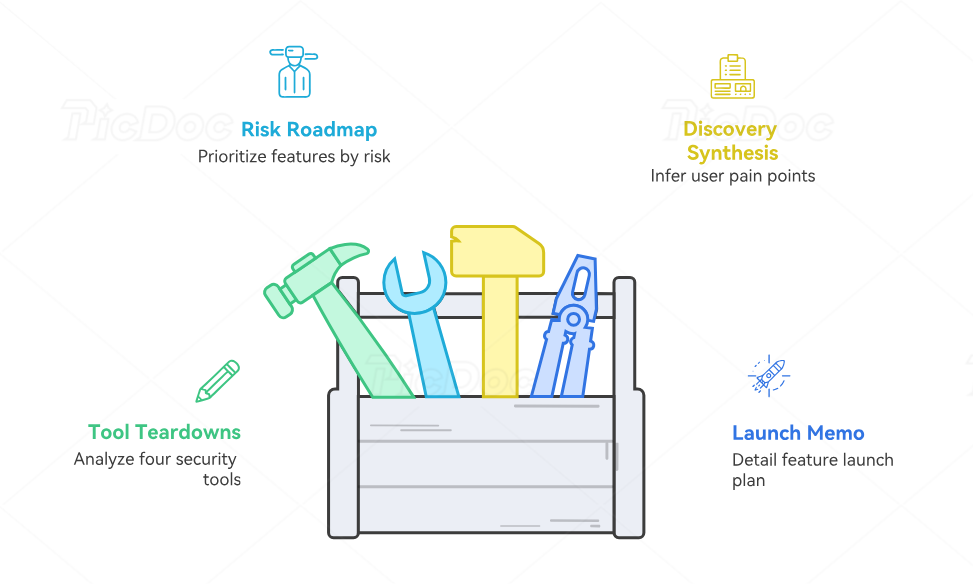
A cybersecurity product management portfolio should prove judgment, not decoration. Hiring managers do not need glossy mockups alone; they need evidence that you can understand a security problem, identify the user, evaluate the risk, compare alternatives, define tradeoffs, and recommend a roadmap. Start with one teardown of a SIEM solution, one teardown of an EDR tool, one teardown of an application security tool, and one teardown of a cloud security product. Each teardown should include the target user, core workflow, buyer pain, onboarding friction, alert quality, integration needs, and one practical roadmap improvement.
Your second asset should be a risk-weighted roadmap. Pick a scenario, such as a mid-market healthcare company improving HIPAA-aligned cybersecurity, a bank responding to financial sector cyber incidents, a manufacturer hardening industrial cybersecurity, or a school system improving education-sector security. Then show how you would prioritize features across risk reduction, user adoption, compliance evidence, engineering complexity, and sales urgency.
Your third asset should be a customer discovery synthesis. Interview security practitioners when possible, or use public product reviews, breach reports, ACSMI directories, and job postings to infer pain points. A strong synthesis might explain why SOC teams need better alert grouping, why compliance teams need cleaner control evidence, why IT teams resist restrictive DLP policies, or why executives fund ransomware preparedness. The key is to show that you can move from scattered complaints to product insight.
Your fourth asset should be a launch memo. Choose a feature, define the target segment, write the problem statement, outline acceptance criteria, identify telemetry, describe enablement needs, and explain how success will be measured. For example, a feature in a phishing prevention product may be measured by reporting speed, false-positive reduction, campaign resilience, and admin time saved. A feature in an endpoint security product may be measured by detection quality, triage speed, response containment, and analyst confidence.
5. Map Your 12- to 36-Month Roadmap by Starting Point
If you are coming from IT support, your first 12 months should focus on security operations fluency. Study the IT support to cybersecurity analyst path, then build literacy in SOC analyst work, SIEM operations, endpoint security, and incident response planning. Your 12-month goal should be a technical support, solutions, security analyst, associate PM, or product operations role near a security product team.
If you are coming from cybersecurity operations, your first 12 months should focus on product discipline. Your advantage is credibility with analysts, engineers, and security leaders. Your gap may be discovery, prioritization, UX tradeoffs, pricing awareness, and go-to-market communication. Study SOC manager advancement, security analyst to engineer progression, senior cybersecurity analyst skills, and cybersecurity manager pathways, then translate your operational experience into roadmap language.
If you are coming from product management, your first 12 months should focus on security depth. Build a category map around email security, PAM, cloud security, AppSec, DLP, or security awareness. Then create teardowns that prove you understand real users, regulatory pressure, deployment friction, and risk outcomes.
By months 13 to 24, aim for role adjacency. Look for security product analyst, technical product owner, associate cybersecurity PM, product operations, solutions consultant, sales engineer, customer success security specialist, or internal tools PM roles. These positions let you build evidence while learning the commercial side of cybersecurity. Use cybersecurity job market trends, remote cybersecurity career predictions, salary progression analysis, and certification salary growth to choose moves that compound.
By months 25 to 36, your target is ownership. You should be able to lead discovery, write requirements, defend roadmap tradeoffs, support launch, review telemetry, and explain security impact to executives. Your portfolio should include teardowns, roadmap memos, compliance mapping, user research, and product metrics. Your interview stories should show how you reduced risk, improved adoption, clarified priority, or translated technical complexity into business value. That is the difference between wanting a cybersecurity PM title and being ready to carry it.
6. FAQs About Becoming a Cybersecurity Product Manager
-
A cybersecurity product manager defines what a security product should solve, who it should serve, how it should reduce risk, and which tradeoffs the team should make. The work includes customer discovery, roadmap planning, feature definition, competitive research, launch support, and success measurement. In a product tied to SOC workflows, EDR tools, cloud security, or compliance frameworks, the PM must understand both the technical control and the buyer’s risk pressure.
-
You can reach the role through engineering, SOC, product, consulting, customer success, or solutions roles. An engineering background helps with technical trust, while a product background helps with discovery and prioritization. A candidate from operations can study security analyst progression, while a product candidate can build depth through cybersecurity certifications, free cybersecurity courses, and category-specific resources like SIEM or AppSec tools.
-
Detection, vulnerability management, email security, and security awareness are strong entry points because the user pain is easier to observe. Vulnerability assessment teaches prioritization, email security teaches user-risk behavior, security awareness platforms teach behavior change, and SIEM products teach alert workflows. Pick one category and build depth before expanding.
-
The best certification depends on your starting gap. If you lack security basics, use broad cybersecurity credentials and ACSMI’s certification directory. If you want offensive security products, study ethical hacking, penetration testing, and OSCP preparation. If you want governance products, study compliance officer careers, audit careers, and NIST adoption.
-
Build four assets: a product teardown, a risk-weighted roadmap, a customer discovery synthesis, and a launch memo. Use real categories from ACSMI resources such as endpoint security, cloud security tools, PAM solutions, and DLP software. Each asset should show decision quality, risk awareness, user empathy, and business impact.
-
A realistic path takes 12 to 36 months depending on your background. A cybersecurity practitioner may move faster after learning product discipline. A product manager may need more time to build security fluency through cloud security, incident response, threat intelligence, and compliance. The timeline shortens when your portfolio proves readiness.
