
Help Desk to Cybersecurity: Reddit Transition Timelines, Skills to Build & the Roles That Open First
Working help desk can become one of the strongest launchpads into cybersecurity when you deliberately convert support work into security evidence. Your exposure to Active Directory, authentication failures, endpoints, permissions, phishing, networking, ticket escalation, and users already overlaps with the work behind a SOC analyst career. The challenge is turning that exposure into the kind of proof described by SOC hiring managers, backed by hands-on cybersecurity labs and a targeted certification strategy.
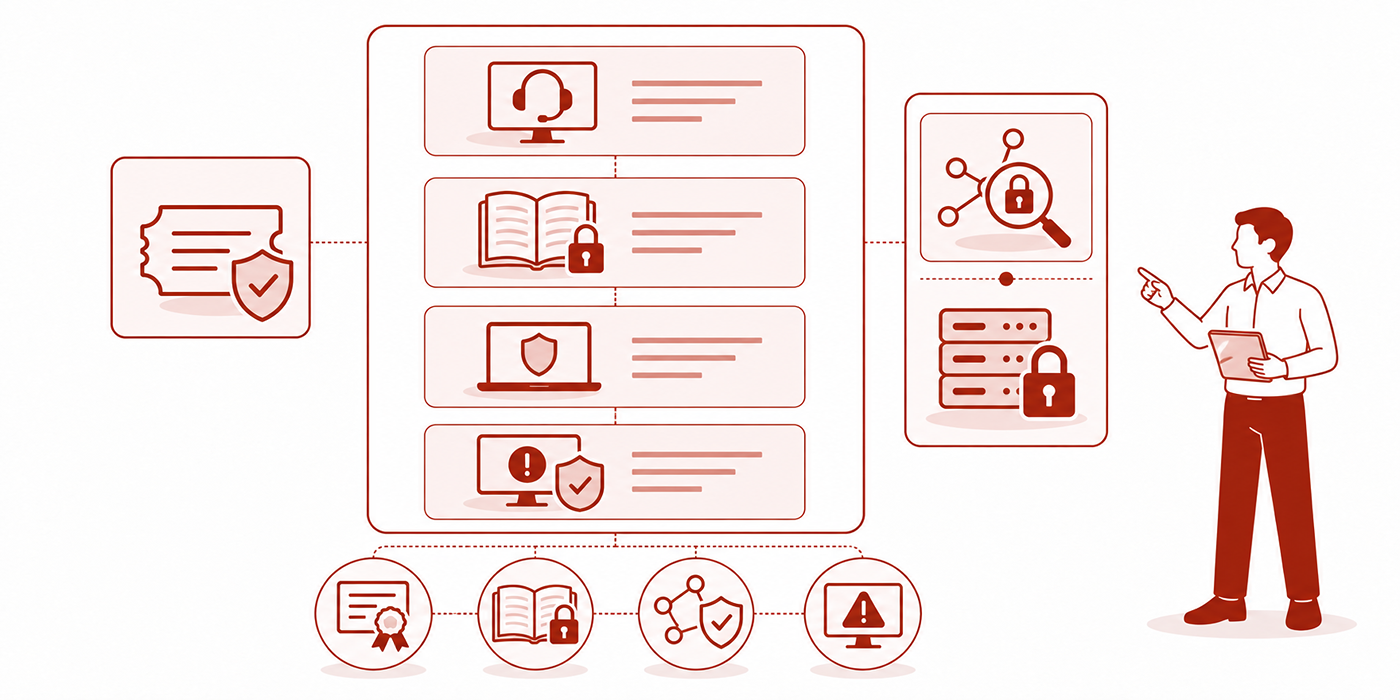
1. Help Desk Experience Can Become Cybersecurity Experience Faster Than Most People Realize
The biggest advantage of help desk work is environmental exposure. Every password reset teaches something about identity. Every locked account touches authentication. Every compromised mailbox exposes you to phishing and account takeover. Every endpoint ticket builds Windows, process, service, permissions, and troubleshooting knowledge. Those connections matter because employers hiring for a first SOC analyst role want candidates who understand how systems normally behave before they investigate abnormal behavior. That is one reason applicants trying to break into cybersecurity without IT experience often face a harder proof problem than someone already handling real users and devices.
A February 2026 Reddit post gives a useful example. The poster had spent a little under four years in help desk before receiving an internal promotion to SOC analyst. Their Security+ was recent, yet their strongest transition signal was already inside the job: they had started managing alerts, entering indicators of compromise, and drafting security reports. That progression illustrates how a support technician can create cybersecurity leverage before the job title changes. Someone studying whether Security+ alone is enough should pay particular attention to this distinction. A certification validates knowledge; operational exposure demonstrates that you can use it.
Help desk employees should therefore audit their current responsibilities before buying another course. Password and MFA administration can support an eventual digital identity management career. Endpoint troubleshooting can become preparation for security operations. Ticket documentation builds investigation chronology. Microsoft 365 administration can lead toward cloud identity and email security. Asset inventory contributes to vulnerability management. Policy-heavy support environments can support a later move into GRC, cybersecurity risk management, or an IT-audit-to-cybersecurity-audit transition.
The painful trap appears when someone spends two or three years closing repetitive tickets without increasing technical depth. Tenure by itself creates weak differentiation. A support technician who deliberately takes ownership of suspicious-email investigations, endpoint alerts, permission reviews, PowerShell tasks, network troubleshooting, vulnerability remediation, and security documentation can accumulate far more transferable evidence in twelve months. This is also why some cybersecurity graduates struggle to get hired: academic knowledge becomes much more powerful once it is paired with observable operational work.
| Help Desk Exposure | Security Skill to Build | Proof You Should Produce | Role It Can Help Unlock |
|---|---|---|---|
| Password resets | Authentication concepts | Explain lockout, MFA and credential-abuse scenarios | IAM / Security Analyst |
| Active Directory | Identity security | Build an AD lab with users, groups and permissions | IAM Analyst |
| Microsoft Entra ID | Cloud identity protection | Document conditional-access scenarios | Identity Security Analyst |
| MFA support | Account-takeover defense | Analyze MFA fatigue and bypass scenarios | Security Operations Analyst |
| Phishing tickets | Email investigation | Create phishing-analysis reports with headers and IOCs | SOC L1 / Email Security |
| Windows troubleshooting | Endpoint telemetry | Analyze Windows Event Logs and Sysmon events | SOC Analyst |
| Antivirus incidents | EDR investigation | Document a simulated malicious-process investigation | Endpoint Security Analyst |
| Device provisioning | Security baselines | Compare secure and insecure workstation configurations | Endpoint Security |
| Software patching | Vulnerability remediation | Map a CVE through detection, prioritization and remediation | Vulnerability Analyst |
| Asset inventory | Attack-surface management | Create an asset-to-risk prioritization register | Vulnerability Management |
| DNS troubleshooting | DNS threat analysis | Investigate suspicious domain-resolution logs | SOC Analyst |
| TCP/IP support | Network-security analysis | Explain packet flow and analyze a PCAP | SOC / NOC-SOC Analyst |
| VPN troubleshooting | Remote-access security | Analyze failed and suspicious VPN authentication events | Security Analyst |
| Firewall tickets | Traffic filtering | Build and explain firewall rules in a lab | Network Security Analyst |
| Microsoft 365 support | Cloud/email security | Investigate mailbox compromise scenarios | M365 Security Analyst |
| User permissions | Least privilege | Perform a sample access review | IAM / GRC Analyst |
| Joiner/mover/leaver tickets | Identity lifecycle | Document an access-provisioning control workflow | IAM Analyst |
| PowerShell | Security automation | Build scripts for account or log analysis | Security Automation / SOC |
| Linux support | Linux security | Analyze auth logs, permissions and processes | SOC Analyst |
| Ticket prioritization | Incident triage | Create severity and escalation criteria | SOC L1 |
| Escalation notes | Incident documentation | Write a structured incident timeline | Incident Response / SOC |
| Knowledge-base writing | Security playbooks | Write phishing or malware-response playbooks | Security Operations |
| Change tickets | Security change control | Document risk, approval and rollback requirements | GRC / Security Operations |
| Policy enforcement | Governance and controls | Map a policy requirement to technical evidence | GRC Analyst |
| Audit requests | Evidence collection | Build a sample control-evidence package | IT Audit / Compliance |
| Vendor support | Third-party risk | Assess a vendor against basic security criteria | Third-Party Risk Analyst |
| Monitoring dashboards | SIEM alert analysis | Create detections and investigate triggered alerts | SOC Analyst |
| User communication | Security communication | Explain a technical incident to a nontechnical stakeholder | SOC / GRC / Security Support |
2. Reddit Transition Timelines Range From Months to Years—Here Is What Actually Changes the Clock
Reddit produces wildly different help-desk-to-cybersecurity timelines, which is useful precisely because there is no universal countdown. One poster reported receiving an internal SOC offer after only three months in a first help desk job. Another 2026 poster reached SOC after just under four years of help desk, while an older contributor described a progression from service desk analyst to service desk level two, then systems administrator, then threat analyst over almost five years. These paths should influence how you interpret advice about cybersecurity entry barriers, degree-versus-certification ROI, and the bootcamp-degree-certification decision.
The faster transitions usually have a catalyst. Internal mobility is a powerful one because an employer already knows the technician's reliability, communication style, environment knowledge, and troubleshooting ability. Security-adjacent responsibilities create another accelerator. A help desk employee who already investigates suspicious emails, works with EDR alerts, assists with IAM, or remediates vulnerable endpoints has a much smaller evidence gap than a technician whose work stays limited to password resets and printer problems. Building a cybersecurity home lab with hiring evidence can close another part of that gap, particularly when the lab produces investigations rather than screenshots.
A March 2026 Reddit discussion captures the opposite problem. The poster had spent around eight months in technical support and wanted to move into cybersecurity, while local positions requested one or two years of security experience. A response recommended continuing to build the foundation and potentially moving through systems or network administration. That intermediate step can be valuable when the desired destination is security engineering, cloud security, or infrastructure-heavy defensive work. Someone aiming specifically at SOC L1 may instead concentrate on the narrower capabilities emphasized by current SOC hiring expectations and entry-level SOC proof.
There is also a sobering lesson from candidates with long tenure. One Reddit poster had four years of help desk experience plus CCNA, Network+, Security+, CySA+, an associate degree, and progress toward a bachelor's, yet reported four months of applications without phone screens. The case demonstrates why accumulating credentials without sharpening role positioning can stall a transition. The résumé must translate support work into security outcomes, the portfolio must verify technical depth, and applications must target roles compatible with that evidence. Anyone stacking credentials should compare that strategy with the certifications-versus-hands-on-labs hiring mix before buying the next exam.
A practical timeline therefore looks like this: three to six months can happen when an internal opening appears and the candidate already touches security work; six to eighteen months is a realistic deliberate transition window for many support professionals who build targeted proof; two or more years can make sense when the candidate is deliberately moving through networking, systems, or cloud administration toward a deeper technical security role. The clock should be measured by capabilities acquired and interview traction generated. Someone spending eighteen months mastering identity, networking, SIEM investigation, EDR, and incident documentation has progressed farther toward security operations employment than someone repeating the same basic ticket queue for three years.
3. Build the Skills That Security Teams Actually Consume During an Incident
Start with networking because security alerts frequently describe network behavior. You should be able to explain IP addressing, subnets, TCP versus UDP, DNS resolution, HTTP/HTTPS, VPNs, ports, NAT, basic routing, and firewall behavior. Wireshark should become a reasoning tool: given a packet capture, you should identify who initiated communication, which protocol was used, what happened next, and what looks suspicious. This foundation improves your SOC analyst readiness, strengthens a future cybersecurity risk career, and prevents the shallow tool memorization that often weakens otherwise polished candidates.
Next comes Windows, identity, and endpoint behavior. Understand local and domain accounts, groups, permissions, authentication, Windows Event Logs, services, scheduled tasks, processes, PowerShell, Active Directory, Entra ID, MFA, and common persistence concepts. A 2026 SOC listing reviewed for this article asked for familiarity with Windows, Linux, Active Directory, Entra ID, Microsoft 365 security, TCP/IP, DNS, HTTP/HTTPS, VPNs, EDR, SIEM, MITRE ATT&CK, and vulnerability-management tools. That skill cluster explains why help desk experience can feed directly into identity management, security automation, and eventually cybersecurity leadership.
Then learn security operations as a workflow. Collect logs. Query them. Generate a benign attack simulation. Trigger an alert. Triage the alert. Decide whether it is a false positive or a genuine incident. Identify affected entities. Map the activity to MITRE ATT&CK. Recommend containment. Document the reasoning. Microsoft’s current SC-200 blueprint emphasizes managing a security operations environment, responding to incidents, and threat hunting, with Microsoft Sentinel, Defender XDR, Entra ID, KQL, detections, and incident investigation all appearing in the role profile. Those are excellent targets for a home-lab portfolio because the artifacts can resemble real analyst work.
Your portfolio should therefore contain evidence packages, not decorative projects. One package might show a failed-login attack: architecture diagram, raw event source, KQL or SPL query, alert logic, investigation screenshots, MITRE mapping, incident timeline, containment recommendation, and lessons learned. Another might investigate PowerShell execution. Another could analyze phishing. Another could demonstrate vulnerability prioritization. This approach solves the central weakness behind many applicants who have Security+ without sufficient job proof or a cybersecurity degree without interview traction.
Finally, improve investigation communication. A SOC analyst who finds the technical answer yet cannot explain severity, scope, evidence, uncertainty, and next action creates operational friction. Help desk professionals already practice communicating under pressure, managing frustrated users, documenting cases, escalating issues, and separating symptoms from root causes. Translate those behaviors explicitly in your résumé. They also transfer well into GRC careers, cybersecurity policy analysis, regulatory security work, and privacy analysis.
4. The Cybersecurity Roles That Usually Open First From Help Desk
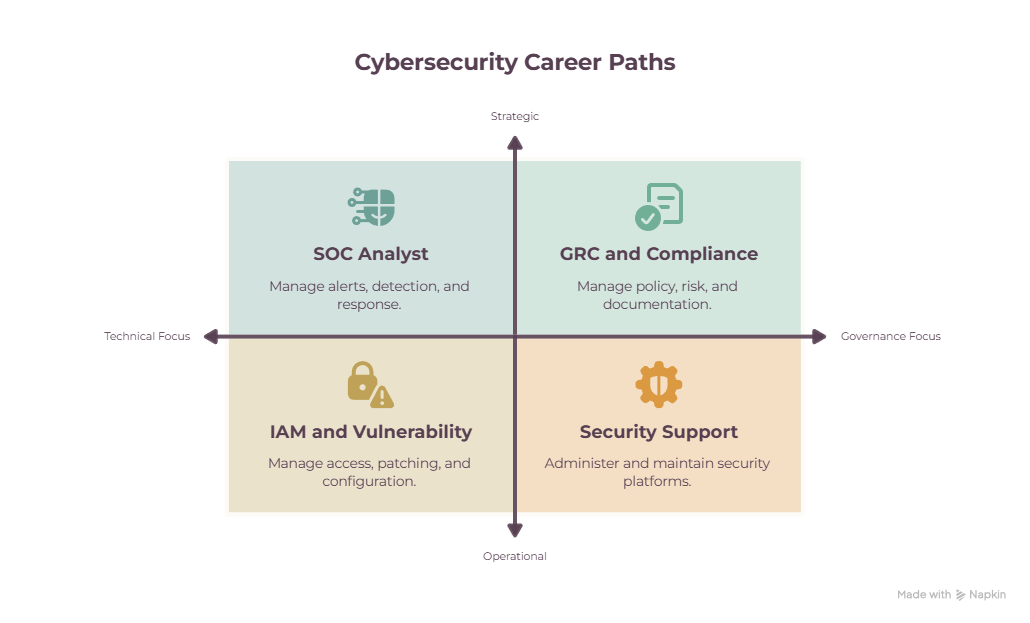
SOC analyst or security operations analyst is the obvious target when your support background includes endpoint troubleshooting, Microsoft administration, phishing, networking, monitoring, and escalation. The strongest candidate can explain an alert from detection through investigation and containment. Microsoft describes the modern security operations role around triage, incident response, detection engineering, threat hunting, Sentinel, Defender XDR, and KQL. Build toward those capabilities using the SOC hiring-manager expectations, SOC-with-no-experience roadmap, and portfolio-focused home lab.
IAM or access-management analyst can be an even tighter transition for technicians who already administer accounts, groups, permissions, MFA, Active Directory, Entra ID, onboarding, offboarding, and access requests. The transition story becomes coherent immediately: you already operate identity workflows, and you are adding least privilege, privileged access, conditional access, access reviews, identity threats, and governance. That foundation can later lead toward a dedicated digital identity management career, cybersecurity privacy work, or wider GRC responsibilities.
Vulnerability management is particularly accessible when help desk or desktop support includes patching, software inventory, endpoint configuration, remediation tickets, or device management. Learn CVSS, CVE interpretation, exploitability, asset criticality, remediation prioritization, scanner output, exceptions, false positives, and stakeholder follow-up. A useful portfolio project should show how you prioritize ten vulnerabilities rather than simply displaying a Nessus scan. That demonstrates judgment and links naturally with cybersecurity risk management, security policy analysis, and later security leadership.
GRC, IT audit, security compliance, and third-party risk can open early for help desk professionals who are strong in documentation, access controls, policy enforcement, evidence collection, change management, asset records, or regulated environments. These careers require technical literacy alongside control reasoning and communication. Someone attracted to this path should study the GRC specialist roadmap, IT auditor transition, cybersecurity regulatory specialist path, and cybersecurity policy analyst career.
Security support, endpoint security, and security-tool administration are frequently overlooked. An organization using Defender, CrowdStrike, Sentinel, Splunk, Proofpoint, Okta, Entra, Tenable, Qualys, or another platform needs people who can administer technologies as well as investigate them. A support technician who already knows the organization's devices and users can be valuable in that bridge role. It can later feed into cybersecurity automation engineering, AI security analysis, or a broader senior-security-to-VP trajectory.
Pentesting and security engineering generally demand a larger technical jump. Someone deeply interested in offensive security can absolutely move there, although the transition usually requires stronger networking, Linux, scripting, Active Directory attack paths, web technologies, exploitation methodology, and extensive practice. The shortest first move from support may therefore be SOC, IAM, vulnerability management, endpoint security, or GRC, followed by specialization once professional security experience begins compounding.
5. A 12-Month Help Desk-to-Cybersecurity Plan Built Around Evidence
Months 1–2: choose one destination. Search 30–50 real vacancies for SOC, IAM, vulnerability management, GRC, or whichever role you want. Build a spreadsheet containing every recurring requirement. This immediately stops random studying. Someone targeting SOC may repeatedly encounter SIEM, networking, Windows, Active Directory, EDR, phishing, incident response, Linux, and scripting. A candidate targeting GRC will encounter frameworks, risk, policies, audit evidence, controls, documentation, and stakeholder communication. Use current hiring signals instead of following a generic cyber roadmap.
Months 2–4: weaponize your current job experience. Volunteer for phishing investigations, access reviews, endpoint-security tickets, vulnerability remediation, security awareness, MFA deployment, asset management, patching, log investigation, or security-tool support. Ask the security team what recurring tasks consume analyst time. Internal relationships can create exactly the kind of transition described in the February 2026 Reddit promotion story. Anyone evaluating whether cybersecurity is still worth pursuing should understand how powerful this internal exposure can be.
Months 3–6: build three serious portfolio investigations. One should cover identity or authentication, one endpoint activity, and one network or phishing scenario if SOC is your goal. Produce the same deliverables an analyst would: hypothesis, telemetry, query, evidence, severity, MITRE mapping, timeline, containment, remediation, and lessons learned. Microsoft’s current analyst material specifically includes ingesting logs, configuring detections, incident investigation, threat hunting, and KQL. A hiring-oriented cybersecurity home lab should demonstrate those reasoning steps.
Months 4–7: add one credential with a defined purpose. Security+ can strengthen baseline credibility. A more role-specific credential can follow when the job descriptions justify it. The mistake is collecting four certifications while still being unable to investigate a login anomaly. Compare degree and certification ROI by career stage, the certification-versus-lab tradeoff, and the limitations of Security+ as a standalone signal.
Months 6–9: rewrite the résumé around transferable security evidence. “Reset passwords and closed tickets” wastes valuable space. A stronger bullet could describe administering identity access for a defined user population, resolving authentication incidents, enforcing MFA, and escalating anomalous activity under documented procedures. “Installed software” can become endpoint provisioning, patch remediation, asset inventory, and configuration work when those responsibilities are genuinely part of the job. Precision matters. Security hiring managers should see how your support work connects with the target role within the first half-page.
Months 7–12: apply before you feel finished. Use interviews as diagnostics. Zero screenings after 40 carefully matched applications suggests a positioning, résumé, geography, seniority, or qualification problem. Screenings followed by technical failures identify a knowledge gap. Technical passes followed by final-stage losses suggest competition, communication, role fit, or interview performance. Track each stage. This makes the search measurable and helps avoid the demoralizing pattern seen when candidates accumulate degrees, certifications, and years of support experience without learning where the hiring funnel is breaking.
Your strongest opportunity may exist inside your current employer. Find out who owns SIEM, endpoint security, vulnerability management, IAM, audits, phishing response, and security awareness. Ask for defined tasks you can support rather than vaguely telling the security manager you are “interested in cybersecurity.” Delivering one useful access review or phishing-analysis process creates more organizational credibility than another conversation about career ambitions. That internal strategy can eventually support paths as different as cybersecurity product management, security leadership, cybersecurity research, and security automation.
6. FAQs About Moving From Help Desk to Cybersecurity
-
Start applying once you can demonstrate the core skills of the target position. For some people, that point arrives within six months; others benefit from eighteen months or an intermediate systems/network role. Reddit examples span three-month internal opportunities, multi-year help desk periods, and longer support-to-sysadmin-to-security routes. Measure progress through technical exposure, home-lab evidence, SOC readiness, and interview traction.
-
It can be. A year containing Active Directory, networking, phishing, endpoint troubleshooting, MFA, logs, EDR exposure, escalation, and hands-on security projects can produce a credible junior-SOC profile. A year dominated by repetitive low-scope tickets will require additional proof. Build toward the abilities found in the SOC analyst entry roadmap and use labs that create portfolio deliverables.
-
Security+ can improve baseline credibility and can satisfy requirements or preferences in some hiring environments. Its greatest value appears when the résumé already contains strong IT fundamentals and the candidate can demonstrate security work. Review how Security+ performs as an employment signal and how certifications compare with practical labs before stacking more exams.
-
The sysadmin route adds substantial infrastructure depth and can be especially useful for security engineering, cloud security, Active Directory security, detection engineering, and higher-level operations. SOC L1, IAM, GRC, vulnerability management, and some endpoint-security positions can be accessible directly from strong support roles. Choose the intermediate step according to the skill requirements of your desired destination rather than following a rigid ladder.
-
Prioritize suspicious-email analysis, MFA and identity administration, access reviews, endpoint alerts, EDR support, vulnerability remediation, patching, asset management, logging, security awareness, PowerShell automation, and audit evidence. These duties create direct stories for SOC interviews, IAM careers, GRC positions, and cybersecurity risk roles.
-
It should prove that you can investigate. A strong project begins with telemetry, produces a detection or suspicious event, requires analysis, and ends with a defensible conclusion and response recommendation. Include logs, queries, findings, incident chronology, screenshots where useful, MITRE ATT&CK mapping, and remediation. Microsoft’s current SOC role framework emphasizes detections, incident response, log ingestion, KQL, Sentinel, Defender XDR, and threat hunting. Use the ACSMI home-lab framework to turn those exercises into hiring evidence.
