
Career Path to Cybersecurity Data Scientist
Cybersecurity data scientists help security teams turn noisy logs, alerts, incidents, endpoint signals, phishing reports, identity events, and threat intelligence into decisions leaders can trust. This role matters because modern cyber defense already produces more data than human analysts can review manually. A strong cybersecurity data scientist can reduce alert fatigue, spot attack patterns earlier, measure control effectiveness, and help teams move from reactive guessing to evidence-led defense. For professionals coming from SOC analysis, threat intelligence, AI cybersecurity, or cybersecurity engineering, it can become one of the highest-leverage career paths in security.
1. What a Cybersecurity Data Scientist Actually Does
A cybersecurity data scientist uses data science, machine learning, statistics, security operations knowledge, and threat context to improve how cyber teams detect, prioritize, investigate, and prevent attacks. The role sits between security operations, SIEM engineering, endpoint detection, network monitoring, and AI-driven cybersecurity tools. The work is practical, because every model or dashboard must help an analyst, engineer, incident responder, auditor, or executive make a better decision.
The job is not just “build a model.” That is where many candidates misunderstand the path. A model that flags impossible travel, suspicious PowerShell, unusual data transfer, credential abuse, phishing clusters, or endpoint behavior only matters if the team can act on it. Cybersecurity data scientists need to understand phishing attack trends, ransomware behavior, data breach patterns, cloud security threats, and incident response effectiveness so they can build detections that reflect attacker behavior instead of clean classroom examples.
The pain point this role solves is painful and expensive: security teams drown in alerts, leaders cannot easily tell which controls are working, and analysts waste hours chasing low-value noise. A cybersecurity data scientist helps reduce this chaos by building better scoring systems, clustering similar incidents, identifying risky users or assets, measuring detection quality, and improving prioritization. This makes the role valuable across financial services cybersecurity, healthcare cybersecurity, government security, retail cybersecurity, and critical infrastructure security.
Cybersecurity Data Scientist Career Matrix: 26 Skills, Projects, and Promotion Signals
| Skill or Project Area | What It Means in Real Work | Career Stage Where It Matters Most | Best ACSMI Resource to Pair With It |
|---|---|---|---|
| Security log analysis | Cleaning and interpreting authentication, endpoint, firewall, proxy, DNS, cloud, and SIEM data. | Entry to early career | SIEM solutions directory |
| Python for security analytics | Using scripts to parse logs, enrich alerts, build features, and automate repeatable analysis. | Entry level | Future cybersecurity skills |
| SQL and data querying | Pulling useful patterns from large security datasets without relying on manual exports. | Entry to early career | SOC analyst career guide |
| Alert prioritization models | Ranking alerts by risk so analysts spend less time on low-value noise. | Early to mid career | Incident response report |
| Endpoint behavior analytics | Studying process activity, file changes, command-line behavior, and suspicious execution patterns. | Early to mid career | EDR tools guide |
| Network anomaly detection | Finding unusual traffic, beaconing, exfiltration indicators, and high-risk connection patterns. | Mid career | Network monitoring tools |
| Phishing classification | Using text, sender, domain, link, and attachment signals to group or classify suspicious emails. | Early career | Phishing trends report |
| User behavior analytics | Identifying suspicious identity activity, unusual access times, impossible travel, and risky privilege use. | Mid career | Privileged access management |
| Threat intelligence enrichment | Adding IP, domain, malware, actor, and campaign context to raw security events. | Early to mid career | Threat intelligence roadmap |
| Ransomware pattern detection | Detecting encryption behavior, lateral movement, unusual file access, and backup tampering signals. | Mid career | Ransomware threat analysis |
| Cloud security analytics | Analyzing cloud logs, identity events, API calls, workload behavior, and misconfiguration patterns. | Mid career | Cloud security engineer guide |
| Model evaluation | Measuring precision, recall, false positives, false negatives, drift, and analyst usefulness. | Mid career | AI in cybersecurity report |
| Detection engineering support | Helping engineers tune rules, thresholds, correlation logic, and attack-based detections. | Early to mid career | Next-gen SIEM technologies |
| Data pipeline design | Building repeatable ingestion, cleaning, transformation, and storage workflows for security data. | Mid career | AI-driven security tools |
| Dashboard storytelling | Turning technical findings into risk trends, control gaps, and leadership-ready security metrics. | All stages | Cybersecurity market report |
| Insider threat analytics | Detecting risky access, abnormal downloads, privilege misuse, and suspicious employee behavior patterns. | Mid career | Insider threat report |
| Vulnerability risk scoring | Prioritizing remediation by exploitability, asset value, exposure, business impact, and threat activity. | Mid career | Vulnerability assessment techniques |
| Compliance analytics | Measuring control coverage, audit exceptions, policy violations, and regulatory risk trends. | Mid to senior career | Compliance trends report |
| Healthcare security analytics | Analyzing access, HIPAA-related risks, endpoint exposure, ransomware patterns, and third-party threats. | Mid career | Healthcare threat report |
| Financial cyber risk modeling | Tracking fraud signals, account compromise patterns, payment risk, and attacker movement across systems. | Mid career | Financial sector incidents |
| AI attack awareness | Understanding how attackers use automation, phishing generation, evasion, and deepfake-enabled deception. | Mid career | AI-powered cyberattacks |
| Adversarial ML awareness | Recognizing model poisoning, evasion, data leakage, and overreliance on untrusted model outputs. | Senior career | Future cybersecurity threats |
| Automation governance | Ensuring automated decisions are explainable, monitored, tested, and safe for analyst workflows. | Mid to senior career | Automation and workforce report |
| Portfolio case studies | Showing projects that connect security pain points, datasets, methods, findings, and practical actions. | Entry to mid career | Cybersecurity job market trends |
| Security leadership metrics | Helping leaders see detection quality, risk reduction, team workload, and control performance clearly. | Senior career | VP of cybersecurity path |
| Research-to-production translation | Turning experimental analytics into stable, monitored, useful systems security teams can rely on. | Senior career | Cybersecurity research organizations |
2. The Technical Skills You Need Before You Can Be Trusted With Security Data
The foundation starts with security knowledge. A cybersecurity data scientist who understands algorithms but does not understand identity abuse, phishing, lateral movement, privilege escalation, endpoint telemetry, vulnerability risk, or incident response will build fragile analytics. Begin with SOC analyst training, security analyst career growth, incident response roles, threat intelligence careers, and cybersecurity analyst to engineer progression. Security context keeps your work grounded in real attacker behavior.
Then build the data stack. You need Python, SQL, statistics, data cleaning, visualization, feature engineering, supervised learning, unsupervised learning, anomaly detection, clustering, classification, time-series analysis, and model evaluation. You also need to understand dirty data, missing logs, inconsistent event formats, duplicated alerts, delayed ingestion, and vendor-specific telemetry. Practical data science matters more than polished notebook screenshots. Combine AI in cybersecurity, future cybersecurity skills, AI-driven cybersecurity tools, next-gen SIEM trends, and automation workforce insights to understand where the field is moving.
The strongest candidates also learn security infrastructure. You should know how data is generated by firewalls, identity providers, EDR tools, cloud platforms, vulnerability scanners, email security gateways, DLP systems, and SIEMs. That means studying endpoint security providers, email security solutions, cloud security tools, vulnerability scanners, and data loss prevention software. The more you understand source systems, the easier it becomes to detect bad data before it corrupts your model.
The painful truth is that many cybersecurity data science projects fail because the team solves the wrong problem. Leadership asks for “AI detection,” analysts need fewer false positives, engineers need better enrichment, and compliance teams need proof that controls are working. Your job is to translate messy needs into useful analytics. That requires security audit processes, cybersecurity frameworks, compliance trend awareness, NIST framework adoption, and risk-based career judgment.
3. How to Build a Portfolio That Makes Hiring Managers Believe You
A strong cybersecurity data science portfolio should look like real security work, not generic machine learning practice. A hiring manager does not need another Titanic dataset or house-price model. They need proof that you can handle alert data, phishing samples, authentication logs, endpoint events, vulnerability findings, or incident timelines. Use free cybersecurity courses, cybersecurity bootcamps, global training providers, cybersecurity books, and cybersecurity YouTube channels to build the learning base, then turn that learning into evidence.
Create one project around phishing classification. Show how you collect features from sender reputation, domain age, link structure, subject patterns, attachment indicators, and text signals. Explain false positives clearly because business teams hate losing real emails to bad filtering. Connect the project to phishing prevention trends, email security solutions, security awareness platforms, deepfake cybersecurity threats, and AI-powered attack predictions. This proves you can connect model design to a real business pain point.
Create a second project around anomaly detection. Use login behavior, impossible travel, privilege changes, suspicious access times, or unusual data transfers. Show your baseline, explain drift, define thresholds, and discuss how analysts would validate alerts. Link your thinking to privileged access management, zero trust security, insider threat reporting, data breach analysis, and cybersecurity compliance trends. This shows that you can handle risk without pretending every outlier is an attack.
Create a third project around vulnerability prioritization. Pull vulnerability findings, asset criticality, public exposure, exploit availability, patch age, business owner, and compensating controls into a risk score. This is powerful because security teams rarely have enough time to fix everything. Connect it to vulnerability assessment techniques, vulnerability scanner rankings, security audit best practices, cybersecurity frameworks, and risk management career paths. This type of project speaks to managers because it turns data into remediation decisions.
4. Certifications, Courses, and Learning Sequence for Cybersecurity Data Science
Cybersecurity data science does not have one perfect certification path, so your credential strategy should match your starting point. If you come from data science, build security credibility through cybersecurity certifications, SOC analyst pathways, threat intelligence training, incident response careers, and cloud security careers. If you come from cybersecurity, build data credibility through Python, SQL, statistics, machine learning, data visualization, and analytics engineering.
For early-career professionals, Security+, ISC2 CC, Google-style data analytics training, Python certificates, SQL certificates, and cloud fundamentals can help create a base. For more advanced professionals, CISSP, cloud security credentials, incident response training, data engineering certificates, or machine learning specializations may be more useful. The right choice depends on whether your target role is SOC analytics, threat intelligence data science, cloud detection analytics, vulnerability risk modeling, or security leadership. Use certification career impact research, salary growth by certification, future certification trends, global salary benchmarks, and remote salary analysis before investing heavily.
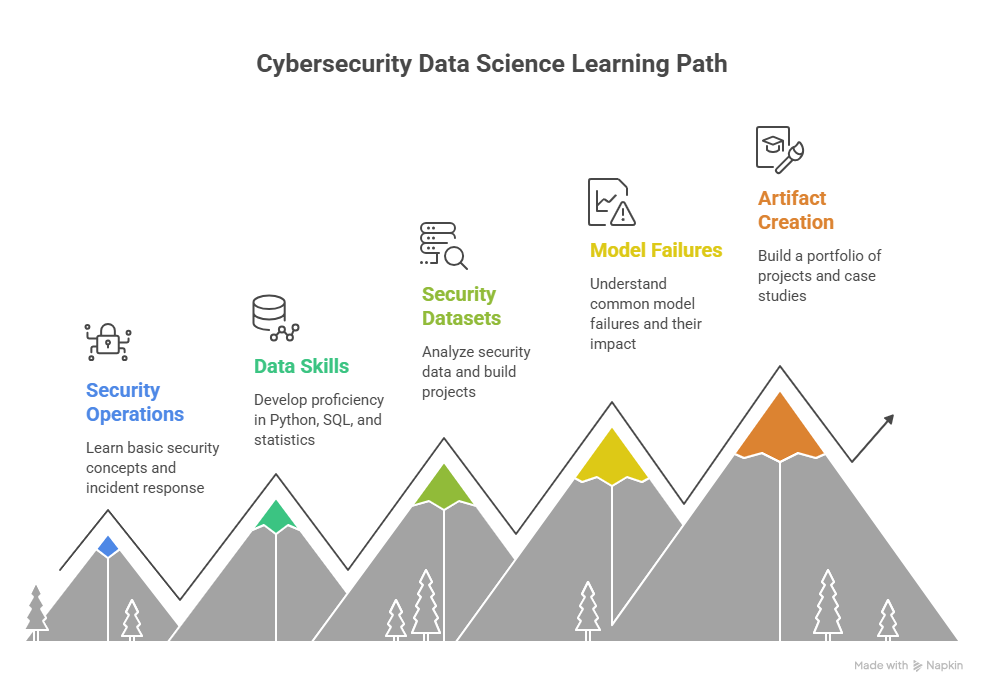
The best learning sequence is layered. First, learn security operations, basic networking, identity, malware behavior, common attack paths, and incident response vocabulary. Second, learn Python, SQL, statistics, data cleaning, visualization, and model evaluation. Third, study security datasets and build projects around phishing, anomaly detection, vulnerability prioritization, and incident clustering. Fourth, learn how models fail: drift, bias, missing data, false positives, false negatives, and analyst distrust. That sequence pairs well with AI cybersecurity adoption, AI attack prediction, future cybersecurity workforce automation, future skills guidance, and specialized role demand forecasts.
The learning path should always produce artifacts. A certificate can open a door, but a portfolio explains your value. Build notebooks, dashboards, detection-scoring examples, risk-prioritization models, written case studies, and short executive summaries. That mix helps you speak to analysts, engineers, managers, and executives. It also supports transitions into cybersecurity program management, security manager roles, director of information security pathways, chief security architect careers, and CISO advancement.
5. Career Path, Job Titles, Salary Leverage, and Advancement Strategy
A practical career path can begin in several places. From SOC analyst, move into security analytics, detection engineering support, incident clustering, alert scoring, and dashboard development. From data analyst, move into security datasets, phishing classification, identity analytics, and vulnerability prioritization. From threat intelligence, move into campaign clustering, indicator enrichment, attacker behavior modeling, and risk scoring. From cloud security, move into cloud log analytics, API anomaly detection, identity misuse detection, and workload risk modeling. These routes connect naturally to SOC analyst advancement, threat intelligence careers, cloud security engineering, cybersecurity analyst growth, and security engineer progression.
Relevant job titles include cybersecurity data scientist, security data analyst, threat intelligence data scientist, detection analytics engineer, security machine learning engineer, SOC analytics engineer, cyber risk data analyst, cloud security analytics specialist, fraud and security data scientist, and security automation engineer. Senior titles may include principal security data scientist, security analytics lead, detection engineering lead, cyber risk analytics manager, security AI lead, or director of security analytics. These senior paths align with security manager roadmaps, security leadership transitions, VP of cybersecurity growth, security architecture leadership, and specialist to CISO advancement.
Salary leverage improves when your work ties directly to measurable outcomes. Reducing false positives, shortening investigation time, improving ransomware detection, prioritizing vulnerabilities accurately, identifying risky identities, and proving control effectiveness are all business-relevant outcomes. This is why cybersecurity data science can be powerful in regulated or high-risk sectors such as finance, healthcare, manufacturing, energy and utilities, and government. The more directly your analytics improves decisions, the stronger your compensation case becomes.
The advancement mistake to avoid is becoming a notebook-only professional. Hiring managers need people who can work with messy logs, explain security relevance, collaborate with analysts, survive model failure, and ship work into operational environments. Build your career story around impact: “I used security data to reduce noise, improve prioritization, detect risk earlier, and help teams respond faster.” Support that story with cybersecurity job market trends, workforce shortage analysis, entry-level to CISO salary progression, freelance cybersecurity income trends, and future job market predictions.
6. FAQs About Becoming a Cybersecurity Data Scientis
-
The best backgrounds are cybersecurity analysis, SOC operations, threat intelligence, incident response, data analytics, data science, software engineering, or cloud security. Cybersecurity professionals need stronger Python, SQL, statistics, and machine learning skills. Data professionals need stronger security context, log knowledge, attacker behavior, and incident response understanding. A strong path combines SOC analyst foundations, AI in cybersecurity, threat intelligence training, cloud security skills, and future cybersecurity skills.
-
You need practical machine learning more than advanced theory at the beginning. Start with data cleaning, feature engineering, classification, clustering, anomaly detection, model evaluation, and visualization. The first job is usually about making security data useful, measurable, and actionable. Advanced techniques become more valuable after you understand false positives, missing telemetry, alert fatigue, and analyst workflows. Build from free cybersecurity learning resources, AI-driven security tools, SIEM technologies, and automation workforce trends.
-
Build projects around phishing classification, suspicious login detection, vulnerability prioritization, ransomware behavior detection, incident clustering, and security dashboarding. Each project should explain the security problem, dataset assumptions, feature choices, model or scoring method, limitations, and operational use. Avoid generic datasets unless you clearly adapt them to a security decision. Useful project ideas connect to phishing trend analysis, ransomware reporting, vulnerability assessment, incident response effectiveness, and insider threat analysis.
-
Security+, ISC2 CC, CEH, CySA+, cloud certifications, data analytics certificates, machine learning certificates, CISSP, and incident response training can all help depending on your starting point and target role. Cybersecurity candidates should use credentials to prove data ability. Data candidates should use credentials to prove security context. Before choosing, review cybersecurity certification rankings, future certification value, certification salary growth, certification career impact, and cybersecurity bootcamp options.
-
It can overlap with all three. In a SOC-heavy company, the role may focus on alert reduction, triage scoring, and detection analytics. In a product company, it may focus on security models, automation, and telemetry pipelines. In a risk organization, it may focus on vulnerability prioritization, control effectiveness, and executive metrics. That is why candidates should study SOC operations, security engineering paths, cybersecurity program management, cybersecurity compliance analysis, and AI cybersecurity adoption.
-
A focused learner with either cybersecurity or data experience can often build credible junior-level proof in six to twelve months, depending on time, project quality, and technical starting point. Someone new to both fields may need longer because they must build security context and data skill together. The fastest route is structured learning plus portfolio output every month. Use global training providers, cybersecurity books, cybersecurity podcasts, cybersecurity research organizations, and cybersecurity conferences to stay close to real industry problems.
