
Career Roadmap to Cybersecurity Compliance Officer
Cybersecurity compliance officers don’t “just do paperwork.” They stop surprise audits from turning into revenue events, they keep security teams from shipping controls nobody can evidence, and they turn vague risk language into board-ready decisions. If you’re aiming for this role, you need a roadmap that builds proof (artifacts, mappings, audit trails) — not just knowledge. Below is a step-by-step path to become the person who can walk into an audit, defend controls, and still help the business move fast without breaking laws, contracts, or trust.
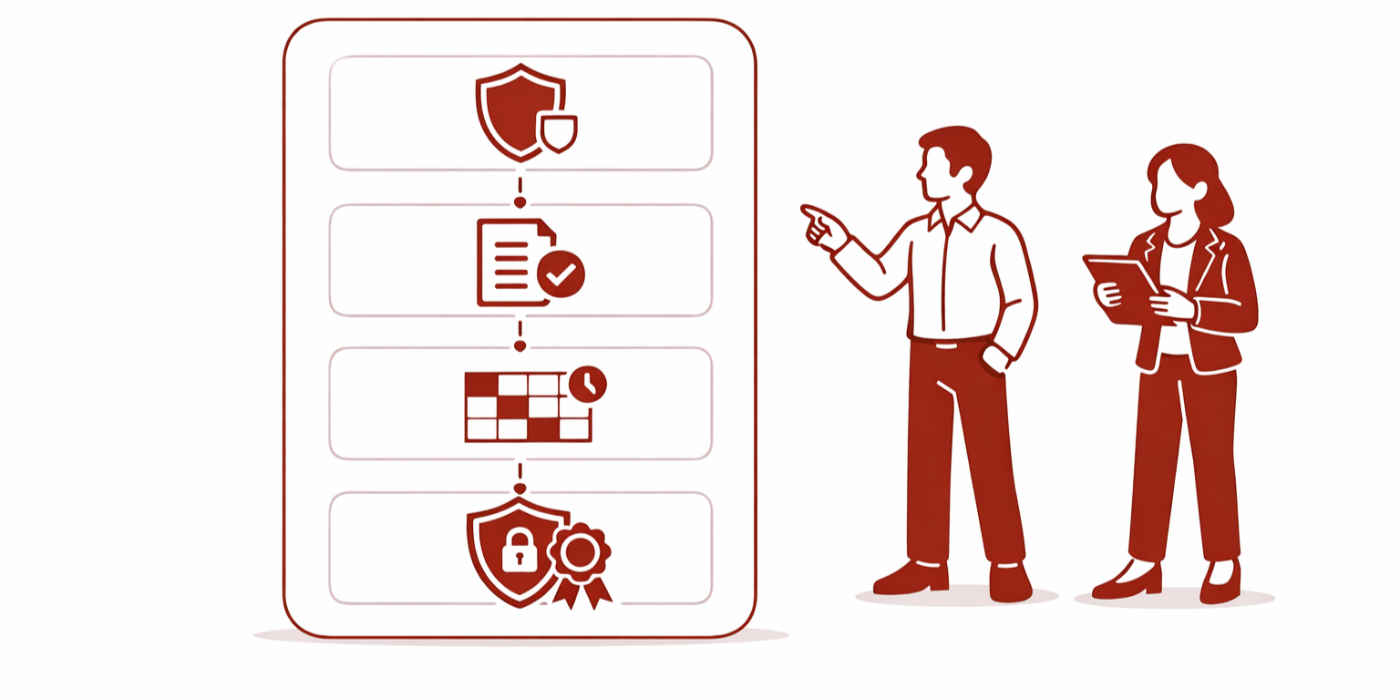
1) What a Cybersecurity Compliance Officer Actually Owns
A cybersecurity compliance officer is the bridge between what the business promises and what security can prove. That means you own the “evidence reality” behind frameworks, regulations, and customer requirements — and you translate them into controls that engineers can implement and auditors can verify. You’re not the person who runs every tool; you’re the person who ensures the organization can demonstrate that tools, processes, and people consistently reduce risk.
In practice, you’ll spend time in three zones. First: governance — policy, standards, risk acceptance, and security exceptions that don’t quietly become permanent (“temporary admin access” problems show up fast in threat signals like the ones discussed in 2030 threat projections). Second: assurance — internal audits, control testing, third-party assessments, and evidence pipelines that prove controls exist and work. Third: enablement — making compliance usable for the technical teams so they don’t treat it like a blocker, which is where understanding real controls like firewall configuration strategy, IDS deployment realities, and SIEM program design becomes career leverage.
The fastest way to stand out is to stop thinking of “compliance” as checklists and start thinking in control objectives: “What must be true, consistently, to reduce this risk and satisfy the requirement?” That mindset keeps you from writing policies no one follows, and it makes you dangerous in the best way during audits because you can show a clear line from requirement → control → implementation → monitoring → evidence. You’ll also become far more credible when security incidents hit (e.g., ransomware events where response quality matters as much as prevention — see ransomware detection, response, and recovery).
| Competency / Control Area | What “Good” Looks Like | Proof You Can Produce (Portfolio Artifact) | Common Failure Mode (Pain Point) | Best Early Practice |
|---|---|---|---|---|
| Framework mapping (NIST/ISO/SOC2) | Requirement → control → evidence chain is clear | Control crosswalk + evidence index | Controls exist but aren’t “provable” | Build a mini crosswalk for 20 controls starter |
| Policy architecture | Policies match how teams really work | Policy set + exception workflow | Policies ignored → audit exposure | Write 1 policy + 1 standard + 1 procedure |
| Evidence operations | Evidence is collected continuously, not in panic | Evidence calendar + collection scripts | “Screenshot hell” during audits | Define evidence owners + cadence |
| Identity & access reviews | Access is least-privilege with periodic review | Access review runbook + sample report | Privilege creep becomes permanent | Run quarterly access review simulation |
| MFA & session risk controls | MFA enforced + risky sessions flagged | MFA coverage report + exceptions list | MFA fatigue abuse, token theft | Define high-risk login monitoring hot |
| Logging baseline | Critical logs exist, retained, and searchable | Logging requirements doc + log inventory | “We can’t reconstruct the incident” | Map “must log” events per system |
| SIEM program basics | Use cases tied to threats + tested alerts | 10 use cases + tuning notes | Alert noise → misses real events | Start with identity + admin actions |
| Incident response governance | Clear severity, roles, comms, escalation | IR plan + tabletop record | Confusion delays containment | Run 1 tabletop per quarter |
| Ransomware readiness | Backups verified + restore tested | Backup/restore test evidence | Backups exist but don’t restore | Document RTO/RPO & test monthly |
| Asset inventory | Known systems, owners, criticality | Asset register + data classification | Shadow IT breaks control coverage | Start with crown jewels list |
| Vulnerability governance | SLAs by severity + exceptions tracked | Vuln SLA policy + exception log | “We accept risk” with no owner | Monthly vuln review cadence |
| Secure configuration standards | Baselines for OS, cloud, network | Baseline doc + drift report | Config drift creates audit gaps | Pick 1 baseline and enforce it |
| Firewall governance | Rules justified, reviewed, and pruned | Firewall rule review sample | Rule sprawl = unknown exposure | Quarterly rule cleanup workflow |
| IDS/monitoring coverage | Monitored segments align to risk | Coverage map + alert validation | Blind spots in key networks | Map sensors to crown jewels |
| Encryption standards | Clear rules for data at rest/in transit | Encryption standard + exceptions | “Encrypted” with weak key practices | Define key rotation + storage rules |
| PKI & certificate hygiene | Cert lifecycle managed, no surprise expiry | Cert inventory + renewal workflow | Expired cert = outage + incident | Track certs for critical services |
| Third-party risk management | Vendors tiered + assessed + monitored | Vendor questionnaire + scoring model | Vendor access becomes hidden backdoor | Start with top 10 vendors |
| Data privacy alignment | Retention, access, consent are enforced | Data map + retention schedule | Can’t answer “where is data?” | Build a minimal data inventory |
| Audit management | Audit scope, evidence, and responses controlled | Audit plan + RACI + evidence tracker | Audits run your calendar, not you | Pre-audit readiness checklists |
| Control testing | Controls tested on schedule with results stored | Control test scripts + results log | No proof controls work consistently | Start testing 5 key controls |
| Metrics & board reporting | KPIs reflect risk reduction, not vanity | Monthly risk dashboard (sample) | Leadership sees “green” then breach happens | Link metrics to key risk scenarios |
| Security awareness governance | Role-based training + tracked completion | Training plan + completion evidence | Training is generic → no behavior change | Target finance + HR first |
| Cloud shared responsibility | Clear ownership for cloud controls | Cloud controls matrix | Misconfigurations become audit failures | Map controls to cloud services used |
| Change management controls | Changes reviewed, approved, traceable | Change workflow + sample records | Unauthorized changes break evidence chain | Define “emergency change” rules |
| Business continuity alignment | BCP ties to critical services & recovery tests | BCP test record + lessons learned | BCP exists but never tested | Run a recovery exercise annually |
| Zero Trust alignment | Identity-based access + segmentation strategy | ZT roadmap snapshot + milestones | “Zero Trust” as slogan only | Start with admin actions & critical apps |
| Regulatory change tracking | Reg changes monitored & mapped to controls | Regulatory watchlist + impact notes | Surprised by new requirements | Quarterly regulatory review cadence |
2) Career Roadmap to Cybersecurity Compliance Officer
This role rewards sequencing. If you try to learn everything at once — frameworks, cloud, audits, legal, incident response, GRC tools — you’ll end up with scattered knowledge and no portfolio. Instead, build in layers where each layer produces tangible outputs that also become your interview “proof.” If you want a direct reference path, start by studying the role expectations in career roadmap: cybersecurity compliance officer and then deliberately expand into audit depth using cybersecurity auditor roles, salaries, and certifications.
Phase 1 (Weeks 1–4): Learn to think in controls, not tools.
Pick one primary framework lens (NIST CSF/ISO/SOC2 equivalent) and practice translating requirements into “what must be true” statements. While learning, ground yourself in how technical controls actually show up in real environments: identity and monitoring are where compliance fails loudest, so you should understand how detection works via SIEM fundamentals and what meaningful telemetry looks like for common attack paths discussed in AI-powered cyberattacks forecasts. Your deliverable in Phase 1: a mini control catalog (20–30 controls) with mapped evidence types.
Phase 2 (Weeks 5–10): Build audit survivability (evidence, testing, cadence).
Most candidates can talk about ISO or SOC; few can run an evidence process without chaos. Create an evidence calendar, define owners, and write control test scripts. This is where people who’ve read a lot lose to people who can run a process. Your credibility accelerates if you can tie control testing to threat reality — for example, identity compromise is escalating via token abuse and social engineering trends like deepfake threat waves, so your access review control shouldn’t be “annual and forgotten.” It should be periodic, risk-based, and provable.
Phase 3 (Weeks 11–18): Add technical fluency that makes engineers respect you.
You don’t need to be a network engineer, but you must understand enough to avoid writing controls that are technically impossible or operationally destructive. Learn baseline control domains and how they’re enforced: perimeter and segmentation via firewall technologies, detection layers via IDS functionality and deployment, secure communications tradeoffs via VPN security benefits and limitations, and trust primitives via PKI components and applications. Your deliverable: a technical control narrative (how the company enforces the control, how it’s monitored, and what evidence exists).
Phase 4 (Months 5–8): Specialize into a compliance lane that matches market demand.
Compliance officers win by understanding the business context. Pick a sector lens and learn what changes there: finance threat patterns in cybersecurity trends in finance, healthcare risk and compliance in healthcare cybersecurity predictions, or public sector constraints in government/public sector predictive analysis. This makes you interview-ready for compliance roles that aren’t generic — they’re tied to real regulatory and customer pressure.
Phase 5 (Months 9–12): Become the “translator” leader (risk decisions + board communication).
The ceiling in this career is your ability to turn control data into business decisions. Learn how compliance evolves, because 2030-era compliance will not be static: track future cybersecurity compliance regulatory trends, privacy regulations global predictions, and the audit function itself via future cybersecurity audit practices. Your deliverable: a risk dashboard and a risk acceptance template that leadership can actually use.
3) Build Your Compliance Portfolio
A hiring manager can’t verify your “interest” — they can verify your artifacts. Your portfolio should prove you can do four things: (1) map requirements to controls, (2) implement evidence operations, (3) run audits without panic, (4) understand enough security to avoid writing fantasy controls. If you want a benchmark path, study how technical roles structure proof and translate that to compliance: a cloud-security narrative from cloud security engineer career guide or a structured learning path from SOC analyst complete guide can inspire how you document progression and outcomes.
Portfolio artifact #1: Control crosswalk + evidence catalog.
Pick a set of 25–40 controls and write them as “control objectives,” not vague statements. Then specify evidence: log queries, ticket exports, policy versions, screenshots only when unavoidable. You’ll sound instantly more senior if you explain how evidence stays valid (frequency, ownership, retention) rather than treating evidence as a one-time snapshot. Tie the control set to threat logic you can defend using sources like next-gen SIEM trends and realistic attack evolutions like ransomware evolution by 2027.
Portfolio artifact #2: Audit readiness pack (RACI + schedule + playbook).
Create an audit playbook: what happens 90 days before audit, 30 days before, week-of, day-of, and post-audit remediation. Include a RACI (who provides evidence, who reviews, who approves). This is the difference between a compliance “participant” and a compliance “operator.” To deepen your audit thinking, borrow structure from the next generation of cybersecurity standards because standards increasingly demand continuous proof, not yearly theatre.
Portfolio artifact #3: Third-party risk model.
Vendors are where audits and breaches collide. Build a vendor tiering model and an assessment workflow (questionnaire, evidence requests, risk scoring, remediation tracking). Use threat landscape shifts as your justification — supply chains are a primary attack surface in the 2026–2030 era highlighted throughout predictive threat content like AI-driven cybersecurity innovations and blockchain innovations predictions (even if you’re skeptical, it helps you speak the language leaders hear).
Portfolio artifact #4: Incident compliance overlay.
Compliance officers who can’t operate during incidents lose trust fast. Build an incident compliance overlay: what evidence must be preserved, who is authorized to communicate, breach notification triggers, and how you document lessons learned. Back it with practical IR readiness resources like ransomware response and recovery and detection fundamentals via SIEM overview.
4) Day-1 Impact: 90-Day Plan in a New Compliance Officer Role
Most new compliance officers fail because they chase perfection before establishing control over the basics. Your first 90 days should focus on: (1) defining scope, (2) stabilizing evidence, (3) removing the top audit risks, (4) creating a repeatable system. You’re trying to stop the organization from living in a permanent “pre-audit panic” mode and move it into “audit-ready by default.”
Weeks 1–2: Inventory commitments. What standards and customer requirements are you claiming today? What contracts mention security obligations? What frameworks are already in scope? Align this with emerging compliance realities by scanning what’s coming next in future compliance regulatory trends and privacy regulation evolution predictions. You’re not trying to become legal counsel — you’re trying to prevent “unknown obligations” from becoming “surprise audit failures.”
Weeks 3–6: Fix evidence operations. Create an evidence tracker with owners and cadence. Tie evidence to systems that matter: identity, privileged access, logging, backups, and change control. If the org is cloud-heavy, match evidence to cloud realities using trends in future of cloud security predictions. If the org has high identity risk (most do), anchor evidence to controls that address modern takeover patterns discussed in 2030 threats.
Weeks 7–10: Run mini control tests. Pick 5–10 “must-not-fail” controls and test them end-to-end. You’ll quickly discover gaps like: access reviews not actually happening, firewall rules never pruned (see firewall configuration practices), logging missing for key actions (see SIEM overview), or encryption standards unclear (see encryption standards). Your goal is to produce a short “control health report” leadership can act on.
Weeks 11–13: Create the compliance operating system. Put recurring meetings on the calendar: evidence review, risk acceptance review, vendor risk review, incident tabletop schedule. If the organization is scaling or changing rapidly, connect this to workforce realities and role specialization trends described in specialized cybersecurity role demand predictions so leaders understand why compliance can’t be an “extra duty” forever.

5) Advanced Track: Specialize Without Getting Boxed In
Once you can operate the basics, your career accelerates by specializing strategically — in a way that matches demand and keeps you promotable. Specialization isn’t about narrowing your identity; it’s about becoming the person leadership trusts for a high-stakes risk surface.
Track A: Compliance + Cloud (high demand, fast growth).
Cloud changes compliance because control ownership is split, environments are dynamic, and evidence must be continuous. Build expertise using future of cloud security predictions and pair it with practical control themes like identity-driven security (often framed in future of zero trust innovations). If you can define cloud control baselines, detect drift, and prove it with logs and configuration reports, you’ll become the compliance officer teams actually want to work with.
Track B: Compliance + Privacy (regulations, retention, cross-border complexity).
Privacy-driven compliance is rising because data flows are global and enforcement is evolving. Study global privacy regulation trend predictions and the next wave via GDPR 2.0 evolution predictions. Then build practical artifacts: data inventory, retention schedule, access request workflow, and breach notification playbook. This track makes you valuable even outside pure cybersecurity roles.
Track C: Compliance + Audit/Assurance (become the control-testing machine).
If you’re strong at audits, you can move into GRC leadership quickly. Deepen your approach through future cybersecurity audit practice predictions and standards evolution via next-gen cybersecurity standards predictions. Then build an internal control testing program that’s measurable and repeatable. This turns you into the person who prevents audit findings rather than documenting them.
Track D: Compliance + Threat Reality (stay relevant as threats evolve).
Compliance officers who ignore threat evolution become checkbox managers. The most respected compliance leaders can explain why a control exists using modern threat logic: AI-powered cyberattacks forecasts, deepfake operational risk, and ransomware evolution projections. This keeps you credible with security teams and leadership.
6) FAQs
-
The fastest feeders are roles that touch controls and evidence daily: junior GRC analyst, security analyst with governance tasks, risk analyst, or internal audit associate. If you’re coming from security operations, align your experience to compliance by showing you can produce traceable evidence from monitoring work (e.g., how SIEM workflows support control proof). If you’re coming from a technical track, demonstrate control thinking using a structured roadmap like cybersecurity manager pathway and pivot into compliance via the role blueprint in compliance officer roadmap.
-
Include artifacts that prove operational competence: a control crosswalk, an evidence calendar, a sample audit RACI, a vendor risk scoring model, and 2–3 control test scripts with mock results. Tie at least one artifact to a real threat path — for example, ransomware response evidence can be mapped using ransomware detection and recovery, while identity takeover controls can be justified using 2030 threat predictions. Employers hire proof, not intentions.
-
You don’t need to be a pentester, but you must be technical enough to write controls that can be implemented and monitored. If you can speak confidently about how common control domains work — like firewall rule governance, IDS placement decisions, and trust foundations like PKI and encryption standards — engineers will treat you as a partner instead of a paperwork generator.
-
They treat compliance as a documentation project instead of an operating system. Documentation matters, but audits fail when evidence is inconsistent, ownership is unclear, and controls are not tested. You avoid this by building routines and proof pipelines early — and by tracking how compliance expectations are shifting through future compliance regulatory trends and audit practice evolution.
-
Frame compliance as risk reduction plus revenue protection: fewer audit findings, faster enterprise deals, and less downtime during incidents. Use threat-driven examples leaders understand, like the business impact of ransomware evolution or fraud risk from deepfake-driven impersonation. Then show metrics that track control health, evidence freshness, and closure time for findings — not vague “compliance completed” statements.
-
Cloud + compliance and privacy + compliance are both strong bets because they’re driven by ongoing tech change and regulation. Anchor your learning with forward-looking insights like future cloud security trends, zero trust evolution, and privacy regulation predictions. The best specialization is the one where you can consistently produce proof and influence decisions.
