
Pathway to Cybersecurity Incident Responder: Roles, Skills & Certifications
Cybersecurity incident response is one of the fastest ways to become valuable in security because it sits where pressure, judgment, technical depth, and business impact collide. When an alert becomes a real incident, organizations do not need vague theory. They need people who can validate suspicious activity, contain damage, preserve evidence, communicate clearly, and move a team from confusion to action.
That is why the incident responder pathway matters. It is not just a job title. It is a career lane built on triage, investigation, containment, coordination, recovery, and continuous improvement. Modern guidance from NIST frames incident response as a capability that helps organizations prepare for incidents, reduce their impact, and improve detection, response, and recovery efficiency, while certifications such as CompTIA CySA+, Microsoft SC-200, and GIAC GCIH explicitly map to detection, investigation, and incident-handling work.
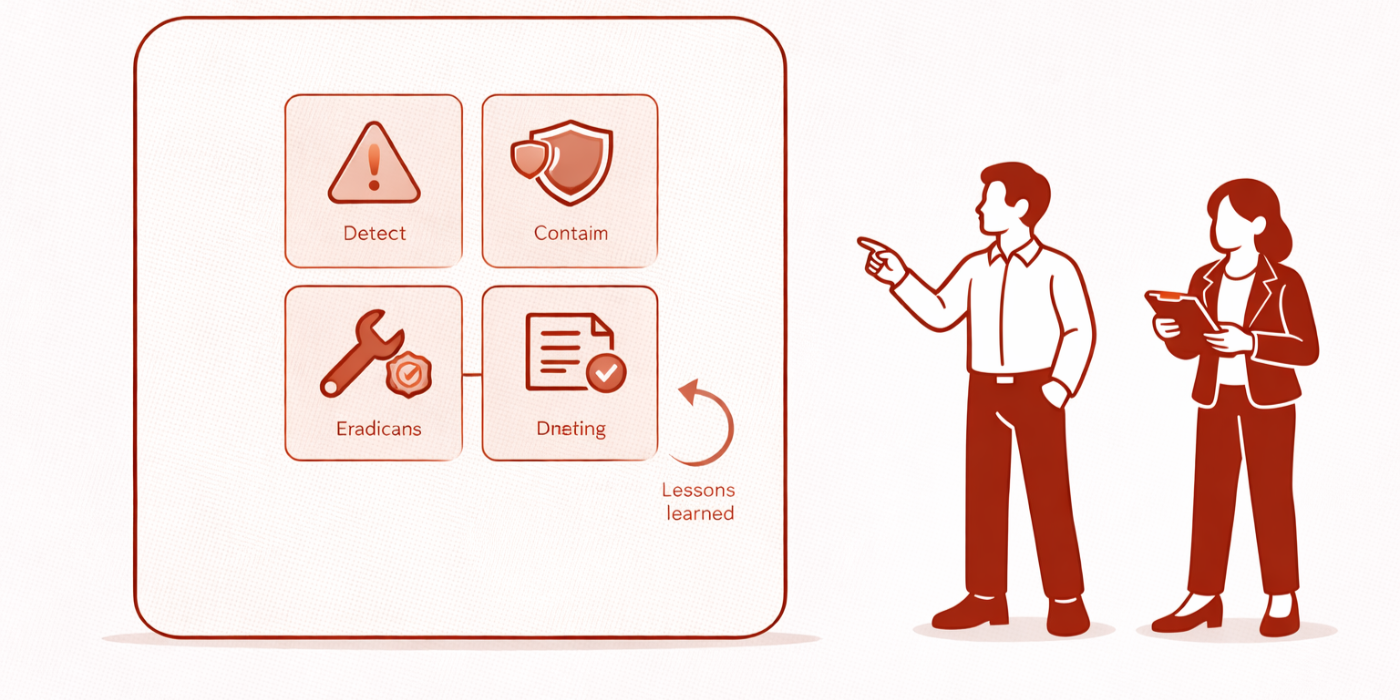
1. What a cybersecurity incident responder actually does and why this career path is growing
A cybersecurity incident responder is the person or team member trusted to investigate suspicious activity, determine what is happening, reduce attacker freedom, coordinate containment, and help the organization recover without losing control of evidence or decision quality. In practice, that means reviewing alerts, correlating logs, analyzing endpoint behavior, tracing identity misuse, escalating accurately, working with IT and leadership, and translating technical chaos into operational decisions. This role overlaps heavily with SOC analyst work, but it usually goes deeper into active incident handling, containment logic, and post-incident lessons.
The role is growing because organizations are dealing with more complex incident conditions: cloud identity abuse, ransomware, SaaS compromise, multi-stage phishing, and attacker movement that crosses endpoints, accounts, email, and infrastructure. NIST’s current incident response recommendations explicitly connect incident response to broader risk management and CSF 2.0, reinforcing that responders are no longer isolated technical firefighters but part of how organizations reduce incident frequency and impact. That is why professionals studying future cybersecurity job market trends, future skills for cybersecurity professionals, specialized role demand, and automation in the cybersecurity workforce keep seeing incident-response capability treated as core, not optional.
A lot of people misunderstand the role and think incident responders only appear after catastrophe. That is too narrow. Strong responders help before, during, and after incidents. Before incidents, they help build playbooks, escalation logic, and telemetry quality. During incidents, they validate signals, scope damage, and guide action. After incidents, they help produce stronger controls, cleaner recovery, and more durable operational learning. This is why the pathway often branches into security manager, cybersecurity auditor, cybersecurity compliance officer, cloud security engineer, and eventually CISO tracks.
The pain point that pushes many people toward this path is simple: they want work that matters in real time. Incident response does. It rewards people who can think under ambiguity, document under pressure, separate signal from noise, and make judgment calls without panic. It is one of the clearest “earn trust fast” roles in cybersecurity, but only if you build the right skills.
| Role / Skill / Credential | Why It Matters | What Strong Candidates Do | Career Advantage Created |
|---|---|---|---|
| 1. SOC analyst foundation | Builds monitoring and triage habits | Learn alert validation and escalation discipline | Creates direct entry path into incident work |
| 2. Incident triage | Determines what is real and urgent | Correlate alerts with identity, endpoint, and asset context | Improves credibility fast |
| 3. Log analysis | Core to reconstructing events | Practice Windows, firewall, email, and cloud logs | Supports real investigations |
| 4. Endpoint investigation | Many incidents start or surface here | Review process, service, startup, and alert artifacts | Builds host-level confidence |
| 5. Identity analysis | Compromised accounts drive modern attacks | Track failed logons, MFA anomalies, privilege misuse | Strengthens detection value |
| 6. Containment judgment | Action quality matters as much as speed | Know when to isolate hosts, disable accounts, revoke tokens | Shows responder maturity |
| 7. Evidence preservation | Prevents investigative loss | Capture artifacts before wiping or reimaging | Improves forensic quality |
| 8. Ticket and timeline discipline | Incidents fail when documentation is weak | Maintain timestamps, actions, owners, and hypotheses | Raises trust with leadership |
| 9. SIEM familiarity | Central for detection and investigation | Write queries, pivot across entities, validate alerts | Improves analyst readiness |
| 10. EDR familiarity | Essential for host response | Investigate alerts and execute isolation carefully | Boosts practical employability |
| 11. Phishing analysis | Common real-world entry vector | Review headers, URLs, attachments, user impact | Adds everyday relevance |
| 12. Malware basics | Helps classify hostile behavior | Understand persistence, execution, and indicators | Improves scoping ability |
| 13. Network fundamentals | Useful for movement and beaconing analysis | Know ports, protocols, segmentation, suspicious flows | Makes investigations sharper |
| 14. Cloud awareness | Incidents increasingly involve cloud identities and services | Learn IAM, logging, storage exposure, control plane events | Future-proofs the path |
| 15. Threat intelligence use | Adds context to investigations | Map IOCs and TTPs to incident behavior | Improves prioritization |
| 16. Incident communication | Executives need clarity, not panic | Summarize scope, impact, confidence, and next steps | Separates juniors from future leads |
| 17. Home lab evidence | Proves readiness beyond theory | Build small investigations and write mini reports | Strengthens interviews |
| 18. Incident report writing | Turns work into reusable learning | Document root cause, timeline, actions, and fixes | Supports promotion potential |
| 19. CompTIA Security+ | Builds core security baseline | Use it to strengthen fundamentals early | Helps entry-level credibility |
| 20. CompTIA CySA+ | Targets analysis, monitoring, and response | Use it to prove detection and IR relevance | Aligns well with analyst hiring |
| 21. Microsoft SC-200 | Maps to security operations analyst work | Build hands-on familiarity with Microsoft security tooling | Strong for Microsoft-heavy shops |
| 22. GIAC GCIH | Validates incident handling depth | Pursue after building practical foundations | Signals serious IR commitment |
| 23. Forensics exposure | Useful for deeper investigations | Learn artifact preservation and host evidence basics | Broadens DFIR options |
| 24. Tabletop participation | Builds coordination and decision skills | Practice with legal, IT, and leadership scenarios | Improves real-world readiness |
| 25. Post-incident improvement mindset | The role is not just firefighting | Translate incidents into stronger controls | Supports leadership growth |
| 26. Long-term pathway planning | Avoids stagnation after first IR job | Map next moves into DFIR, threat hunting, or leadership | Creates sustained momentum |
2. The core roles that usually lead into incident responder positions
Most people do not land in incident response out of nowhere. They usually arrive through feeder roles that build investigation habits first. The most common on-ramp is the SOC analyst. SOC work teaches alert review, case handling, escalation, log correlation, and the discipline of separating real threats from environmental noise. That is why CompTIA describes CySA+ as an intermediate analyst certification focused on incident detection, prevention, and response through continuous security monitoring.
Another common route is IT support or systems administration with security-adjacent exposure. These roles build asset familiarity, authentication troubleshooting, endpoint knowledge, and operational calm under pressure. When paired with deeper practice in incident response plan development and execution, intrusion detection systems, SIEM fundamentals, and cyber threat intelligence collection and analysis, that background becomes highly usable for response work.
A third route comes through vulnerability management, junior security operations, or email security analysis. These roles help people understand control weaknesses, attacker pathways, and how technical findings map to actual business risk. They also build the habit of evidence-driven communication, which matters heavily in incident response. NIST’s guidance still emphasizes that effective incident handling requires coordination with internal groups such as management, legal, and IT support, not just raw technical analysis. That means the best incident responders are rarely “tools-only” people. They are cross-functional operators.
Longer term, incident response can branch into cybersecurity manager, security manager to director progression, cybersecurity instructor, cybersecurity curriculum developer, or cybersecurity auditor. People who perform well in incident work often become valuable because they can explain how controls fail in reality, not just how they should look on paper.
3. The skills that matter most if you want to become a strong incident responder
The first critical skill is investigation thinking. Incident response is not just “seeing an alert and reacting.” It is building and refining a hypothesis. What happened? Is it real? Which systems are affected? Is this malware, phishing, account misuse, misconfiguration, or normal behavior? What evidence confirms or weakens the hypothesis? This is where vulnerability assessment techniques, security audits and best practices, firewall technologies, and DLP strategy become useful foundations rather than separate topics.
The second critical skill is log fluency. Responders need to read system, endpoint, authentication, firewall, email, and cloud records without getting lost. If you cannot pivot between timestamps, users, hosts, IPs, processes, sessions, and actions, you will struggle to scope incidents cleanly. That is why strong responders spend serious time with SIEM environments, IDS deployment concepts, VPN security considerations, and PKI fundamentals.
The third skill is containment judgment. Fast action matters, but sloppy action creates new damage. Responders must know when to isolate a host, disable an account, revoke sessions, block a sender, remove persistence, or escalate to broader business containment. NIST’s incident-response recommendations focus not only on detecting and responding but also on improving the efficiency and effectiveness of detection, response, and recovery activities. That is important because many junior candidates think speed alone defines incident response strength. It does not. Precision matters just as much.
The fourth skill is communication under pressure. Incident responders constantly translate technical work for different audiences. Analysts need detail. IT needs action. Leadership needs impact, confidence levels, and next steps. Legal may need evidence quality and timeline discipline. People who want to grow into this lane should study future compliance trends, privacy regulation trends, GDPR evolution, and next-generation cybersecurity standards because incident communication increasingly touches governance, not just technical clean-up.
The fifth skill is post-incident improvement. Strong responders do not just close tickets. They help answer why the incident succeeded, which controls failed, and how to make repeat failure harder. That is how incident response becomes a leadership accelerator rather than a reactive treadmill.
4. Which certifications actually make sense on the incident responder pathway
Certifications help when they reduce employer uncertainty, prove role alignment, and reinforce practical learning. They hurt when people collect them randomly and still cannot explain how to investigate an incident. For this pathway, the smart sequence usually starts with fundamentals, then moves into analyst and incident-focused credentials.
CompTIA Security+ is still positioned by CompTIA as a baseline certification covering essential skills for core security functions and a career in IT security. For someone coming from IT support, systems administration, or networking, it can provide useful structure. It is not an incident-response certification by itself, but it helps remove basic credibility friction.
CompTIA CySA+ is much closer to the day-to-day reality of junior responders because CompTIA explicitly frames it around incident detection, prevention, and response through continuous monitoring, along with vulnerability management and communication skills for effective security analysis. That makes it a strong bridge credential for people aiming at SOC analyst, junior IR, and security operations roles.
Microsoft SC-200 is especially valuable for organizations running heavily on Microsoft security tooling because Microsoft positions it as the Security Operations Analyst certification, with the linked training course explicitly tied to people working in the Security Operations job role and preparing for the SC-200 exam. In the real job market, that means SC-200 can be a practical differentiator when the environment uses Microsoft Sentinel, Defender, and related ecosystems.
GIAC GCIH is a more explicitly incident-handling credential. GIAC states that GCIH validates the ability to detect, respond to, and resolve computer security incidents, including understanding common attack techniques, vectors, and tools. This is a strong credential for people who already have some hands-on maturity and want to show deeper commitment to incident handling. GIAC also maintains a dedicated DFIR focus area and offers advanced incident-handler paths such as GX-IH, which signals that incident response can evolve into a deeper DFIR specialization rather than remain a narrow first-job function.
The trap to avoid is prestige chasing without sequence. A candidate with one sensible certification, real lab work, and strong investigation stories usually beats a candidate with scattered badges and no real incident narrative.

5. A practical step-by-step roadmap to become a cybersecurity incident responder
Start with the right feeder role. That could be IT support with security-adjacent work, a junior security operations role, a SOC analyst seat, or a systems role with strong exposure to authentication, endpoints, and logs. Build from where you already touch incidents or suspicious behavior.
Next, build investigation repetition. Set up small labs. Review Windows events, authentication anomalies, phishing scenarios, PowerShell activity, suspicious processes, and basic network artifacts. Practice writing short incident summaries with timeline, evidence, likely impact, and recommended next action. Tie that work to ransomware detection and recovery, botnet disruption methods, DoS prevention and mitigation, and encryption standards so your learning reflects real attack surfaces, not just abstract theory.
Then build tool fluency around the environments responders actually use: SIEM, EDR, email security, identity systems, and cloud logs. You do not need mastery of every platform. You do need to become comfortable asking responder questions inside tools. What changed? Who logged in? What host executed this? What session is still active? What else touched this indicator? That is the mindset employers hire.
After that, add the right certification layer. For many people, Security+ first, then CySA+ or SC-200, then GCIH later is a logical progression. The best sequence depends on your background and target environment, but the general principle is stable: fundamentals first, analyst validation second, deeper incident specialization after that.
Finally, build proof that looks like responder work. Write mini incident reports. Summarize tabletop lessons. Publish short breakdowns of AI-powered cyberattacks, deepfake threats, zero trust futures, and next-gen SIEM trends only if you can connect them back to investigation and response. Hiring managers trust candidates who look operational, not merely interested.
6. FAQs
-
It can be, but it is more commonly reached through SOC analyst, security operations, or security-adjacent IT roles first. The critical thing is not the title alone but whether you are building real investigation, escalation, and containment skills.
-
Investigation judgment is the most important because the role depends on interpreting evidence under pressure. Technical knowledge matters, but the ability to decide what is happening and what should happen next is what makes responders valuable.
-
There is no single universal best option. Security+ is useful for fundamentals, CySA+ aligns strongly to analyst and detection work, SC-200 is especially relevant in Microsoft-heavy environments, and GCIH is a strong incident-handling credential once you already have practical foundations.
-
You do not need to be a software engineer, but scripting helps. Basic PowerShell or Python can make log parsing, enrichment, and repetitive analysis faster, which improves responder efficiency.
-
Use labs, incident write-ups, alert investigations, log analysis practice, tabletop participation, and tightly written resume bullets that show investigation and escalation discipline. Employers trust visible proof more than generic interest.
-
Yes. IT support can be a very strong feeder path when it includes identity troubleshooting, endpoint support, access issues, ticket discipline, and operational calm. The missing layer is usually deeper security analysis, not completely different experience.
-
Start with SIEM basics, endpoint investigation tooling, identity and authentication logs, email analysis, and cloud logging fundamentals. Tool names matter less than learning how responders ask questions inside them.
-
It can lead into DFIR, threat hunting, security operations leadership, cloud security, compliance, audit, management, and eventually senior leadership tracks. Incident response builds trust quickly because it proves you can operate when consequences are real.
