
Cybersecurity Vulnerability Researcher: How to Start Your Career
It sits close to the fault lines of modern technology: flawed code, broken assumptions, weak trust boundaries, unsafe defaults, and the tiny implementation mistakes that turn ordinary software into a real attack surface. That excitement hides a harder truth. This career punishes shallow curiosity. It demands patience, precision, strong system knowledge, and the willingness to spend hours proving why something fails instead of just guessing that it might. A real entry path has to build that discipline first, or the job stays a fantasy made of buzzwords, screenshots, and dead-end labs.
1. What a Cybersecurity Vulnerability Researcher Actually Does
A vulnerability researcher studies software, systems, protocols, applications, devices, and security boundaries to discover flaws that attackers could exploit. The work can include source code review, binary analysis, fuzzing, protocol testing, web application analysis, exploitability assessment, patch diffing, and validating whether a suspected bug is truly security-relevant. In stronger teams, the role goes further than bug discovery. The researcher explains root cause, assesses impact, proposes safer fixes, and often helps engineering or product teams understand why the weakness happened in the first place. That is why this path overlaps with vulnerability assessment techniques and tools, offensive thinking from the guide to becoming an OSCP certified penetration tester, engineering awareness through best application security tools expert directory reviews, control context from security audits processes and best practices, and a defensive lens from intrusion detection systems functionality and deployment.
The day-to-day work changes depending on the environment. In product security, a researcher may inspect an internal application or platform feature, trace how user input moves through code, identify unsafe trust assumptions, and demonstrate a practical exploit path. In a vendor research team, the work may center on reverse engineering, protocol behavior, firmware inspection, or patch analysis. In bug bounty-heavy practice, the cycle often involves aggressive reconnaissance, attack-surface mapping, chaining smaller issues, and proving impact with clean, reproducible evidence. Across all versions of the role, the same core principle applies: good researchers do not stop at “something looks weird.” They move until they can explain what broke, why it broke, how far it can go, and how it should be fixed.
That is also why a vulnerability researcher benefits from broader understanding in access control models DAC MAC and RBAC explained, public key infrastructure components and applications, encryption standards AES RSA and beyond, firewall technologies types and configurations, and security information and event management SIEM an overview. Even highly specialized bug work improves when the researcher understands where the weakness sits inside a broader security system. Hiring managers often test exactly that: whether a candidate can connect a flaw to architecture, exposure, exploitability, and real-world consequences instead of just naming a category.
Vulnerability Research Career Roadmap: 26 Skills, Study Areas, and Career Leverage Points
| Skill / Research Area | Why It Matters | How to Build It | Career Value |
|---|---|---|---|
| Networking fundamentals | Protocols and trust boundaries shape attack surface | Study TCP/IP, DNS, HTTP, TLS, SMB, routing, ports | Improves triage and exploit reasoning |
| Linux internals basics | Many services and targets live on Linux | Learn processes, permissions, syscalls, logs, file layouts | Helps with bug validation and impact analysis |
| Windows internals basics | Enterprise software often fails inside Windows assumptions | Study services, registry, tokens, memory, auth behavior | Useful for product and enterprise research roles |
| Programming fluency | Reading and testing code requires more than syntax familiarity | Learn Python plus one lower-level language like C or C++ | Critical for deeper research roles |
| Web security fundamentals | Many first wins come from web attack surface | Study auth, sessions, APIs, injection, file handling, SSRF | Fastest route to visible results |
| Source code review | Root causes become clearer in code | Trace input paths, trust assumptions, unsafe function use | Builds research depth fast |
| Binary analysis basics | Not all targets come with source code | Learn disassembly basics, strings, imports, execution flow | Opens advanced researcher paths |
| Fuzzing concepts | Automation finds edge-case crashes humans miss | Study input mutation, coverage, harnesses, crash triage | Valuable for vendor and product security roles |
| Patch diffing | Updates often reveal hidden security fixes | Compare versions, inspect changed functions, infer root cause | Strong signal of research maturity |
| Threat modeling mindset | Research improves when assumptions are mapped first | Define assets, trust boundaries, entry points, likely abuse paths | Produces smarter target selection |
| Burp Suite fluency | Manual testing needs strong request control | Use proxy, repeater, intruder, comparer, decoder effectively | Essential in web-focused research |
| API security analysis | Modern apps expose complex API trust logic | Test object access, auth, rate limits, parameter trust, tokens | High relevance in SaaS and cloud work |
| Authentication and session analysis | Identity flaws create severe impact | Study token lifecycle, resets, MFA gaps, session binding | Improves exploit quality |
| Input validation reasoning | Many bugs start with unsafe parsing or assumptions | Trace server-side handling and validation bypasses | Useful across web, APIs, and services |
| Memory safety awareness | Deeper research often meets crash behavior and corruption | Study stack, heap, pointers, overflow basics, UAF concepts | Important for advanced research tracks |
| Reproduction discipline | A bug is weak if no one can verify it cleanly | Write exact steps, conditions, payloads, and observed outcomes | Increases credibility with employers and vendors |
| Proof-of-concept writing | Findings need executable clarity | Build minimal demos that prove impact safely | Strong differentiator in portfolios |
| Severity judgment | Not every weird behavior is critical | Assess exploitability, preconditions, privilege, reach, and business risk | Improves trust fast |
| Responsible disclosure skills | Communication affects how findings land | Practice concise reports, timelines, proof, and fix guidance | Essential for public research credibility |
| Cloud attack-surface awareness | Modern applications leak risk through identity and storage paths | Study IAM, metadata abuse, exposed buckets, token misuse | Future-proofs the career |
| Protocol analysis basics | Services often fail at edge-case communications | Inspect packet flows, message sequences, parser expectations | Useful for network and device research |
| Tool building and scripting | Research scales better with custom helpers | Write parsers, recon helpers, diff tools, payload builders | Turns curiosity into visible output |
| Target prioritization | Good researchers choose rich surfaces, not random ones | Rank complexity, exposure, novelty, trust boundaries, code churn | Improves win rate and learning efficiency |
| Research note-taking | Months of work collapse without structured notes | Track hypotheses, failed paths, payloads, observations, versions | Essential for serious progression |
| Portfolio publishing | Hiring teams need evidence of thought process | Publish writeups, advisories, research notes, safe case studies | Huge advantage for first role |
| Humility and revision | Weak assumptions waste weeks | Re-test, re-read code, challenge your own conclusions | Core trait of long-term researchers |
2. Build the Technical Base Before You Chase Deep Research
A lot of beginners romanticize vulnerability research as a straight path into zero-days, advanced fuzzers, or reverse engineering wizardry. That fantasy causes real damage. People jump into advanced topics before they understand ordinary application behavior, common trust boundaries, basic coding patterns, or how real software breaks under normal pressure. The result is predictable: endless half-finished labs, shallow writeups, copied payloads, and no reliable intuition. A stronger path begins with system literacy. Learn operating systems, networks, HTTP, APIs, authentication flows, input handling, and permission models. Ground that learning with how to become an ethical hacker comprehensive career roadmap, how to transition from IT support to cybersecurity analyst, complete guide to becoming a security operations center SOC analyst, cyber threat intelligence collection and analysis, and ransomware detection response and recovery. Even researcher roles get stronger when the candidate understands how exploitation appears to defenders and why certain bugs matter more operationally than others.
Then move into programming and application logic. You do not need to become a senior software engineer before you begin, but you do need to read code without panic and write small scripts without feeling lost. Python is a strong starting point, and one lower-level language such as C or C++ becomes increasingly useful as you move deeper. In parallel, spend time with web apps and APIs. Learn what normal behavior looks like first. That matters more than beginners think. A researcher who does not understand expected workflow will miss subtle authorization flaws, session logic mistakes, and trust boundary confusion. Support that growth with best application security tools expert directory reviews, complete directory of best cloud security tools, best data loss prevention software directory and reviews, directory of leading endpoint security providers, and state of endpoint security original data on solutions effectiveness. Those resources help translate abstract weaknesses into the kinds of systems real organizations actually rely on.
A simple question can tell you whether your foundation is ready: when you see a feature, API route, parser, or update mechanism, do you naturally start asking what assumptions it trusts, what inputs it mishandles, and where authorization or validation may crack? When that habit starts to feel automatic, you are moving into real research territory.
3. The Best Entry Routes Into Vulnerability Research
Very few people begin with the job title “vulnerability researcher.” Most arrive through adjacent paths that teach pieces of the craft. Web application testing, application security analyst work, secure code review, offensive security labs, bug bounty practice, product security, exploit development hobby work, and even strong QA or software engineering backgrounds can all become entry points. The best route depends on what you already bring. A developer can lean into secure code review and app logic flaws. A pentesting candidate can move from exposed weaknesses to root-cause reasoning. A SOC or IR professional can pivot by studying exploitability and product behaviors more deeply. That is why this path can connect well with career path from junior penetration tester to senior security consultant, career roadmap security analyst to cybersecurity engineer, pathway to cybersecurity incident responder roles, how to become a cloud security engineer complete career guide, and detailed roadmap to IoT security specialist careers.
One of the smartest early paths is web and API research. It offers visible feedback, abundant targets in labs and legal programs, and repeated practice in the exact habits researchers need: observing assumptions, tracing data flows, validating impact, and documenting findings. Another strong route is patch diffing and advisory study. Pick a disclosed vulnerability, compare versions, inspect the fix, and try to understand the root cause at a deeper level than the public summary gives you. This kind of work sharpens your eyes fast. It also builds one of the traits hiring teams value most: seriousness. Plenty of candidates can repeat vulnerability names. Far fewer can explain how a subtle trust failure emerged in real software.
The market also rewards evidence. If a beginner shows a clean portfolio of writeups, code snippets, responsible disclosure notes, and thoughtful case studies, that proof often carries more weight than a vague claim of “passion for cybersecurity.” To build that edge, stay plugged into best cybersecurity blogs and industry news sites, use the directory of top cybersecurity research organizations and institutes to understand how serious research is published, browse top cybersecurity books essential reads, follow the best YouTube channels for cybersecurity learning and updates, and absorb community discussion from the directory of top cybersecurity podcasts for industry professionals. The stronger your research taste becomes, the less time you waste chasing shallow noise.
Quick Poll: What Is Blocking Your Vulnerability Research Progress Most?
Choose the pain point that feels most real, because the right starting path changes once the real bottleneck is visible.
4. The Skills, Projects, and Certifications That Actually Create Momentum
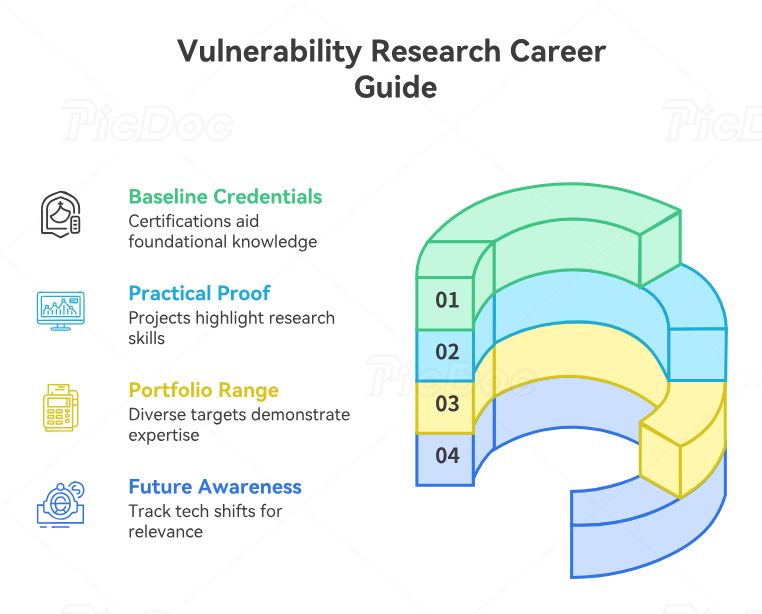
Vulnerability research careers reward visible thinking. Certifications can help establish baseline knowledge, but they matter most when attached to proof of research discipline. A candidate who can publish a clean writeup, explain a root cause, build a simple proof of concept, or compare the security impact of two implementation choices usually stands out more than someone with several generic badges and no body of work. Still, baseline credentials from the top cybersecurity certifications directory ranked and reviewed, broad offensive grounding from the step-by-step guide to becoming a certified ethical hacker CEH, practical study support from the directory of free cybersecurity courses and resources, structured learning through the directory of best cybersecurity bootcamps and academies, and market awareness from impact of cybersecurity certifications on career advancement can help if used intelligently.
The best projects are the ones that force deep explanation. Write a report on an authorization flaw and show exactly where trust broke. Reproduce a disclosed bug in a safe lab and explain the root cause in plain language. Compare two application versions and infer what the patch fixed. Build a small fuzzer for a simple parser or endpoint. Document an API abuse case with realistic business impact. These projects train the exact muscles employers want: patience, precision, reproduction, and communication. They also help cure one of the biggest beginner problems: mistaking weird behavior for valuable research. Research becomes valuable when it is validated, framed, and communicated cleanly.
A strong portfolio should also show range across targets and techniques. One piece might focus on web authorization, another on unsafe file handling, another on patch diffing, and another on product logic. Balance that with reading from artificial intelligence in cybersecurity original data on industry adoption and impact, future-facing context from AI-driven cybersecurity tools predicting top innovations, cloud exposure analysis in emerging cybersecurity threats in cloud environments, forward-looking risk thinking from top 10 cybersecurity threats predicted to dominate by 2030, and technology-shift pressure from quantum computing and cybersecurity original report on threats and opportunities. Good researchers do not only understand today’s bug classes. They track how changing technology creates new surfaces and old mistakes in new clothes.
5. A Realistic 12-Month Roadmap to Your First Vulnerability Research Opportunities
Months 1 through 3 should focus on technical base and application behavior. Learn networking, Linux and Windows basics, HTTP, APIs, auth flows, and core programming. Start simple labs on web application weaknesses and spend extra time understanding why each issue happens rather than only how to trigger it. Support this phase with cybersecurity frameworks NIST ISO and COBIT, cybersecurity compliance trends report original regulatory insights, GDPR and cybersecurity compliance challenges and best practices, healthcare compliance report cybersecurity and HIPAA, and cybersecurity in North America original report and emerging trends. Even researchers benefit from understanding how real industries frame exposure and legal pressure.
Months 4 through 6 should become research-heavy. Pick target classes and go deeper. Focus on web and APIs first if you need visible momentum. Start reading code where possible. Practice patch diffing. Write concise notes after every session: assumption tested, result observed, dead end reached, next hypothesis. This is where scattered curiosity has to become disciplined experimentation. Read sector and incident analysis from 2025 data breach report industries most at risk and mitigation strategies, iot security breaches report original data and industry insights, financial sector cybersecurity incidents detailed original analysis, healthcare cybersecurity threat report actionable insights, and critical infrastructure cybersecurity report original threat assessment. These sharpen your instinct for which weaknesses matter in the wild.
Months 7 through 9 should become proof-focused. Publish polished writeups. Build one or two simple tools or helpers. Improve proof-of-concept quality. Start aiming for responsible disclosures or internal-quality research notes that look like real work deliverables. Your goal is to create a body of evidence that shows persistence and clarity, not just isolated wins.
Months 10 through 12 should turn toward market positioning. Decide whether your first move is likely to be appsec, product security, bug bounty-supported contracting, offensive security, or a research-adjacent analyst role. Tailor your portfolio accordingly. Use cybersecurity job market trends emerging roles and salary predictions, predicting demand for specialized cybersecurity roles ethical hacking and threat intelligence, remote cybersecurity careers predicting long-term trends and opportunities, cybersecurity freelance and consulting market income data and trends, and entry-level to CISO complete salary progression analysis to understand where your research strengths can convert into real opportunities. The aim is not just to learn how vulnerabilities work. The aim is to become the kind of person who can discover, explain, and communicate them in a way that teams trust.
6. FAQs
-
You can begin learning the field before becoming highly fluent, but programming depth becomes increasingly important as you progress. Reading code, writing helpers, validating edge cases, and understanding root cause all get easier once code stops feeling foreign. Python is a strong starting point, and a lower-level language becomes more useful later.
-
It can be a strong entry route, especially for web and API research, because it forces real target analysis and clear reporting. Still, it works best when paired with structured learning. Random target hopping often teaches less than focused practice on chosen weakness classes.
-
They chase novelty before mastering basics. That usually means jumping into advanced topics, rare bug classes, or flashy tooling without understanding normal application behavior, common trust failures, or how to prove impact cleanly. Strong researchers grow from depth, not excitement alone.
-
Not for every entry path. Web and application security research can begin without deep reverse engineering. Still, reverse engineering becomes important for binaries, firmware, client applications, and deeper vendor research roles. It is a specialization layer, not the only door into the field.
-
Include writeups, responsible disclosure-style reports, patch-diff case studies, proof-of-concept demos, code review notes, small tools, and clear root-cause explanations. The best portfolio pieces show how you think, not just what you found.
-
For a focused learner producing steady, visible work, nine to twelve months can build enough proof for appsec, junior product security, or research-adjacent roles. For others, the smart path may pass through pentesting, secure code review, or general security engineering first.
