
Cybersecurity Freelance and Consulting Market: Original Income Data & Trends
Cybersecurity freelancing is no longer a side lane for a few independent pentesters chasing short-term contracts. It has become a serious income engine for specialists who can solve urgent business problems faster than internal teams can hire, onboard, and mature talent. Companies are buying outcomes now: faster assessments, sharper incident response, clearer compliance readiness, and expert guidance that reduces risk without forcing a full-time headcount.
That shift matters because the money in freelance cybersecurity does not go to people who merely “know security.” It goes to professionals who can package trust, speed, specialization, and business clarity. The market is rewarding experts who turn complexity into action, especially in cloud security, compliance, risk, incident response, PAM, application security, and advisory work. Current benchmarks still support strong earning potential: Upwork lists cybersecurity developers at roughly $40–$90 per hour, ZipRecruiter places the U.S. average for freelance cyber security consultants at about $131,892 annually or $63.41 per hour, and the BLS says information security analysts earned a median $124,910 in May 2024 while employment is projected to grow 29% from 2024 to 2034.

1. Where the cybersecurity freelance and consulting market is actually moving
The biggest mistake people make when entering independent cybersecurity work is assuming clients buy technical brilliance first. They do not. They buy relief. A founder buys relief from regulatory uncertainty. A healthcare practice buys relief from audit anxiety. A SaaS company buys relief from insecure permissions, exposed tokens, and cloud misconfigurations. A mid-market firm buys relief from not knowing whether its controls would survive a ransomware event. That is why the strongest independent positioning often sits at the intersection of cybersecurity compliance officer pathways, cybersecurity auditor expertise, cloud security engineering, and practical incident response planning. NIST’s 2025 guidance for non-employer firms explicitly notes that many small businesses rely on consultants for cybersecurity support, which is a direct signal that solo and boutique advisory demand is not theoretical; it is built into how smaller organizations operate.
That demand is being strengthened by two pressures at once. First, organizations still need security outcomes even when permanent hiring is slow. Second, many buyers do not need a full internal team for every problem. They need a scoped engagement: a gap assessment, a security roadmap, a tabletop exercise, a SIEM tune-up, a privileged access review, or a cloud posture baseline. This is why consultants who understand SIEM fundamentals, PAM solutions, data loss prevention strategies, security audits, and NIST, ISO, and COBIT frameworks can command better pricing than generalists who only advertise “cybersecurity services.” The market pays more for a painful problem solved than for a broad skill list. Meanwhile, BLS data shows many information security analysts work for consulting and business services environments, which reinforces that advisory and services work remains central to the field’s labor market.
| Freelance / Consulting Offer | What Clients Are Really Buying | Typical Buyer | Why It Sells | Income Potential Signal |
|---|---|---|---|---|
| vCISO advisory | Executive guidance without full-time leadership cost | SMBs, funded startups | Board-level clarity and vendor oversight | High retainers |
| Cloud security assessment | Misconfiguration discovery and remediation roadmap | SaaS, cloud-native teams | Fast risk reduction | High hourly or fixed-fee |
| SOC maturity consulting | Detection quality and analyst workflow improvement | Growing security teams | Cuts alert fatigue | Strong mid-to-high rates |
| GRC program buildout | Policies, controls, audit readiness | Regulated firms | Turns ambiguity into evidence | Recurring project work |
| Compliance gap assessment | Clear delta between current and target state | Healthcare, finance, SaaS | Immediate executive value | Excellent packaged offer |
| Internal audit support | Evidence mapping and control validation | Mid-market orgs | Saves internal bandwidth | Reliable project revenue |
| Penetration test coordination | Offensive testing plus remediation guidance | Tech firms, enterprises | Combines discovery with credibility | Premium niche |
| Web app security review | App risk prioritization | Product teams | Prevents expensive release issues | High-value specialist work |
| IAM / access review | Role sprawl cleanup and least privilege design | Hybrid enterprises | Immediate control improvement | Strong demand |
| PAM implementation advisory | Privileged account governance | Enterprise IT | Reduces blast radius | Premium consulting |
| SIEM tuning | Signal quality, noise reduction, use-case alignment | SOC teams, MSSPs | Measurable operational value | Retainer-friendly |
| Threat detection content engineering | Better detections mapped to real risks | Mature SOCs | Highly specialized | Upper-tier rates |
| Incident response retainer | Rapid access to expertise during breach pressure | SMBs, mid-market | Fear-driven but necessary buy | High-margin recurring |
| Ransomware readiness review | Backup, identity, segmentation, recovery readiness | All sectors | Directly tied to resilience | Fast-selling package |
| Vendor risk assessments | Third-party exposure evaluation | Enterprises, fintech | Supports procurement and compliance | Scalable consulting line |
| Security awareness program advisory | Behavior change and phishing resilience | SMBs, education, nonprofits | Easy pain point to explain | Moderate but repeatable |
| DLP strategy engagement | Sensitive data control and monitoring | Healthcare, legal, finance | Protects regulated data | Premium compliance crossover |
| IoT security assessment | Device exposure mapping and segmentation advice | Manufacturing, healthcare | Few experts, rising urgency | High specialist leverage |
| OT / manufacturing security review | Operational resilience guidance | Industrial firms | Sector risk is expensive | Premium niche |
| Healthcare security roadmap | Risk controls around PHI and operations | Clinics, providers | Sector-specific fear and regulation | Strong consulting demand |
| Security policy and standards drafting | Governance documents that hold up in audits | Growing businesses | Foundational need | Good entry consulting offer |
| Board reporting and metrics design | Executive-ready risk visibility | vCISO clients | Makes security legible to leadership | Excellent retainer add-on |
| Zero Trust roadmap consulting | Identity, access, segmentation maturity plan | Hybrid/cloud orgs | Strategic transformation work | High-value advisory |
| Cloud security training workshops | Team uplift without full certification path | Engineering teams | Fast capability boost | Good productized service |
| Fractional security program management | Execution oversight across vendors and controls | Understaffed organizations | Bridges strategy and delivery | Sticky monthly retainers |
| Security content / curriculum consulting | Training design and enablement | Training firms, academies | Specialized educational need | Niche but defensible |
2. Income data: where freelancers actually make more money
The cleanest way to think about cybersecurity freelance income is to separate commodity work from consequence-heavy work. Commodity work includes generic policy templates, basic awareness decks, simple vulnerability scan interpretation, and low-context technical cleanup. Consequence-heavy work includes breach readiness, executive risk advisory, identity hardening, cloud architecture review, regulated-environment compliance, application security findings triage, and control design that must survive scrutiny. Upwork’s current benchmark for cybersecurity developers at roughly $40–$90 per hour gives you a visible baseline for platform-priced work, while ZipRecruiter’s freelance cyber security consultant average of about $63.41 per hour suggests that independent security consulting can sit materially above many general IT freelance categories when expertise is packaged correctly.
But raw hourly rate is only the surface. Real income expands when the consultant stops selling labor and starts selling lower-risk decisions. Someone following a SOC analyst to SOC manager career path can monetize alert-triage pain, while someone with a cloud security engineer background can package posture reviews, IAM fixes, and architecture guidance. A consultant grounded in cyber threat intelligence collection and analysis, intrusion detection systems deployment, firewall technologies, and ransomware response and recovery can price around business impact because the buyer is paying to avoid a far more expensive failure. That is the central income truth in this market: the more expensive the client’s problem, the less they care about your hourly math and the more they care about your ability to de-risk the outcome. This is partly why upper-percentile freelance consultant earnings separate so sharply from entry-level platform gigs.
A second major income driver is retainer structure. One-time projects can be lucrative, but retainers change the business model from hunting work to managing delivery. vCISO support, monthly compliance oversight, quarterly security roadmaps, detection engineering reviews, and incident response preparedness all lend themselves to recurring contracts. That structure is especially attractive now because the SMB segment is more cybersecurity-conscious than before. ConnectWise’s 2025 SMB research says 57% of SMBs rank cybersecurity as their top priority, 83% believe AI and GenAI increase their threat exposure, and 58% spent more on cybersecurity in 2024 than they had planned. That combination usually creates advisory demand, not just product demand, because companies that overspend reactively eventually look for external experts who can help them spend intelligently.
3. The highest-value consulting niches from 2026 onward
The best freelance niches are not always the flashiest. Pentesting gets attention, but many consultants quietly build stronger revenue in governance, architecture, cloud, identity, and audit-linked work because those services are tied to renewals, board reporting, cyber insurance pressure, and regulatory milestones. If you are studying how to become a cybersecurity manager, how to become a compliance officer, or how to become a CISO, pay attention to what that means commercially: these tracks train you to solve prioritization problems, not just tool problems. And prioritization problems are where consulting margins widen.
Cloud security will remain one of the strongest lanes because cloud mistakes scale fast and hide well. Identity and access advisory will keep growing because privilege sprawl, contractor access, and hybrid work create constant control drift. Compliance consulting will stay resilient because buyers rarely feel “done”; they feel under-documented, under-prepared, or uncertain. Application security and DevSecOps advisory will rise where release velocity is high but secure development maturity is uneven. Sector-specific advisory is also underpriced by many freelancers. Consultants who deeply understand healthcare cybersecurity trends, finance cybersecurity risks, manufacturing security pressures, and energy and utilities recommendations can charge more because they reduce the client’s translation burden.
4. How to move from cybersecurity practitioner to profitable consultant
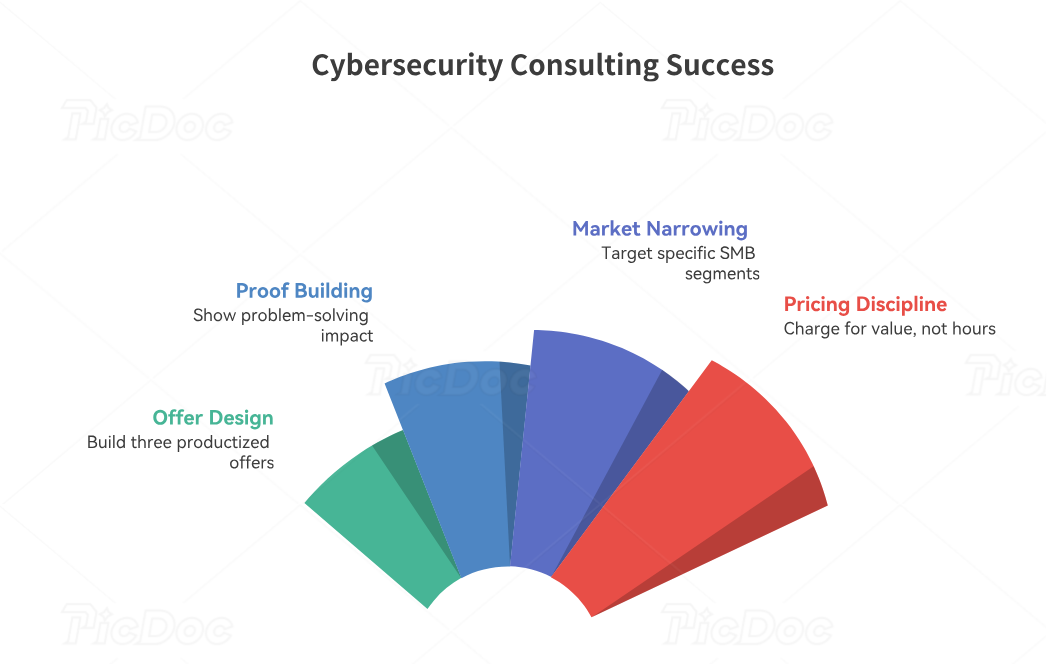
Most skilled professionals underperform in consulting because they present themselves like job applicants instead of revenue producers. A client does not care that you are “passionate about cybersecurity.” They care whether you can cut audit prep time, improve MFA discipline, reduce false positives, harden privileged access, or create a defensible security roadmap. That is why your transition should start with offer design, not logo design. Build three productized offers: one diagnostic, one implementation-light engagement, and one retainer. Your diagnostic could be a controls gap review. Your implementation-light service could be a cloud or IAM findings workshop. Your retainer could be fractional advisory with monthly risk tracking. Professionals coming from auditor roles, SOC careers, ethical hacking pathways, and security manager tracks can all convert their background into clear service lines if they stop describing duties and start describing problems solved.
The second move is to build proof around decisions, not just tasks. Case studies should show what was unclear before your engagement, what framework or method you used, what changed operationally, and what risk or friction was reduced. The third move is to narrow your market. “I help SMB healthcare groups prepare for security audits and reduce identity risk” is dramatically stronger than “I provide cybersecurity consulting.” NIST’s latest small-business guidance is useful here because it confirms that small firms and solopreneurs need accessible, staged cybersecurity support, and it also explicitly recognizes consultants as a key audience serving that segment. That means smaller organizations are not a consolation prize; they are a defined advisory market.
The fourth move is pricing discipline. Beginners often anchor on low hourly rates because they are afraid to lose work. That creates the wrong client mix: disorganized buyers, fuzzy scopes, and endless back-and-forth. Better clients buy certainty. Better consultants charge for scope, urgency, risk, and context. A 90-minute executive risk briefing can be worth more than ten hours of scattered technical cleanup because it changes budget decisions, priorities, and accountability. That pricing maturity is often what separates a stressed freelancer from a serious consulting practice.
5. Trends that will shape cybersecurity freelance income over the next few years
The first trend is AI pressure on low-value work. Repetitive reporting, lightweight triage, template-driven documentation, and basic research are becoming easier to automate or compress. ISC2’s 2025 workforce study says skills issues now matter more than raw headcount in many organizations, which is a meaningful signal for independents: buyers will keep paying for judgment-heavy capabilities even if some routine work becomes cheaper. In plain terms, the market is likely to punish shallow generalists and reward consultants who can think across business risk, technical controls, architecture, and regulatory context.
The second trend is stronger demand for externally validated strategy in SMB and mid-market environments. Security is now a business priority for many smaller firms, but confidence, tooling maturity, and execution are still uneven. That mismatch is exactly where consultants win. Companies that know they are exposed but do not know where to start often need security awareness platforms, cloud security tools, application security tools, network monitoring and security tools, and implementation priorities translated into a realistic roadmap. Vendor noise is rising. Buyer clarity is not. That gap is consulting revenue.
The third trend is specialization around future-facing risk domains. Buyers are increasingly aware of AI-powered cyberattacks, deepfake-enabled threats, Zero Trust evolution, future cloud security trends, and future compliance shifts. But awareness without implementation creates anxiety, and anxiety creates buying momentum. Consultants who can convert emerging-risk headlines into prioritized action plans will sit in one of the most defensible corners of the market. BLS growth projections and current median pay reinforce that security work itself remains economically strong; the independent advantage comes from focusing on the problems organizations cannot afford to misunderstand.
6. FAQs
-
Yes, but not by marketing yourself as a full-spectrum consultant on day one. Enter through a narrow service line tied to your strongest proven skill. Someone with hands-on logging experience can sell SIEM content tuning. Someone with audit exposure can sell control evidence preparation. Someone with cloud experience can offer configuration and identity reviews. Start narrow, build proof, then expand.
-
The easiest to sell are usually the ones attached to expensive business pain: compliance gap reviews, cloud security assessments, IAM cleanup, ransomware readiness, vendor risk support, incident response planning, and fractional advisory. These are easier to explain to buyers than abstract security improvement work because the risk and business value are visible quickly.
-
Fixed pricing is usually better once your process is repeatable. Hourly pricing is useful when the scope is genuinely uncertain or highly reactive, such as incident response support. But fixed pricing protects margin when your expertise helps you solve the issue faster than the client expects. Fast, accurate work should increase your profit, not reduce it.
-
Usually four things: sharper positioning, stronger client trust, better packaging of services, and experience solving consequence-heavy problems. The consultant who can tie security work to audit readiness, executive decisions, insurance pressure, or operational resilience will usually out-earn the consultant who only lists tools and certifications.
-
That depends on your niche. Governance and audit work benefits from framework fluency and evidence discipline. Offensive work benefits from technical credibility. Cloud work benefits from architecture and platform-specific depth. But for consulting, certification alone is never the deciding factor. Buyers trust people who can communicate risk clearly, define scope cleanly, and reduce uncertainty.
-
Take your current role, identify the most painful business problem hidden inside it, then build a repeatable offer around that problem. A SOC analyst can evolve into detection engineering or SOC maturity consulting. A cybersecurity auditor can move into compliance advisory. A future cybersecurity manager or CISO can step into fractional leadership and board-facing advisory. The premium is rarely in “more services.” It is in clearer value.
