
GRC Cybersecurity Career in 2026: Reddit Experiences on Pay, Entry Difficulty, Certifications & Remote Work
Governance, risk, and compliance has become one of cybersecurity’s most discussed career paths in 2026, especially among people questioning whether cybersecurity is still worth entering, struggling to break into cybersecurity without IT experience, comparing SOC analyst versus GRC careers, or deciding whether certifications or hands-on proof matter more. The opportunity is real, but Reddit experiences reveal a harder truth: GRC rewards evidence, business judgment, technical literacy, and framework fluency far more than collecting certificates and applying to every “GRC Analyst” opening.
1. What a GRC Cybersecurity Career Actually Looks Like in 2026
GRC sits where cybersecurity controls meet business accountability. A good GRC professional can take a requirement such as “privileged access must be controlled,” determine which systems are in scope, identify the applicable control, collect evidence, test whether the control is operating effectively, document a gap, quantify the resulting risk, assign ownership, and explain the issue to leadership without turning the conversation into technical noise. That makes the field broader than the traditional image of compliance paperwork and explains why people moving toward a GRC specialist career, cybersecurity risk management, cybersecurity policy analysis, and regulatory cybersecurity work can share many foundational skills.
NIST CSF 2.0 elevated Govern into one of its six core Functions, explicitly covering organizational context, cybersecurity strategy, roles, policy, oversight, supply-chain risk, and alignment with enterprise risk. That gives governance greater formal visibility in modern cybersecurity programs and helps explain why GRC expertise increasingly intersects with executive decision-making rather than living exclusively inside audit departments.
Day-to-day work varies sharply. Someone in third-party risk may spend Monday reviewing vendor SOC reports and Tuesday challenging remediation plans. An IT auditor may test access-management evidence. A compliance analyst may map ISO 27001 requirements against existing controls. An RMF analyst may work through control selection, assessment, authorization, and continuous monitoring. A privacy-focused practitioner may eventually move toward a cybersecurity privacy analyst career, while an auditor can follow the path from IT auditor to cybersecurity auditor. These jobs share a requirement that many applicants underestimate: you must understand what the control is protecting, rather than merely recognize the framework language.
Recent Reddit discussions reinforce that distinction. One GRC professional described work involving access reviews, audit requirements, PCI and SOX obligations, and process documentation, while another noted that much of the stress comes from depending on other teams to execute remediation. A separate 2026 discussion from someone entering GRC straight after graduation showed the opposite concern: gaining governance experience while worrying about insufficient exposure to networking, Active Directory, firewalls, and operational security.
That tension matters. Candidates who treat GRC as an escape hatch from technology can become weak reviewers because they cannot tell whether evidence demonstrates an effective security control. Candidates pursuing cybersecurity with no IT experience should therefore build enough technical literacy to discuss identity, networking, endpoints, cloud services, logging, vulnerabilities, encryption, backups, and incident response. The same logic explains why Security+ by itself has limited hiring power, why a cybersecurity home lab needs verifiable outputs, and why graduates can still struggle to secure cybersecurity jobs.
GRC Cybersecurity Career in 2026: 28-Role Entry & Leverage Matrix
| Search Title | What You Actually Own | Entry Difficulty | Proof That Creates Hiring Leverage |
|---|---|---|---|
| GRC Analyst | Controls, risks, policies, evidence | Moderate | Control matrix, risk register, audit-ready evidence pack |
| Junior GRC Analyst | Evidence collection, testing support | Best direct-entry target | NIST/ISO mapping plus clearly written findings |
| Security Compliance Analyst | Compliance controls and remediation | Moderate | Framework mapping and sample compliance assessment |
| IT Risk Analyst | Risk identification, scoring, treatment | Moderate | Risk register with impact, likelihood, owners and treatment |
| Cyber Risk Analyst | Cyber risk scenarios and reporting | Moderate | Business-impact-driven cyber risk assessment |
| IT Auditor | Control testing and audit evidence | Moderate | Walkthrough, test procedure, exception and conclusion samples |
| Internal IT Auditor | Independent assurance testing | Moderate | ITGC understanding and defensible audit workpapers |
| Technology Risk Consultant | Client risk and controls engagements | Moderate-high | Presentation ability plus controls and audit knowledge |
| Third-Party Risk Analyst | Supplier security assessments | Moderate | Vendor questionnaire review and residual-risk decision |
| Vendor Risk Analyst | Vendor due diligence and monitoring | Moderate | SOC report review plus vendor remediation memo |
| Controls Analyst | Control design and effectiveness | Moderate | Control objective, owner, frequency, evidence and test procedure |
| Security Assurance Analyst | Customer and internal assurance | Moderate | Evidence packages and concise control narratives |
| SOC 2 Compliance Analyst | Trust Services Criteria readiness | Moderate | SOC 2 control mapping and evidence request list |
| ISO 27001 Analyst | ISMS controls and audit readiness | Moderate | Statement of Applicability and internal audit simulation |
| PCI DSS Analyst | Payment-card compliance | Moderate-high | Scope diagram and requirement-to-evidence mapping |
| HIPAA Security Analyst | Healthcare security safeguards | Moderate | Security risk analysis with remediation priorities |
| CMMC Analyst | Defense-industry compliance | Moderate-high | CUI scoping and control-assessment knowledge |
| RMF Analyst | Risk Management Framework lifecycle | Moderate-high | NIST 800-53/RMF control-selection and assessment practice |
| ISSO | System security and authorization | Moderate-high | System boundary, SSP and POA&M familiarity |
| Security Policy Analyst | Policy creation and governance | Moderate | Policy suite tied to control and business requirements |
| Regulatory Compliance Specialist | Regulatory obligations and controls | Moderate-high | Regulation-to-control obligation register |
| Privacy Analyst | Data governance and privacy risk | Moderate | Data inventory, privacy risk assessment and control map |
| Cloud Compliance Analyst | Cloud controls and evidence | Moderate-high | AWS/Azure control evidence and shared-responsibility mapping |
| Security Program Analyst | Security metrics, programs and governance | Moderate | Metrics dashboard tied to risks and remediation |
| Risk & Controls Associate | Control documentation and testing | Entry-friendly | Strong workpapers and control-testing logic |
| Cybersecurity Auditor | Security-specific assurance | High for beginners | Audit experience plus technical security understanding |
| GRC Engineer | Automated controls and evidence | High | APIs, scripting, cloud telemetry and automated evidence collection |
| GRC Manager | Program ownership and stakeholder leadership | Career progression role | Risk decisions, audit leadership, metrics and executive communication |
2. GRC Cybersecurity Salary in 2026: Where the Money Actually Comes From
GRC compensation becomes confusing when people treat every governance-related title as the same job. As of September 2026, Salary.com places the average U.S. GRC Analyst salary around $77,438, with the 25th-to-75th-percentile range around $63,526 to $85,919. Its separate IT Auditor data places the average near $90,044, demonstrating how titles, specialization, employer type and methodology can materially change published numbers.
The broader security ceiling is considerably higher. The U.S. Bureau of Labor Statistics reports a $129,180 median annual wage for information security analysts in May 2025, although that occupation includes many roles outside GRC and therefore should be treated as a cybersecurity-market benchmark rather than a GRC salary figure. BLS also projects information-security-analyst employment to grow 21% from 2025 to 2035.
Reddit's 2026 GRC salary discussions illustrate the spread better than a single average. Reported examples included a first full-time post-college role around $70,000 plus a 5% bonus and fully remote work, a professional with four years of experience at $100,000, another with roughly 3.5 years of direct GRC experience reporting a $150,000 base, and a seven-year GRC professional reporting approximately $155,000-$160,000 total compensation. Those are self-reported anecdotes, so they are useful for understanding possible career outcomes rather than calculating a reliable market median.
The practical lesson is more valuable than the numbers: pay rises when you progress from documenting controls to owning risk decisions. Someone who only gathers screenshots is easier to replace than someone who can challenge a control owner, determine whether evidence proves operating effectiveness, calculate residual risk, translate technical weaknesses for leadership, negotiate remediation, and defend the conclusion to an auditor.
That progression can lead from GRC specialist to risk management specialist, cybersecurity policy roles, privacy leadership, and eventually broader cybersecurity leadership. Professionals who combine governance with business ownership can also move toward cybersecurity program management, while highly technical practitioners may build toward security architecture.
Industry matters too. Financial services, healthcare, defense, government contracting, SaaS, insurance and heavily regulated enterprises often create deeper GRC requirements because the consequence of weak controls extends beyond internal cybersecurity. Regulatory exposure, customer assurance, contractual obligations and third-party risk can make strong governance expertise commercially valuable. Someone considering whether cybersecurity remains worthwhile in 2026 should therefore evaluate the employer's risk environment, rather than choosing a career purely from national salary averages.
3. How Hard Is It to Break Into GRC Cybersecurity in 2026?
GRC has a strange entry-level problem: many responsibilities sound beginner-friendly until you examine what competent execution requires.
Collecting audit evidence sounds simple. Determining whether the evidence proves the control worked throughout the assessment period requires judgment. Writing policy sounds straightforward. Writing policy that reflects the company's systems, risk appetite, contractual obligations, operational reality, and enforceable ownership requires context. Performing a vendor assessment sounds administrative. Recognizing that a supplier's encryption response fails to address key management requires technical understanding.
That explains why people frustrated by the 2026 cybersecurity job market, graduates struggling with cybersecurity hiring gaps, and candidates attempting a no-experience cybersecurity transition can discover that “entry-level GRC” still asks for one to three years of relevant experience.
Recent Reddit discussions reflect exactly that frustration. In June 2026, applicants described entry-level GRC positions as scarce, while commenters emphasized cybersecurity fundamentals, ISO 27001, SOC 2, risk management, labs and documentation practice. Another 2026 discussion complained that ostensibly entry-level roles frequently request several years of experience. At the same time, a July 2026 graduate described landing GRC as a first job, proving that direct entry exists even though it cannot be treated as the default outcome.
The highest-probability strategy is therefore to build GRC experience before someone gives you the GRC title.
Create a fictional SaaS company. Define its critical systems, customers, employees, cloud provider and sensitive information. Build an asset inventory. Create five realistic risks. Score inherent risk. Map controls to NIST CSF and ISO 27001. Assign owners. Build an evidence request list. Test two controls. Document an exception. Create remediation. Calculate residual risk. Perform one vendor assessment. Write one executive summary.
Those outputs are substantially stronger than writing “familiar with NIST” on a cybersecurity resume with no experience. They follow the same proof-first principle behind a cybersecurity home lab that helps candidates get hired and the broader argument for combining certifications with hands-on evidence.
Career changers should translate existing work rather than erase it. An accountant may already understand evidence, materiality, sampling and controls. A lawyer may understand regulatory interpretation and policy. A project manager may understand ownership, deadlines and stakeholder escalation. A systems administrator may understand access control, backups, patching and change management. Someone comparing a degree against cybersecurity certifications or a bootcamp, degree and certification path should ask which option closes an actual skills gap rather than merely adds another résumé line.
For job searches, expand beyond “GRC Analyst.” Search technology risk associate, IT risk analyst, security compliance analyst, controls analyst, third-party risk analyst, vendor risk analyst, IT auditor, security assurance analyst, RMF analyst, ISSO, privacy analyst, SOC 2 analyst, ISO 27001 analyst and security policy analyst. That search strategy opens routes into cybersecurity auditing, regulatory security, privacy analysis, and cybersecurity risk management without waiting for one exact title.
4. Which GRC Certifications Actually Matter in 2026?
The strongest certification strategy depends on career stage. Beginners frequently make the expensive mistake of building a certificate stack before determining whether the jobs they want emphasize audit, risk, federal RMF, privacy, cloud compliance or general security.
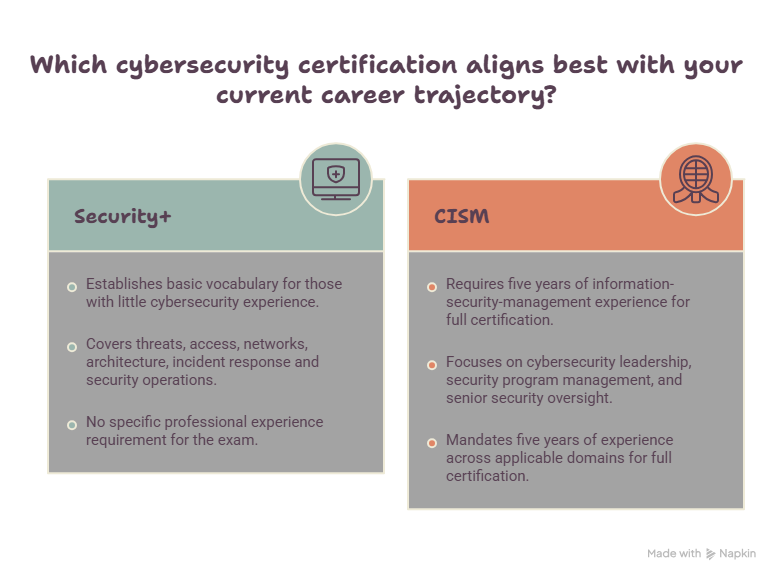
For someone with little cybersecurity experience, Security+ can establish basic vocabulary around threats, access, networks, architecture, incident response and security operations. Its value rises when the candidate can demonstrate those concepts through practical work. That is why the question is rarely whether Security+ alone is enough; a stronger question is whether the credential complements verifiable project evidence, a credible no-experience cybersecurity résumé, and the mix of certifications plus hands-on labs.
ISC2 CGRC becomes more directly relevant when the target is governance, RMF, authorization, control assessment and compliance maintenance. ISC2 currently requires two years of relevant experience across its CGRC domains. A candidate who passes the exam before meeting that requirement can become an Associate of ISC2 and has three years to obtain the required two years of qualifying experience.
CISA is particularly aligned with IT audit, assurance and controls. ISACA allows candidates to sit the exam before satisfying the experience requirement, while full certification requires five years of professional information-systems auditing, control or security experience, subject to ISACA's applicable requirements. This makes CISA potentially valuable for someone moving toward cybersecurity auditing, while a beginner should understand the difference between passing the exam and holding the certification.
CRISC is more directly risk-oriented. ISACA currently requires at least three years of qualifying professional experience for certification, although the exam can be taken before that requirement has been completed. It becomes increasingly relevant when your work includes risk identification, analysis, response, monitoring and control design, making it logical for professionals progressing through a cybersecurity risk management career.
CISM belongs later in the journey. ISACA requires five years of information-security-management experience across the applicable CISM domains for certification. Someone still fighting for a first analyst position will usually gain more leverage by producing credible control work than by pursuing a management credential prematurely. CISM becomes more coherent as responsibility expands toward cybersecurity leadership, security program management, and eventually senior security leadership.
Framework-specific education can sometimes produce faster interviewing value than another broad certification. If target vacancies repeatedly mention ISO 27001, learn how scope, risk treatment, the Statement of Applicability, controls, internal audit and corrective action connect. If they mention SOC 2, understand evidence and Trust Services Criteria. If they mention federal work, learn RMF and NIST controls. If privacy dominates, consider building toward a cybersecurity privacy career. If regulatory interpretation is central, study the route into cybersecurity regulatory work.
The certification decision can therefore be reduced to a useful rule:
Choose the credential that validates skills already appearing repeatedly in your target job descriptions, then build an artifact proving you can apply those skills.
That avoids the common trap behind the degree-versus-certification debate, the bootcamp-versus-degree-versus-certification decision, and endless discussions about certifications versus practical labs: employers are ultimately buying useful capability.
5. Are GRC Cybersecurity Jobs Really Remote-Friendly?
GRC contains many tasks that translate naturally to distributed work: reviewing policies, analyzing risks, testing evidence, completing vendor assessments, mapping controls, maintaining risk registers, writing findings, tracking remediation, preparing audit packages and meeting control owners. That creates genuine remote potential and helps explain why remote GRC listings receive substantial attention.
A recent Reddit discussion in August 2026 specifically described seeing more GRC postings, including remote roles. Another 2026 salary thread included professionals reporting fully remote GRC positions, including one early-career example and a highly experienced professional who described remote work as a major reason for staying with the employer. These are useful indicators that remote GRC employment exists across experience levels, although Reddit anecdotes cannot establish the share of the total market that is remote.
The harder part is winning one.
Remote roles collapse geographic applicant pools. A local employer may compare you against fifty plausible candidates. A remote employer can attract applicants across an entire country. Candidates already concerned about cybersecurity market saturation, weak résumé evidence, or missing hands-on cybersecurity proof should expect remote applications to magnify those weaknesses.
Remote also does not necessarily mean work-from-any-country. Organizations may restrict hiring because of payroll, tax, labor law, data-access requirements, government contracts, security clearances, customer obligations or time-zone coverage. Some GRC positions also require onsite audits, client travel or sensitive-environment access. Candidates should distinguish fully remote within a specified country, hybrid, remote with travel, and location-independent employment before judging an opportunity.
A remote-ready candidate should be unusually good at written evidence. Produce a concise risk statement using condition → threat → impact logic. Write an audit finding that distinguishes criteria, condition, cause, consequence and remediation. Build an executive summary that a CISO can understand in two minutes. Demonstrate that you can conduct a structured control-owner interview. Those skills support careers in GRC, risk management, policy analysis, and cybersecurity auditing.
A practical 90-day GRC entry plan would look like this:
Days 1-15: Learn cybersecurity fundamentals, networking basics, identity, cloud concepts and the purpose of core controls. Candidates with limited background should use the same foundational thinking required when entering cybersecurity without IT experience rather than skipping directly to framework memorization.
Days 16-30: Study NIST CSF, basic NIST control concepts and ISO 27001. Learn how risks produce control requirements and how controls produce evidence. Start a fictional company environment.
Days 31-45: Create an asset register, eight-to-ten-item risk register, risk methodology, control library and framework crosswalk. Follow the proof mentality behind a job-winning cybersecurity home lab.
Days 46-60: Conduct a mock audit. Request evidence, test access control, test one change-management control, identify an exception and create a remediation plan. This work directly supports an eventual IT-audit-to-cybersecurity-audit path.
Days 61-75: Perform a third-party risk assessment, review a fictional vendor's controls and document inherent versus residual risk. Create an executive risk memo. This begins to demonstrate the judgment expected in a cybersecurity risk management role.
Days 76-90: Rewrite the résumé around deliverables, tailor applications across the 20-plus GRC-adjacent titles in the matrix above, rehearse scenario-based interviews and start targeted applications. Use the principles behind a cybersecurity resume with no experience, study why graduates still get rejected, and treat every application as an evidence-matching exercise.
That approach produces something certification stacking cannot: a candidate who can walk into an interview and discuss the work as work.
6. FAQs About GRC Cybersecurity Careers in 2026
-
Yes, especially for people who enjoy analyzing risk, interpreting requirements, writing clearly, challenging weak controls and communicating with both technical and business teams. NIST CSF 2.0's dedicated Govern Function also reflects how central governance has become to modern cyber-risk management.
Career potential extends beyond one analyst title. GRC can lead into cybersecurity risk management, cybersecurity policy, regulatory cybersecurity, privacy, audit, security programs and leadership. Someone evaluating whether cybersecurity is still worth pursuing in 2026 should therefore treat GRC as a substantial cybersecurity discipline rather than a backup option for people who dislike SOC work.
-
Direct entry happens, particularly through junior analyst, graduate, consulting, audit, compliance and risk-associate programs, but it is competitive. Recent Reddit discussions show both outcomes: new graduates entering GRC directly and applicants struggling against experience requirements.
Your odds improve when you can show transferable experience and practical artifacts. Someone following a no-IT-experience cybersecurity roadmap should combine fundamentals with a credible home-lab portfolio, a proof-focused résumé, and targeted knowledge of GRC responsibilities.
-
You usually do not need the same depth as a security engineer, but technical illiteracy places a ceiling on your effectiveness. A GRC professional assessing MFA, logging, network segmentation, encryption, vulnerability remediation or cloud security needs enough understanding to decide whether the control design and evidence make sense.
This is especially important as GRC becomes more integrated with automation, cloud systems and continuous control monitoring. Someone worried that AI will replace entry-level cybersecurity work should build the harder-to-automate combination of judgment, technical context, communication and risk ownership. The same technical foundation that helps SOC candidates satisfy hiring managers can strengthen GRC work without requiring a career in SOC.
-
Security+ can help establish baseline security knowledge, but employers still need evidence that you can apply risk and control concepts. A stronger package is Security+ plus a risk register, framework mapping, control-testing sample, vendor assessment and clearly written audit finding.
That is why candidates should study the limitations of Security+ as a standalone hiring signal, understand the tradeoff between certifications and hands-on labs, and decide whether their next investment should be a degree or certification based on actual target vacancies.
-
For beginners, a foundational security credential can be useful. For GRC-specific work, ISC2 CGRC aligns closely with governance, risk, controls, assessment and compliance. CISA becomes highly relevant to audit. CRISC aligns strongly with risk and control. CISM becomes more appropriate as a professional moves toward management.
Experience requirements matter. CGRC currently requires two years of relevant experience, CISA five years of applicable auditing/control/security experience, CRISC three years of qualifying experience, and CISM five years of applicable information-security-management experience. Some allow candidates to take the exam before completing experience requirements, so candidates should distinguish exam passage from full certification status.
-
Often, the stress is different. SOC work may involve alerts, incidents, shifts and immediate operational pressure. GRC commonly creates deadline pressure around audits, customer commitments, regulatory obligations, remediation and dependencies on other teams. A Reddit GRC discussion specifically highlighted the frustration of depending on technical teams to execute what the governance function requires.
Someone choosing between the fields should compare the realities of SOC analyst versus GRC work, understand the fastest credible SOC entry route, and choose according to work preference rather than assuming one path is universally easier.
