
Cybersecurity Burnout: Reddit Stories on On-Call Work, Alert Fatigue, Understaffing & How Roles Differ
Cybersecurity burnout rarely comes from one difficult incident. It builds when understaffed security teams combine endless queues, unpredictable on-call rotations, constant learning, weak boundaries, and executive pressure with little recovery time. Reddit stories from SOC analysts, incident responders, engineers, and managers repeatedly expose that pattern. For people asking whether cybersecurity is still worth it, choosing between SOC and GRC, or considering IAM, the smarter question is which cybersecurity working conditions fit the life you actually want.
1. Why Cybersecurity Burnout Feels Different From Ordinary Job Stress
Burnout in cybersecurity often combines high consequence, unfinished work, and persistent uncertainty. A marketing task can be completed and closed. A security team can remediate twenty vulnerabilities and still wake up to another hundred. A SOC analyst can clear yesterday's queue while today's detections keep arriving. An incident responder can finish a twelve-hour containment effort without knowing whether persistence remains elsewhere. That permanent sense of unfinished defense is one reason someone considering SOC analyst work, penetration testing, GRC, risk management, or security leadership should investigate workload design as carefully as salary.
The pressure is measurable. ISC2's 2025 workforce study surveyed 16,029 cybersecurity practitioners and decision-makers. Almost half reported feeling exhausted from trying to keep current with threats and emerging technology, while 47% said they often felt overwhelmed by their workloads. Thirty-two percent reported being overworked because of workforce shortages, and 20% said those shortages led to expectations of long working hours.
Those statistics become more vivid in Reddit accounts. In a February 2026 thread, a SOC analyst described being moved through four shift schedules in only six months while low headcount persisted. The problem was not simply night work. The analyst could never establish a stable sleep, social, or weekend routine because staffing emergencies kept changing the schedule. That is useful context for beginners attracted to entry-level SOC positions, people studying what SOC hiring managers expect, graduates struggling with cybersecurity hiring barriers, and career changers wondering how to enter cybersecurity without IT experience.
Another 2025 Reddit poster described being on call every other week for six months while simultaneously carrying major projects. A vacation produced temporary relief, yet the exhaustion immediately returned once normal working conditions resumed. A responder suggested targeting larger teams where rotations could be spread across more people. That story captures an important career lesson: the same cybersecurity title can create radically different lives depending on staffing, escalation design, management discipline, and operational maturity.
Candidates therefore need to examine the organization behind the title. A security engineering role on a mature team with predictable escalation may create less strain than a poorly staffed GRC role where one person owns every audit. A structured IAM team may offer cleaner boundaries than a solo security position. Even someone pursuing cybersecurity management can face severe burnout when staffing, executive expectations, and accountability become misaligned.
| Cybersecurity Role | Typical Burnout Driver | On-Call / Shift Exposure | What to Check Before Accepting the Job |
|---|---|---|---|
| SOC Tier 1 Analyst | Alert volume, false positives, repetitive triage | Often high | Alert load per analyst, shift rotation, escalation support |
| SOC Tier 2 Analyst | Complex investigations plus queue pressure | Moderate to high | Case ownership, after-hours escalation, investigation time |
| Incident Responder | Unpredictable crises and long containment windows | High | Rotation size, compensatory time, major-incident frequency |
| DFIR Analyst | High-stakes investigations and evidence pressure | Moderate to high | Case volume, travel, legal deadlines, incident rotation |
| Threat Hunter | Investigation ambiguity and pressure to find meaningful threats | Usually moderate | Protected hunting time versus reactive SOC work |
| Detection Engineer | Rule maintenance, noisy detections, constant tuning | Moderate | Ownership of production alerts and tuning capacity |
| Security Engineer | Too many tools, projects and operational ownership | Varies widely | Exact systems owned and escalation responsibilities |
| Cloud Security Engineer | Rapid platform change and production dependencies | Moderate to high | Whether security owns production incident response |
| IAM Analyst | Ticket queues, access requests, lifecycle failures | Low to moderate | Automation level and provisioning ticket volume |
| IAM Engineer | Integration failures and identity outages | Moderate | Critical IdP ownership and after-hours escalation |
| PAM Engineer | Privileged-account failures and business-critical access | Moderate | Emergency-access procedures and rotation structure |
| GRC Analyst | Audit deadlines, evidence chasing, stakeholder resistance | Usually low | Concurrent frameworks, audits and control workload |
| Cybersecurity Auditor | Deadline compression and documentation volume | Usually low | Travel, busy seasons and simultaneous engagements |
| Risk Analyst | Ambiguous ownership and constant stakeholder negotiation | Low | Number of assessments and escalation expectations |
| Privacy Analyst | Regulatory deadlines and cross-functional dependencies | Low | Incident obligations and regulatory response duties |
| Application Security Engineer | Developer friction and growing vulnerability backlog | Low to moderate | Number of applications and security-to-developer ratio |
| Product Security Engineer | Release pressure and competing product priorities | Moderate | Release cadence and production incident duties |
| Penetration Tester | Deadline-heavy engagements and repetitive reporting | Usually low | Concurrent engagements, travel and report deadlines |
| Red Team Operator | Long operations and pressure to demonstrate impact | Usually low to moderate | Operation length, travel and after-hours testing |
| Vulnerability Analyst | Never-ending backlog and weak remediation ownership | Low | Whether security owns fixes or only prioritization |
| Security Architect | Meeting overload and responsibility without direct control | Usually low | Emergency escalation and number of concurrent projects |
| Security Consultant | Utilization targets, client demands and context switching | Low to moderate | Billable-hours targets, travel and project overlap |
| MSSP Analyst | Multiple customers and relentless alert queues | Often high | Customers per analyst and average daily case volume |
| Security Awareness Specialist | Engagement fatigue and proving behavioral impact | Low | Program ownership and campaign expectations |
| Security Program Manager | Dependency management and executive deadlines | Low to moderate | Program count, authority and escalation ownership |
| Cybersecurity Manager | People management plus operational accountability | Moderate to high | Team size, staffing vacancies and incident expectations |
| Security Director / VP | Executive accountability, budget and breach consequences | Moderate | Board exposure, staffing authority and incident ownership |
| Solo Security Practitioner | Everything becomes your responsibility | Potentially extreme | Backup coverage, budget, MSP support and true scope |
2. On-Call Work Can Change the Entire Quality of a Cybersecurity Job
Two vacancies can advertise identical salaries, identical technologies, and the same job title while creating completely different lifestyles. The difference may be hidden inside one interview question: “How does your on-call rotation actually work?”
A mature rotation has enough people to distribute coverage, documented escalation rules, realistic severity thresholds, functioning runbooks, backup engineers, and compensatory time after serious incidents. A dysfunctional rotation turns every notification into a possibility that dinner, sleep, weekends, or family plans will disappear. Anyone comparing SOC and GRC roles, evaluating IAM as a specialization, exploring security architecture, or moving from IT management into security leadership should treat rotation design as compensation.
One older Reddit SOC account described repeated 3 a.m. wake-ups for false positives, while a 2025 incident-response discussion described stress accumulating through long hours, sleep-deprived decisions, executives, and unpredictable adversaries. These stories matter because entry-level candidates often focus almost entirely on obtaining their first offer. After months struggling with a cybersecurity résumé, building a home lab, earning certifications, and fighting through a saturated security market, it becomes psychologically difficult to question an employer aggressively.
Ask anyway.
You need to know how many people share the rotation, how frequently each person is called, what percentage of pages require action, what qualifies as a page, whether secondary escalation exists, whether weekends rotate separately, whether major incidents generate time off afterward, and whether the team is currently carrying vacancies. “Occasional on-call” could mean one quiet week every two months. It could also mean carrying a laptop everywhere and regularly losing sleep.
Shift work deserves the same scrutiny. Follow-the-sun SOC models can provide stable shifts when properly staffed. Rotating schedules can repeatedly disturb sleep timing. An MSSP can expose a junior analyst to huge amounts of security activity and accelerate learning, yet multiple customer environments, strict queues, and volume-driven performance metrics can create intense cognitive load. That trade-off matters for someone deciding whether SOC experience is the fastest entry route, whether GRC offers a better beginner path, whether penetration testing still offers attractive career options, or whether identity security better matches their desired work pattern.
The painful truth is that an impressive cybersecurity title does not compensate for having no reliable off-switch. Career strategy should optimize for sustainable exposure to valuable work, because a role that teaches excellent skills while destroying the employee's ability to remain in it long enough to compound those skills can become a bad trade.
3. Alert Fatigue and Understaffing Create a Dangerous Feedback Loop
Alert fatigue is more serious than “getting bored with notifications.” IBM defines it as mental and operational exhaustion caused by overwhelming alert volume, particularly when large numbers are low-priority, false positive, or otherwise non-actionable.
The numbers show why SOC analysts describe the experience so intensely. Devo's 2025 survey of 200 U.S. security-operations managers and directors found that 83% said analysts were overwhelmed by alert volume, false positives, and missing context. Eighty-five percent reported substantial time being spent gathering and connecting evidence, while 84% said analysts unknowingly duplicated investigations of the same incidents. Splunk's 2025 State of Security research similarly reported that 59% dealt with too many alerts, 55% with excessive false positives, and 46% spent more time maintaining tools than defending their organization.
That explains a frustration often missed by people studying for their first cybersecurity certification, creating a SOC portfolio, polishing a beginner security résumé, or learning what SOC employers want: the difficulty is frequently prioritization under noise rather than lack of alerts.
Understaffing then multiplies that burden. ISC2 found that 33% of organizations lacked budget to adequately staff cybersecurity teams, while 29% could not afford the people with the skills they needed. Twenty-six percent reported cybersecurity-process oversights associated with skills shortages, and a quarter had placed underqualified or inexperienced employees into roles to cover missing capabilities. This matters far beyond the debate over whether cybersecurity is saturated, whether AI will replace junior cybersecurity jobs, or why qualified graduates still face rejection.
A team can simultaneously have hundreds of applicants and insufficient operational capacity. Applicant supply does not guarantee that organizations have approved headcount, senior expertise, appropriate training budgets, or enough people with the exact capabilities needed.
This produces a vicious cycle:
low staffing → higher workload → less time for tuning and automation → more noisy work → exhaustion → departures → even lower staffing.
The best SOCs attack that cycle operationally. They tune detections, suppress known benign behavior, improve enrichment, correlate related events, automate repeatable investigation steps, define clear severity models, measure false-positive rates, and protect time for detection engineering. That is why skills related to cybersecurity automation, AI security, security architecture, and program management can improve careers as well as defenses.
Automation deserves realistic expectations. It can remove repetitive work, enrich alerts, prioritize signals, and accelerate investigation. It can also produce new noise when deployed poorly. SANS reported in its 2025 AI survey that 66% of respondents said AI systems generated excessive false positives, adding to alert fatigue. The valuable professional therefore learns to design cleaner security operations, rather than simply adding another tool to an already crowded stack.
4. SOC, GRC, IAM, Pentesting and Engineering Burn People Out in Different Ways
Cybersecurity careers should not be sorted into “stressful” and “easy.” Each specialty has a different stress signature, and matching that signature to your temperament is more useful than chasing whichever role currently gets the most social-media attention.
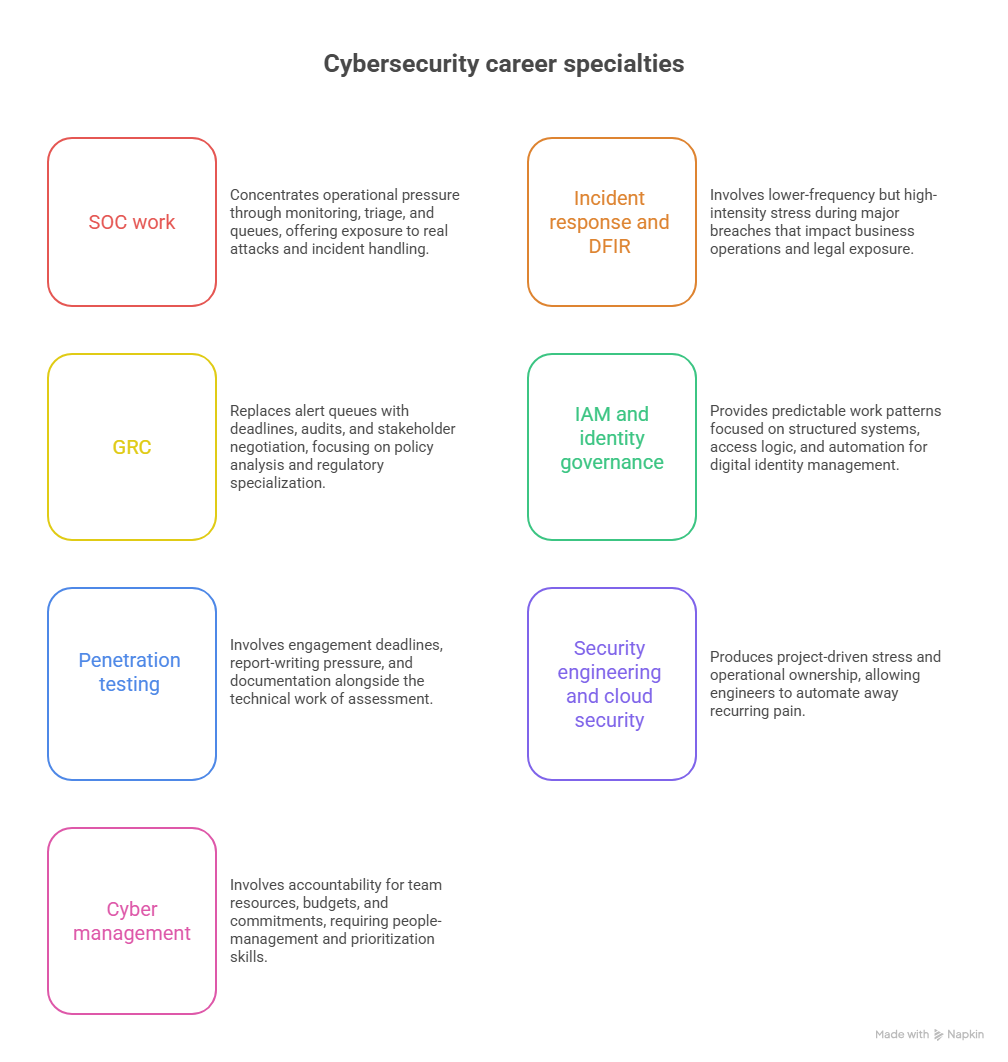
SOC work tends to concentrate operational pressure. Monitoring, triage, escalation, shifts, false positives, and measurable queues can create fatigue quickly when staffing is poor. The upside is enormous exposure to real attacks, SIEM data, endpoint telemetry, investigation workflows, and incident handling. A strong SOC can therefore be valuable for someone following a SOC entry roadmap, building hands-on security skills, improving recruiter-visible evidence, or later moving toward security engineering.
Incident response and DFIR can create lower-frequency but much higher-intensity stress. A serious breach does not care that your workday has ended. During major incidents, decisions may affect business operations, evidence preservation, legal exposure, regulators, customers, and executives. People who enjoy crisis work can find it deeply engaging; people who need predictable working hours should investigate escalation expectations carefully.
GRC replaces alert queues with deadlines, evidence, audits, controls, meetings, and stakeholder negotiation. Someone comparing SOC analyst and GRC work, considering a GRC career, pursuing policy analysis, or moving toward regulatory specialization may escape overnight alerts while encountering a different frustration: chasing dozens of control owners who have other priorities.
IAM and identity governance often provide more predictable work patterns, especially in governance-oriented roles. Stress appears during identity outages, failed provisioning, access-review deadlines, mergers, migrations, or privileged-access incidents. The field can suit someone who enjoys structured systems, access logic, automation, and cross-functional work. Candidates interested in digital identity management, cybersecurity auditing, privacy, or risk management can find significant overlap.
Penetration testing often has fewer genuine emergencies, yet commercial pentesting can create engagement deadlines, travel, report-writing pressure, utilization targets, and repetitive assessment work. Reddit discussions about whether penetration testing is changing matter here because the glamorous image of continuous exploitation can hide how much professional work involves scoping, documentation, retesting, client communication, and deadline management.
Security engineering and cloud security often produce project-driven stress combined with operational ownership. The dangerous phrase is “you build it, you own it” when ownership includes constant paging across too many systems. The advantage is that engineers can automate away recurring pain. People interested in cybersecurity automation, AI security, security architecture, or eventually VP-level security leadership often benefit from learning how operational systems fail before moving upward.
Burnout also changes at management level. A 2024 Reddit poster described years of technical high performance followed by a move into cyber management without meaningful mentorship, eventually reporting severe burnout. The individual-contributor problem of “too many alerts” can become the manager problem of too few people, too little budget, too many commitments, and accountability for everything the team cannot finish. Anyone aiming for cybersecurity program management, security product management, security leadership, or VP-level progression needs people-management and prioritization skills alongside technical credibility.
5. How to Build a Cybersecurity Career Without Normalizing Burnout
The strongest protection starts before accepting the job.
Candidates routinely ask employers what technologies they use, then fail to ask how work reaches the team. Ask about alert volume, ticket volume, current vacancies, turnover, average tenure, on-call frequency, weekend expectations, incident frequency, backlog size, escalation paths, protected training time, and what happened after the last serious incident. Those answers reveal operational maturity better than a list of expensive tools.
This matters particularly for people fighting hard to break into cybersecurity. Desperation for the first role can make almost any workload feel acceptable. Yet an entry-level employee placed into an unsupported environment can mistake organizational dysfunction for personal incompetence. That risk is especially relevant for candidates who have already struggled with graduate hiring rejection, invested heavily in certifications and labs, or worried that Security+ is not enough.
Look for operational evidence during interviews. A mature team can usually explain who owns alerts, how detections are tuned, what happens after a page, how vacation coverage works, which tasks are automated, and how priorities are cut when capacity disappears. A dangerous team talks proudly about everyone “wearing many hats” while being vague about staffing.
Once employed, track workload patterns rather than waiting until exhaustion becomes normal. Which alerts consume hours without producing value? Which tickets repeat? Which manual task could become a script? Which stakeholder dependency causes the same delay every month? Professionals building skills in automation engineering, identity management, program management, and security architecture can improve their career value by removing recurring friction instead of simply enduring it.
Role changes can also solve problems that another certification cannot. Someone exhausted by rotating SOC shifts may prefer detection engineering, vulnerability management, IAM, GRC, AppSec, or architecture. Someone bored by control evidence may want hands-on engineering. Someone drained by client utilization targets may prefer an internal security team. Career movement should therefore follow the stressor you want to change, not merely the title you want next.
A July 2026 Reddit thread from a professional with roughly fifteen years in information security showed another form of exhaustion: technology remained interesting, but cross-functional friction with business departments had drained much of the person's enthusiasm. A 2025 security engineer similarly described management friction, overloaded teams, alert flooding, and organizational politics. These accounts remind people pursuing technical security careers, policy roles, privacy, or leadership that progression often replaces one type of pressure with another.
The goal should be a career in which difficult weeks are exceptions produced by genuine events, rather than the permanent operating model. Cybersecurity will always contain urgency. Sustainable teams build enough staffing, automation, prioritization, and recovery around that urgency that professionals can still perform well when a real emergency arrives.
6. FAQs About Cybersecurity Burnout, Stress and Career Choice
-
SOC work contains several recognized burnout drivers at once: alert volume, false positives, shift coverage, measurable queues, repetitive investigation, and potential after-hours escalation. Devo reported that 83% of surveyed SOC professionals were overwhelmed by alert volume, false positives, and missing context, while Splunk reported widespread problems with excessive alerts and false positives.
That makes working conditions especially important when considering SOC analyst jobs, studying SOC hiring requirements, comparing SOC with GRC, or building a SOC-focused home lab.
-
Governance, policy, audit, privacy, awareness, some risk-management positions, many pentesting roles, and some architecture roles commonly have more predictable schedules than SOC or incident-response positions. Employer design still matters enormously. A GRC specialist facing simultaneous audits can work long hours, while an IAM engineer responsible for a critical identity outage may be paged after hours. Consider policy careers, privacy analysis, and cybersecurity auditing if predictable schedules are a major priority.
-
It changes the source of pressure. GRC usually reduces alert fatigue and overnight operational incidents, while increasing documentation, audits, control testing, evidence collection, executive communication, and stakeholder dependence. Someone considering SOC versus GRC should determine whether reactive technical work or deadline-heavy coordination is more draining personally. The GRC specialist path, risk-management track, audit route, and regulatory career path each produce different daily work.
-
AI can accelerate triage, enrichment, correlation, summarization, and repetitive investigative work. ISC2 found widespread movement toward AI security-tool adoption, while Splunk reported that many respondents had already experienced efficiency improvements. Implementation quality remains critical because SANS also reported widespread concern about AI-generated false positives. People worried about AI replacing entry-level cybersecurity should therefore develop judgment, investigation, automation skills, and hands-on evidence.
-
Ask how many people share on-call, how often analysts receive actionable pages, how shift schedules change, how many vacancies currently exist, what the typical backlog looks like, how much overtime occurred during the last major incident, whether compensatory time is provided, and which repetitive tasks have been automated. Candidates focused on getting their first cybersecurity job, improving résumé performance, understanding employer expectations, or navigating market saturation should evaluate the employer as seriously as the employer evaluates them.
-
It can be. ISC2 found that 48% of respondents felt exhausted trying to stay current with threats and emerging technologies. The solution is selective depth. A SOC analyst does not need to master every offensive framework, cloud platform, regulatory standard, and programming language simultaneously. Build skills around the problems your target role actually requires. That principle also improves decisions about certifications versus labs, degrees versus certifications, bootcamp pathways, and whether Security+ alone creates enough leverage.
