
CISSP Too Early? Reddit Experiences on Experience Requirements, Associate Status & Better Mid-Career Timing
CISSP can look like the obvious upgrade once Security+ and a few years of cybersecurity study are behind you, especially when senior job descriptions keep mentioning it. Timing changes its value dramatically. Someone still fighting the cybersecurity entry barrier may gain more from hands-on security evidence, while an experienced practitioner approaching architecture, risk, or leadership may find CISSP removes genuine career friction. The useful question is when your experience becomes strong enough for CISSP to amplify it rather than outrun it.

1. When Is CISSP Actually Too Early?
CISSP becomes poorly timed when your biggest career problem sits below the level the credential is designed to validate.
ISC2 describes CISSP as validating broad technical and managerial knowledge across eight domains: Security and Risk Management, Asset Security, Security Architecture and Engineering, Communication and Network Security, Identity and Access Management, Security Assessment and Testing, Security Operations, and Software Development Security. Full certification currently requires five years of cumulative experience across at least two domains, subject to a maximum one-year waiver through qualifying education or an approved credential.
That experience requirement should shape how an early-career candidate thinks about CISSP.
Someone who still needs to learn why DNS logs matter, how authentication flows work, what a subnet controls, how a SIEM query is constructed, or how an incident timeline is built has more immediate leverage available through SOC-oriented skill development, a serious cybersecurity home lab, networking depth, and a stronger evidence-based cybersecurity résumé.
The same applies to candidates facing graduate rejection patterns, struggling with Security+ employment outcomes, or competing in a saturated cybersecurity market. The immediate bottleneck is usually operational credibility. CISSP study can strengthen conceptual breadth, although it does not manufacture the troubleshooting history or security judgment employers expect from people pursuing experienced positions.
Reddit career experiences make that mismatch visible. A prospective candidate with only 1.5 years of security work asked whether pursuing CISSP made sense; one of the highest-rated responses recommended allowing several years of experience to accumulate first. Another Associate of ISC2 described passing the CISSP exam without practical security experience and then receiving little response to entry-level applications because employers still wanted two to five years of experience. These accounts are anecdotes rather than labor-market statistics, yet they illustrate a crucial distinction: passing an advanced exam does not reset the experience expectations attached to advanced jobs.
CISSP starts becoming better timed when your work already touches multiple security domains and the credential can package that experience into a recognizable senior-level signal. A practitioner who has worked across identity, risk, architecture, incident response, governance, network security, cloud security, auditing, or application security can extract more value because the material connects to decisions they have already made.
This is why CISSP often fits more naturally alongside movement into security architecture, cybersecurity program management, IT-to-security leadership, risk management, GRC specialization, and senior analyst-to-VP progression.
A practical way to think about timing is:
0–1 years: establish IT/security fundamentals and production credibility.
1–3 years: deepen one role, expand into adjacent domains, and document measurable responsibility.
3–5 years: evaluate CISSP if your experience is broad enough and the jobs you want increasingly request it.
5+ qualifying years: CISSP can become particularly efficient because you can potentially move directly through the certification process instead of maintaining Associate status.
The calendar matters less than the quality and domain coverage of your experience.
| Your Situation | CISSP Timing | Main Career Bottleneck | Higher-Value Immediate Move |
|---|---|---|---|
| Security+ with zero IT experience | Very early | No production experience | IT role + networking + labs |
| Cybersecurity degree, no job experience | Usually early | Employer proof gap | Projects, internships, SOC/NOC/support applications |
| Six months in a SOC | Early | Limited investigation depth | Incident handling + SIEM + EDR |
| One year in help desk | Early | Security-specific exposure | Networking, IAM, security tasks |
| Two years in IT support | Usually early | Domain breadth | Move toward sysadmin/network/security responsibilities |
| Two years as SOC analyst | Possible, often premature | Depth beyond alert triage | Tier 2, IR, detection engineering |
| Two years in GRC | Possible, often early | Cross-domain exposure | Own risk assessments and remediation |
| Three years across SOC + sysadmin | Worth evaluating | Experience qualification | Map work carefully to CISSP domains |
| Three years cloud/security engineering | Potentially useful | Broader security context | Architecture + IAM + risk exposure |
| Three years pentesting only | Depends on breadth | Domain diversity | Expand into architecture, risk and remediation |
| Four qualifying years + Security+ | Strong timing candidate | Confirm waiver eligibility | Validate domain evidence and prepare |
| Four qualifying years + relevant degree | Strong timing candidate | Documentation | Confirm experience mapping |
| Five years across 2+ domains | Well timed | Exam preparation | Target senior-role requirements |
| Five years narrow tool administration | Review carefully | Breadth of qualifying work | Map actual duties rather than title |
| Senior security analyst seeking promotion | Often strong | Senior-market signaling | CISSP + broader ownership |
| Security engineer seeking architecture | Strong | Architecture credibility | CISSP + design portfolio |
| GRC professional seeking management | Strong | Cross-domain credibility | CISSP + risk ownership |
| Cloud engineer entering security | Depends on security experience | Security depth | Cloud-security projects and IAM |
| IT manager taking security ownership | Potentially strong | Security breadth | Map managerial work to domains |
| Security consultant with multiple client environments | Often strong | Documentation and endorsement | Capture domain-specific evidence |
| Student planning CISSP before graduation | Usually very early | Work experience | Internships + practical certs |
| Career changer with finance background | Usually early | Security experience | GRC/audit/security bridge role |
| Auditor with security-control exposure | Could be well timed | Domain mapping | Document risk, controls and assessment work |
| Software engineer moving to AppSec | Depends on security duties | Security domain coverage | Secure SDLC + AppSec ownership |
| Already passed CISSP exam with 1 year experience | Associate route | Accumulating qualifying experience | Track six-year window carefully |
| Associate with 3 years experience | Midway | Remaining qualifying time | Broaden domains and maintain status |
| Associate approaching six-year limit | Urgent review | Experience eligibility deadline | Audit experience records immediately |
| Already getting senior interviews without CISSP | Optional leverage | Employer-specific filters | Check target postings before investing |
| Repeatedly blocked by CISSP-preferred postings | Potentially high ROI | HR/contract filter | Take once experience is valid |
| Moving toward architect, manager or director | Often excellent timing | Breadth and strategic signaling | CISSP + measurable leadership scope |
2. CISSP Experience Requirements and Associate of ISC2 Status Explained Correctly
The full experience rule is straightforward on paper and more nuanced when applied to a real résumé.
ISC2 requires five years of cumulative full-time experience in two or more CISSP domains. A qualifying degree or one credential from ISC2's approved waiver list can reduce the requirement by one year, meaning an eligible candidate may qualify with four years of relevant work. The April 2026 waiver list includes credentials such as Security+, CySA+, CCNA, AWS Certified Security – Specialty, CISM, CCSP, SSCP, and several others. Multiple waivers cannot be stacked to reduce the requirement further.
This matters for people deciding between Security+ and additional credentials, weighing degree versus certification ROI, or mapping a bootcamp, degree, and certification pathway. A waiver can shorten the formal requirement, while the underlying quality of experience still drives employability.
What counts as experience?
Experience must map to at least two of the eight CISSP domains. ISC2 says qualifying part-time work can count, and documented paid or unpaid internships can also qualify. Full-time experience is accrued monthly based on at least 35 hours per week for four consecutive weeks. Part-time work between 20 and 34 hours per week is converted based on accumulated hours.
Your title therefore matters less than what you actually did.
A systems administrator may accumulate qualifying experience through IAM, network security, asset protection, security operations, architecture decisions, hardening, vulnerability management, or risk-related responsibilities. An IT auditor may accumulate relevant experience through security assessment and testing, cybersecurity risk management, regulatory security work, and policy analysis.
A SOC analyst may cover Security Operations, Communication and Network Security, IAM, assessment, and risk depending on responsibilities. Someone working toward cloud security, cybersecurity automation, AI security, or security architecture may accumulate relevant experience across several domains even when “cybersecurity” never appeared in an old title.
What happens if you pass before you have enough experience?
You can apply for the Associate of ISC2 designation. For the CISSP pathway, ISC2 currently allows Associates up to six years to earn the required experience and complete the upgrade process. Associates maintain the designation by paying the current $50 annual maintenance fee and earning 15 CPE credits annually.
There is another deadline candidates regularly overlook: after passing an ISC2 exam, the certification application process must be completed within nine months. Candidates lacking the required experience still need to submit the Associate application during that window.
This is exactly why early CISSP timing deserves more thought than “I can pass it now, so why wait?”
Someone who takes the exam with virtually no qualifying experience starts a six-year clock while still needing to establish a career. The person now has to maintain Associate status, gain sufficient experience within the allowed period, satisfy ongoing CPE obligations, and eventually submit a qualifying certification application.
A candidate only a few months short of eligibility faces a completely different risk profile.
Can you call yourself “Associate CISSP”?
ISC2's current policies specify that Associates are Associates of ISC2 and have not earned the certification mark. ISC2 states that associates may use the “Associate of ISC2” designation and cannot represent themselves using CISSP certification marks until all certification requirements are satisfied.
That distinction affects résumé strategy. Someone trying to strengthen a cybersecurity résumé without conventional experience should avoid using wording that implies full certification. The skills hiring managers evaluate, your hands-on lab evidence, and the quality of your career-entry experience still carry the burden of proving practical readiness.
3. What Reddit Career Outcomes Say About Taking CISSP Early
Reddit experiences point in two directions, and that tension is useful.
One group reports that CISSP meaningfully improved interview access. In an April 2026 discussion, a professional reflecting one year after earning CISSP said the credential had helped generate multiple interviews and contributed to movement into a senior cybersecurity role. That account supports the credential's ability to strengthen a profile when employers already see enough underlying experience to consider the candidate for senior work.
A separate 2026 CISSP certification story described a candidate whose eventual certification followed years of preparation and professional experience, culminating in a cybersecurity systems architect position. This is closer to the classic CISSP use case: accumulated experience plus a credential that makes that breadth easier for employers to recognize. That type of progression fits naturally with security architecture, cybersecurity program management, security leadership, and senior security career growth.
The weaker outcomes tend to appear where the credential gets too far ahead of the candidate's experience.
One Reddit poster who passed the CISSP exam without practical experience reported difficulty gaining traction with entry-level applications. Responders highlighted that jobs genuinely expecting CISSP typically also expect experienced candidates. Another Associate-status discussion from 2025 involved someone with mostly internship experience asking whether the designation would carry employer weight; several responses emphasized the risk of starting the six-year experience window long before establishing stable qualifying employment.
That concern becomes more significant in the current cybersecurity hiring environment, where graduates face rejection despite credentials, Security+ alone may fail to unlock interviews, and even well-built entry routes require practical proof.
There is another important Reddit lesson: CISSP cannot guarantee employment even after full certification. A March 2026 poster with CISSP and several years across vCISO, risk, MSP clients, and remediation described hundreds of unsuccessful applications after a layoff. Responses focused on networking, location, market conditions, and positioning.
That case matters because candidates sometimes treat advanced certifications as insurance against a difficult market. Market demand, specialization, résumé positioning, geographic constraints, professional network, employer budgets, and recent accomplishments still influence outcomes. This is why professionals should continue developing risk-management depth, GRC capability, privacy expertise, security automation, or digital identity expertise after earning broad credentials.
The best timing pattern visible across these experiences is simple: CISSP tends to amplify career capital that already exists.
A candidate with three to five years of expanding responsibility, cross-domain exposure, project ownership, and measurable outcomes can use CISSP to package that experience for a wider set of senior roles. A candidate who has mainly accumulated classroom knowledge still has to solve the experience problem afterward.
4. What to Build Before CISSP if Your Career Is Still Early
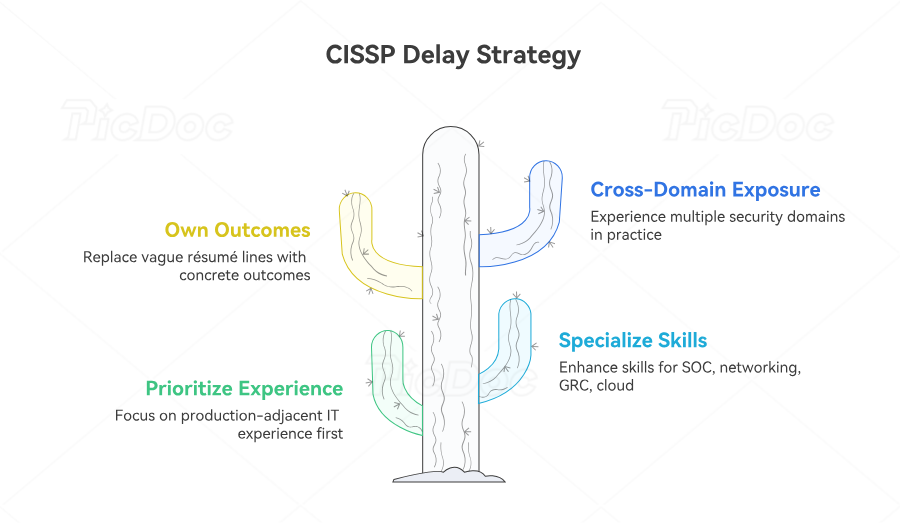
For an early-career professional, delaying CISSP can free hundreds of study hours for work that changes employability immediately.
The first priority is production-adjacent experience. Help desk, systems administration, networking, IAM administration, NOC work, cloud operations, audit, IT risk, vulnerability management, and SOC work can all create foundations that later strengthen CISSP. Someone trying to break into cybersecurity without prior IT experience should care about acquiring responsibilities that eventually map into security domains.
For SOC-bound candidates, the stronger near-term investment is often learning how to investigate.
Build SIEM queries. Analyze Windows authentication. Investigate phishing. Use Wireshark. Understand DNS. Map attacks to MITRE ATT&CK. Write an incident timeline. Explain false positives. Develop alert-tuning logic. These activities strengthen a SOC-focused home lab, align with SOC hiring-manager expectations, improve your cybersecurity résumé evidence, and create a stronger route into SOC analyst positions.
For networking-heavy candidates, deepen routing, switching, segmentation, DNS, VPNs, firewalls, packet analysis, and identity traffic. That knowledge supports penetration-testing careers, security automation, cloud-security development, and eventual security architecture.
For GRC-oriented candidates, move beyond policy memorization. Perform risk assessments. Map controls. Review evidence. Work with stakeholders on remediation. Understand audit exceptions. Learn third-party risk. Translate technical findings into business exposure. Those capabilities build toward GRC specialization, cybersecurity risk management, regulatory specialization, cybersecurity policy analysis, and privacy careers.
For cloud-focused professionals, secure actual infrastructure. Configure IAM correctly. Build network segmentation. Centralize logs. Manage keys and secrets. Deploy controls through infrastructure as code. Investigate cloud events. Design guardrails. These abilities feed directly into digital identity management, cybersecurity automation, AI security analysis, and security architecture.
The next priority is measurable ownership.
Replace résumé lines such as “monitored security alerts” with outcomes that show scale and judgment. Document how many endpoints you supported, how many detections you tuned, what false-positive volume you reduced, what control gap you remediated, how a vulnerability program improved, how an IAM policy changed, or how quickly incidents were contained.
This is the practical gap behind many cybersecurity graduate rejections, Security+-only profiles, certification-versus-lab debates, and candidates fighting through 2026 job-market saturation.
The third priority is cross-domain exposure.
CISSP becomes easier to understand and more valuable when you have seen several domains interact in real systems. Incident response touches identity, networking, asset security, risk, operations, and architecture. Cloud security intersects architecture, IAM, network security, data security, operations, and software development. GRC intersects risk, assets, testing, policy, architecture, and operations.
That breadth gives CISSP content context.
5. The Mid-Career Sweet Spot: When CISSP Starts Producing Better Leverage
The strongest timing often appears when three conditions line up.
First, you are already eligible or close to eligibility.
A professional with four years of qualifying experience and Security+, CySA+, CCNA, or another approved waiver credential may already satisfy the experience threshold because ISC2 permits one year to be waived through an approved credential. Someone with four years and three months of broad security experience therefore faces a completely different decision from someone with six months of help desk experience.
Second, the roles you want actually value CISSP.
Review 30–50 target postings. Count how many require or prefer CISSP. Separate senior analyst, consultant, architect, manager, GRC, risk, and leadership positions. If CISSP appears repeatedly across jobs you can otherwise perform, it may represent a real market constraint.
This is especially relevant for professionals moving toward cybersecurity program management, security architecture, policy leadership, cybersecurity product management, chief privacy responsibility, or VP-level security progression.
Third, CISSP complements an existing specialty.
A cloud security engineer with CISSP plus strong AWS/Azure/IaC/IAM experience can present both breadth and depth. A senior SOC analyst with CISSP plus detection engineering and incident leadership presents operational depth with wider security awareness. A GRC professional with CISSP plus risk ownership and technical fluency can communicate across governance and engineering teams.
This type of combination matters more than certification count.
Someone pursuing cybersecurity automation engineering can combine coding depth with broad security judgment. Someone building toward digital identity management can combine IAM expertise with risk and architecture breadth. A practitioner moving into AI security or blockchain security can pair an emerging specialty with a recognized enterprise-security framework.
A simple CISSP readiness test can prevent poor timing. Give yourself one point for each statement that is true:
You have at least three to five years of relevant professional experience.
Your work maps credibly to at least two CISSP domains.
You can explain security decisions you personally owned.
You have handled real incidents, risks, systems, controls, designs, or assessments.
Senior jobs you want repeatedly mention CISSP.
Your current limitation is broader recognition rather than basic technical readiness.
You understand several security domains beyond your primary specialty.
You can document your experience for endorsement.
You have a clear plan for certification maintenance.
You expect to apply for senior, consulting, architecture, GRC, risk, or management roles within the next 12–24 months.
A high score signals much better timing.
A low score points toward hands-on labs, entry-level hiring evidence, practical SOC skills, role-specific certifications, or more production experience first.
CISSP can then become a multiplier for experience already earned.
6. FAQs About CISSP Timing, Experience and Associate Status
-
Yes. ISC2 allows candidates to pass the CISSP examination before satisfying the complete work-experience requirement. Candidates without enough qualifying experience can apply for Associate of ISC2 status and then accumulate the remaining experience. For CISSP, the Associate period can last up to six years.
The career decision still depends on timing. Someone with four years of qualifying experience may be very close to full certification, while someone currently trying to enter cybersecurity without IT experience may create more immediate value through home-lab evidence, SOC skills, and stronger résumé proof.
-
Associate of ISC2 is a formal designation for someone who has passed an ISC2 certification exam that requires work experience but has not yet satisfied the certification's complete experience requirements. ISC2 currently requires Associates to pay a $50 annual maintenance fee and earn 15 CPE credits each year.
For candidates still building a cybersecurity career foundation, the value of that status should be compared against hands-on certification alternatives, SOC career development, and gaining experience that later qualifies for CISSP.
-
ISC2's policy specifies Associate of ISC2 as the permitted designation. Associates have not yet earned the CISSP certification mark and should avoid representing themselves as fully CISSP-certified.
This distinction is particularly important when building a cybersecurity résumé without experience, applying in a competitive cybersecurity job market, or presenting certifications alongside practical labs. Accurate credential wording protects credibility.
-
Security+ appears on ISC2's current approved experience-waiver credential list. An approved credential can satisfy one year of the five-year CISSP experience requirement, reducing the remaining work-experience requirement to four years where all other conditions are satisfied. Only one year can be waived, even if you hold several approved credentials or a qualifying degree as well.
Someone deciding between Security+ and more advanced certifications, degrees versus certifications, and practical security labs should still prioritize career capability over accumulating redundant waiver credentials.
-
ISC2 states that properly documented paid or unpaid internships may count toward the experience requirement. Part-time work can also qualify under ISC2's defined hour thresholds.
Students should therefore document security-related internships carefully, especially work involving risk management, security operations, audit, privacy, or IAM.
-
For the CISSP Associate pathway, ISC2 currently provides up to six years to earn the required experience and complete the certification upgrade. Candidates also need to submit the initial certification or Associate application within nine months of passing the exam.
Candidates who are still working through cybersecurity entry barriers, market saturation, and first-role SOC competition should consider that time window before testing years ahead of eligibility.
