
Complete Pathway to Cybersecurity Policy Director
Cybersecurity policy directors sit where security strategy becomes enforceable behavior. They translate risk, regulation, budgets, audits, incidents, vendor obligations, and executive pressure into rules people can actually follow. The path demands more than policy writing. It requires governance judgment, regulatory fluency, board-ready communication, and the ability to turn security expectations into measurable operating standards. This guide gives a practical pathway for professionals moving from analyst, auditor, compliance, GRC, or security management roles into policy leadership.
1. What the Cybersecurity Policy Director Role Really Owns
A Cybersecurity Policy Director owns the security rulebook behind the organization’s risk posture. That includes acceptable use, access control, incident reporting, data classification, cloud security, third-party security, audit readiness, privacy alignment, and policy exceptions. The role connects technical realities from security audits, cybersecurity frameworks, access control models, incident response planning, and NIST Cybersecurity Framework adoption into decisions executives can approve and employees can follow.
The hardest part is authority without daily operational control. A policy director may define privileged access standards, but identity teams implement them. They may require vulnerability remediation timelines, but engineering teams carry the workload. They may set incident escalation rules, but SOC and IR teams execute them. That means the path into policy leadership depends on influence. You need enough technical fluency to challenge weak controls, enough compliance knowledge to survive regulatory scrutiny, and enough business judgment to avoid creating policies that look perfect in an audit binder while failing inside real workflows. ACSMI resources on cybersecurity compliance trends, cybersecurity workforce shortage, future cybersecurity compliance, and privacy regulations are useful because policy leaders must understand how talent limits and regulatory pressure collide.
The role also carries political weight. Security policy becomes uncomfortable when it blocks shortcuts, raises project costs, changes vendor selection, limits risky data handling, or forces leaders to accept documented risk. A strong policy director can defend why endpoint rules support endpoint detection and response, why SIEM logging standards matter for security information and event management, why anti-phishing training connects to phishing prevention strategy, and why cloud requirements must reflect cloud security trends. The director’s value appears when policy prevents confusion before incidents, audits, vendor reviews, and executive escalations expose the gaps.
| Director-Track Capability | What You Must Prove | Career Leverage Created | Best ACSMI Resource Anchor |
|---|---|---|---|
| Security governance ownership | You can align policy, standards, procedures, exceptions, evidence, and reporting into one operating system. | Positions you for GRC, policy, audit, and security leadership roles. | Cybersecurity frameworks |
| Regulatory interpretation | You can convert laws, regulations, and contractual obligations into practical internal requirements. | Creates trust with legal, privacy, compliance, and executive teams. | Compliance trends |
| Risk-based policy design | You can write policy based on threat impact, business tolerance, control maturity, and audit exposure. | Separates strategic leaders from template-based policy writers. | NIST adoption analysis |
| Audit evidence mapping | You can map each policy requirement to testable evidence, control owners, and audit artifacts. | Improves credibility with internal audit and external assessors. | Security audit practices |
| Access control policy | You understand RBAC, least privilege, segregation of duties, access reviews, and exception workflows. | Builds authority in identity governance and insider-risk reduction. | Access control models |
| Incident policy governance | You can define escalation, severity, reporting, communication, legal hold, and post-incident review rules. | Connects policy leadership to business resilience and crisis response. | Incident response planning |
| Ransomware readiness policy | You can define backup, recovery, reporting, tabletop, endpoint, and privilege-control requirements. | Makes your work visible during board-level resilience planning. | Ransomware response |
| Cloud policy leadership | You can govern cloud identity, encryption, logging, workload ownership, configuration, and vendor responsibility. | Supports movement into modern enterprise security governance. | Cloud security tools |
| Endpoint policy alignment | You can connect device standards to EDR, patching, hardening, encryption, and remote-work controls. | Strengthens cross-functional influence with IT operations. | EDR tools |
| SIEM and logging policy | You can define what must be logged, retained, protected, monitored, and escalated. | Creates stronger control over detection and investigation quality. | SIEM overview |
| Vendor and third-party policy | You can set security due diligence, contract clauses, evidence renewal, and vendor risk acceptance standards. | Builds enterprise-wide relevance across procurement and legal. | Consulting firm analysis |
| Privacy-security alignment | You can connect data protection, privacy impact, retention, consent, breach reporting, and access controls. | Improves eligibility for regulated-industry leadership. | GDPR and cybersecurity |
| Healthcare policy fluency | You can support HIPAA-aligned security policy, patient data protection, access review, and breach readiness. | Creates strong leverage in healthcare security roles. | Healthcare compliance report |
| Financial-sector governance | You can address fraud exposure, regulatory audits, vendor risk, data protection, and resilience expectations. | Positions you for high-pressure, high-compensation environments. | Financial services security |
| Critical infrastructure policy | You can govern availability, segmentation, industrial risk, incident readiness, and supplier security. | Supports movement into energy, utilities, manufacturing, and public sector roles. | Critical infrastructure report |
| Policy exception governance | You can build exception intake, risk rating, compensating controls, expiration, approval, and reporting processes. | Shows executive maturity because real businesses always need controlled flexibility. | Compliance officer roadmap |
| Metrics and KPI design | You can measure overdue exceptions, failed controls, policy attestations, audit gaps, and recurring violations. | Turns policy from documentation into operational intelligence. | Incident response effectiveness |
| Executive reporting | You can summarize policy risk in decision language: exposure, cost, owner, deadline, impact, and tradeoff. | Prepares you for director interviews and CISO-facing meetings. | CISO roadmap |
| Security awareness governance | You can align policy communication with training, attestation, phishing risk, and employee behavior. | Improves real adoption instead of relying on policy publication alone. | Security awareness platforms |
| Policy lifecycle management | You can run review cycles, owner accountability, version control, approval workflows, and sunset reviews. | Proves you can lead policy as a program. | Compliance analyst roadmap |
| Threat-informed policy updates | You can refresh policy based on ransomware, phishing, cloud, AI, insider, and supply-chain threats. | Keeps governance relevant as threats change. | Top cybersecurity threats |
| AI security policy | You can govern AI tool use, data leakage, model access, vendor claims, and employee behavior. | Creates future-facing leadership credibility. | AI-powered cyberattacks |
| Cloud and remote-work policy | You can address device trust, VPN, identity, data movement, SaaS access, and remote monitoring requirements. | Supports modern hybrid workforce governance. | Remote cybersecurity careers |
| Certification strategy | You can select credentials that validate governance, risk, audit, security management, and technical fluency. | Improves interview credibility for director-track roles. | Certification directory |
| Salary and role positioning | You can connect policy leadership achievements to compensation, scope, and title movement. | Improves negotiation power during promotion and job search cycles. | Salary report |
| Cross-functional influence | You can persuade legal, HR, engineering, procurement, finance, and operations to support security requirements. | Shows director-level readiness through organization-wide adoption. | Security analyst to engineer path |
| Board-level risk translation | You can explain control failure, policy gaps, and regulatory exposure without drowning leaders in technical detail. | Builds visibility with CISOs, CIOs, general counsel, and risk committees. | CISO career path |
| Program maturity roadmap | You can move policy from scattered documents into a measurable governance program with owners and milestones. | Creates the strongest proof for Cybersecurity Policy Director interviews. | Cybersecurity manager pathway |
2. Build the Policy Foundation: Governance, Frameworks, Risk, and Compliance
The first stage is learning how organizations decide what “secure enough” means. Policy directors rarely invent requirements from scratch. They interpret frameworks, regulations, contracts, risk appetite, audit history, incident patterns, and business constraints. Start by mastering NIST, ISO, and COBIT, then connect them to NIST adoption patterns, cybersecurity compliance trends, GDPR cybersecurity challenges, and future regulatory expectations. Your goal is to understand why a requirement exists, what evidence proves it is working, and which teams must change behavior to support it.
A strong foundation begins in practical controls. Access policies should reflect DAC, MAC, and RBAC models. Network rules should make sense beside firewall technologies, VPN security limitations, intrusion detection systems, and network monitoring tools. Data protection policies should align with encryption standards, public key infrastructure, data loss prevention strategies, and DLP software directories. This technical grounding protects you from writing unrealistic language that engineers ignore or auditors challenge.
The second layer is risk literacy. Policy leadership requires a mature view of threat likelihood, business impact, control gaps, and residual risk. Study ransomware detection and recovery, state of ransomware analysis, data breach risk by industry, insider threat prevention, and emerging cloud threats. A director-track professional can explain which policy gaps expose the organization to loss, which controls reduce the exposure, and which exceptions require executive acceptance.
The third layer is industry specialization. Healthcare policy directors face HIPAA, patient safety, clinical workflow, vendor access, and device risk, so healthcare compliance, healthcare cybersecurity tools, healthcare threat reporting, and healthcare cybersecurity predictions matter. Finance policy leaders deal with fraud, audits, third-party risk, and strict resilience expectations, so financial services cybersecurity firms, financial-sector incident analysis, cybersecurity trends in finance, and cybersecurity salary benchmarks become valuable positioning tools. A policy director with industry depth makes sharper decisions than a generalist copying universal templates.
3. Move From Policy Writer to Policy Operator
The professional who only writes documents stays stuck at coordinator or manager level. The professional who turns policy into an operating rhythm becomes director material. That means every policy must have an owner, approval path, review cycle, training connection, evidence requirement, exception process, and metric. Use security audit best practices, cybersecurity auditor guidance, detailed cybersecurity auditor pathways, compliance analyst roadmaps, and cybersecurity compliance officer career guidance to understand how policy becomes evidence.
A practical policy operator builds a policy inventory first. List every security policy, standard, procedure, guideline, control mapping, and exception form. Identify owner, last review date, approval body, framework mapping, regulatory driver, and evidence source. Then connect those documents to operational systems: IAM for access policy, ticketing for exception management, EDR for endpoint compliance, SIEM for logging standards, GRC tools for audit tracking, and training platforms for employee attestations. ACSMI resources on best SIEM solutions, endpoint security providers, EDR tools, security awareness platforms, and PAM solutions can help you understand the tool ecosystem behind enforceable policy.
Your next move is building exception discipline. Weak organizations treat exceptions as informal favors. Strong organizations treat exceptions as time-bound, risk-rated, owner-approved decisions with compensating controls. For example, a legacy system may receive a temporary MFA exception only if network segmentation, monitoring, limited access, and retirement deadlines are documented. This is where knowledge of vulnerability assessment techniques, vulnerability scanners, penetration testing tools, penetration testing companies, and red-team-adjacent career paths becomes useful. You can challenge risky exceptions with evidence instead of opinion.
Policy operators also understand communication failure. Employees violate policies they cannot find, cannot understand, cannot apply, or believe leadership quietly ignores. Replace legalistic language with role-specific instructions. Build quick guides for engineers, HR, procurement, finance, executives, and vendors. Pair acceptable use policy with onboarding. Pair vendor security policy with procurement workflows. Pair incident reporting rules with tabletop exercises. ACSMI’s cybersecurity instructor pathway, cybersecurity curriculum developer pathway, free cybersecurity courses directory, and global training providers directory can help you think like someone responsible for adoption, not documentation alone.
Quick Poll: What Is Blocking Your Cybersecurity Policy Director Promotion Right Now?
Choose the gap that feels most expensive, because your next career move should attack the real blocker.
4. Prove Executive Readiness Through Metrics, Stakeholder Power, and Decision Control
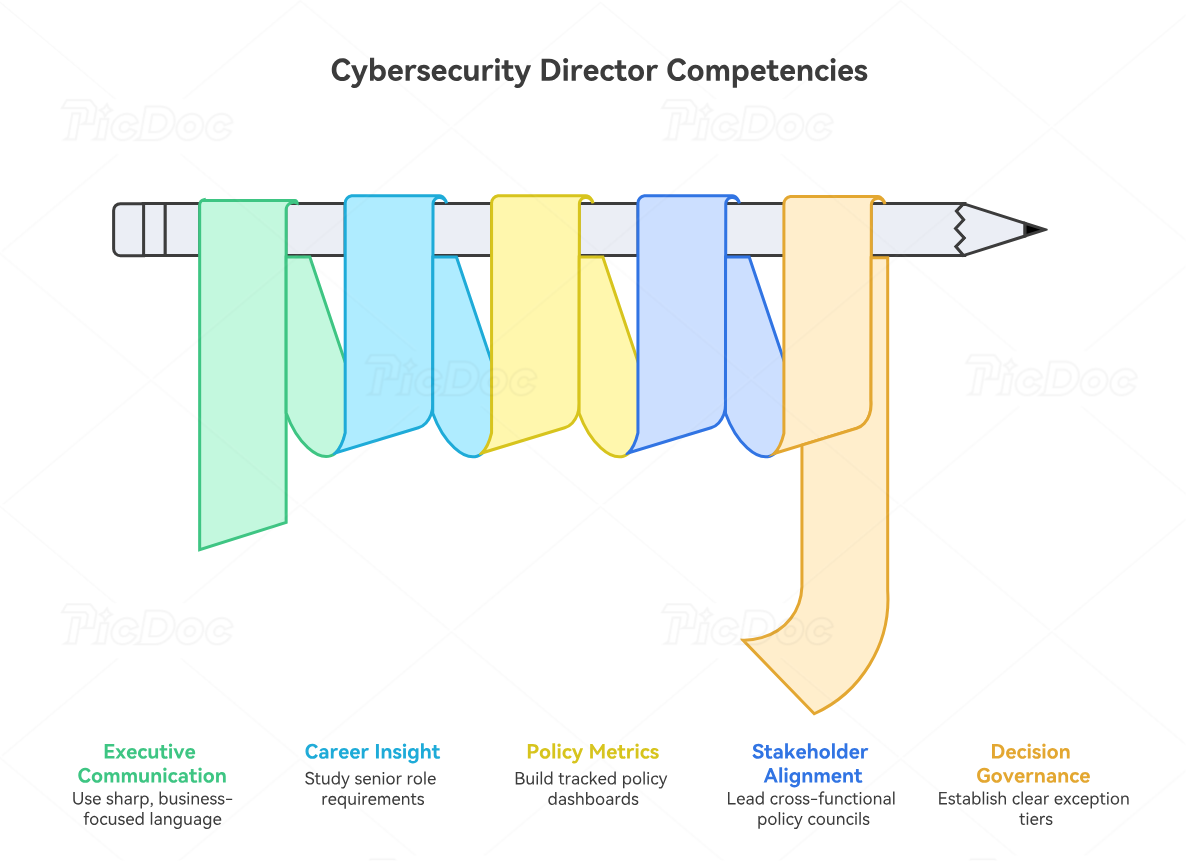
A Cybersecurity Policy Director must speak in executive language. Executives care about exposure, cost, accountability, regulatory impact, customer trust, operational drag, and decision options. Replace vague statements like “policy needs updating” with sharper statements: “Forty-two privileged access exceptions have expired, eight support critical systems, and three lack compensating controls; approving this remediation plan reduces audit exposure before the next assessment.” That is the difference between a document owner and a decision leader. Study CISO career roadmaps, security manager pathways, security manager to director advancement, cybersecurity job market trends, and future cybersecurity skills to understand what senior roles reward.
Build a policy dashboard before you ask for a director title. Track policy review status, overdue approvals, unresolved exceptions, control gaps, failed attestations, audit findings by policy area, incident root causes tied to policy failure, third-party evidence delays, and training completion by high-risk department. Connect those metrics to operational risk using incident response effectiveness research, phishing trend analysis, botnet disruption methods, denial-of-service mitigation, and cloud environment threat analysis. Metrics become powerful when they reveal where policy language, control execution, and business behavior diverge.
Stakeholder power is the next proof point. A director-track policy leader can run a security policy council with representatives from legal, privacy, HR, procurement, finance, IT, engineering, and operations. Each group brings different resistance. Legal wants defensible wording. HR wants enforceable employee rules. Procurement wants vendor requirements that do not stall every contract. Engineering wants standards that fit release cycles. Finance wants budget clarity. Operations wants minimal disruption. Your job is to create alignment without watering down risk. ACSMI guidance on cybersecurity compliance officer careers, security analyst to engineer pathways, threat intelligence analyst careers, and incident responder pathways helps you understand the teams whose work your policies affect.
Decision control means creating pathways for tradeoffs. Security policy fails when every exception becomes a personal negotiation. Build clear decision tiers: low-risk exceptions approved by control owners, medium-risk exceptions reviewed by GRC or security leadership, high-risk exceptions escalated to executive risk committees. Require expiration dates, business justification, affected assets, compensating controls, residual risk, and named accountability. This governance pattern connects directly to audit process maturity, compliance regulation forecasting, future legislation impact, and next-generation cybersecurity standards. A director must make the organization faster at making safe decisions.
5. Shape Your 24-Month Advancement Plan Toward Director-Level Authority
Months one through six should focus on credibility repair. Review your current policy library and identify gaps that create real pain: expired policies, duplicated standards, unclear ownership, outdated cloud rules, missing AI usage policy, weak vendor requirements, informal exceptions, or audit evidence confusion. Pick one high-visibility area and fix it end to end. For example, rebuild access control policy using RBAC guidance, identity evidence, audit expectations, PAM solution awareness, security audit practices, and cybersecurity frameworks. One complete improvement beats ten half-finished policy drafts.
Months seven through twelve should focus on program mechanics. Create a policy lifecycle calendar, assign owners, set review frequency, build a policy exception register, define approval tiers, and launch a basic dashboard. Then align your work with career assets. Document before-and-after results, including reduced overdue policies, cleaner audit evidence, fewer expired exceptions, improved attestation rates, and faster approval cycles. Compare your growth against cybersecurity certification impact, salary growth for CISSP, CEH, and Security+, certification directories, cybersecurity bootcamps, and free cybersecurity learning resources. Your résumé should show measurable governance outcomes, not task participation.
Months thirteen through eighteen should focus on executive exposure. Volunteer to present policy risk updates to a governance committee, audit steering group, risk council, or security leadership meeting. Prepare a one-page report with three sections: policy risks needing decisions, metrics showing program movement, and upcoming regulatory or threat drivers. Use insights from global cybersecurity market outlooks, North America cybersecurity trends, Europe cybersecurity analysis, Asia-Pacific cybersecurity reports, and global salary benchmarks to make your view broader than your current company’s backlog.
Months nineteen through twenty-four should focus on title readiness. Build a portfolio that includes policy inventory cleanup, framework mapping, exception workflow, executive dashboard, audit evidence map, cross-functional council charter, and one major policy transformation project. Match your experience to roles like Cybersecurity Policy Manager, Senior GRC Manager, Security Governance Lead, Director of Security Governance, Director of Cybersecurity Policy, or Deputy CISO for Governance. Use cybersecurity manager career pathways, security manager to director guidance, entry-level to CISO salary progression, remote vs on-site salary analysis, and cybersecurity workforce demographics to position your next move with market intelligence.
6. FAQs: Complete Pathway to Cybersecurity Policy Director
-
The strongest backgrounds are GRC, cybersecurity audit, compliance, risk management, security management, incident response governance, privacy-security alignment, and enterprise security operations. A SOC analyst can move into policy by building control and reporting experience through SOC analyst career guidance, SOC manager advancement, security analyst to engineer pathways, and cybersecurity compliance analyst roadmaps. The key is proving that you can connect technical controls to business rules, risk decisions, and audit evidence.
-
You need practical technical fluency rather than hands-on mastery of every tool. You should understand how policies affect SIEM operations, endpoint security, cloud security tools, application security tools, and vulnerability management. You need enough knowledge to ask hard questions, spot unrealistic requirements, and challenge weak exceptions with evidence.
-
Governance, risk, audit, security management, privacy, and cloud credentials usually help most. The right mix depends on your current stage, target industry, and credibility gaps. Use the ACSMI cybersecurity certifications directory, certification career impact report, salary growth certification analysis, and future certification value guide to choose credentials that support director-level policy authority.
-
The biggest mistake is treating policy as writing instead of governance. A director-track candidate must show lifecycle control, stakeholder adoption, evidence mapping, metrics, exception management, and risk-based decision support. Build proof through security audits, compliance officer pathways, cybersecurity auditor guidance, and future audit practice predictions. Hiring leaders want evidence that your policies changed behavior.
-
Create a portfolio of policy leadership outcomes. Include a policy inventory, framework mapping, exception dashboard, board-ready risk summary, audit evidence matrix, revised high-risk policy, communication plan, and measurable improvement results. Tie your proof to cybersecurity job market trends, future cybersecurity workforce skills, automation and workforce change, and specialized cybersecurity role demand. Director readiness is visible when your work influences decisions beyond your own team.
-
Regulated and high-risk sectors create the strongest demand: finance, healthcare, government, energy, education, manufacturing, transportation, and e-commerce. Each sector has different policy pressure points. Study financial services cybersecurity, healthcare cybersecurity firms, government cybersecurity providers, energy and utilities cybersecurity, and manufacturing cybersecurity trends before choosing your specialization.
