
Career Guide to Blockchain Security Engineer
Blockchain security engineering is where software security, cryptography, cloud infrastructure, threat modeling, and financial risk collide. A weak smart contract, exposed private key, broken bridge, or poorly monitored validator can turn one missed control into public loss, regulatory pressure, and permanent trust damage. This career path rewards people who can read code, understand attacker economics, and explain risk before money moves. For learners building from cybersecurity foundations, security certifications, or ethical hacking, blockchain security can become a high-leverage specialization.
1. What a Blockchain Security Engineer Actually Does
A blockchain security engineer protects systems where code often controls assets directly. In a traditional application, a vulnerability may expose records, accounts, or internal systems; in Web3, a vulnerability can instantly move funds, mint tokens, drain liquidity pools, or corrupt governance logic. That is why this role sits between application security tools, penetration testing methods, vulnerability assessment techniques, and deeper cybersecurity threat prediction.
The daily work changes by employer. At a crypto exchange, the role may involve wallet security, withdrawal logic, custody systems, fraud signals, and incident response playbooks connected to SIEM monitoring and endpoint security. At a blockchain protocol, it may center on smart contract review, consensus assumptions, validator operations, bridge design, and formal verification support. At a consulting firm, it may look closer to penetration testing, cybersecurity consulting, and structured audit reporting.
The pain point many beginners miss is that blockchain security requires judgment, not tool worship. A scanner may flag reentrancy, access-control weakness, or arithmetic risk, but it cannot fully understand token economics, oracle manipulation, governance capture, or bridge trust assumptions. The best engineers learn from blockchain cybersecurity research, future blockchain innovations, cloud security trends, and AI-powered cyberattack analysis so they can separate real exploitability from noisy findings.
Blockchain Security Engineer Career Matrix: 26 Skills, Risks, and Advancement Signals
| Skill or Responsibility | What It Means in Real Work | Career Stage Where It Matters Most | Best ACSMI Resource to Pair With It |
|---|---|---|---|
| Smart contract code review | Reading Solidity, Rust, or Move logic for exploitable flaws before deployment. | Early to mid career | Vulnerability assessment techniques |
| Reentrancy analysis | Finding external-call patterns that allow attackers to repeatedly withdraw or manipulate state. | Early career | Vulnerability scanner guide |
| Access-control testing | Checking whether privileged functions, owner roles, multisigs, and admin paths are safely restricted. | Entry to early career | Access control models |
| Oracle manipulation review | Testing whether price feeds, liquidity pools, or governance inputs can be distorted. | Mid career | Emerging threat analysis |
| Bridge security assessment | Reviewing cross-chain messaging, validator assumptions, relayer trust, and asset-locking logic. | Mid to senior career | Blockchain cybersecurity use cases |
| Wallet and key management | Protecting private keys, signing flows, hardware wallet usage, recovery processes, and custody workflows. | All stages | Privileged access management |
| Threat modeling | Mapping who can attack, what they can gain, and which assumptions collapse first. | Early to senior career | Cybersecurity frameworks |
| Secure SDLC participation | Embedding review, testing, documentation, and release gates into protocol development. | Mid career | Security audit processes |
| Incident response for exploits | Coordinating triage, freezing mechanisms, attacker tracing, communications, and postmortem actions. | Mid to senior career | Incident response effectiveness |
| On-chain monitoring | Watching suspicious contract calls, wallet movement, bridge activity, and governance changes. | Early to mid career | SIEM solutions directory |
| Cloud and node security | Hardening RPC endpoints, validator infrastructure, deployment pipelines, secrets, and monitoring. | Mid career | Cloud security engineer guide |
| Penetration testing | Testing wallets, APIs, dashboards, admin panels, node services, and exchange infrastructure. | Early to mid career | OSCP penetration tester guide |
| Cryptography basics | Understanding signatures, hashing, Merkle proofs, randomness, and protocol-level trust. | Entry to mid career | Future cybersecurity skills |
| DeFi risk analysis | Assessing liquidation logic, collateral math, flash-loan exposure, and incentive abuse. | Mid career | Specialized security roles |
| Audit report writing | Turning technical findings into clear severity, impact, reproduction steps, and remediation guidance. | All stages | Cybersecurity auditor guide |
| Secure code remediation | Helping developers fix issues without breaking protocol behavior or business logic. | Mid career | Application security tools |
| Bug bounty participation | Building proof through responsible disclosure, exploit reproduction, and public security credibility. | Entry to early career | IT to ethical hacking |
| Regulatory awareness | Understanding custody, privacy, financial crime, disclosure, and operational risk expectations. | Mid to senior career | Compliance trends report |
| Governance security | Reviewing DAO voting, proposal execution, quorum thresholds, delegate risks, and upgrade paths. | Mid career | Future compliance trends |
| Zero trust thinking | Designing security around minimal trust, least privilege, strong verification, and controlled blast radius. | All stages | Zero trust security |
| Security automation | Using automated tests, monitors, scanners, alerts, and CI gates without depending on them blindly. | Mid career | Security automation workforce |
| Threat intelligence | Tracking attacker patterns, exploit techniques, laundering routes, and emerging protocol risks. | Mid to senior career | Threat intelligence analyst roadmap |
| Financial-sector security | Applying stronger controls where assets, payments, custody, and customer trust are central. | Mid career | Financial services cybersecurity |
| Risk communication | Explaining exploit paths to founders, engineers, executives, auditors, and nontechnical stakeholders. | Mid to senior career | Specialist to CISO path |
| Portfolio proof | Showing audits, labs, writeups, CTF work, bug bounty reports, and secure design examples. | Entry to mid career | Cybersecurity job market trends |
| Leadership readiness | Moving from finding flaws to setting security review standards, mentoring reviewers, and owning risk gates. | Senior career | Chief security architect roadmap |
2. The Skills You Need Before Employers Trust You With Blockchain Security
The strongest path starts with fundamentals. A blockchain security engineer who cannot explain authentication, authorization, network exposure, logging, secure deployment, and basic incident response will struggle when an exploit crosses from smart contract logic into cloud infrastructure. Build first around SOC analyst skills, security analyst advancement, IT support to cybersecurity transition, and cybersecurity workforce realities. Blockchain security becomes far easier when the base is already solid.
From there, learn software security. You need to read code, follow control flow, understand insecure dependencies, review API behavior, and recognize how one weak permission can become an exploit chain. This is where application security tools, penetration testing companies, ethical hacking certification paths, and red team career guidance become valuable. The beginner mistake is jumping into smart contract audit checklists before understanding how attackers chain small weaknesses into operational compromise.
Then add blockchain-specific depth. Learn how Ethereum-style accounts differ from smart contract accounts, how gas affects execution, how oracles feed contracts, how bridges pass messages, how multisigs govern upgrades, and how token incentives can be abused. Study blockchain cybersecurity use cases, future blockchain security innovations, quantum computing and cybersecurity, and future cybersecurity standards. These areas help you think beyond syntax and into trust, governance, and system design.
Your technical stack should include Solidity, Rust or Move depending on ecosystem, JavaScript or TypeScript for testing, Python for automation, GitHub for review workflows, Linux for tooling, Docker for repeatable labs, and cloud basics for node infrastructure. Pair that with cloud security engineering, network monitoring tools, EDR knowledge, and data loss prevention thinking. The real employer fear is hiring someone who can audit one contract but cannot secure the environment around it.
3. How to Build a Portfolio That Proves You Can Do the Job
A blockchain security portfolio should prove your thinking under pressure. Recruiters and technical leads want to see how you investigate, reproduce, prioritize, and explain risk. A weak portfolio says “I completed a course.” A strong portfolio shows a vulnerable contract, a test case, an exploit explanation, a remediation, and a short business-risk summary. Start with free cybersecurity resources, cybersecurity bootcamps, global training providers, and cybersecurity books, then turn learning into artifacts.
Create three kinds of proof. First, publish smart contract audit writeups on common issues: missing access control, unsafe external calls, oracle dependency, signature replay, upgradeability mistakes, and weak randomness. Second, build small labs where you intentionally introduce and fix vulnerabilities. Third, complete public CTFs or bug bounty exercises and document your methodology. This aligns with vulnerability researcher career paths, offensive security engineering, junior to senior penetration testing growth, and ethical hacking to consulting.
Your portfolio also needs operational proof. Blockchain companies need engineers who can protect keys, monitor transactions, support incident response, and explain what happened after a suspicious event. Add a sample on-chain monitoring dashboard, a suspicious wallet movement triage note, or a mock bridge incident postmortem. Tie it to incident responder careers, incident response effectiveness, threat intelligence careers, and annual insider threat analysis. This shows you understand attacks after deployment.
Avoid the common portfolio trap: too many copied writeups and too little original reasoning. Employers can tell when candidates repeat course language. They want to see your decision-making: why a finding matters, why severity is high or medium, what control reduces exposure, and how the fix changes attacker economics. A strong writeup connects to salary growth from certifications, career advancement impact, specialized role demand, and cybersecurity job market predictions.
4. Certifications, Courses, and Learning Paths That Actually Help
Blockchain security hiring is skills-driven, but certifications still matter when they reduce uncertainty. A hiring manager may trust your portfolio faster when your foundation is supported by recognized training. For beginners, start with broad cyber credentials, then move into offensive security, application security, cloud, auditing, or incident response. Use top cybersecurity certifications, cybersecurity certifications of the future, salary growth by certification, and certification career impact to choose credentials strategically.
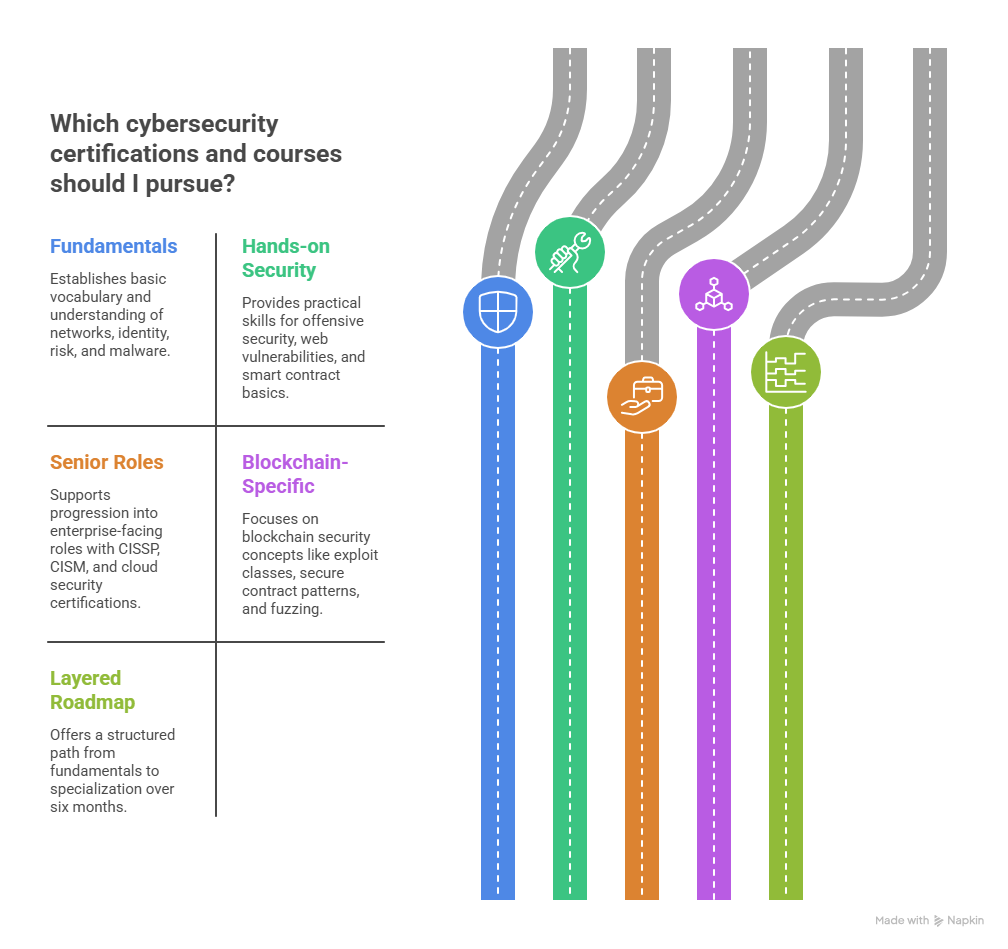
For entry-level learners, Security+, ISC2 CC, or comparable fundamentals can help establish vocabulary around networks, identity, risk, malware, and controls. For hands-on security credibility, CEH, eJPT, PNPT, OSCP, or similar practical pathways can help, depending on your budget and target employer. For senior or enterprise-facing roles, CISSP, CISM, cloud security certifications, or auditing credentials may support progression. Match this with CEH preparation, OSCP career planning, cybersecurity auditor guidance, and cybersecurity compliance officer careers.
Blockchain-specific courses should teach exploit classes, secure contract patterns, DeFi mechanics, fuzzing, invariant testing, formal verification concepts, and audit reporting. The course must force you to write, test, and defend findings. Passive video consumption will not create job readiness. Look for training aligned with cybersecurity bootcamp directories, global training providers, cybersecurity research organizations, and cybersecurity conferences. The best learning path produces evidence, not completion badges alone.
The most efficient route is a layered roadmap. Months one to two: security fundamentals, Linux, Git, networking, and one programming language. Months three to four: application security, web vulnerabilities, smart contract basics, and simple audits. Months five to six: DeFi labs, bridge models, fuzzing, monitoring, and portfolio publishing. After that, specialize into audit, protocol security, exchange security, cloud-node security, or threat intelligence. This route connects naturally to security analyst progression, cloud security engineering, SOC analyst to manager growth, and specialist to CISO advancement.
5. Career Paths, Salaries, and How to Move From Beginner to Senior Blockchain Security Engineer
There are several entry doors into blockchain security. Developers can move through secure smart contract development and code review. SOC analysts can move through on-chain monitoring, exchange security, incident response, and threat intelligence. Penetration testers can move through wallet, API, infrastructure, and protocol testing. Compliance analysts can move through custody controls, governance risk, audit readiness, and regulatory security. Each path can be strengthened by SOC analyst career guidance, incident responder roadmaps, penetration testing manager paths, and compliance analyst roadmaps.
Typical job titles include smart contract auditor, blockchain security engineer, protocol security engineer, Web3 security researcher, crypto exchange security engineer, DeFi security analyst, wallet security engineer, security automation engineer, and security architect for blockchain infrastructure. Senior roles expand into audit lead, protocol security lead, head of security, chief security architect, or security program manager. These transitions align with cybersecurity engineer pathways, security manager roles, security program manager careers, and chief security architect goals.
Salary leverage comes from scarcity and consequence. Blockchain security can pay well because the risk is public, fast-moving, and financially direct, but compensation depends heavily on proof, market cycle, location, remote competitiveness, and employer type. A general cybersecurity background gives stability; a strong blockchain portfolio creates differentiation. Use global cybersecurity salary benchmarks, remote versus on-site salary analysis, entry-level to CISO salary progression, and freelance cybersecurity income trends to judge opportunity realistically.
The biggest career mistake is chasing the word “blockchain” while ignoring security maturity. Employers trust candidates who can make systems safer, reduce review bottlenecks, write clean findings, and protect production assets. Build a trail of evidence: audits, labs, detection rules, postmortems, remediation notes, and architecture reviews. Then apply to roles through a focused story: “I understand security fundamentals, I can review blockchain systems, and I can communicate risk clearly.” That story is stronger when supported by job market trend analysis, future specialized role demand, remote cybersecurity career predictions, and future skills guidance.
6. FAQs About Becoming a Blockchain Security Engineer
-
The strongest backgrounds are software development, application security, penetration testing, cloud security, SOC analysis, incident response, or cybersecurity auditing. Developers often adapt faster to smart contract review, while security analysts often adapt faster to monitoring, response, and infrastructure risk. A practical learner can start with free cybersecurity courses, build through ethical hacking, add cloud security, and then specialize through blockchain cybersecurity research. The key is proving that you can find, reproduce, explain, and help fix real vulnerabilities.
-
You need enough programming skill to read code carefully, write tests, understand control flow, and explain why a vulnerability exists. For smart contract auditing, Solidity, Rust, or Move may become important depending on ecosystem. For monitoring and automation, Python and JavaScript or TypeScript help. A beginner can pair application security tools, vulnerability assessment methods, penetration testing tools, and offensive security engineering to build enough technical depth for junior roles.
-
Broad security certifications help establish credibility, while hands-on credentials help prove practical ability. Security+, ISC2 CC, CEH, OSCP, cloud security certifications, CISSP, CISM, and auditing credentials can all support different routes. The best choice depends on whether you want audit, offensive testing, cloud-node security, governance risk, or security leadership. Use certification rankings, future certification value, salary growth analysis, and career advancement survey insights before spending money.
-
Build a portfolio that removes doubt. Publish two or three smart contract audit writeups, one exploit lab, one remediation walkthrough, and one operational security project such as wallet monitoring or incident triage. Then target junior smart contract auditor, security researcher, Web3 application security analyst, exchange security analyst, or blockchain infrastructure security roles. Support the transition with IT support to cybersecurity guidance, SOC analyst pathways, ethical hacking transition advice, and cybersecurity job market trends.
-
It can be both, depending on the role. Smart contract auditing leans toward secure software review, exploit reasoning, and testing. Exchange security, wallet security, and infrastructure roles may involve penetration testing, cloud hardening, monitoring, and incident response. Protocol security often requires deeper design review and threat modeling. The most employable candidates connect penetration testing career paths, software security tooling, cloud security engineering, and security audit practices into one coherent skill set.
-
Spend the first phase on cybersecurity fundamentals, Linux, networking, Git, and one scripting language. Spend the second phase on web security, application security, and penetration testing basics. Spend the third phase on smart contracts, DeFi mechanics, exploit labs, audit reports, and on-chain monitoring. Spend the fourth phase applying to narrow roles with a portfolio tailored to that role. Use cybersecurity bootcamps, global training providers, cybersecurity books, and security conferences to keep the path structured.
