
Cloud Security vs SOC Analyst: Reddit Career Experiences, Skills, Certifications & Which Path Has Better Leverage
Choosing between cloud security and SOC work becomes difficult when both appear to promise a route into cybersecurity, yet they reward very different skill stacks. Anyone already struggling with the 2026 cybersecurity job market, wondering whether cybersecurity is still worth pursuing, or trying to break in without prior IT experience needs a more useful comparison than “defense versus cloud.” The real question is which path gives your existing experience the greatest career leverage, which skills employers can verify, and what each route can realistically unlock next.
1. Cloud Security vs SOC Analyst: The Difference That Actually Matters for Your Career
A SOC analyst is primarily paid to observe, investigate, prioritize, and respond. Cloud security professionals are increasingly paid to design, configure, automate, harden, and govern. That distinction affects everything from the skills hiring managers expect to the kind of home-lab evidence that gets taken seriously, the value of certifications versus hands-on labs, and eventually the ceiling of your technical responsibility.
SOC work usually gives beginners a clearer security-specific target. You can learn networking, Windows and Linux logs, endpoint telemetry, SIEM querying, phishing analysis, incident triage, MITRE ATT&CK mapping, and detection logic without already being capable of designing production infrastructure. That is why a carefully built SOC analyst entry strategy can make sense for candidates coming from support, networking, systems administration, or an academic program where graduates are struggling to convert degrees into jobs.
The painful catch is that “SOC analyst” and “entry level” are often treated as synonyms when the hiring market does not behave that way. A May 2026 Reddit discussion from an applicant with a cybersecurity master's degree but no IT experience drew blunt responses emphasizing practical capability and the unusually crowded applicant market. Another 2026 thread described a candidate with Security+, basic support experience, and a developing lab who still felt unable to turn scattered study into employment. These are anecdotes rather than labor-market statistics, but they capture the same bottleneck addressed in discussions of resume proof without experience and whether Security+ alone is enough.
Cloud security reverses the problem. Fewer people can convincingly demonstrate cloud IAM, network architecture, secrets handling, encryption, infrastructure as code, workload protection, logging, container security, and remediation. However, employers frequently expect candidates to understand the infrastructure before securing it. Someone comparing a degree with certifications, considering a bootcamp versus a certification path, or hoping to jump directly into cloud security must therefore solve a deeper problem: Can you operate the systems you claim you can secure?
That produces the most useful high-level verdict. SOC usually offers the shorter bridge into security operations; cloud security usually offers stronger technical leverage once you have infrastructure depth. The stronger long-term candidate often learns both: investigate attacks like an analyst, understand infrastructure like an engineer, and automate controls like someone moving toward cybersecurity automation engineering or eventually security architecture.
| Career Factor | SOC Analyst | Cloud Security | Practical Leverage |
|---|---|---|---|
| Typical entry barrier | Moderate | High | SOC usually offers the easier first security move |
| Prior IT experience value | Very useful | Often critical | Cloud rewards infrastructure experience heavily |
| Networking depth | Moderate to high | High | Both benefit; cloud requires architectural application |
| Linux skill | Useful | Very useful | Cloud workloads frequently expose Linux administration gaps |
| Windows knowledge | Very useful | Useful | SOC benefits strongly from endpoint and identity knowledge |
| SIEM expertise | Core | Useful | Major SOC differentiator |
| Incident triage | Core | Useful | SOC builds investigation reflexes rapidly |
| Threat hunting | Common progression | Situational | SOC has the clearer route |
| IAM expertise | Useful | Core | Identity creates major cloud-security leverage |
| Infrastructure as code | Rarely core at L1 | Increasingly important | Terraform skills materially strengthen cloud candidates |
| Python/automation | Useful | Highly useful | Automation increases leverage in both tracks |
| KQL/SPL querying | Core in many environments | Useful for monitoring | Stronger immediate SOC signal |
| AWS/Azure/GCP depth | Helpful | Core | Mandatory for serious cloud-security progression |
| Containers/Kubernetes | Optional for many roles | Increasingly valuable | Can unlock platform and DevSecOps paths |
| On-call exposure | Can be substantial | Role dependent | Employer design matters more than title |
| Shift work risk | Higher in 24/7 SOCs | Usually lower | Important lifestyle distinction |
| Alert fatigue | Potentially high | Lower as a defining feature | Poorly tuned SOCs can become exhausting |
| Engineering responsibility | Low to moderate early | Moderate to high | Cloud tends to create more build ownership |
| Beginner certification value | Moderate | Limited without cloud practice | Certification-only cloud profiles are weak |
| Portfolio usefulness | High when evidence is concrete | Very high | Cloud projects can expose implementation ability directly |
| First-job accessibility | Better | Worse | SOC wins for many career changers |
| Path to detection engineering | Excellent | Possible | SOC creates direct evidence |
| Path to security architecture | Indirect | Strong | Cloud design experience compounds |
| Path to DevSecOps | Possible with reskilling | Strong | Cloud engineering maps better |
| Path to incident response | Excellent | Useful specialization | SOC wins |
| Path to GRC | Possible | Possible | Control knowledge from either side transfers |
| Cross-team exposure | Security-heavy | Security, platform, DevOps, architecture | Cloud can widen business and engineering exposure |
| Automation ceiling | Strong in mature SOCs | Very strong | Both reward code; cloud makes it harder to avoid |
| Long-term specialization breadth | Strong | Very strong | Cloud connects security to architecture and platform engineering |
| Best leverage profile | Investigator with strong fundamentals | Engineer who understands security | Choose according to the evidence you can build fastest |
2. What Reddit Career Experiences Reveal About SOC Work and Cloud Security
Reddit discussions are useful because they expose career friction that polished certification pages omit. They should be treated as anecdotal evidence, yet the recurring patterns matter. One of the clearest is that people trying to enter SOC work without experience often underestimate how much employers value actual troubleshooting history. Candidates obsess over an extra certificate while hiring teams may care more about whether they can explain DNS, interpret authentication logs, investigate a suspicious process, query a SIEM, and document a decision. That is exactly why certification-plus-lab evidence and a verifiable cybersecurity résumé matter more than collecting badges.
The second Reddit pattern is SOC burnout, especially where shift rotation, staffing shortages, repetitive triage, false positives, and limited progression coexist. A September 2026 thread described a SOC analyst considering leaving because of burnout and its effect on personal life. Earlier discussions describe similar frustration with night shifts, alert monotony, and on-call interruptions. Those reports should not be projected onto every SOC; internal security teams with well-tuned detections, strong staffing, automation, threat-hunting opportunities, and good management can produce an entirely different experience. Still, anyone comparing SOC with GRC or deciding whether cybersecurity remains worth the effort should investigate the operating model of the SOC, not merely the job title.
The third pattern is particularly important: experienced analysts often look toward cloud security, detection engineering, threat hunting, incident response, or security engineering when plain alert triage stops creating new skills. One Reddit contributor with a decade of SOC experience specifically discussed cloud security as a possible pivot, while another contributor described moving into a cloud-focused SOC and monitoring AWS, Azure, and GCP environments. A separate 2026 thread from an SOC analyst seeking cloud-security progression produced advice centered on hands-on cloud environments and documented projects.
That progression makes sense. Someone who already understands attacker behavior, incident timelines, endpoint telemetry, and detection quality can become unusually valuable after adding cloud IAM, workload architecture, infrastructure as code, and platform-native security controls. This is where a cybersecurity automation path, digital identity specialization, AI security work, or eventual security architecture becomes much more credible.
Cloud professionals face the opposite weakness. Someone can become excellent at deploying services and still lack the investigative instincts needed to recognize abuse. A cloud engineer who adds threat modeling, telemetry design, incident response, detection logic, least-privilege analysis, and attack-path thinking develops much stronger security depth than someone who merely passes another exam. That is also why candidates should think beyond the simplistic degree-versus-certifications debate and ask what operational evidence each learning investment produces.
3. Skills That Separate Hireable Candidates From People Who Merely Studied the Topic
For SOC candidates, the most important skill is investigative reasoning. A recruiter may screen for Security+, Splunk, Sentinel, EDR, or Windows, but the interview exposes whether you can move from alert → evidence → hypothesis → validation → containment recommendation. A strong SOC home lab should therefore generate artifacts rather than screenshots. Produce raw logs, a detection rule, false-positive analysis, investigation notes, an incident timeline, MITRE ATT&CK mappings, and a final report. That directly addresses what SOC hiring managers want, strengthens a no-experience résumé, and gives you something substantial to discuss when entry-level competition is intense.
Your SOC skill stack should eventually include TCP/IP, DNS, HTTP/S, identity and authentication, Windows event logs, Linux logs, EDR concepts, SIEM querying, phishing investigation, malware fundamentals, alert tuning, basic scripting, incident documentation, and threat frameworks. KQL or SPL becomes more valuable when you can explain why you wrote a query, what malicious behavior it detects, what benign behavior creates noise, and how you would tune it. That depth separates a candidate who followed a tutorial from someone preparing for threat-oriented SOC work.
Cloud-security candidates need a broader engineering foundation. Learn how identities authenticate, how roles and policies authorize, how workloads communicate across networks, where secrets live, how encryption keys are managed, how logs are centralized, how infrastructure is deployed, and where developers can accidentally introduce exposure. That knowledge naturally connects cloud security with risk management, GRC specialization, privacy work, and regulatory security responsibilities.
A portfolio-worthy cloud project should go much further than “I launched an EC2 instance.” Build a small environment, establish least-privilege IAM, segment networks, encrypt sensitive storage, manage secrets appropriately, enable logging, introduce one controlled misconfiguration, detect it, remediate it, and document the security decision. Then rebuild the environment through Terraform or another IaC workflow. A second project can secure a containerized workload or CI/CD pipeline. A third can map cloud controls to a compliance requirement. That portfolio makes automation engineering, cloud-oriented architecture, cybersecurity product work, and even security research more believable future moves.
4. Certifications for SOC and Cloud Security: Where Candidates Waste the Most Time
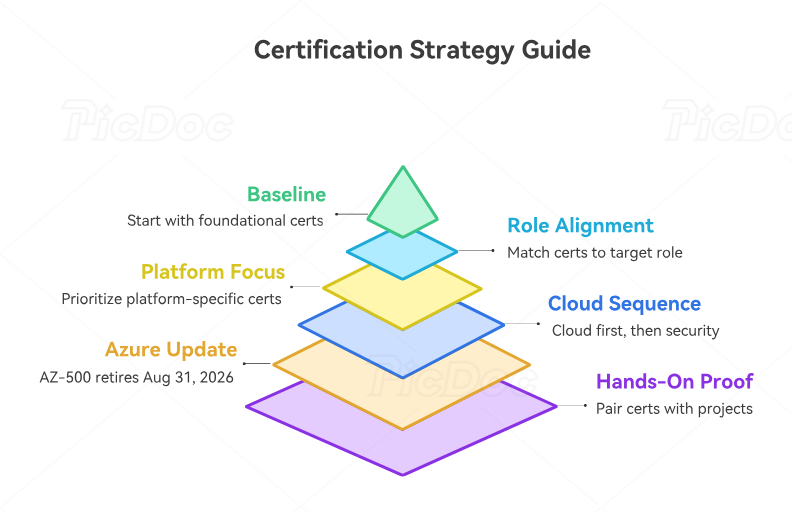
Certification strategy should follow the role you are trying to prove. That principle matters because candidates frequently delay applications while accumulating credentials that fail to repair their actual weakness. Someone with no troubleshooting history may gain more from support experience and a cybersecurity home lab than a fourth certificate. Someone already administering AWS every day may get substantial value from a cloud-security credential. The correct mix is better understood through certifications versus hands-on labs, degree-versus-certification ROI, and actual employer skill signals.
SOC certification sequence
For a candidate who already understands basic IT, Security+ remains a sensible baseline because it creates broad security vocabulary without prematurely specializing. After that, the next credential should correspond to the tooling or role you actually want. Microsoft SC-200 is particularly relevant for Microsoft-centric security operations. Microsoft's current blueprint covers managing a security operations environment, incident response, and threat hunting using tooling including Sentinel and Defender.
CySA+ can make sense for candidates who want a vendor-neutral analyst credential, while platform-specific training can be more useful if job postings in your market repeatedly request the same SIEM or EDR ecosystem. The mistake is believing that passing three analyst certifications compensates for being unable to investigate an alert. Candidates facing repeated cybersecurity rejection, wondering whether Security+ is sufficient, or considering the broader bootcamp-degree-certification tradeoff should diagnose that gap before buying another exam voucher.
Cloud-security certification sequence
Cloud security usually rewards a platform-first, security-second sequence. Learn to operate the cloud before specializing in protecting it. On AWS, that often means developing real associate-level architecture or operations capability before treating the AWS Certified Security - Specialty as the next badge. AWS explicitly positions its Security - Specialty credential for people already securing cloud solutions; the current SCS-C03 blueprint covers detection, incident response, infrastructure security, IAM, data protection, and security foundations/governance. AWS describes the target candidate as having several years of cloud-security experience, reinforcing why this should not be treated as a beginner shortcut.
There is also an important 2026 Azure certification update that makes older advice dangerous. Microsoft's AZ-500 exam and Azure Security Engineer Associate certification retired on August 31, 2026. Microsoft's current Cloud and AI Security Engineer Associate certification uses SC-500 and covers identity, access, storage, databases, networking, compute, posture management, hybrid environments, and AI-related security responsibilities. Candidates following outdated roadmaps can therefore waste weeks preparing for a credential that can no longer be earned.
Whichever platform you choose, pair the credential with implementation proof. Someone aiming for AI security, cybersecurity automation, digital identity management, or blockchain security engineering will gain more from a project showing engineering judgment than from a résumé containing certificates with no corresponding technical story.
5. Which Path Has Better Career Leverage? Use Your Starting Point, Not the Hype
For someone with zero professional IT experience, SOC is usually the more rational direct security target, while help desk, networking, desktop support, NOC, or junior systems work should remain active fallback routes. That is especially important in a market where entry-level security applicants face saturation, career changers need credible stepping stones, and employers increasingly want evidence they can verify. Refusing adjacent IT work while waiting indefinitely for a cloud-security title can turn ambition into an employment gap.
For someone already working in help desk, systems administration, networking, or cloud infrastructure, cloud security can create stronger leverage because the candidate already owns part of the missing foundation. A sysadmin who understands identity, permissions, networking, patching, virtualization, Linux, PowerShell, and operational troubleshooting can add cloud architecture and security controls far faster than someone starting from pure theory. An experienced IT manager can eventually translate those same capabilities into cybersecurity leadership, security program management, risk management, or security architecture.
For an existing SOC analyst, cloud security becomes particularly powerful after the analyst has extracted the high-value lessons from operations. Build cloud detections. Investigate IAM abuse. Learn native audit logs. Understand role assumption, service identities, storage exposure, network controls, secrets, workload identity, and container telemetry. Automate one repetitive investigation. Deploy security controls through infrastructure as code. This converts “I monitor cloud alerts” into “I understand how cloud attacks happen, how the infrastructure produces evidence, and how to prevent recurrence.” That transition supports progression toward senior analyst and security leadership, automation engineering, cybersecurity product management, and architecture.
For an existing cloud engineer or DevOps professional, moving backward into an L1 SOC purely to “get cybersecurity experience” may destroy leverage. A 2023 Reddit discussion about moving from cloud engineering into SOC included the view that cloud engineering was already a higher-level position, while a cybersecurity mentorship thread similarly advised someone with cloud-security experience against stepping backward into SOC operations. The more efficient move is usually to add security responsibilities where you already have engineering credibility: IAM hardening, policy-as-code, CSPM remediation, threat modeling, network security, workload protection, CI/CD controls, secrets management, and cloud incident response.
The same logic applies to candidates worried that AI will replace entry-level security work. Repetitive alert handling is easier to automate than architectural judgment, cross-system troubleshooting, security engineering, detection design, incident command, or risk ownership. Building toward AI security analysis, cybersecurity data science, automation engineering, or quantum-security specialization therefore means increasing the amount of judgment and engineering in your work.
If leverage is defined as fastest credible first security job, SOC usually wins. If leverage means technical ownership, architecture adjacency, engineering mobility, and long-term specialization breadth, cloud security generally has the advantage. If leverage means becoming difficult to replace, the strongest profile combines both sides: infrastructure understanding, security engineering, detection thinking, automation, and the ability to explain risk to people outside security.
A practical 12-month approach is therefore straightforward. Beginners can spend the first quarter fixing networking, operating-system, and security fundamentals; the second building a serious cybersecurity lab; the third developing SOC evidence while applying to realistic entry routes; and the fourth adding one cloud platform. Existing analysts can compress the fundamentals stage and invest that time into IaC, IAM, cloud networking, logging, and cloud-native detection. Existing infrastructure engineers should invert the roadmap: preserve their engineering advantage and deliberately add security depth.
6. FAQs About Cloud Security vs SOC Analyst Careers
-
SOC is generally the more accessible security-specific target because cloud-security positions often assume prior infrastructure knowledge. Candidates beginning from zero should study the realistic cybersecurity entry barriers, understand what SOC hiring managers actually expect, build verifiable home-lab evidence, and keep adjacent IT roles open rather than waiting exclusively for an ideal title.
-
Yes, and the transition can be strategically strong because SOC experience already supplies investigation, incident, detection, and attacker-behavior knowledge. The missing layer is usually cloud infrastructure. Build IAM, networking, compute, storage, secrets, logging, IaC, and workload-security capability while studying cybersecurity automation, digital identity management, risk management, and eventual security architecture. A cloud-focused SOC can also be a useful bridge.
-
Compensation depends heavily on country, employer, seniority, clearance requirements, platform expertise, and whether “SOC analyst” means Tier 1 monitoring or advanced detection/incident work. Cloud-security roles frequently carry greater engineering responsibility, which can create stronger compensation leverage at mid and senior levels. Candidates should focus on the progression available from a role rather than chase a title, especially when planning movement toward VP-level security careers, security architecture, program management, or cybersecurity product leadership.
-
Start with a foundation appropriate to your existing knowledge, then choose credentials that match target jobs. Security+ can establish baseline vocabulary; SC-200 is relevant to Microsoft security operations; CySA+ can support vendor-neutral analyst positioning. Pair every credential with the kind of lab evidence employers can inspect, because certification-only candidates still struggle when interviews expose weak investigation skills. Your cybersecurity résumé should show what you investigated and built.
-
Choose a cloud platform, learn to administer it, and then specialize in security. AWS candidates can progress toward AWS Certified Security - Specialty after developing meaningful AWS experience. Azure candidates should be careful with outdated advice because AZ-500 retired on August 31, 2026; Microsoft's current Cloud and AI Security Engineer Associate credential is tied to SC-500. Candidates considering advanced cybersecurity certification routes, degree-versus-certification ROI, or certifications versus labs should prioritize current credentials and implementation ability.
-
SOC experience can add excellent defensive instincts, but infrastructure, networking, systems, cloud engineering, DevOps, IAM, or platform experience can provide equally valuable starting points. Someone already operating production cloud environments should usually deepen security where they are rather than deliberately move into junior SOC work. That candidate can strengthen risk-management capability, GRC knowledge, security automation, and architecture skills while preserving valuable engineering experience.
