
The Ultimate Guide to Getting Advanced Cybersecurity & Management Certification in Pakistan: Everything You Need to Know in 2026-2027
Advanced cybersecurity careers in Pakistan increasingly demand more than tool knowledge. Employers need professionals who can investigate incidents, secure cloud environments, assess business risk, manage compliance, lead teams, and explain technical exposure to decision-makers. The challenge is choosing a credential that employers recognize, paying international examination costs without wasting money, and building enough practical evidence to compete for local, remote, and Gulf-region roles. This guide provides a career-first certification strategy for Pakistan’s 2026–2027 cybersecurity market.
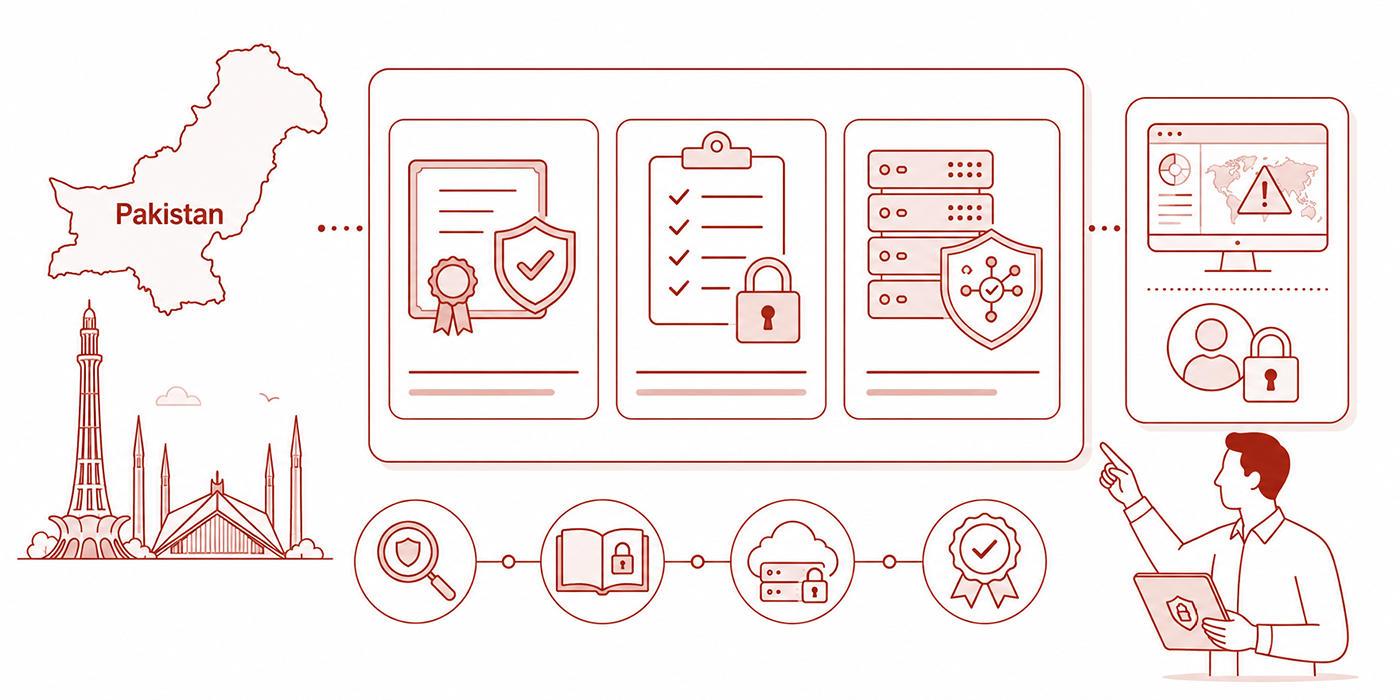
1. Why Advanced Cybersecurity and Management Certification Matters in Pakistan
Pakistan’s cybersecurity ecosystem is becoming more structured around governance, coordinated incident response, critical-infrastructure protection, security assurance, and workforce development. The National Cyber Security Policy 2021 established broad national objectives, while the Computer Emergency Response Team Rules 2023 created a formal framework for national, government, sectoral, and organizational CERT functions. Pakistan’s National CERT also publishes advisories, supports incident management, conducts security audits, and delivers capacity-building initiatives.
The Pakistan Information Security Framework 2025 further translates national direction into practical governance and technical expectations. Its 13-document structure covers areas such as essential governance controls and supports organizations seeking a more consistent approach to information-security management. Professionals who understand cybersecurity frameworks such as NIST, ISO, and COBIT, conduct effective security audits, apply appropriate access-control models, and perform structured vulnerability assessments are therefore positioned to contribute beyond routine technical support.
This shift creates opportunities for candidates who can connect operations with management. A SOC analyst may understand alerts, yet career progression requires the ability to improve detection coverage, coordinate incident response, communicate risk, measure performance, and guide junior analysts. Professionals planning that route should study the SOC analyst career pathway, the progression from SOC analyst to SOC manager, and the responsibilities involved in moving from security analyst to cybersecurity engineer.
The same principle applies to offensive security. Running automated scans creates limited leverage when a candidate cannot define scope, validate findings, explain exploitability, assess business impact, or recommend practical remediation. Aspiring testers should combine certification with a structured ethical-hacking career roadmap, a clear path from junior penetration tester to senior consultant, familiarity with leading penetration-testing tools, and an understanding of how established penetration-testing companies present commercial findings.
Management credentials become especially valuable when technical professionals reach the point where deeper tool knowledge alone produces diminishing returns. Security leaders must prioritize investments, allocate limited staff, defend budgets, manage vendors, prepare for audits, coordinate incidents, and explain why a vulnerability deserves immediate action. The transition can be mapped through a cybersecurity manager career pathway, a security manager-to-director roadmap, and a long-term CISO advancement strategy.
Pakistan’s 2025–2026 HEC cybersecurity curriculum also signals greater formalization of the discipline. HEC published a dedicated cybersecurity curriculum and introduced cybersecurity among the high-demand specialization areas in its updated computing framework. Degree recognition should still be checked through HEC’s official lists before enrolment, particularly when a provider uses the language of a university programme without clearly identifying the awarding institution.
For candidates who cannot commit to a degree, vocational and short-course pathways may provide an entry point. NAVTTC lists cybersecurity qualifications, digital forensics and cybersecurity short courses, and training routes connected to programmes such as the Prime Minister’s Youth Skill Development Program. Its published material has also included CEH, CHFI, and a six-month Certificate in Cyber Security. Availability, eligibility, institute selection, and funded seats can change by batch, so applicants should verify the current programme directly rather than relying on an old social-media advertisement.
The strongest reason to pursue certification is the possibility of converting knowledge into a more valuable responsibility. A credible credential can help a candidate move into incident response, cloud security, GRC, audit, penetration testing, security architecture, consulting, or leadership. That conversion becomes much stronger when certification is supported by current knowledge of the cybersecurity job market, future specialized-role demand, expected future cybersecurity skills, and the changing impact of automation on cybersecurity careers.
Cybersecurity Certifications and Career Impact: 30-Credential Pakistan Advancement Matrix
| Certification | Best Career Stage | Primary Career Value | Evidence Needed Alongside It |
|---|---|---|---|
| ISC2 Certified in Cybersecurity | Entry level | Builds a security foundation for career changers | Networking lab, incident ticket, basic risk register |
| CompTIA Security+ | Entry level | Supports junior security and defensive roles | System hardening, log analysis, security documentation |
| ISC2 SSCP | Early career | Strengthens operational security credibility | Access reviews, monitoring procedures, control checks |
| CompTIA CySA+ | Early career | Supports SOC, detection, and threat-analysis work | SIEM investigation, detection rule, incident timeline |
| CompTIA PenTest+ | Early career | Introduces structured vulnerability testing | Authorized lab report with remediation guidance |
| CompTIA SecurityX | Mid career | Signals advanced enterprise-security capability | Architecture decision and risk-based control plan |
| EC-Council CEH | Early to mid career | Builds broad ethical-hacking knowledge | Legal lab exercises and professional findings report |
| EC-Council CHFI | Mid career | Supports forensic and investigation pathways | Evidence-handling plan and forensic case timeline |
| OffSec OSCP | Technical mid career | Demonstrates practical penetration-testing ability | Methodology, enumeration notes, executive report |
| OffSec OSEP | Advanced offensive | Develops mature enterprise attack capability | Attack-chain analysis and defensive recommendations |
| OffSec OSWE | Advanced offensive | Develops advanced web-security testing skills | Secure code review and web vulnerability research |
| GIAC GSEC | Early to mid career | Strengthens practical defensive knowledge | Hardening checklist and security operations evidence |
| GIAC GCIH | Mid career | Supports incident-handling specialization | Containment playbook and after-action review |
| GIAC GCIA | Technical mid career | Develops traffic and intrusion-analysis depth | Packet analysis and network-detection logic |
| GIAC GPEN | Mid career | Supports professional penetration-testing work | Scoping document, test evidence, retest report |
| ISC2 CISSP | Experienced practitioner | Supports broad technical and leadership progression | Risk decisions, programme metrics, architecture examples |
| ISACA CISM | Mid to senior career | Develops security-management credibility | Business-aligned security programme and KPIs |
| ISACA CRISC | Mid career | Builds technology-risk specialization | Risk scenarios, treatment options, KRIs |
| ISACA CISA | Mid career | Supports audit and assurance careers | Audit programme, evidence matrix, corrective actions |
| ISACA CGEIT | Senior career | Strengthens enterprise IT-governance positioning | Governance model and executive reporting framework |
| ISC2 CCSP | Mid career | Supports cloud governance and architecture | Cloud-control matrix and secure reference design |
| ISC2 CSSLP | Mid career | Supports secure software-lifecycle leadership | Threat model and secure-development workflow |
| ISC2 ISSMP | Senior career | Validates advanced security-management depth | Strategy, governance calendar, board-level metrics |
| ISO/IEC 27001 Lead Implementer | Mid to senior career | Supports ISMS implementation and consulting | Scope, risk register, Statement of Applicability |
| ISO/IEC 27001 Lead Auditor | Mid to senior career | Supports assurance and certification-audit work | Audit plan, findings report, evidence sampling |
| AWS Certified Security – Specialty | Cloud practitioner | Develops AWS security specialization | Secure landing zone and logging architecture |
| Microsoft Cybersecurity Architect Expert | Mid to senior cloud career | Supports enterprise and zero-trust architecture | Identity, endpoint, data, and cloud design |
| Google Professional Cloud Security Engineer | Cloud practitioner | Develops Google Cloud security capability | IAM model, encryption, logging, workload controls |
| Certified Kubernetes Security Specialist | Cloud-native specialist | Supports container and Kubernetes security | Cluster hardening and workload-policy lab |
| ISO 22301 Business Continuity Credential | Management and resilience | Connects cybersecurity with operational continuity | Business-impact analysis and recovery exercise |
2. How to Choose the Right Cybersecurity Certification in Pakistan
Begin with a role target rather than a certification brand. Write down the position you want within the next 12 to 24 months, then collect at least 20 relevant job descriptions from Pakistan, remote employers, and any overseas market you intend to pursue. Record recurring responsibilities, required platforms, experience levels, reporting lines, and requested credentials. This process exposes whether your real gap is foundational knowledge, practical evidence, leadership experience, cloud expertise, audit competence, or stronger communication.
A candidate targeting SOC work should prioritize investigation, alert validation, log analysis, endpoint telemetry, escalation, incident documentation, and detection engineering. Security+, SSCP, CySA+, GSEC, GCIH, or GCIA may support different stages of that path. Certification should be reinforced through hands-on familiarity with leading SIEM solutions, modern endpoint detection and response tools, current endpoint-security providers, and practical network-monitoring platforms.
Entry-level candidates often make the expensive mistake of collecting several broad credentials without becoming job-ready for any specific function. One foundational certification, one focused lab environment, and three well-documented projects usually create a clearer professional story than four overlapping certificates. Candidates can structure this progression through the IT support-to-cybersecurity analyst route, the detailed SOC analyst career guide, and the path toward becoming a senior cybersecurity analyst.
Offensive-security candidates should distinguish between knowledge-based credentials and performance-based examinations. CEH or PenTest+ can help organize terminology, attack concepts, methodology, and defensive context. OSCP, OSEP, OSWE, and similar practical routes demand deeper execution. A candidate should understand enumeration, exploitation, privilege escalation, web testing, Active Directory, reporting, and remediation before presenting themselves as a penetration tester.
The portfolio is crucial because employers have seen candidates who passed through memorized question banks yet struggle with basic methodology. Build legal, isolated lab projects and explain the scope, assumptions, steps taken, evidence found, false positives rejected, impact established, and fixes recommended. Use the OSCP penetration-tester roadmap, the path toward becoming a red-team specialist, the career progression to penetration-testing manager, and the broader vulnerability-researcher pathway to plan increasing depth.
Management candidates should assess how much operational context they already possess. CISM can support security-programme leadership, CISSP provides broad security-domain coverage, CRISC targets technology risk, CISA supports audit and assurance, and ISO/IEC 27001 credentials can support implementation or auditing. The best selection depends on the work you want to own.
A network administrator with strong infrastructure experience may find CISSP, CCSP, or cloud-security certification more useful than another entry-level credential. An internal auditor may gain more leverage from CISA, CRISC, or ISO/IEC 27001. A technical lead seeking departmental responsibility may prioritize CISM, CISSP, programme management, budgeting, vendor governance, and executive communication. Relevant pathways include the move from IT management to cybersecurity leadership, advancement toward director of information security, and eventual progression to VP of cybersecurity.
Cloud-security candidates should choose the environment most relevant to their current employer or desired vacancies. CCSP provides vendor-neutral breadth, while AWS, Microsoft, and Google certifications build platform-specific confidence. CKS becomes relevant when the intended work includes Kubernetes and containerized workloads. Study should cover shared responsibility, identity, secrets, network segmentation, encryption, posture management, data protection, logging, workload security, and incident response.
Candidates can strengthen this pathway through the cloud-security engineer career guide, the comparison of leading cloud-security tools, research into emerging cloud threats, and analysis of the future of cloud security.
Candidates targeting compliance, GRC, audit, or consulting should learn to produce usable governance artifacts. These include a risk register, control matrix, policy set, audit plan, business-impact analysis, third-party questionnaire, corrective-action tracker, incident-escalation procedure, and management dashboard. Useful career references include the cybersecurity compliance analyst roadmap, the pathway to becoming a cybersecurity auditor, and the longer-term route toward cybersecurity policy leadership.
Sector alignment also affects credential value. Pakistan’s banks, telecommunications providers, software exporters, government bodies, healthcare organizations, energy companies, and growing digital platforms face different operational pressures. Financial-sector candidates should understand the cybersecurity threat landscape in finance, examine financial-sector security incidents, and study leading financial-services cybersecurity firms.
Healthcare candidates need knowledge of sensitive-data handling, system availability, third-party exposure, ransomware resilience, and privileged access. They can build sector knowledge through the healthcare cybersecurity threat report, the directory of healthcare cybersecurity firms, and the comparison of healthcare-specific cybersecurity solutions.
3. Certification Costs, Training Providers, Funding, and Exam Preparation
Pakistan-based candidates must budget for more than the advertised training price. The true cost may include an internationally priced exam voucher, currency-conversion charges, taxes or banking fees, official learning material, practice examinations, lab subscriptions, travel to a test centre, retake exposure, and renewal requirements. Exchange-rate movement can also change the rupee cost between the day study begins and the day the voucher is purchased.
Create three budgets before enrolment. The minimum budget should cover self-study, the examination, and essential labs. The supported budget should include instructor-led preparation and structured practice. The contingency budget should include a possible reschedule or retake. This prevents the painful situation in which a candidate completes months of training yet cannot afford the official exam.
A provider should be evaluated through evidence rather than marketing language. Ask for the complete syllabus, instructor biography, guided hours, lab duration, class size, examination-voucher terms, support period, mock-exam quality, recording access, refund policy, and learner prerequisites. Compare local offerings with a global directory of cybersecurity training providers, recognized cybersecurity bootcamps and academies, quality free cybersecurity courses, and respected cybersecurity books.
Be cautious when an institute promises guaranteed examination success, guaranteed employment, immediate six-figure income, or an advanced credential without enforcing prerequisites. Another warning sign is a curriculum built around “dumps.” Memorized examination content creates ethical concerns, may violate certification rules, and leaves the candidate unable to answer scenario questions in interviews. The short-term pass can produce long-term embarrassment when an employer asks the candidate to interpret a log, prioritize a risk, or explain a control failure.
For local academic programmes, verify that the institution and campus appear in HEC’s recognition resources. For vocational programmes, check current NAVTTC listings and the specific training batch. HEC maintains recognized-institution information and updated computing curricula, while NAVTTC publishes qualifications and short-course material.
Government-supported learning opportunities can reduce costs, although a funded seat should still be evaluated for role relevance. NAVTTC’s youth-skills programmes are intended to develop market-oriented technical and high-tech capabilities, and its published course materials have included cybersecurity, CEH, CHFI, and digital-forensics pathways. HEC’s Digital Learning and Skills Enrichment Initiative has also listed introductory cybersecurity learning.
Candidates pursuing advanced management can also monitor capacity-building initiatives from National CERT. Its published Executive Cybersecurity Leadership Program is structured as a three-month, six-module programme covering the national cyber-threat landscape, governance, legal obligations, accountability, strategic risk, and leadership responsibilities. Programme availability and eligibility should be confirmed directly for the relevant intake.
Build preparation around outputs rather than hours consumed. Watching 60 hours of lectures proves attendance. Explaining a control decision, investigating an alert, hardening an environment, or defending a risk treatment proves capability. Divide preparation into four stages:
Foundation: Learn concepts, terminology, processes, and examination domains.
Application: Complete labs, scenarios, diagrams, reports, and governance artifacts.
Assessment: Attempt timed questions and diagnose why each incorrect option fails.
Correction: Rebuild weak domains and repeat practical work without step-by-step guidance.
Technical candidates should maintain a lab journal containing objectives, environment details, commands, observations, failed attempts, findings, and remediation. Defensive learners can compare vulnerability scanners, email-security solutions, application-security tools, and privileged-access management platforms without turning the portfolio into a collection of vendor screenshots.
Management candidates should practise executive-level reasoning. Given a ransomware scenario, identify critical services, probable impact, immediate authority, communication channels, evidence requirements, containment priorities, recovery dependencies, and lessons to take into governance. The state of ransomware, analysis of data-breach exposure, the annual insider-threat report, and research into incident-response effectiveness provide useful scenario material.
Remote-proctored candidates should also prepare their physical environment. Confirm identity-document requirements, system compatibility, camera placement, room restrictions, internet stability, power backup, and rescheduling rules before examination day. A preventable connectivity or environment issue is especially painful when the exam fee represents a significant portion of monthly income.
Quick Poll: What Is the Biggest Barrier to Your Cybersecurity Career in Pakistan?
Choose the problem currently costing you the most time, money, or career momentum.
4. Step-by-Step Certification Roadmap for Pakistan-Based Candidates
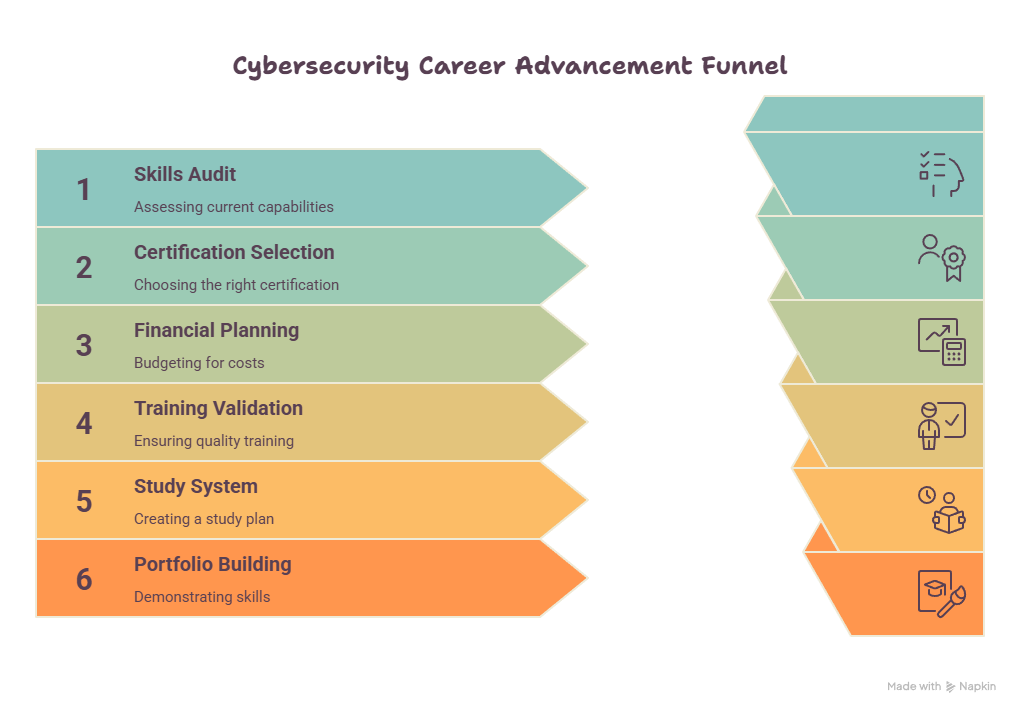
Step 1: Choose one primary career destination
Select the role you want before selecting the exam. Possible destinations include SOC analyst, penetration tester, incident responder, threat-intelligence analyst, cloud-security engineer, security auditor, compliance analyst, security manager, architect, or consultant.
Someone pursuing threat intelligence should study the threat-intelligence analyst roadmap, while an incident-response candidate should examine the incident-responder career path. Candidates planning offensive work can use the network administrator-to-ethical hacker transition, while leadership candidates can examine the route from cybersecurity specialist to CISO.
Step 2: Perform an honest skills audit
Divide your existing capability into five categories: technical knowledge, practical execution, business understanding, communication, and evidence. Rate each capability according to what you can perform independently. Familiarity should receive less weight than repeatable competence.
For example, a candidate may recognize SIEM terminology yet remain unable to investigate a suspicious login. Another may understand risk definitions yet struggle to write a usable treatment plan. A senior engineer may possess strong technical depth while lacking budgeting, stakeholder management, or policy experience. This audit prevents certification from becoming an escape from the harder work of closing the actual gap.
Step 3: Select one anchor certification
The anchor certification should map directly to the target role. Security+ or SSCP can anchor an early defensive path. CySA+ or GCIH can support SOC and incident work. OSCP can anchor a penetration-testing pathway. CCSP or a vendor cloud credential can support cloud security. CISA can anchor audit, CRISC can support technology risk, CISM can support management, and CISSP can provide broader senior-level positioning.
Review the wider cybersecurity certification directory, research how certifications affect career advancement, examine the salary impact of major credentials, and consider which future certifications employers may value.
Step 4: Build a realistic financial plan
Calculate the complete rupee cost before joining a course. Include examination, training, official material, labs, payment charges, travel, renewal, and contingency. Decide whether you will purchase the voucher immediately or save toward it during preparation.
Candidates with limited budgets can begin through official documentation, free courses, low-cost labs, and open-source tools. Spending should increase only when a paid resource solves a specific problem, such as instructor feedback, a required lab environment, structured examination practice, or an official voucher.
Step 5: Validate the training provider
Request written answers to the following questions:
Is the instructor currently working in the discipline?
How many live, guided lab hours are included?
Does the fee include the official exam voucher?
How long will recordings and labs remain available?
How is individual work assessed?
Does the course use current official objectives?
What happens when a learner falls behind?
Are refund, transfer, and retake terms documented?
Review independent learning options through leading cybersecurity research institutes, credible cybersecurity industry sites, educational cybersecurity YouTube channels, and professional cybersecurity podcasts.
Step 6: Create a 12-to-16-week study system
Break the certification syllabus into weekly domains. Each week should include concept review, retrieval practice, lab work, scenario questions, and a written artifact. Maintain a weakness log containing the topic, reason for error, corrected principle, and date of reassessment.
Candidates working full-time should favour repeatable 60-to-90-minute sessions. Long weekend sessions become unreliable when family responsibilities, overtime, electricity interruptions, or fatigue intervene. A sustainable schedule wins because advanced certification requires retention and judgment.
Step 7: Build three portfolio artifacts
Each artifact should solve a realistic problem and demonstrate professional communication.
A SOC portfolio might contain an alert investigation, incident timeline, detection recommendation, and management summary. A cloud portfolio might contain an identity model, threat model, logging strategy, and secure architecture. A GRC portfolio might contain a risk register, control matrix, audit programme, and executive dashboard. A penetration-testing portfolio might contain an authorized lab assessment with evidence, impact, remediation, and retest notes.
Candidates can draw scenarios from phishing trends, IoT security breaches, AI-powered cyberattacks, and predicted deepfake security threats.
Step 8: Practise business communication
Write a one-page executive summary for every technical project. Explain what happened, what could be affected, how confident you are, what action is required, who should own it, and what delay could cost. This skill separates a tool user from a professional trusted with decisions.
Aspiring managers should also practise presenting a risk with three treatment options, their costs, operational effects, and residual exposure. Future leaders can use the chief security architect roadmap, the cybersecurity programme manager guide, and the progression from senior security analyst to VP.
Step 9: Book the examination after reaching defined thresholds
Book when practice performance is stable, major labs are complete, and weak domains have been retested. Set a threshold for timed-question performance and explain every incorrect option. A lucky mock-exam score should carry less weight than consistency across several fresh assessments.
For performance-based credentials, readiness should include completing unfamiliar systems without a walkthrough, managing time under pressure, preserving clear notes, and producing a professional report within the required window.
Step 10: Prepare job conversion before receiving the result
Rewrite the résumé, professional profile, portfolio, and interview stories before examination day. This allows applications to begin quickly once the credential is confirmed. Prepare stories about technical troubleshooting, incident handling, risk prioritization, stakeholder disagreement, process improvement, and leadership.
5. Turning Certification Into Jobs, Remote Work, Promotions, and Salary Growth
A newly earned certification should be converted into employer evidence within 30 days. Add it accurately to your résumé and professional profiles, then connect it with relevant projects, responsibilities, and measurable outcomes. A credential listed without context may pass an applicant-tracking filter, although it gives the interviewer little reason to trust your practical ability.
For each certification domain, create a proof statement. Instead of “knowledge of incident response,” write that you developed a triage and escalation playbook, investigated a simulated endpoint alert, constructed a timeline, and recommended containment. Instead of “familiar with ISO 27001,” describe the ISMS scope, risk assessment, control mapping, audit evidence, or corrective-action process you created.
Candidates seeking their first role must reduce beginner-risk perception. Employers worry that an inexperienced hire may mishandle sensitive data, exceed authorization, overlook evidence, communicate poorly, or fail to escalate. Your portfolio and interview answers should demonstrate scope discipline, confidentiality, documentation, verification, escalation, and willingness to seek guidance.
The transition can be strengthened through a detailed IT support specialist-to-security analyst guide, a pathway for advancing as a cybersecurity analyst, and a roadmap for moving toward a senior cybersecurity analyst role.
Remote roles require additional proof. Employers evaluating candidates across borders look closely at written communication, independent execution, time-zone reliability, secure working practices, documentation quality, and professional English. Candidates should build asynchronous work habits by writing clear updates, documenting decisions, recording assumptions, and raising blockers early.
Research the direction of remote cybersecurity careers, compare remote and on-site compensation, examine the wider global cybersecurity salary landscape, and understand trends in the cybersecurity freelance market.
Freelancing requires commercial discipline. A technically capable freelancer can still lose clients through unclear scope, weak reporting, poor communication, insecure evidence handling, or unrealistic promises. Define exactly what will be tested, excluded, delivered, retested, and deleted. Obtain written authorization before performing security testing. Keep client information protected and avoid publishing findings without explicit permission.
Promotion candidates should propose an expanded responsibility tied to the credential. A CISSP or CISM holder might volunteer to improve security metrics, coordinate a risk committee, lead a third-party review, or revise incident governance. A CISA holder might strengthen audit preparation. A CCSP holder might assess cloud controls. An OSCP holder might improve vulnerability validation and remediation testing
This approach gives management a business reason to increase responsibility. It also prevents the certification from becoming a decorative line on the résumé. Leadership candidates should understand cybersecurity compliance trends, the evolving future of cybersecurity compliance, changing cybersecurity audit practices, and the emerging next generation of cybersecurity standards
Salary negotiation should focus on higher-value output. State how the credential and applied work allow you to reduce risk, lead a new function, replace external support, improve audit readiness, shorten incident handling, secure cloud adoption, or serve larger clients. Compare your current scope with the entry-level-to-CISO salary progression and wider cybersecurity career-advancement data
Candidates targeting Gulf-region opportunities should tailor their portfolios to the role and sector rather than relying on the global reputation of a credential. Cloud, GRC, SOC, incident response, audit, identity, critical infrastructure, and security architecture can each require distinct evidence. Review role descriptions in the intended country and identify the platforms, frameworks, sector expectations, and experience levels that recur
Long-term career growth also requires visible professional contribution. Write technical explanations, present internal lessons, mentor junior candidates, participate in authorized competitions, contribute to defensive open-source projects, and attend credible events. Relevant resources include the directory of global cybersecurity conferences, guidance on becoming a cybersecurity content creator, and the pathway toward becoming a cybersecurity instructor.
6. Frequently Asked Questions
-
ISC2 Certified in Cybersecurity and CompTIA Security+ are common foundations for candidates entering cybersecurity. The stronger choice depends on your target role, existing IT knowledge, budget, and access to the official examination.
A beginner interested in SOC work should combine certification with networking, Windows and Linux fundamentals, log analysis, endpoint concepts, and incident documentation. Follow the SOC analyst career roadmap, use quality free cybersecurity resources, and build evidence with SIEM tools and endpoint-security platforms.
-
CISM commonly aligns with security-programme management, CISSP supports broad senior-level security responsibilities, CRISC targets technology risk, CISA supports audit, and ISO/IEC 27001 credentials support management-system implementation or assurance.
Select the credential that matches the responsibility you want next. Review the cybersecurity manager pathway, the route to becoming a director of information security, the progression toward CISO leadership, and the roadmap for aspiring chief security architects.
-
International credentials such as CISSP, CISM, CISA, CRISC, Security+, CEH, OSCP, CCSP, and cloud certifications may appear in relevant job requirements, although recognition varies by employer, role, seniority, and sector. Local employers still assess experience, technical performance, communication, and role fit.
Review a meaningful sample of current vacancies before choosing. A credential produces stronger results when supported by a portfolio, relevant projects, sector knowledge, and interview evidence.
-
NAVTTC publishes cybersecurity qualifications and has listed short courses and programme material covering cybersecurity, digital forensics, CEH, and CHFI. Its Prime Minister’s Youth Skill Development Program focuses on market-oriented conventional and high-tech skills. Current batches, funded places, institutes, and eligibility requirements should be checked through NAVTTC’s official channels.
Compare any available programme with global cybersecurity training providers, established bootcamp programmes, and a clear certification comparison.
-
CEH provides broad exposure to ethical-hacking concepts, tools, and attack categories. OSCP places greater emphasis on hands-on testing, independent problem-solving, exploitation methodology, and reporting. Their difficulty, prerequisites, assessment models, and career uses differ.
Candidates should select according to their current level. Build fundamentals through the ethical-hacker roadmap, understand the CEH pathway, examine the OSCP career route, and plan progression toward a red-team operator role.
-
CISSP can be valuable for experienced professionals working in architecture, engineering, consulting, governance, management, or security leadership. Its value rises when the candidate can connect the domains with real decisions, projects, risks, and organizational outcomes.
Early-career candidates should review the experience requirements and assess whether a more focused operational credential would produce faster career progress. Compare CISSP with CISM, CCSP, CISA, CRISC, and role-specific technical certifications before committing.
