
Complete Pathway to Cybersecurity Bootcamp Instructor
Cybersecurity bootcamp instructors are not hired because they know theory. They are hired because they can turn confusion into capability under pressure. A strong instructor can simplify SIEM workflows, explain vulnerability logic without drowning students in jargon, troubleshoot broken labs live, coach overwhelmed beginners through technical roadblocks, and prepare students for real hiring environments. The role blends technical depth, teaching structure, operational realism, and communication stamina. That is why the strongest instructors usually build experience through SOC analyst pathways, ethical hacking roadmaps, cybersecurity auditor careers, cybersecurity curriculum development, and cybersecurity instructor guides.

1. Understand What Separates a Bootcamp Instructor From a Traditional Teacher
Traditional classroom teaching often rewards lecture delivery and content coverage. Cybersecurity bootcamp instruction rewards transformation speed. Students join bootcamps because they want career outcomes quickly. Many arrive overwhelmed, underprepared, career-switching, financially stressed, or terrified by technical complexity. A bootcamp instructor must convert uncertainty into employable skill through labs, simulations, troubleshooting, frameworks, career coaching, and operational realism. This is why effective instructors understand not only cybersecurity certifications, but also job market trends, future cybersecurity skills, workforce shortages, and entry-level cybersecurity pathways.
The biggest mistake aspiring instructors make is assuming technical expertise automatically creates teaching ability. Students do not care how impressive your résumé sounds if your explanations create panic, confusion, or dependency. Great instructors break concepts into operational logic. They explain why SIEM correlation matters, how attackers abuse weak identities, why vulnerability prioritization matters more than scanner noise, and how audit evidence supports compliance decisions. They simplify without dumbing things down. That balance comes from studying SIEM platforms, vulnerability assessment techniques, EDR tools, security audits, and cybersecurity frameworks.
Bootcamp students also need emotional structure. Many struggle with imposter syndrome after their first failed lab, first Linux error, first networking issue, or first incident response simulation. Weak instructors respond with vague encouragement. Strong instructors identify the exact learning bottleneck. Is the student missing networking fundamentals? Command-line confidence? Pattern recognition? Logging literacy? Risk prioritization? This diagnostic ability separates average trainers from career-changing mentors. That is why instructors benefit from understanding SOC analyst growth, incident responder pathways, threat intelligence analyst careers, cloud security engineering, and security analyst advancement.
A cybersecurity bootcamp instructor also acts like a hiring translator. Students often believe learning tools equals job readiness. Employers actually evaluate troubleshooting ability, communication clarity, evidence handling, ticket hygiene, escalation judgment, documentation quality, and operational consistency. A strong instructor constantly bridges that gap. They explain how labs map to employer expectations, how interviewers test practical reasoning, how junior analysts fail onboarding, and how students can avoid those failures. This career awareness comes from staying current with cybersecurity salary trends, remote cybersecurity career trends, specialized role demand, AI-driven cybersecurity changes, and automation workforce trends.
Cybersecurity Bootcamp Instructor Career Roadmap: 26-Step Progression Matrix
| Career Stage | What You Must Build | Proof Employers Want | Relevant ACSMI Resource |
|---|---|---|---|
| 1. Build cybersecurity fundamentals | Networking, identity, threats, logging, endpoints, cloud basics | Hands-on labs and structured notes | Free cybersecurity resources |
| 2. Learn operational security workflows | Alert triage, escalation, documentation, remediation logic | SOC workflow walkthroughs | SOC analyst guide |
| 3. Develop technical teaching clarity | Explain difficult concepts in simple operational language | Recorded mini-lessons | Cybersecurity instructor guide |
| 4. Study frameworks and compliance | NIST, ISO, CIS Controls, governance basics | Framework comparison exercises | Cybersecurity frameworks |
| 5. Learn SIEM workflows | Logging, correlation, alert review, escalation | SIEM demo labs | Best SIEM solutions |
| 6. Build vulnerability management literacy | CVSS, remediation prioritization, scanner logic | Vulnerability triage exercises | Vulnerability assessment |
| 7. Understand endpoint security | EDR alerts, device visibility, containment basics | Endpoint lab demonstrations | EDR tools |
| 8. Build cloud security awareness | IAM, cloud logging, storage exposure, shared responsibility | Cloud risk walkthroughs | Cloud security engineer guide |
| 9. Learn incident response teaching | Containment, escalation, communication, documentation | Tabletop simulation facilitation | Incident responder pathway |
| 10. Study phishing and email threats | Credential theft, mailbox abuse, awareness failures | Phishing simulation lessons | Phishing trends |
| 11. Learn access control logic | RBAC, least privilege, privileged accounts | Identity governance exercises | Access control models |
| 12. Build lab troubleshooting ability | Fix broken student labs quickly and calmly | Live troubleshooting demonstrations | Cybersecurity bootcamp directory |
| 13. Create beginner-friendly explanations | Reduce intimidation without removing technical accuracy | Beginner lesson series | Cybersecurity content creator guide |
| 14. Build certification coaching skill | Guide students through exam structure and strategy | Certification prep workshops | Certification directory |
| 15. Learn curriculum pacing | Balance theory, labs, revision, and student fatigue | Structured lesson plans | Curriculum developer pathway |
| 16. Study real-world threat trends | Ransomware, AI threats, deepfakes, cloud attacks | Threat trend teaching modules | Future threat predictions |
| 17. Build hiring-market awareness | Interview expectations, entry-level screening, portfolio standards | Career coaching sessions | Job market trends |
| 18. Develop presentation stamina | Teach for long sessions while maintaining clarity and engagement | Recorded long-form instruction | Instructor pathway |
| 19. Learn student performance tracking | Spot struggling learners before they disengage | Progress-monitoring systems | Workforce shortage analysis |
| 20. Build industry credibility | Operational experience, certifications, technical projects | Public teaching portfolio | Certification impact report |
| 21. Learn hybrid and remote instruction | Virtual engagement, lab coordination, remote support | Remote workshop recordings | Remote cybersecurity trends |
| 22. Build cybersecurity storytelling skill | Use incidents and failures to create memorable lessons | Case-study driven sessions | Ransomware analysis |
| 23. Learn employer expectations deeply | SOC workflows, ticket hygiene, escalation quality | Employer-readiness curriculum | Senior analyst pathway |
| 24. Build curriculum ownership | Design labs, assessments, projects, and capstones | Complete teaching modules | Curriculum developer roadmap |
| 25. Mentor students into jobs | Interview prep, résumé feedback, portfolio coaching | Student placement outcomes | Cybersecurity job predictions |
| 26. Advance into senior instructional leadership | Program leadership, instructor training, curriculum governance | Multi-cohort management success | Cybersecurity educator advancement |
2. Build Technical Depth Before You Try to Teach Others
Students can sense shallow expertise quickly. A bootcamp instructor does not need to be the world’s top penetration tester or cloud architect, but they must understand operational security deeply enough to explain workflows, troubleshoot confusion, and answer real-world questions confidently. Start with security operations because SOC logic teaches visibility, escalation, logging, investigation, and incident handling. Build this foundation through SOC analyst career guides, SOC manager advancement, incident responder pathways, threat intelligence careers, and security analyst growth.
Next, develop hands-on familiarity with the tools students repeatedly encounter in labs and interviews. This includes SIEM platforms, vulnerability scanners, endpoint tools, identity systems, cloud environments, ticketing systems, and compliance frameworks. You should know how to explain why logs matter, how alerts are triaged, how vulnerabilities are prioritized, why MFA changes attacker behavior, and how audit evidence supports governance decisions. That technical fluency grows through studying SIEM tools, vulnerability scanners, EDR tools, cloud security solutions, and access control models.
The strongest instructors also understand failure patterns. Students rarely fail because they cannot memorize definitions. They fail because they cannot connect concepts operationally. For example, they may understand phishing theoretically but fail to investigate mailbox compromise during a lab. They may know vulnerability terminology but fail to prioritize exploitable internet-facing systems. They may memorize incident response phases but panic during a live simulation. Your job is to predict those breakdowns before students hit them. That predictive teaching skill comes from understanding phishing attack trends, ransomware evolution, AI-powered attacks, deepfake threats, and future cybersecurity threats.
Cloud and compliance literacy also matter because modern bootcamps increasingly combine operational security with governance awareness. Students are expected to understand IAM risk, cloud exposure, logging retention, access governance, vendor risk, data protection, and compliance basics. An instructor who cannot explain how NIST controls map to operational workflows creates fragmented learning. Build this layer through cybersecurity frameworks, NIST framework adoption, GDPR cybersecurity challenges, healthcare compliance reporting, and future compliance trends.
3. Learn How to Teach Cybersecurity Without Overwhelming Students
Technical knowledge alone does not create employable graduates. A cybersecurity bootcamp instructor must control pacing, reduce panic, maintain clarity, and keep students moving forward during difficult labs. Many instructors overload students with acronyms, advanced attack theory, or unnecessary complexity too early. Strong instructors sequence learning carefully. They teach networking before SIEM correlation, identity before privilege escalation, logging before detection engineering, and incident response before threat-hunting depth. This instructional structure aligns naturally with curriculum development pathways, cybersecurity educator advancement, bootcamp directory analysis, cybersecurity instructor guides, and cybersecurity content creation careers.
One of the most valuable teaching skills is lab narration. Students often freeze because they cannot interpret what they are seeing. A strong instructor verbalizes the thinking process. For example: “We’re checking the SIEM timeline because we want to confirm whether the login failure spike aligns with the suspicious mailbox rule change.” That narration trains operational reasoning instead of passive memorization. Practice this style through walkthroughs based on SIEM solutions, incident response workflows, endpoint security operations, vulnerability remediation, and cloud security risk.
Student fatigue management is another overlooked skill. Bootcamps move fast, and overwhelmed students stop absorbing information long before they admit it. Great instructors watch for subtle warning signs: silence during troubleshooting, repeated command-line mistakes, passive participation, unfinished labs, and declining question quality. Instead of repeating the same explanation louder, they simplify the workflow, isolate the confusion point, or temporarily narrow the problem scope. This human coaching layer becomes even more important in remote environments, which is why instructors should study remote cybersecurity trends, future workforce shifts, AI-driven cybersecurity tools, future cybersecurity skills, and cybersecurity workforce research.
A bootcamp instructor should also teach employability constantly, not just during résumé week. Students need repeated exposure to interview logic, documentation quality, escalation habits, communication discipline, and ticket-writing standards. Explain why junior analysts fail onboarding. Show how poor documentation hurts incident investigations. Teach students how to explain their labs confidently during interviews. Connect every technical concept to workplace reality using cybersecurity job market analysis, entry-level salary progression, future role demand, cybersecurity salary benchmarks, and career advancement analysis.
Quick Poll: What Is the Biggest Barrier to Becoming a Cybersecurity Bootcamp Instructor?
Choose the challenge that feels most real right now because great instructors solve specific bottlenecks deliberately.
4. Build a Teaching Portfolio That Proves You Can Create Job-Ready Students
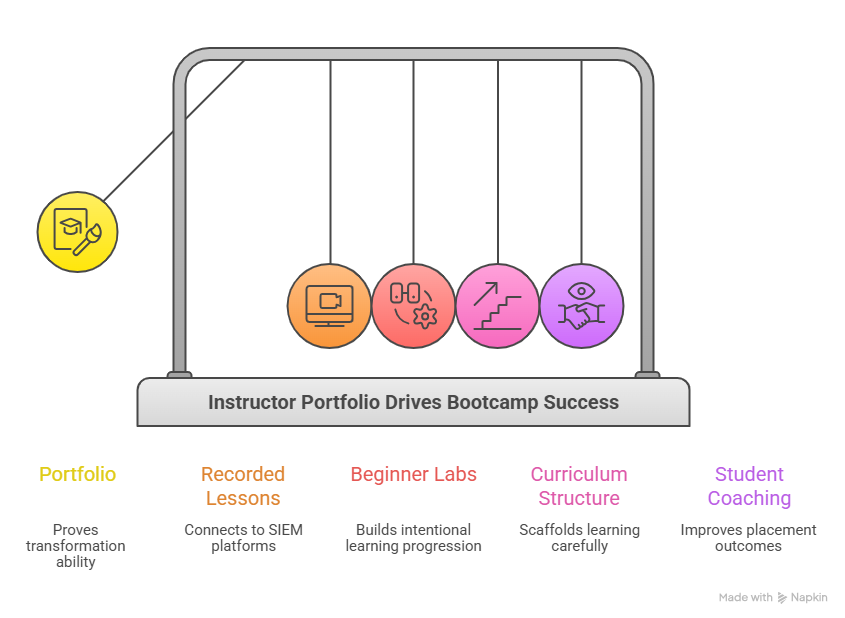
A cybersecurity bootcamp instructor portfolio should prove transformation ability, not just technical knowledge. Employers want evidence that you can guide beginners toward operational competence. Start by creating recorded lessons. Choose topics such as SIEM alert triage, vulnerability prioritization, phishing analysis, access control review, incident response basics, or cloud IAM risk. Explain concepts clearly, narrate reasoning, and walk through practical examples. These assets connect naturally with SIEM platforms, phishing analysis, incident response improvement, access control frameworks, and cloud security engineering.
Next, create beginner-to-intermediate labs with instructor notes. Employers value instructors who can design learning progression intentionally. A good lab explains objectives, prerequisites, setup logic, expected mistakes, troubleshooting hints, and post-lab reflection. Include escalation paths for struggling students and alternate explanations for common confusion points. Build labs around vulnerability scanners, endpoint security tools, cloud security tools, incident response scenarios, and SOC analyst workflows.
Your portfolio should also include curriculum structure examples. Show how you sequence modules, balance theory with hands-on work, and align labs to career outcomes. A weak curriculum overloads students early or jumps randomly between unrelated topics. A strong curriculum scaffolds learning carefully: networking → logging → SIEM → detection → incident response → cloud exposure → governance → career preparation. Connect your curriculum logic to cybersecurity curriculum development, bootcamp research, future cybersecurity skills, cybersecurity educator advancement, and industry training providers.
Finally, show student-readiness coaching ability. Build résumé review templates, interview-prep documents, mock incident-analysis exercises, and portfolio-review rubrics. Explain how students should present labs during interviews, describe escalation decisions, and explain technical workflows under pressure. Employers value instructors who improve placement outcomes, not just lecture completion rates. Strengthen this layer with insight from cybersecurity job trends, salary progression analysis, remote cybersecurity work trends, future specialized roles, and cybersecurity consulting market analysis.
5. Position Yourself for Bootcamp Instructor Roles and Long-Term Growth
The fastest route into bootcamp instruction usually comes through operational experience combined with visible teaching ability. Many successful instructors begin as SOC analysts, security analysts, incident responders, GRC specialists, ethical hackers, or cybersecurity consultants who start mentoring junior staff or publishing educational content. Employers trust instructors who can explain concepts grounded in real operational experience. Build credibility through SOC analyst advancement, ethical hacking pathways, incident responder careers, security analyst progression, and cybersecurity educator growth.
When applying for instructor roles, tailor your résumé around transformation ability. Mention lab development, student mentorship, technical presentations, workshop facilitation, curriculum contributions, onboarding support, troubleshooting guidance, and career coaching. Include technologies honestly, but focus heavily on teaching outcomes and communication clarity. Strong résumés show operational credibility plus instructional structure. This positioning aligns well with cybersecurity instructor careers, curriculum development pathways, content creator careers, cybersecurity manager growth, and security leadership progression.
Interview preparation should include teaching demonstrations. Many bootcamps ask candidates to explain a concept live. Choose examples that reveal structure and calmness under pressure. Good topics include SIEM alerts, phishing investigation, vulnerability prioritization, MFA logic, incident response basics, or cloud IAM mistakes. Explain not only the concept, but how beginners misunderstand it and how you would coach them through confusion. Practice using examples from SIEM tools, phishing attacks, cloud security risks, ransomware trends, and future cybersecurity threats.
Long-term growth can move into lead instructor, curriculum director, bootcamp operations leadership, enterprise cybersecurity training, certification-program design, educational consulting, or cybersecurity education entrepreneurship. Some instructors eventually transition into large-scale training platforms, corporate education, certification-authoring teams, or global workforce-development initiatives. The strongest long-term advantage comes from combining operational cybersecurity credibility with scalable teaching systems. Continue growing through cybersecurity curriculum development, future workforce analysis, AI-driven cybersecurity evolution, future cybersecurity standards, and future job-market predictions.
6. FAQs About Becoming a Cybersecurity Bootcamp Instructor
-
You need enough operational understanding to teach workflows confidently, troubleshoot labs, answer real-world questions, and guide students through employer expectations. Many instructors start after gaining experience in SOC operations, security analysis, incident response, GRC, ethical hacking, or cloud security. Build practical depth through SOC analyst pathways, incident response careers, ethical hacking roadmaps, cloud security engineering, and security analyst advancement.
-
Focus on networking, SIEM workflows, endpoint protection, vulnerability management, incident response, identity and access management, phishing analysis, cloud security basics, and compliance frameworks. You should understand these areas well enough to explain them clearly and troubleshoot confusion during labs. Study SIEM tools, EDR platforms, vulnerability assessment, access control models, and cloud security tools.
-
Create a public teaching portfolio with recorded lessons, structured labs, beginner-friendly walkthroughs, curriculum examples, troubleshooting guides, and mock student exercises. Employers want proof that you can simplify complexity while maintaining technical accuracy. Build portfolio pieces around incident response, phishing analysis, SOC operations, vulnerability management, and cloud risk analysis.
-
Certifications that align with the topics you teach help build credibility. Foundational security certifications, SOC-oriented certifications, cloud security credentials, governance-related credentials, and offensive-security certifications can all strengthen your profile depending on the bootcamp focus. Pair certifications with teaching proof and operational experience using ACSMI’s certification directory, certification impact research, salary-growth analysis, future certification trends, and bootcamp directory.
-
Students trust instructors who stay calm during technical issues, explain concepts clearly, connect lessons to real job workflows, predict common mistakes, and genuinely help students improve instead of showing off expertise. The best instructors reduce intimidation while keeping standards high. Build that balance through studying cybersecurity educator advancement, curriculum development pathways, future workforce trends, remote cybersecurity work, and future cybersecurity skills.
-
Prepare teaching demonstrations, troubleshooting walkthroughs, curriculum examples, and beginner-focused explanations. Expect to explain technical concepts live and respond to simulated student confusion. Strong candidates show structure, patience, clarity, operational realism, and confidence under pressure. Practice using examples from SIEM workflows, incident response, cloud security risks, ransomware analysis, and future cybersecurity threats.
