
The Ultimate Guide to Getting Advanced Cybersecurity & Management Certification in Germany: Everything You Need to Know in 2026–2027
Germany’s cybersecurity market increasingly needs professionals who can connect technical risk with executive decisions, regulatory duties, and measurable business resilience. An Advanced Cybersecurity & Management Certification can strengthen that bridge, especially for candidates pursuing cybersecurity program management, GRC specialization, security architecture leadership, or a transition from IT management into cybersecurity leadership. The decisive question is whether your credential, experience, portfolio, and German-market positioning reinforce one another.
1. Why Advanced Cybersecurity and Management Skills Carry Real Value in Germany
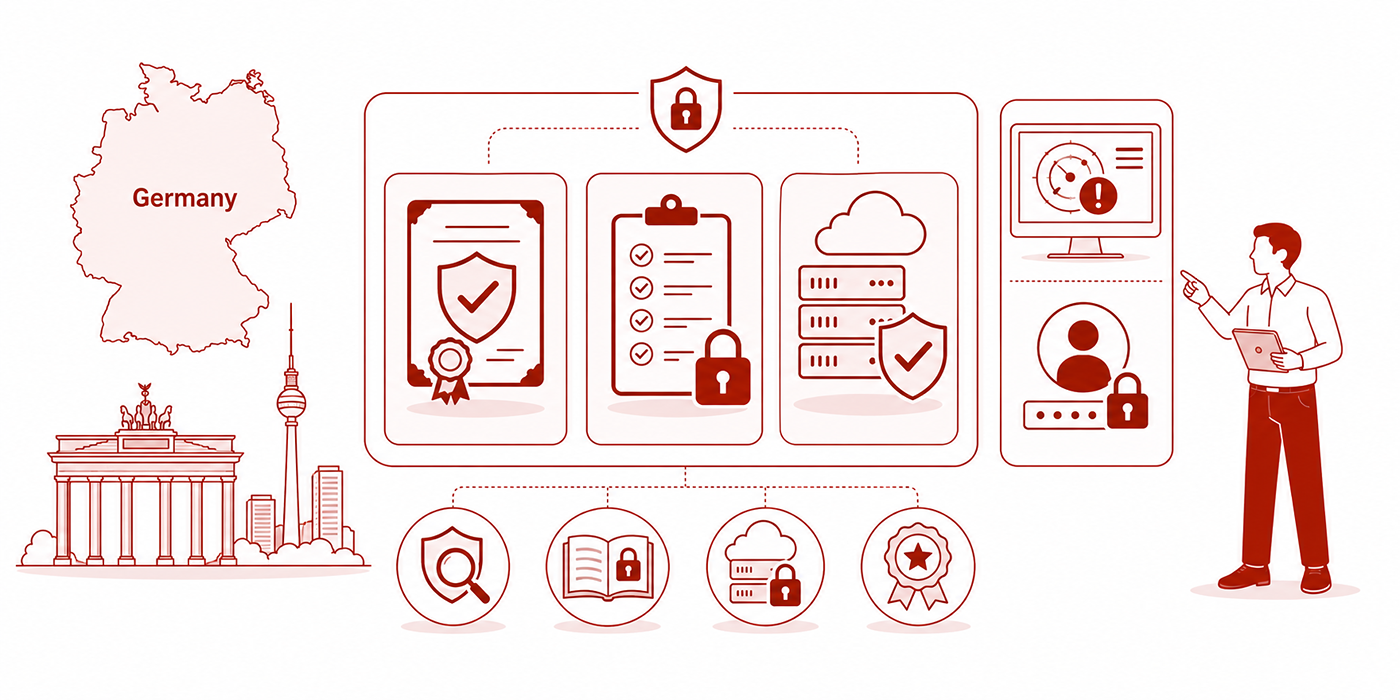
Germany entered 2026 with a materially expanded cybersecurity compliance environment. Its NIS-2 implementation law took effect on 6 December 2025, extending security, governance, and incident-reporting expectations across additional organizations and sectors. The German Federal Government’s NIS-2 overview emphasizes stricter security requirements, reporting duties, and management accountability. That creates demand for professionals who can convert threat information into risk ownership, controls, investment decisions, and executive reporting.
This environment favors blended profiles. A technically capable incident responder can investigate an attack, while a management-oriented practitioner can also establish escalation criteria, quantify business interruption, brief senior leaders, and connect remediation to governance obligations. A cybersecurity risk management specialist can assess exposure, while someone with program leadership competence can prioritize remediation across budgets, dependencies, and deadlines. Candidates who understand both sides can pursue broader responsibility than professionals whose evidence ends with tool knowledge.
The timing also matters. Cyber Resilience Act reporting obligations begin on 11 September 2026, with the regulation’s main obligations applying from 11 December 2027. The European Commission’s implementation timeline gives hardware manufacturers, software producers, product teams, suppliers, and security leaders a limited preparation window. This increases the practical relevance of cybersecurity product management, regulatory specialization, privacy analysis, and secure product-lifecycle governance.
The strongest certification candidate therefore asks a commercial question: “Which decisions will employers trust me to make after I earn this credential?” Someone targeting a Security Operations Center should emphasize detection, triage, response metrics, and crisis coordination through an analyst transition plan. Someone pursuing leadership should demonstrate governance, portfolio prioritization, stakeholder negotiation, and strategic communication through a cybersecurity program manager roadmap. The same certificate produces different value depending on the evidence built around it.
Germany Cybersecurity Certification Value Matrix: 26 Career Targets and Proof Requirements
| Career Target | Knowledge to Prioritize | Portfolio Evidence to Build | Where the Certification Creates Leverage |
|---|---|---|---|
| Cybersecurity analyst | SIEM triage, identity events, endpoint telemetry, vulnerability prioritization | An investigation report connecting alerts, evidence, severity, containment, and lessons learned | Supports the move from general IT support into structured defensive analysis |
| Incident responder | Playbooks, evidence handling, containment decisions, crisis communication | A timed ransomware tabletop with an incident timeline and executive briefing | Shows readiness to coordinate response beyond isolated technical actions |
| GRC specialist | NIS-2, ISO 27001, risk registers, control testing, third-party assurance | A scoped risk assessment with control owners, deadlines, and residual-risk decisions | Demonstrates the ability to turn requirements into operating controls |
| Regulatory specialist | NIS-2, DORA, GDPR intersections, CRA obligations, reporting governance | A regulatory applicability map covering entity, product, jurisdiction, and deadline | Builds credibility for compliance-readiness and policy-interpretation assignments |
| Cyber risk specialist | Risk scenarios, likelihood, business impact, treatment options, risk appetite | A quantified risk register with treatment cost and decision rationale | Connects technical findings with management-level investment choices |
| Security policy analyst | Policy hierarchy, control intent, exception handling, enforcement, review cycles | A policy package containing standards, procedures, metrics, and exception workflow | Supports roles requiring defensible, implementable governance documentation |
| Cybersecurity policy director | Enterprise governance, regulatory strategy, board reporting, policy ownership | A three-year governance roadmap with accountable owners and maturity targets | Signals preparation for policy leadership across multiple business units |
| Cybersecurity auditor | Evidence sampling, control design, operating effectiveness, finding severity | An audit workpaper set with evidence requests and defensible conclusions | Strengthens the transition from general IT audit into security-focused assurance |
| Privacy analyst | Data flows, access control, breach assessment, retention, privacy risk | A data-flow review connecting processing activities with security controls | Shows an ability to bridge cybersecurity safeguards and privacy obligations |
| Cybersecurity program manager | Roadmaps, budgets, dependencies, RAID logs, benefits realization | A portfolio dashboard showing scope, milestones, risk, cost, and outcomes | Validates management vocabulary alongside cybersecurity understanding |
| Cybersecurity product manager | Secure development, vulnerability handling, customer risk, product strategy | A secure-product backlog mapped to CRA lifecycle obligations | Supports product-security coordination ahead of CRA implementation milestones |
| Chief security architect | Reference architecture, trust boundaries, design assurance, technical standards | A target-state architecture with trade-offs, threat model, and migration plan | Shows the ability to govern design decisions across complex environments |
| VP of Security | Strategy, operating models, investment governance, executive metrics | A board-ready security strategy connected to business objectives and risk appetite | Strengthens leadership positioning when combined with substantial delivery history |
| Cybersecurity leader | Security governance, organizational change, stakeholder alignment, assurance | A 100-day security leadership plan with priorities and success measures | Helps experienced IT managers translate existing leadership into security outcomes |
| Chief Privacy Officer | Privacy governance, breach oversight, data strategy, executive accountability | A privacy operating model defining committees, ownership, and escalation | Provides complementary cybersecurity context for privacy leadership |
| Ethical hacker | Network attack paths, validation, reporting, remediation communication | A sanitized assessment report with reproducible evidence and prioritized fixes | Adds risk and stakeholder context to an infrastructure-heavy background |
| Offensive security engineer | Adversary simulation, exploitation methodology, detection feedback, ethics | A lab engagement demonstrating discovery, exploitation, reporting, and cleanup | Broadens offensive capability with governance and management awareness |
| Red team operator | Threat emulation, operational security, objectives, deconfliction, reporting | A rules-of-engagement package and after-action report tied to defensive improvement | Shows disciplined operational thinking alongside technical execution |
| Penetration testing manager | Scoping, quality assurance, staffing, client communication, remediation governance | An engagement plan with effort estimates, acceptance criteria, and QA gates | Supports advancement from individual testing into delivery leadership |
| Vulnerability researcher | Root-cause analysis, responsible disclosure, exploitability, remediation coordination | A responsible-disclosure case study with technical evidence and impact analysis | Adds product-risk and stakeholder discipline to deep technical research |
| Blockchain security engineer | Smart-contract threats, key management, protocol risk, secure architecture | A threat model and audit report for a controlled decentralized application | Connects specialist engineering with enterprise risk and governance |
| AI security analyst | Model threats, data poisoning, prompt attacks, access control, AI governance | An AI-system threat model with mitigations, owners, and test procedures | Supports work where AI Act governance and security engineering intersect |
| Quantum security analyst | Cryptographic inventory, migration risk, crypto-agility, post-quantum planning | A phased cryptographic migration plan prioritized by exposure and system lifetime | Creates an evidence-based entry into an emerging security planning area |
| Cybersecurity data scientist | Security telemetry, feature engineering, model validation, false-positive economics | A detection model evaluated through precision, recall, drift, and analyst workload | Shows the ability to connect analytics performance with operational value |
| Security automation engineer | SOAR, APIs, identity workflows, testing, failure handling, auditability | An automated response workflow with rollback, approvals, logs, and time saved | Demonstrates scalable security delivery and measurable process improvement |
| Identity management specialist | IAM governance, privileged access, lifecycle controls, federation, access reviews | A joiner-mover-leaver design with control evidence and exception treatment | Supports roles where identity is managed as both a technical and business-control domain |
2. How to Evaluate Certification Eligibility, Recognition, and Employer Fit
Advanced programs commonly suit practitioners with foundations in IT, cybersecurity, audit, risk, privacy, engineering, project delivery, or operational management. Relevant backgrounds can include a candidate moving from network administration into ethical hacking, an auditor following a cybersecurity audit pathway, or an experienced manager pursuing security leadership. Applicants should still check the provider’s formal prerequisites, assessment method, identity-verification rules, renewal requirements, and permitted exam attempts.
The word “advanced” deserves careful examination. A valuable curriculum should progress beyond definitions and ask learners to make defensible decisions with incomplete information. Look for risk scenarios, incident simulations, control selection, regulatory mapping, security investment prioritization, executive communication, and program governance. Candidates aiming for cybersecurity policy analysis should encounter policy exceptions and control enforcement. Future penetration testing managers should practice scoping, resource planning, report quality, and remediation escalation.
Recognition also has several layers:
Provider recognition: Can employers verify the issuing organization and credential?
Curriculum relevance: Does the syllabus address capabilities appearing in target vacancies?
Assessment integrity: Does completion require credible examination, applied work, or verified competence?
Market portability: Can the learning support roles outside one company, tool, or country?
Professional evidence: Can you demonstrate the claimed competence through projects and decisions?
A professional certification can strengthen an application for GRC work, security program management, security policy leadership, or privacy-focused cybersecurity. German immigration authorities assess residence eligibility through statutory criteria such as job offers, salary thresholds, recognized qualifications, and documented professional experience. The certificate operates as career evidence within that larger file.
For 2026, Germany’s official EU Blue Card guidance lists a standard gross annual salary threshold of €50,700. A lower threshold of €45,934.20 applies to shortage occupations and qualifying recent graduates, subject to relevant conditions. IT specialists may also qualify without a degree when they can demonstrate at least three years of university-level IT experience within the previous seven years and satisfy the applicable employment conditions. Candidates should verify the current figures through the federal EU Blue Card guidance, because thresholds are updated annually.
German-language ability also changes the reachable job pool. English can support applications to multinational companies, technology businesses, consultancies, and internationally distributed teams. German becomes increasingly influential in regulated organizations, public-sector environments, Mittelstand companies, local stakeholder workshops, audit interviews, and policy implementation. A candidate pursuing a regulatory specialist career or cybersecurity policy director pathway gains practical leverage from reading requirements and conducting meetings in German.
Before enrolling, collect ten to fifteen German vacancies matching your intended destination. Extract recurring responsibilities, frameworks, tools, language requirements, seniority expectations, and evidence requested. Compare them with the syllabus. A candidate targeting digital identity management should find IAM governance, privileged access, and lifecycle controls. Someone pursuing cybersecurity automation engineering should find APIs, orchestration, testing, logging, and failure handling. A visible mismatch at this stage prevents an expensive credential with weak career alignment.
3. A High-Performance Study and Certification Strategy
Begin with a competency baseline covering governance, risk, technical security, incident management, architecture, privacy, regulation, communication, and program delivery. Rate each area according to three evidence levels: knowledge you can explain, work you can perform, and outcomes you can prove. This exposes a common pain point among experienced professionals: years of responsibility can coexist with poorly organized evidence. A senior analyst pursuing security leadership may already manage incidents and mentor colleagues while lacking board metrics, budget ownership, or documented strategic planning.
Build the study plan backward from the assessment. Divide the syllabus into weekly outputs instead of passive reading targets. A governance week should produce a control map. A risk week should produce a quantified scenario. An incident-management week should produce a tabletop report. An architecture week should produce a threat model and design decision. This approach supports candidates moving toward chief security architecture, cybersecurity risk management, incident response, and program management.
Use Germany-specific scenarios throughout your preparation. Examples include:
A manufacturer preparing product-security reporting for the Cyber Resilience Act
A healthcare provider implementing NIS-2 governance and incident escalation
A financial entity coordinating DORA controls with existing security operations
A cloud service provider strengthening assurance under BSI-oriented requirements
A Mittelstand organization managing supplier access and ransomware exposure
A multinational aligning German operations with group-wide cybersecurity policy
These scenarios help a future cybersecurity regulatory specialist distinguish applicability from implementation. They also help a cybersecurity product manager connect secure development, vulnerability handling, reporting, and customer assurance. Germany’s BSI 2025 security assessment describes the threat situation as continuing to be tense, giving candidates a clear reason to practice operationally realistic decisions.
Create a portfolio with five compact artifacts:
A two-page executive cyber-risk briefing
A NIS-2 readiness gap assessment
A ransomware tabletop and after-action report
A security investment roadmap with priorities and owners
A technical-to-business case study from your strongest specialty
Each artifact should expose your reasoning. A vulnerability researcher can translate exploitability into product and business impact. An offensive security engineer can connect findings with control improvement. A security data scientist can explain how detection performance affects analyst workload and risk. A privacy analyst can connect data flows with access control, retention, and breach response.
Use retrieval practice for the knowledge component and timed decision exercises for the management component. Management questions often turn on prioritization, ownership, communication, and proportionality. Create short scenarios in which several answers appear technically plausible, then identify which response best protects the organization while respecting scope, evidence, regulation, and business continuity. This is especially important for professionals targeting security leadership, policy analysis, or GRC specialization.
Quick Poll: What Could Stop Your Certification From Creating Career Results in Germany?
Choose the barrier currently limiting your return on certification. Your answer will reveal the next evidence you should build.
Your priority: Build two decision-based case studies. Show the problem, evidence, options considered, selected action, stakeholder communication, and measurable outcome.
Your priority: Select one primary role and one adjacent role. Extract recurring requirements from 10–15 German vacancies and map every study activity to those requirements.
Your priority: Combine workplace German with cybersecurity vocabulary. Practise explaining risks, controls, incidents, and recommendations in concise, stakeholder-ready language.
Your priority: Verify the issuer, assessment, syllabus, credential-checking method, renewal policy, and graduate evidence. Pair the certification with a focused portfolio.
Your priority: Review the official residence pathway separately. Track qualification recognition, relevant experience, contract length, salary thresholds, and annual rule changes.
4. How to Convert the Certification Into a Cybersecurity Job in Germany
Start the job search before completing the program. Waiting until graduation creates a gap between learning and market feedback. Build a target list containing German employers, international employers with German operations, cybersecurity consultancies, managed security providers, manufacturers, financial institutions, healthcare organizations, cloud providers, and public-sector suppliers. Segment them according to role fit, language requirements, regulation exposure, and willingness to hire internationally.
Choose a precise professional identity. “Cybersecurity professional” gives recruiters little usable information. “NIS-2 and ISO 27001-focused GRC specialist,” “cloud incident responder,” “IAM governance analyst,” or “security program manager for regulated transformation” communicates a credible destination. The GRC specialist pathway, incident response roadmap, identity management career guide, and cybersecurity program management guide show how sharply those routes differ.
Rewrite your résumé around security outcomes. Replace responsibility-only statements with evidence such as:
Reduced privileged-access exceptions by redesigning approval and review ownership
Coordinated an incident tabletop across security, legal, operations, and communications
Prioritized vulnerabilities using exploitability, asset criticality, exposure, and business impact
Converted audit findings into a funded remediation roadmap with accountable owners
Automated repetitive response tasks while preserving approvals, logging, and rollback
These outcomes support applications for cybersecurity automation engineering, IT-to-cybersecurity audit transitions, security risk management, and executive security progression. Every bullet should answer three questions: what changed, how you influenced it, and why the result mattered.
Translate certification learning into German-market keywords with judgment. NIS-2, BSI IT-Grundschutz, ISO/IEC 27001, DORA, GDPR, Cyber Resilience Act, KRITIS, ISMS, SOC, IAM, cloud security, incident response, and third-party risk may improve discoverability when they truthfully represent your capability. A regulatory career candidate should distinguish familiarity from implementation experience. A policy analyst should show how requirements become enforceable standards, procedures, metrics, and exceptions.
Prepare six interview stories: a difficult risk decision, a security incident, a stakeholder disagreement, a failed control, a prioritization conflict, and a measurable improvement. Use context, decision, action, and result. Candidates targeting penetration testing management should explain scope and remediation governance. Aspiring chief security architects should explain design trade-offs. Future cybersecurity product managers should explain how security requirements influenced backlog, release, support, or customer decisions.
International applicants should operate two parallel tracks. The career track builds employer fit, interviews, and evidence. The immigration track verifies the appropriate residence route, recognized qualification status, experience requirements, salary thresholds, and documentation. Germany’s official IT-professional visa guidance explains routes for formally qualified applicants and experienced IT specialists. Keeping these tracks connected prevents a painful situation in which a candidate earns the credential yet pursues jobs that cannot support the intended residence pathway.

5. Costs, Return on Investment, and a 12-Month Germany Roadmap
Calculate total investment across tuition, examination, retakes, study materials, renewal, travel, translation, language learning, and time away from paid work. Ask the provider for a written cost schedule and refund terms. A low advertised fee can become expensive when assessment, resits, or renewal are separate. A higher fee can produce weak value when assessment integrity, employer relevance, and graduate evidence remain unclear.
Evaluate return through career movement rather than salary alone. Useful outcomes include entry into cybersecurity, advancement from technical execution to decision ownership, access to regulated-sector roles, stronger interview conversion, eligibility for larger programs, and improved mobility across EU-oriented security functions. A professional following the security analyst transition route may value a first defensive role. An experienced practitioner following the VP of Security pathway needs evidence of strategy, organizational influence, investment governance, and business outcomes.
Use the following 12-month execution plan:
Months 1–2: Select the destination. Choose one primary role, analyze German vacancies, assess language requirements, and compare the syllabus with market demand. Study the relevant career research analyst route, privacy analyst pathway, GRC career guide, or security architecture roadmap.
Months 3–4: Build foundations and evidence. Complete core governance, risk, technical, and management modules. Produce a risk register, incident report, policy map, and architecture decision. Candidates targeting ethical hacking or red-team operations should connect offensive evidence with remediation and defensive learning.
Months 5–6: Specialize. Choose one domain aligned with vacancies: GRC, incident response, product security, IAM, cloud, offensive security, privacy, or automation. Follow a focused automation engineering pathway, digital identity roadmap, AI security analyst guide, or blockchain security engineering route.
Months 7–8: Prepare for assessment. Use timed practice, decision scenarios, weak-area review, and teach-back sessions. Convert every major syllabus domain into a portfolio artifact or interview story. This is especially valuable for cybersecurity trainers and bootcamp instructors, whose credibility depends on explaining complex decisions accurately.
Months 9–10: Enter the market. Publish selected sanitized projects, optimize your résumé, begin networking, and apply to tightly matched roles. Candidates interested in education can develop a cybersecurity content and educator portfolio, while technical candidates can demonstrate work aligned with vulnerability research or security data science.
Months 11–12: Improve conversion. Track application response rate, interview progression, recurring objections, missing skills, language barriers, and salary alignment. Adjust your evidence according to actual employer feedback. Leadership candidates should refine their cybersecurity program management positioning and IT-management transition strategy.
A sensible decision rule is simple: enroll when the curriculum closes a documented competency gap, the assessment creates credible evidence, and the target German roles value the resulting capabilities. Career returns become strongest when certification, applied work, language development, and market outreach run concurrently.
6. Frequently Asked Questions About Advanced Cybersecurity & Management Certification in Germany
-
Most German cybersecurity roles assess a combination of competence, experience, education, communication, and role-specific evidence. Certification can strengthen applications for GRC specialization, cybersecurity program management, security policy analysis, and security architecture. Employers can still require particular academic qualifications, professional experience, language ability, security clearance eligibility, or technology expertise.
-
The EU Blue Card decision depends on statutory requirements, including an eligible job offer, contract duration, salary, qualification or qualifying IT experience, and other applicable conditions. In 2026, the published thresholds are €50,700 generally and €45,934.20 for specified lower-threshold cases. A candidate can use the certification to improve competitiveness for roles such as cybersecurity analyst, risk specialist, or identity specialist, while immigration eligibility remains a separate official assessment.
-
Many professional certification programs accept candidates from IT, engineering, audit, privacy, risk, compliance, project management, and business operations. Provider prerequisites determine formal eligibility. Germany also provides certain immigration routes for experienced IT professionals without a university degree, subject to specific work-history, job, and salary conditions. A career changer can strengthen the transition through an IT support-to-security roadmap, network-to-ethical-hacking plan, or IT-audit transition pathway.
-
English supports opportunities in multinational employers, technology companies, research environments, and distributed security teams. German expands access to local organizations, stakeholder-facing roles, regulated sectors, policy work, consulting engagements, and management positions. Professionals pursuing regulatory specialization, cybersecurity policy leadership, privacy leadership, or security executive progression gain particular value from business-level German.
-
Prioritize NIS-2 and its German implementation, the BSI framework relevant to your sector, GDPR, DORA for financial entities, and the Cyber Resilience Act for products with digital elements. CRA reporting obligations start on 11 September 2026, while the main requirements apply from 11 December 2027. These developments increase the relevance of cybersecurity product management, regulatory cybersecurity work, GRC specialization, and policy analysis.
-
Choose a project matching the target role. A cybersecurity incident responder should build a tabletop and investigation report. A security architect should produce a threat model and target-state design. A program manager should present a funded roadmap with dependencies and metrics. A regulatory specialist should create an applicability and implementation matrix.
