
The Ultimate Guide to Getting Advanced Cybersecurity & Management Certification in Spain: Everything You Need to Know in 2026–2027
Spain’s cybersecurity industry is moving beyond isolated technical defense toward governance, resilience, product security, and executive accountability. An Advanced Cybersecurity & Management Certification can help professionals prepare for cybersecurity program management, GRC specialization, security architecture leadership, and the transition from IT management into cybersecurity leadership. Career value ultimately depends on how well the credential aligns with Spanish employer needs, regulatory frameworks, practical evidence, language ability, and the candidate’s existing professional foundation.
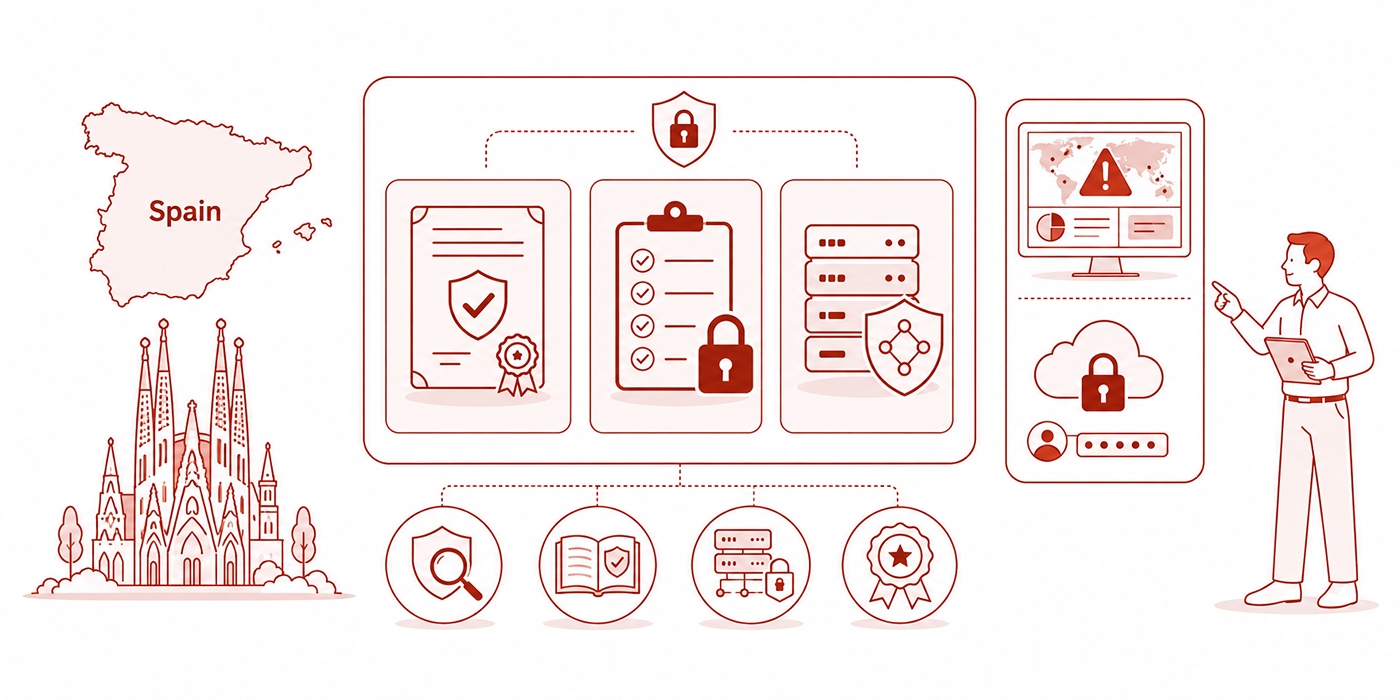
1. Why Advanced Cybersecurity and Management Skills Matter in Spain
Spain has developed one of Europe’s largest cybersecurity ecosystems. According to INCIBE’s 2025 industry study, released in March 2026, the sector generated more than €6.351 billion in revenue and supported approximately 164,761 jobs. Spain ranked as Europe’s fourth-largest cybersecurity market, with 3,431 companies operating across security products, services, consulting, managed operations, training, and specialist technologies.
INCIBE projects annual employment growth of 14.25% between 2026 and 2029, potentially taking the sector beyond 282,000 workers. That expansion creates opportunities for professionals entering through a cybersecurity analyst pathway, experienced specialists pursuing incident response careers, managers building cybersecurity leadership credentials, and auditors following a cybersecurity audit transition.
Demand is also being shaped by Spain’s threat environment. Spanish authorities recorded 488,426 cybercrimes in 2025, representing 19.8% of all recorded crime and a 5.1% increase over 2024. Computer fraud accounted for 429,677 cases. These official cybercrime figures reinforce the need for professionals who can coordinate prevention, detection, investigation, recovery, customer protection, and executive decision-making.
Spain’s regulatory environment adds another layer of opportunity. The Esquema Nacional de Seguridad, or ENS, establishes security principles and measures for public-sector information systems and private suppliers serving public bodies. Updated CCN-STIC guidance strengthens governance, auditing, system categorization, security policies, and compliance verification. This makes ENS knowledge especially valuable for GRC specialists, cybersecurity auditors, policy analysts, and professionals pursuing cybersecurity regulatory careers.
NIS2 creates additional preparation work. On 8 July 2026, the European Commission referred Spain to the Court of Justice of the European Union for failing to notify full national transposition. Spain’s proposed Cybersecurity Coordination and Governance Law is intended to incorporate NIS2, expand covered sectors, and strengthen national coordination. Organizations still need risk-management, supply-chain security, incident-reporting, business-continuity, and management-accountability capabilities while the legislative process continues.
The Cyber Resilience Act also affects companies producing or distributing software and connected products. Reporting duties begin on 11 September 2026, followed by the main requirements on 11 December 2027. These deadlines increase the relevance of cybersecurity product managers, vulnerability researchers, security architects, and security automation engineers who can integrate security throughout a product’s lifecycle.
Spain Cybersecurity Certification Matrix: 26 Career Targets, Skills and Proof Projects
| Career Target | Spain-Relevant Knowledge | Best Portfolio Evidence | Certification Leverage |
|---|---|---|---|
| Cybersecurity analyst | SIEM, endpoint telemetry, identity events and vulnerability triage | An alert investigation showing evidence, severity, containment and lessons learned | Supports movement from general IT into defensive security operations |
| Incident responder | Incident classification, evidence preservation, escalation and recovery | A ransomware tabletop with a decision timeline and executive report | Demonstrates readiness for coordinated incident management |
| GRC specialist | ENS, NIS2, ISO 27001, GDPR and third-party governance | An applicability matrix and risk-based remediation plan | Connects regulatory knowledge with implementable controls |
| Regulatory specialist | NIS2, DORA, CRA, ENS and sector-specific obligations | A regulatory horizon map with owners and deadlines | Supports compliance-readiness and advisory assignments |
| Cyber risk specialist | Risk scenarios, likelihood, impact, treatment and risk appetite | A quantified risk register with treatment costs and residual risk | Shows management-ready security decision-making |
| Security policy analyst | Policy hierarchy, ENS controls, exceptions and enforcement | A policy package with standards, metrics and exception workflow | Demonstrates the ability to convert requirements into operating rules |
| Cybersecurity policy director | Enterprise governance, accountability and regulatory strategy | A three-year security governance roadmap | Supports progression into multi-unit policy leadership |
| Cybersecurity auditor | ENS auditing, evidence sampling and operating effectiveness | Audit workpapers with findings, evidence and corrective actions | Strengthens movement from general IT audit into security assurance |
| Privacy analyst | GDPR, data flows, breach assessment, access and retention | A processing-risk review connected to security controls | Combines privacy duties with practical cyber risk management |
| Cybersecurity program manager | Budgets, roadmaps, dependencies, benefits and stakeholder governance | A security portfolio dashboard with milestones and risk | Validates management capability alongside cybersecurity knowledge |
| Cybersecurity product manager | CRA, secure development, vulnerability handling and product risk | A product-security backlog mapped to CRA obligations | Supports product teams preparing for 2026–2027 CRA deadlines |
| Security architect | Trust boundaries, reference architecture and design assurance | A target-state architecture with a threat model and migration plan | Shows disciplined security design and technical governance |
| VP of Security | Strategy, investment governance, executive metrics and operating models | A board-ready strategy connected to business risk | Reinforces executive positioning when paired with leadership history |
| Cybersecurity leader | Organizational change, assurance, resilience and accountability | A 100-day security leadership plan | Helps IT managers translate existing leadership into security outcomes |
| Chief Privacy Officer | Privacy governance, breach oversight and data strategy | A privacy operating model with escalation and ownership | Adds cybersecurity context to senior privacy leadership |
| Ethical hacker | Attack paths, validation, reporting and remediation | A sanitized penetration-testing report with reproducible evidence | Converts infrastructure experience into offensive-security evidence |
| Offensive security engineer | Exploitation, adversary behavior, detection feedback and ethics | A controlled lab engagement from discovery through cleanup | Adds management and risk context to technical testing |
| Red team operator | Threat emulation, operational security and deconfliction | Rules of engagement and an after-action report | Shows controlled adversary simulation with business discipline |
| Penetration testing manager | Scoping, staffing, quality assurance and remediation governance | An engagement plan with effort estimates and QA gates | Supports progression from testing into delivery management |
| Vulnerability researcher | Root cause, disclosure, exploitability and product coordination | A responsible-disclosure case study | Connects technical research with CRA-era vulnerability handling |
| Blockchain security engineer | Smart contracts, key management and protocol risk | A threat model and controlled smart-contract assessment | Connects specialist engineering with enterprise governance |
| AI security analyst | Model threats, data security, access and AI governance | An AI threat model with controls, owners and tests | Supports roles combining AI adoption with security oversight |
| Quantum security analyst | Cryptographic inventory, crypto-agility and migration planning | A risk-prioritized post-quantum migration roadmap | Creates evidence for an emerging strategic-security specialty |
| Cybersecurity data scientist | Security telemetry, detection models, drift and false-positive cost | A detection model evaluated against operational workload | Links analytical accuracy with security outcomes |
| Security automation engineer | SOAR, APIs, approvals, logging and failure handling | An automated response workflow with rollback controls | Demonstrates measurable improvements in security delivery |
| Identity specialist | IAM governance, privileged access and identity lifecycle | A joiner-mover-leaver design with review evidence | Supports identity roles across regulated and public-sector environments |
2. How to Choose a Credible Certification for the Spanish Market
Start with the target role. A candidate pursuing incident response needs different evidence from someone entering cybersecurity policy analysis, penetration testing management, or privacy-focused cybersecurity. Selecting a credential before identifying the role often produces broad knowledge with weak hiring relevance.
Collect fifteen Spanish job descriptions for the position you want. Record recurring frameworks, tools, responsibilities, language requirements, experience levels, and evidence expected. Madrid offers strong exposure to headquarters, financial services, consulting, telecom, public-sector suppliers, and multinational operations. Barcelona has significant technology, product, startup, e-commerce, and international business activity. Valencia, Málaga, Bilbao, Seville, and León also support growing technology and cybersecurity communities.
Compare the findings with the curriculum. A strong advanced program should include governance, risk analysis, incident management, security architecture, leadership communication, budgeting, regulatory interpretation, third-party risk, and program delivery. Candidates targeting security product management should find secure lifecycle and vulnerability-handling content. Future cybersecurity risk specialists should practice scenario development, treatment decisions, and residual-risk acceptance.
Examine the assessment method carefully. Multiple-choice testing can verify knowledge recall. Applied assignments, case analysis, scenario-based examinations, and documented projects provide stronger evidence of professional judgment. A future chief security architect should be tested on design trade-offs. A prospective cybersecurity program manager should demonstrate prioritization, dependency management, and executive reporting.
Verify the provider’s legal identity, instructor credentials, syllabus version, examination integrity, credential-verification method, retake policy, refund terms, renewal requirements, and data-protection practices. Ask for sample lessons and assessment examples. Graduate testimonials become more useful when they identify the candidate’s starting position, completed work, target role, and actual result.
Professional certification and formal academic recognition serve different purposes. A professional credential can strengthen applications and demonstrate focused development. Spanish immigration or university processes may separately assess degrees, qualifications, experience, employment contracts, and regulated-profession requirements. Candidates planning relocation should keep the cybersecurity career pathway and immigration pathway connected while documenting each independently.
Spanish-language ability can substantially expand the reachable market. English may support multinational technology companies, international consulting teams, product businesses, and shared-service environments. Spanish becomes especially valuable in local stakeholder engagement, policy implementation, audits, public-sector work, customer-facing consulting, and management. Professionals targeting GRC careers, cybersecurity policy leadership, or privacy leadership should treat professional Spanish as a career asset.
3. How to Study, Pass and Build Spain-Relevant Evidence
Begin with a baseline assessment across technical security, governance, risk, incident response, architecture, regulation, privacy, communication, and program delivery. Score each area according to what you can explain, perform, and prove. This prevents experienced candidates from assuming that time served automatically translates into evidence suitable for a security leadership transition, VP of Security progression, or cybersecurity policy director role.
Build the study schedule around weekly deliverables. A risk module should produce a risk register. An incident module should create a decision timeline. A governance module should produce an accountability matrix. An architecture module should generate a threat model. A regulatory module should create an applicability analysis. These artifacts strengthen candidates following a cybersecurity audit pathway, security architecture roadmap, regulatory specialist route, or risk management career plan.
Use Spanish-market scenarios during preparation:
An autonomous-community supplier preparing for an ENS audit
A financial organization aligning security operations with DORA
A manufacturer preparing CRA vulnerability-reporting procedures
A healthcare provider evaluating NIS2 exposure and incident escalation
A tourism platform managing payment fraud and customer-account compromise
A managed security provider improving SOC governance and service evidence
A municipality reviewing identity, supplier access, and resilience controls
These scenarios force candidates to connect frameworks with operational decisions. Someone following an offensive security roadmap can show how findings influence risk treatment. A red-team operator can explain how threat emulation improves detection. A vulnerability researcher can document responsible disclosure and product remediation.
Create five portfolio artifacts before completing the certification:
An ENS-oriented control and evidence matrix
A NIS2 readiness assessment based on a defined organization
A ransomware tabletop with executive decisions
A CRA vulnerability-handling workflow
A one-page cybersecurity investment briefing
Every artifact should identify scope, assumptions, assets, risk, decisions, owners, evidence, and measurable outcomes. This structure supports cybersecurity program managers, policy analysts, security automation engineers, and identity management specialists.
Use retrieval practice for definitions and timed scenarios for judgment. Advanced management questions usually test prioritization, proportionality, ownership, escalation, and business impact. Study groups can improve reasoning when members challenge one another’s assumptions. Teaching a topic also exposes hidden knowledge gaps, making this method especially useful for aspiring cybersecurity trainers, bootcamp instructors, and cybersecurity educators.
Quick Poll: What Is Blocking Your Cybersecurity Career Progress in Spain?
Choose the obstacle most likely to weaken your certification return and reveal your next priority.
Your priority: Build two role-specific case studies showing the problem, evidence, decision, stakeholders, action, and measurable result.
Your priority: Select one primary role and analyze 15 Spanish vacancies. Map the repeated requirements directly to your study plan.
Your priority: Practise explaining risks, incidents, controls, and recommendations in professional Spanish through short written and spoken exercises.
Your priority: Verify the issuer, syllabus, assessment, credential-checking method, renewal terms, and graduate evidence before paying.
Your priority: Create a separate immigration checklist covering qualification recognition, experience, contract, salary, documentation, and current official rules.
4. How to Convert the Certification Into a Cybersecurity Job in Spain
Define your market identity in one sentence. “Cybersecurity professional” gives employers limited information. “ENS-focused security auditor,” “NIS2 readiness consultant,” “cloud incident responder,” “IAM governance specialist,” or “CRA-focused product security manager” communicates a recognizable problem you can solve. Use a relevant GRC roadmap, incident response career plan, identity management pathway, or product-security roadmap to sharpen that positioning.
Rewrite your résumé around outcomes and decisions. Replace “responsible for vulnerability management” with evidence showing how vulnerabilities were prioritized using exposure, exploitability, asset criticality, and operational impact. Replace “supported security audits” with the controls assessed, evidence collected, gaps identified, and remediation achieved. These improvements strengthen applications for cybersecurity auditors, risk management specialists, security program managers, and automation engineers.
Maintain Spanish and English versions of the résumé when targeting both local and international employers. Translate meaning and market vocabulary carefully instead of performing a literal word-for-word conversion. Relevant Spanish terms may include ciberseguridad, gestión de riesgos, respuesta a incidentes, Esquema Nacional de Seguridad, análisis de vulnerabilidades, continuidad de negocio, gestión de identidades, cumplimiento normativo, and seguridad de la información.
Prepare six interview stories covering an incident, a difficult risk decision, a failed control, a stakeholder disagreement, a prioritization conflict, and a measurable improvement. A future penetration testing manager should explain scoping and quality assurance. A security architect should explain trade-offs. An aspiring cybersecurity leader should explain accountability, investment, and organizational change.
Use a focused application system. Score each vacancy for role alignment, required experience, Spanish level, location, work authorization, compensation, and evidence match. Apply heavily where the match is strong. Track response rate, screening conversion, technical interview conversion, recurring objections, and missing capabilities. This converts the search into an evidence-based improvement process.
Candidates relocating from outside the EU should review immigration criteria through official Spanish sources. Spain’s 2026 EU Blue Card rules use a reference salary of 1.4 times the published average annual gross earnings, with a reduced coefficient in specified cases. The relevant BOE order took effect on 31 January 2026. Immigration eligibility depends on current statutory conditions, while the certification helps improve professional positioning for roles such as cybersecurity analyst, regulatory specialist, or security program manager.

5. Costs, ROI and a 12-Month Certification Roadmap
Calculate the entire acquisition cost: tuition, examination, retakes, materials, renewal, translation, language learning, travel, and study time. Request a written fee schedule before enrollment. Check whether the advertised price includes assessment, digital verification, certificate issuance, instructor support, practical projects, and retake access.
Measure return through career movement. Useful results include entering cybersecurity, gaining interview traction, moving into a specialist role, obtaining leadership responsibility, accessing regulated-sector work, or improving eligibility for international positions. A candidate following an analyst transition pathway may prioritize the first security role. Someone pursuing VP of Security progression needs evidence of strategy, investment governance, organizational influence, and business outcomes.
Use this 12-month plan:
Months 1–2: Select one target role, analyze Spanish vacancies, assess your language level, and compare the curriculum with market requirements. Explore the relevant security research analyst path, privacy analyst guide, GRC pathway, or security architecture route.
Months 3–4: Study governance, risk, technical security, incident management, and regulation. Create an ENS matrix, risk assessment, and incident tabletop. Offensive candidates can follow an ethical hacking transition or red-team development plan.
Months 5–6: Specialize in GRC, cloud, identity, product security, privacy, automation, offensive security, or incident response. Use the IAM specialist roadmap, automation engineering guide, AI security pathway, or blockchain security route to structure deeper practice.
Months 7–8: Complete timed assessments, close weak areas, and refine five portfolio artifacts. Practise explaining each artifact in Spanish and English. Future cybersecurity instructors and certification trainers should record short teach-back sessions.
Months 9–10: Publish sanitized work, optimize professional profiles, begin targeted networking, and apply to carefully matched positions. Technical candidates can demonstrate vulnerability research, security data science, or offensive engineering.
Months 11–12: Analyze employer feedback, improve interview stories, address missing skills, and refine the application strategy. Leadership candidates should strengthen their program management positioning, policy leadership evidence, and executive security roadmap.
6. Frequently Asked Questions About Cybersecurity Certification in Spain
-
Recognition depends on the provider’s reputation, assessment integrity, curriculum relevance, verification process, and employer familiarity. The credential becomes stronger when paired with practical evidence supporting GRC work, cybersecurity program management, security architecture, or incident response.
-
Spanish authorities assess the Blue Card through official qualification, employment, salary, and documentation requirements. A certification can improve competitiveness for cybersecurity analyst roles, risk positions, identity careers, and security management jobs. Immigration eligibility receives a separate statutory assessment.
-
Provider prerequisites determine certification eligibility. Professionals frequently enter advanced cybersecurity education from IT, audit, engineering, privacy, compliance, risk, and project management. Career changers can build foundations through an IT support transition, network administration transition, IT audit pathway, or cybersecurity research route.
-
English can support roles in multinational and internationally distributed organizations. Spanish increases access to local employers, public-sector suppliers, consulting, auditing, governance, customer-facing work, and leadership. The language carries particular value for policy analysts, regulatory specialists, privacy professionals, and cybersecurity leaders.
-
Prioritize ENS, NIS2 developments, GDPR, DORA where financial services are involved, and the Cyber Resilience Act for products with digital elements. This knowledge strengthens pathways in GRC, cybersecurity auditing, product security, and cybersecurity policy.
-
Choose a project aligned with the target position. An incident responder should build a tabletop and investigation report. A security architect should produce a threat model. A regulatory specialist should create an applicability matrix. A program manager should present a roadmap with cost, owners, dependencies, and outcomes.
