
The Ultimate Guide to Getting Advanced Cybersecurity & Management Certification in Ireland: Everything You Need to Know in 2026–2027
Ireland offers a powerful environment for cybersecurity professionals, combining multinational technology operations, financial services, cloud infrastructure, public-sector modernisation, and a growing domestic security ecosystem. Career progress still depends on choosing credentials that match real employer needs. A professional targeting a cybersecurity analyst career needs a different pathway from someone entering governance, risk, and compliance, pursuing cloud-security engineering, or preparing for cybersecurity leadership. This guide explains how to build a certification strategy that produces practical career leverage in Ireland throughout 2026–2027.
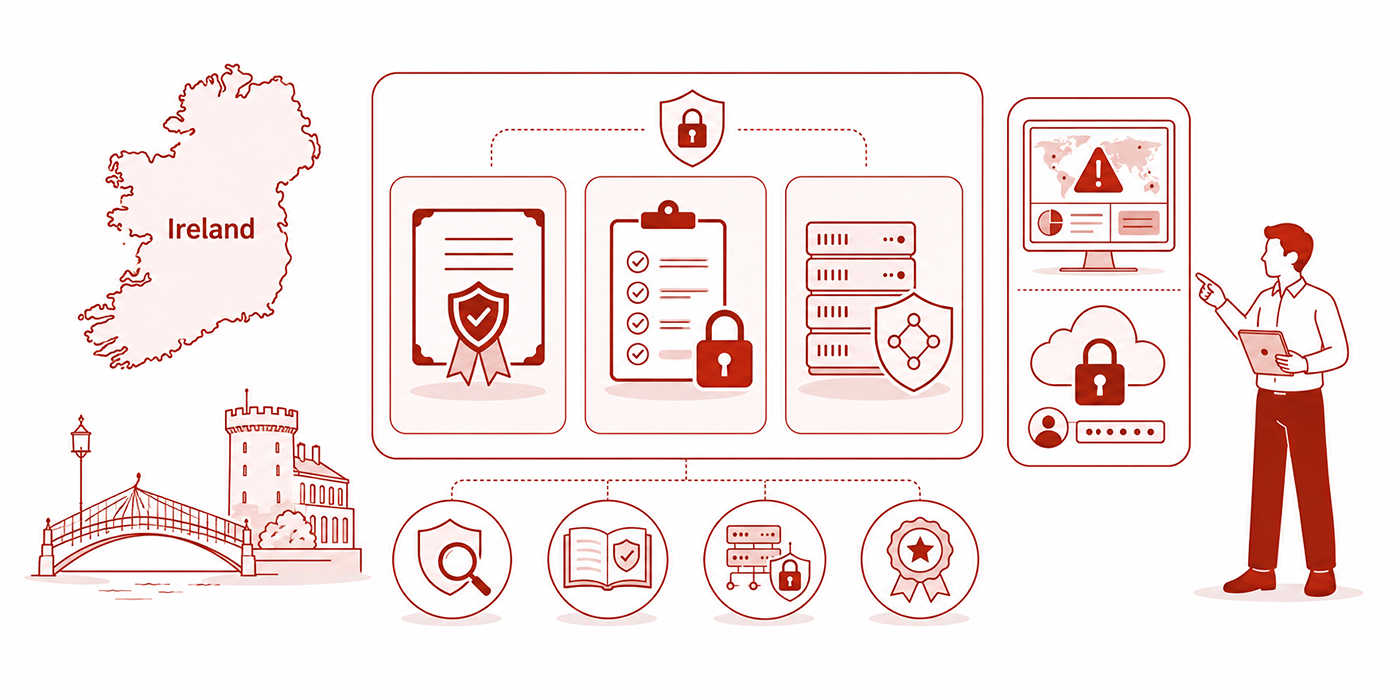
1. Why Advanced Cybersecurity and Management Certification Matters in Ireland
Ireland’s cybersecurity market includes security vendors, multinational technology companies, consultancies, financial institutions, public bodies, managed-service providers, and internal security teams. A 2025 all-island sector study identified 632 firms providing cybersecurity products, services, research, or internal capabilities. It estimated 7,911 cybersecurity-related professionals in Ireland, with major concentrations around Dublin, Cork, Galway, and Limerick. These figures support opportunities across security analysis, incident response, cybersecurity consulting, and security product management.
The market has also become more selective. Employers increasingly want candidates who can connect technical controls with business continuity, regulatory exposure, supplier risk, data protection, executive reporting, and measurable operational resilience. A certification can provide a recognised knowledge signal, while an employable profile also requires practical evidence, clear communication, and experience relevant to the target role.
Ireland’s regulatory direction strengthens management demand
Ireland launched a public consultation on its draft National Cyber Security Strategy in July 2026. The strategy follows the 2019–2024 framework and sits alongside plans to strengthen the National Cyber Security Centre, support research, improve resilience, and prepare organisations for emerging risks involving artificial intelligence, critical infrastructure, and connected supply chains. Professionals following a cybersecurity policy pathway, risk-management career, information-security director roadmap, or CISO progression plan should understand this changing national environment.
Ireland is implementing the NIS2 Directive through the forthcoming National Cyber Security Bill. The legislation is expected to establish the NCSC on a statutory basis, expand cybersecurity duties across additional sectors, strengthen supervision, and introduce broader risk-management and incident-reporting requirements. As of 2026, Ireland’s official sources continued to describe the Bill as the instrument intended to transpose NIS2, while the earlier NIS framework remained operational for existing designated entities.
NIS2 also places direct responsibility on management bodies. Covered organisations must have leadership approval and oversight of cybersecurity risk-management measures, while members of management bodies must receive appropriate training. This creates career value for professionals who combine technical security knowledge with cybersecurity programme management, enterprise risk management, security architecture, and executive cybersecurity leadership.
Financial-services professionals must also account for the Digital Operational Resilience Act. DORA became applicable on 17 January 2025 and establishes requirements involving ICT risk management, resilience testing, incident management, and third-party technology risk. This makes credentials in cybersecurity auditing, financial-sector security, cloud-risk management, and regulatory cybersecurity especially relevant to banks, insurers, payment providers, investment firms, and their technology suppliers.
Professional certifications and Irish qualifications provide different signals
Ireland’s National Framework of Qualifications is a ten-level system covering further education, higher education, and doctoral awards. QQI maintains trusted information about qualifications included in the NFQ, while NARIC Ireland provides comparability guidance for many foreign academic qualifications. An NFQ qualification may support academic progression and formal educational recognition, while a professional certification demonstrates competence against a certification provider’s examination and experience framework.
A Level 8 cybersecurity higher diploma or honours degree can provide structured academic depth. A Level 9 postgraduate diploma or master’s degree may support advanced research, architecture, leadership, or specialist work. Credentials such as CISSP, CISM, CISA, CRISC, CCSP, OSCP+, Security+, and Microsoft role-based certifications provide different forms of professional validation.
The strongest pathway may combine formal education, role-specific certification, and portfolio evidence. This combination supports professionals pursuing threat-intelligence analysis, cybersecurity engineering, ethical-hacking careers, or cybersecurity research.
Cybersecurity Certifications and Career Impact: 30-Credential Ireland Advancement Matrix
| Certification or Qualification | Best Career Stage | Primary Capability Signal | Where It Creates Real Leverage |
|---|---|---|---|
| ISC2 Certified in Cybersecurity | Entry level | Foundational security knowledge | Career switching, internships and junior-security applications |
| CompTIA Security+ | Entry level | Broad technical-security foundation | SOC support, junior analysis and security-administration roles |
| Microsoft SC-900 | Entry level | Security, compliance and identity concepts | Microsoft environments, identity support and compliance teams |
| NFQ Level 8 Cybersecurity Higher Diploma | Graduate conversion | Structured academic and applied learning | Career conversion, graduate recruitment and academic progression |
| NFQ Level 9 Cybersecurity Postgraduate Award | Graduate or experienced | Advanced academic specialisation | Research, architecture, consulting and advanced technical work |
| ISC2 SSCP | Early career | Operational security administration | Infrastructure security, administration and analyst progression |
| CompTIA CySA+ | Early to mid-career | Threat detection and security analytics | SOC analysis, vulnerability management and blue-team work |
| Microsoft Security Operations Analyst Associate | Early to mid-career | Microsoft detection and response | Sentinel, Defender, threat hunting and SOC environments |
| GIAC Security Essentials | Early to mid-career | Applied technical-security competence | Security operations, engineering and technical consulting |
| GIAC Certified Incident Handler | Mid-career | Incident handling and attack analysis | DFIR teams, SOC escalation and incident leadership |
| CompTIA PenTest+ | Early offensive career | Penetration-testing methodology | Vulnerability assessment and junior testing positions |
| eJPT | Entry offensive career | Practical junior penetration testing | Laboratory evidence and first offensive-security interviews |
| OSCP+ | Mid-career technical | Hands-on penetration-testing ability | Penetration testing, red teaming and offensive engineering |
| Certified Ethical Hacker | Early to mid-career | Broad ethical-hacking coverage | Vacancies explicitly requesting CEH and consulting frameworks |
| GIAC Penetration Tester | Mid-career technical | Advanced penetration-testing knowledge | Specialist testing, consulting and red-team operations |
| CISA | Mid-career | Information-systems audit and assurance | Technology audit, controls testing and regulated sectors |
| ISO/IEC 27001 Lead Implementer | Mid-career | ISMS design and implementation | Compliance programmes, consulting and security governance |
| ISO/IEC 27001 Lead Auditor | Mid to senior career | ISMS auditing and evidence assessment | Assurance, certification readiness and supplier audits |
| ISC2 CGRC | Early to mid-career | Governance and control-framework knowledge | GRC analysis, authorisation and compliance assessment |
| CRISC | Mid to senior career | Enterprise technology-risk management | Risk advisory, control ownership and third-party assurance |
| CISM | Experienced manager | Security governance and programme management | Security manager, programme lead and executive progression |
| CISSP | Experienced professional | Broad security architecture and leadership knowledge | Senior technical, consulting, architecture and management roles |
| CCSP | Experienced cloud professional | Vendor-neutral cloud-security expertise | Cloud governance, architecture and security leadership |
| AWS Certified Security – Specialty | Mid to senior technical | AWS security implementation | AWS engineering, DevSecOps and cloud consulting |
| Microsoft Identity and Access Administrator Associate | Early to mid-career | Identity governance and access administration | Microsoft Entra, Zero Trust and identity-security teams |
| Microsoft Cybersecurity Architect Expert | Senior technical career | Enterprise and multicloud security architecture | Architecture, Zero Trust and security-transformation leadership |
| CompTIA SecurityX | Advanced practitioner | Enterprise security engineering | Senior practitioner, architecture and engineering positions |
| COBIT Foundation | Management transition | Enterprise technology governance | Governance, assurance and security-programme oversight |
| Project Management Professional | Experienced delivery professional | Project governance and delivery discipline | Cyber transformation, implementation and remediation programmes |
| CGEIT | Senior leadership | Enterprise technology governance | Executive strategy, board oversight and governance leadership |
2. How to Choose the Right Cybersecurity Certification in Ireland
Begin with a clearly defined destination role
A certification decision should start with the work you intend to perform. “I want to work in cybersecurity” leaves too many possible directions. A stronger objective specifies a role, sector, location, and target date:
Within 12 months, I want to qualify for a security operations analyst role in Dublin or Cork within a financial-services, technology, or managed-security organisation.
This statement helps you select a practical SOC analyst pathway, incident-response roadmap, threat-intelligence specialisation, or security-engineering progression plan.
A governance objective could read:
Within 18 months, I want to move from IT operations or audit into a GRC role supporting GDPR, NIS2 preparation, ISO/IEC 27001, and third-party risk.
That target points toward CISA, CRISC, CGRC, CISM, or ISO/IEC 27001 credentials, supported by a GRC career guide, cybersecurity-audit roadmap, privacy analyst pathway, and regulatory specialist plan.
Analyse Irish vacancies before buying training
Collect 20 to 30 current job descriptions for the role you want. Record every repeated requirement under five headings:
Technical tools and platforms
Security functions
Certifications
Regulatory or industry knowledge
Communication and management responsibilities
A SOC vacancy may emphasise SIEM investigations, Microsoft Sentinel, Defender, identity alerts, endpoint telemetry, threat hunting, incident documentation, and escalation. That pattern supports SC-200, CySA+, SSCP, or GCIH alongside incident-response practice, insider-threat analysis, cloud-threat detection, and critical-infrastructure security.
A financial-services vacancy may emphasise DORA, ICT risk, third-party oversight, operational resilience, control testing, incident classification, recovery testing, and executive reporting. Those requirements align more closely with CISA, CRISC, CISM, CISSP, ISO/IEC 27001, COBIT, and financial-sector security analysis.
Match the examination format to the capability employers need
Knowledge-based multiple-choice examinations can validate broad conceptual coverage. Practical examinations can provide stronger evidence for roles requiring configuration, exploitation, investigation, or troubleshooting. Management credentials can validate risk, governance, programme, and leadership frameworks.
An aspiring penetration tester gains limited career value from studying governance credentials before developing networking, Linux, Windows, web-security, Active Directory, and reporting skills. A professional pursuing OSCP certification, red-team operations, vulnerability research, or penetration-testing management needs a pathway with substantial laboratory practice.
A security manager requires evidence involving risk acceptance, investment prioritisation, policy governance, supplier management, incident leadership, metrics, and board communication. CISM, CISSP, CRISC, CGEIT, and relevant project-management credentials can support a security-leadership transition, director-level pathway, VP of security roadmap, or chief security officer progression plan.
Confirm experience requirements before registration
ISC2 CC currently requires no prior work experience. SSCP generally requires one year of relevant experience, while CISSP requires five years of cumulative experience across at least two domains, subject to applicable waivers. Candidates who pass CISSP before satisfying the experience requirement can use the Associate of ISC2 route while completing the required experience.
CISM requires five years of professional information-security management experience within the relevant job-practice areas. Candidates may take the examination before meeting the full experience requirement, although they must satisfy the requirement before certification is awarded. ISACA has also announced that a revised CISM examination outline will take effect on 3 November 2026, making blueprint verification essential for candidates studying during the transition.
CCSP’s examination outline changed from 1 August 2026. Microsoft’s SC-100 content was updated in July 2026 and covers architecture across identity, security operations, infrastructure, applications, data, AI, governance, and compliance. Professionals preparing for cloud-security careers, digital identity roles, AI-security positions, or chief security architecture should always download the latest official outline before purchasing materials.
Calculate the full credential cost
The examination fee represents one part of the investment. Your budget should include:
Exam fee + training + practice tests + laboratory access + books + travel + rescheduling risk + retake reserve + maintenance fees + continuing education
A lower-priced credential may generate poor value when it has little recognition in target vacancies. A more expensive certification can produce better returns when it closes a repeated hiring gap or enables higher-value cybersecurity consulting, freelance security work, security training, or cybersecurity programme leadership.
3. A Step-by-Step Plan for Earning Your Certification
Step 1: Select one role and one primary credential
Choose a credential that directly supports your next role. Avoid building a long list of beginner qualifications covering the same material. A candidate moving from help desk work can combine Security+ with a cybersecurity analyst transition, practical SIEM investigations, a threat-intelligence foundation, and an incident-response portfolio.
A candidate moving from audit into GRC could prioritise CISA or CRISC, then develop an ISO/IEC 27001 control matrix, NIS2 readiness assessment, DORA supplier-risk review, and GDPR breach workflow. This route supports a cybersecurity auditor career, risk-management specialisation, privacy analyst pathway, and policy analyst career.
Step 2: Conduct a baseline skills assessment
Score yourself from zero to five across:
Networking
Windows administration
Linux
Cloud platforms
Identity and access management
Scripting
Security monitoring
Incident response
Vulnerability management
Risk and compliance
Documentation
Stakeholder communication
A score below three in a prerequisite area indicates a study priority. Someone following a network-administrator-to-ethical-hacker route may already have networking depth while needing stronger web-security, privilege-escalation, and reporting skills. Someone following an IT-manager-to-security-leadership route may understand budgets and teams while needing deeper incident governance, architecture, and cyber-risk quantification.
Step 3: Download the official exam outline
Create a spreadsheet containing every examination domain, its weighting, your current confidence, and the evidence you will produce. Verify the version immediately before scheduling because certification providers regularly change blueprints, prerequisites, delivery methods, and renewal conditions.
Microsoft associate, expert, and speciality certifications generally require annual renewal through Microsoft Learn, while providers such as ISC2 and ISACA maintain their own continuing professional education and maintenance requirements. Planning these obligations early protects the long-term value of your cloud-security credential, cybersecurity management qualification, audit certification, or architecture credential.
Step 4: Use a 12-week study cycle
Weeks 1–3: Build conceptual coverage. Read the complete syllabus and establish a clear understanding of every domain.
Weeks 4–6: Apply the concepts. Complete technical labs, risk exercises, control assessments, incident investigations, or architecture designs.
Weeks 7–9: Diagnose weaknesses. Use practice questions to expose misunderstandings, weak domains, and poor decision-making patterns.
Weeks 10–12: Simulate the exam. Complete timed assessments, revise weak areas, validate identification requirements, and test online-proctoring equipment where applicable.
Allocate study time according to weakness and examination weighting. A candidate scoring 85% in identity governance and 48% in network security should prioritise network-security improvement. Professionals building toward blockchain security, quantum-security analysis, cybersecurity data science, or security automation should also reserve time for specialist foundations beyond the exam.
Step 5: Build a portfolio during preparation
Every major domain should produce evidence that can be discussed during an interview.
A SOC portfolio could contain:
An alert-triage workflow
A phishing investigation
A compromised-account timeline
A Microsoft Sentinel detection rule
An endpoint incident report
An executive incident summary
A GRC portfolio could contain:
A cybersecurity risk register
An ISO/IEC 27001 gap assessment
A NIS2 readiness checklist
A DORA third-party review
A GDPR breach workflow
A management-level risk dashboard
A cloud portfolio could contain:
An identity architecture
A least-privilege review
A logging and monitoring design
A cloud threat model
An incident-response runbook
An infrastructure-as-code security review
Ireland’s NCSC recommends the voluntary Cyber Fundamentals framework as a structured method for organising and evidencing controls associated with NIS2 preparation. CyFun uses a risk-based maturity approach and reflects governance, identification, protection, detection, response, and recovery. It can therefore provide useful portfolio structure for candidates pursuing GRC roles, security programme management, critical-infrastructure security, and cybersecurity consulting.
Step 6: Connect study topics to Irish obligations
A security professional operating in Ireland should be able to explain how technical controls support legal and operational duties. Under GDPR, reportable personal-data breaches must be notified to the Data Protection Commission without undue delay and, where required, within 72 hours of awareness. High-risk breaches may also require communication to affected individuals.
Translate this obligation into practical capability: breach classification, evidence preservation, timeline creation, legal escalation, impact analysis, stakeholder communication, and regulator-ready documentation. These skills support privacy analysis, incident response, regulatory cybersecurity, and chief privacy officer progression.
Step 7: Prepare for the examination environment
Register with a personal email address that you expect to retain. Confirm the accepted identification documents, examination timezone, rescheduling rules, technical requirements, and accommodation procedure. Complete a full system test before an online examination and arrive early for testing-centre appointments.
Keep a retake reserve in your budget and avoid scheduling during major work deadlines. A failed attempt becomes more expensive when it triggers rushed preparation, repeated travel, or expired training access.
Step 8: Plan the first seven days after passing
Schedule these actions before sitting the examination:
Add the certification and verification information to your CV.
Update your professional profile and portfolio.
Publish two practical projects linked to the credential.
Contact specialist recruiters and hiring managers.
Request role-relevant responsibilities from your current employer.
Begin preparing for technical and behavioural interviews.
This conversion phase connects the credential to an analyst-to-engineer roadmap, ethical-hacker-to-consultant pathway, senior-analyst-to-VP progression, or cybersecurity specialist-to-CISO plan.
Quick Poll: What Is Really Delaying Your Cybersecurity Career in Ireland?
Select the obstacle creating the most frustration. Your result will identify the certification strategy most likely to produce movement.
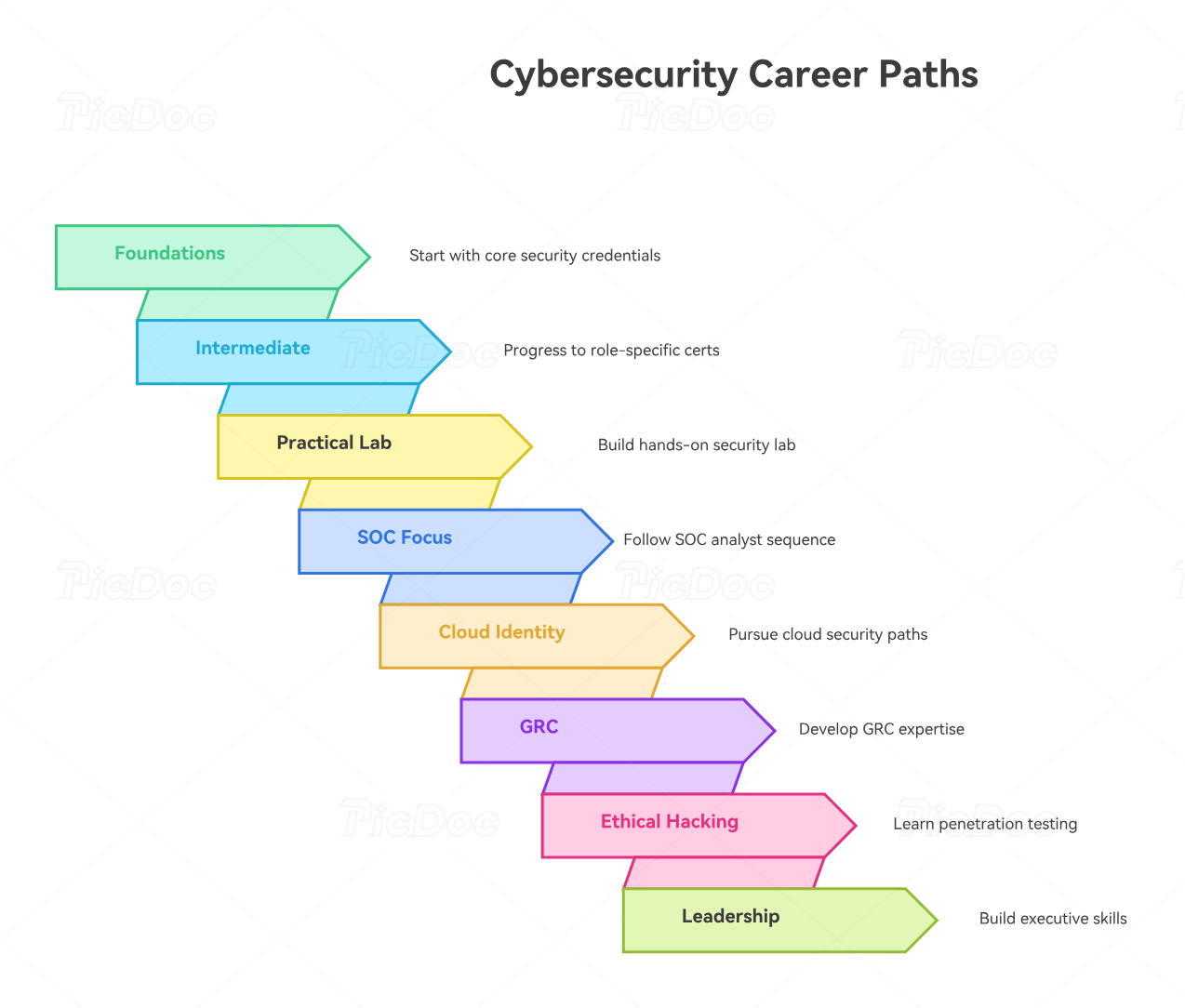
4. The Best Certification Stacks for Major Cybersecurity Careers
Entry-level security analyst
A useful starting stack combines ISC2 CC or Security+ with operating-system knowledge, networking, SIEM practice, and incident documentation. Microsoft SC-900 can add value in environments using Microsoft identity, compliance, and security technologies.
After building foundations, progress toward CySA+, SSCP, or Microsoft Security Operations Analyst Associate. Support the credential with an IT-support transition plan, security analyst roadmap, threat-intelligence pathway, and analyst-to-engineer progression.
Your laboratory should include Windows and Linux systems, centralised logging, endpoint telemetry, basic cloud logs, vulnerability scanning, and simulated investigations. Create concise reports that explain the alert, evidence, scope, containment decision, and recommended control improvement.
SOC analyst and incident responder
A SOC-focused sequence may include Security+, CySA+, SC-200, SSCP, or GCIH. The optimal combination depends on the employer’s tooling, the analyst level, and whether the role includes threat hunting, endpoint investigation, cloud monitoring, or incident coordination.
Build cases involving phishing, stolen credentials, suspicious PowerShell, malicious OAuth applications, ransomware indicators, unusual privilege changes, data exfiltration, and insider activity. This supports an incident-responder career, threat-intelligence analyst role, insider-threat specialisation, and critical-infrastructure security pathway.
Ireland’s 2025 National Cyber Risk Assessment describes an escalating threat environment and systemic risks affecting the State. Candidates who can interpret national threats, translate them into organisational detection priorities, and communicate operational consequences gain stronger credibility than candidates whose knowledge remains limited to examination terminology.
Cloud security and identity
Ireland’s technology and multinational environment creates strong relevance for AWS, Microsoft Azure, Google Cloud, multicloud governance, identity security, and SaaS risk. A cloud pathway might combine a platform-level administrator or architect credential with AWS Certified Security – Specialty, CCSP, SC-300, SC-200, or SC-100.
A strong portfolio should address identity architecture, conditional access, privileged access, network segmentation, encryption, secrets management, cloud logging, posture management, workload protection, DevSecOps, and incident response. These capabilities support cloud-threat analysis, digital identity management, cybersecurity automation, and chief security architecture.
Governance, risk, compliance, audit, and privacy
A practical GRC stack may begin with ISO/IEC 27001 training, then progress toward CISA, CGRC, CRISC, CISM, or CISSP according to the target responsibility. Ireland-specific preparation should cover GDPR, DPC breach notification, NIS2 readiness, CyFun, DORA, supplier risk, operational resilience, and management reporting.
Create a risk register, control matrix, supplier questionnaire, breach-escalation workflow, statement of applicability, board dashboard, and incident-governance plan. These artefacts strengthen applications for GRC specialist roles, cybersecurity auditing, privacy analysis, and cybersecurity policy work.
Professionals should practise translating control weaknesses into business exposure. “Multifactor authentication is missing” identifies a technical gap. A stronger management explanation describes which systems could be compromised, which services could be disrupted, which records could be exposed, and which legal, financial, and customer consequences could follow.
Ethical hacking and penetration testing
Begin with TCP/IP, Linux, Windows, Active Directory, web applications, scripting, authentication, privilege escalation, tunnelling, and report writing. eJPT or PenTest+ can structure early development, while OSCP+ and specialised GIAC credentials can support advanced progression.
Every assessment must operate under explicit authorisation and clear rules of engagement. Build your career through a network-administrator transition, penetration-tester roadmap, red-team specialist pathway, and vulnerability-research career.
Professionals aiming for consulting or management should add assessment scoping, estimation, client communication, remediation planning, quality assurance, and team leadership. These capabilities support penetration-testing management, cybersecurity consulting, and chief security officer progression.
Cybersecurity management and executive leadership
CISM, CISSP, CRISC, CGEIT, COBIT, PMP, and architecture credentials can support senior progression when paired with leadership evidence. Employers expect security leaders to manage strategy, operating models, investment, talent, suppliers, incidents, regulatory obligations, and board communication.
Prepare a leadership portfolio containing a three-year security roadmap, annual investment case, target operating model, risk dashboard, incident-governance structure, supplier-risk programme, workforce plan, and board presentation. This supports movement toward cybersecurity programme management, director of information security, VP of cybersecurity, and CISO leadership.
5. How to Convert Certification Into Career Advancement in Ireland
Rewrite your CV around evidence and results
Place the certification near the top when it directly matches the vacancy. Beneath each position, describe security outcomes, decisions, and improvements.
Weak wording:
Responsible for security monitoring and incident response.
Stronger wording:
Investigated identity and endpoint alerts, introduced a documented escalation process, and improved the consistency of high-priority incident handling.
A candidate targeting senior analyst positions, incident-response work, risk-management roles, or security architecture should ensure that each bullet demonstrates relevant capability.
Target Ireland’s main opportunity clusters
The 2025 sector research identified substantial cybersecurity activity around Dublin, Cork, Galway, and Limerick, with Dublin holding the largest concentration. The study also found a mix of dedicated cybersecurity vendors, consultancies, multinational firms, internal security teams, and smaller indigenous providers.
This variety creates different routes:
Dublin: financial services, multinational technology, consulting, cloud operations, regulators, and public-sector functions.
Cork: security vendors, technology operations, product development, managed services, and research.
Galway and Limerick: regional technology, healthcare, manufacturing, research, and growing security functions.
Remote and hybrid roles: cloud operations, consulting, product security, security engineering, and multinational team support.
Candidates can prepare for sector-specific work through healthcare cybersecurity analysis, financial-sector incident research, cloud-security analysis, and critical-infrastructure threat assessment.
Prepare six interview stories
Develop concise examples covering:
A technical problem you diagnosed
An incident you investigated
A risk you prioritised
A control you improved
A stakeholder disagreement you resolved
A mistake that changed your approach
Each response should explain the context, evidence, decision, action, outcome, and lesson. Senior candidates pursuing security programme management, security product management, privacy leadership, or VP-level security roles should emphasise trade-offs, influence, and organisational outcomes.
Use a 90-day credential-conversion plan
Days 1–30: Update your CV, professional profile, credential verification, and portfolio. Analyse 30 target employers and identify recurring capability gaps.
Days 31–60: Submit carefully matched applications, contact specialist recruiters, attend relevant industry events, and request conversations with professionals performing the target role.
Days 61–90: Review rejection patterns, strengthen weak portfolio areas, practise interviews, and approach employers with evidence tailored to their security environment.
Candidates seeking independent income can create focused services around cybersecurity freelancing, security consulting, cybersecurity content development, or certification training.
Build international portability deliberately
Ireland’s position within the European Union makes EU regulatory knowledge valuable, while its multinational environment rewards internationally recognised certifications and cross-border communication skills. Professionals may also compare credential strategies across Australia, Singapore, Hong Kong, and the United Arab Emirates.
A portable profile combines a globally recognised credential, documented practical experience, cloud capability, regulatory awareness, strong writing, and experience working across distributed teams.
Stop collecting overlapping credentials
Before purchasing another examination, ask four questions:
Does this credential appear in my target vacancies?
Does it close a genuine capability gap?
Does it support a promotion or billable service?
Will I produce new practical evidence while preparing?
Someone holding Security+, SSCP, and CySA+ may gain greater value from six months of SOC experience than another foundation-level certificate. Someone holding CISSP and CISM may gain greater value from cloud architecture, financial understanding, board reporting, or programme ownership.
Advanced professionals can later branch into AI security, blockchain security, quantum-security analysis, or cybersecurity data science. Ireland’s NCSC published a national AI cybersecurity risk assessment in 2026, while the EU AI Act became broadly applicable on 2 August 2026, increasing the relevance of secure AI governance, lifecycle risk, data protection, and resilience.
6. Frequently Asked Questions About Cybersecurity Certification in Ireland
-
ISC2 CC and CompTIA Security+ are common foundational choices. SC-900 may help candidates entering Microsoft-focused security, identity, or compliance environments. Graduates and career changers may also consider an NFQ-aligned higher diploma where they need a structured academic conversion route.
The best choice depends on your baseline. Someone with networking and systems-administration experience may progress more quickly toward SSCP, CySA+, or SC-200. Someone entering technology from another field may benefit from a broader IT-support transition plan, analyst roadmap, incident-response pathway, and identity-management specialisation.
-
CISSP can provide substantial value for experienced professionals targeting senior analysis, architecture, engineering, consulting, and management positions. ISC2 requires five years of cumulative professional experience across at least two CISSP domains, with applicable waiver rules. Candidates can pass the examination before completing the requirement and use the Associate of ISC2 route.
The credential becomes especially useful when supported by leadership or architecture evidence. It can strengthen a specialist-to-CISO pathway, chief security architect roadmap, information-security director plan, or cybersecurity consulting career.
-
Choose according to the work you want:
CISSP: broad security architecture, engineering, leadership, and management.
CISM: security governance, programme management, risk, and incident oversight.
CISA: information-systems audit, assurance, and control assessment.
CRISC: enterprise technology risk and control design.
A security manager may eventually benefit from CISSP and CISM. An auditor may prioritise CISA. A risk professional may gain greater immediate value from CRISC. Link the decision to a GRC career, cybersecurity-audit pathway, risk-management roadmap, or security-leadership transition.
-
A professional certification does not automatically receive an Irish NFQ level. The NFQ describes recognised qualifications within Ireland’s ten-level education and training framework. Professional credentials, vendor certifications, university awards, and provider-issued completion certificates follow different recognition structures.
Before enrolling in a programme advertised with an NFQ level, verify the awarding body, programme title, award type, NFQ level, credit value, and recognition information. International applicants can also consult NARIC Ireland for available academic comparability guidance. This distinction is important for professionals pursuing cybersecurity teaching, bootcamp instruction, certification training, or security research.
-
Certification can strengthen screening credibility and show structured learning. Employers still need evidence that you can investigate, configure, analyse, document, and communicate.
Build experience through authorised labs, internships, internal security assignments, open-source work, capture-the-flag platforms, volunteer projects with clear scope, and portfolio exercises. A strong junior application could combine Security+ or CC with several incident investigations, a SIEM dashboard, a vulnerability report, a cloud-risk review, and a GDPR breach workflow.
This evidence supports an IT-support transition, security analyst career, threat-intelligence pathway, or incident-response roadmap.
-
Useful options include ISO/IEC 27001 Lead Implementer or Lead Auditor, CISA, CRISC, CGRC, CISM, and CISSP. The appropriate credential depends on whether you implement controls, audit them, manage enterprise risk, oversee programmes, or advise leadership.
Irish professionals should also understand GDPR breach handling, NIS2 preparation, DORA, CyFun, supplier risk, and sector-specific requirements. Combine certification with a privacy analyst career, regulatory specialist roadmap, policy analyst pathway, and chief privacy officer plan.
