
The Ultimate Guide to Getting Advanced Cybersecurity & Management Certification in Nigeria: Everything You Need to Know in 2026–2027
Nigeria’s expanding digital economy needs professionals who can connect technical security, business risk, regulatory compliance, incident response, and leadership. An Advanced Cybersecurity & Management Certification can support that development when it produces demonstrable skills rather than another isolated résumé line. This guide explains how Nigerian learners can choose a credible certification path, build locally relevant evidence, control training costs, and prepare for opportunities in security operations, cybersecurity risk management, privacy analysis, cloud security, auditing, and leadership during 2026–2027.
1. Why Advanced Cybersecurity and Management Certification Matters in Nigeria
Nigeria’s cybersecurity environment is becoming more demanding because digital services now connect financial transactions, customer identities, cloud platforms, telecommunications networks, government systems, health information, educational services, e-commerce operations, and critical infrastructure. Each connection creates operational value alongside new exposure to fraud, ransomware, compromised accounts, data leakage, supplier failures, cloud misconfigurations, and social-engineering attacks.
Nigeria’s Computer Emergency Response Team warned in April 2026 that organizations across multiple sectors were experiencing an increase in high-impact incidents involving phishing, ransomware, business email compromise, and data breaches. The advisory also highlighted the growing use of cybercrime-as-a-service models and AI-enabled techniques, which allow attackers to operate at greater scale. These conditions create stronger career relevance for professionals developing toward SOC leadership, security automation engineering, cybersecurity research analysis, and AI security specialization.
Technical expertise alone covers only part of the employer’s problem. A capable professional must determine which alerts require escalation, which assets need immediate containment, which vulnerabilities create material business exposure, which controls can be implemented with available resources, and which risks must be presented to management. These responsibilities sit at the center of cybersecurity program management, security architecture, cybersecurity product management, and IT-to-cybersecurity leadership transitions.
Nigeria’s Data Protection Act 2023 adds another layer of responsibility. It established the Nigeria Data Protection Commission and created obligations covering lawful personal-data processing, security safeguards, data-subject rights, governance, cross-border processing, and breach management. The NDPC’s General Application and Implementation Directive states that qualifying personal-data breaches must be reported to the Commission within 72 hours after awareness. Professionals pursuing cybersecurity privacy analysis, regulatory specialization, cybersecurity auditing, and Chief Privacy Officer development therefore need practical knowledge of investigation, escalation, evidence, communication, and remediation.
The compliance challenge becomes more difficult when a company has policies without dependable evidence. A document may require multifactor authentication, quarterly access reviews, secure backups, supplier assessments, and incident exercises. Auditors and executives still need proof that these controls operate consistently. This creates opportunities for professionals trained in governance, risk, and compliance, cybersecurity policy analysis, technology-risk management, and regulatory compliance.
National digital priorities reinforce the same direction. NITDA’s Strategic Roadmap and Action Plan 2.0 identifies cybersecurity and digital trust as major concerns within Nigeria’s broader digital transformation. It also emphasizes technology talent, innovation, AI, data, inclusion, research, and stronger policy implementation. Professionals who can secure these initiatives can build valuable pathways into AI security, cybersecurity data science, digital identity management, and quantum-security analysis.
The Advanced Cybersecurity & Management Certification is structured around multi-domain development. ACSMI describes more than 300 interactive modules and over 360 lessons covering governance, risk, compliance, network security, cloud security, SOC operations, incident response, threat hunting, ethical hacking, malware analysis, and security management. The program is delivered online through flexible completion formats and encourages learners to create practical artifacts that can be discussed during interviews.
This breadth can help an early-career learner compare red-team operations, penetration-testing management, vulnerability research, and security automation. It can also help an experienced IT professional develop the broader reasoning required for security-program leadership, policy direction, enterprise security architecture, or VP-level security progression.
A useful certification strategy should produce five outcomes:
A coherent understanding of security across technical and management domains.
A defined target role supported by vacancy research.
Practical evidence that employers can examine.
Nigerian regulatory awareness covering the NDP Act and incident response.
Clear communication for technical teams, executives, auditors, customers, and regulators.
Nigeria Cybersecurity Certification Decision Matrix: 28 High-Value Options
| Certification or Training Path | Ideal Career Stage | Capability It Signals | Best Nigerian Career Use | Evidence to Build During Training |
|---|---|---|---|---|
| ACSMC | Beginner through management | Integrated technical, risk and leadership capability | SOC, cloud, GRC, consulting and management preparation | Risk register, SOC workflow, incident plan and executive briefing |
| ISC2 Certified in Cybersecurity | Beginner | Foundational security knowledge | Entry-level roles and internal IT transitions | Asset inventory, threat summary and control map |
| CompTIA Security+ | Beginner to early career | Broad technical security fundamentals | Junior analyst, infrastructure and managed-service roles | Vulnerability report and security-control assessment |
| CompTIA Network+ | Beginner | Networking and troubleshooting foundations | Network security, SOC and infrastructure preparation | Segmented network diagram and traffic-analysis notes |
| CompTIA CySA+ | Early career | Detection, triage and defensive analysis | SOC analyst progression | Detection matrix, alert workflow and incident timeline |
| CompTIA PenTest+ | Early offensive career | Structured security testing | Penetration-testing development | Authorized assessment report and remediation plan |
| CompTIA SecurityX | Experienced practitioner | Advanced enterprise-security decisions | Senior engineering and technical-lead roles | Enterprise architecture review and risk-treatment roadmap |
| ISC2 SSCP | Early to mid-career | Operational security administration | Identity, infrastructure and security-operations roles | Access-management procedure and operational security plan |
| ISC2 CISSP | Experienced professional | Broad senior-level security knowledge | Architecture and leadership progression | Security strategy, architecture proposal and executive risk memo |
| ISACA CISM | Management track | Governance and security-program management | Cybersecurity program leadership | Program charter, metrics dashboard and governance calendar |
| ISACA CRISC | Risk track | Technology-risk identification and treatment | Cyber-risk specialization | Risk register, treatment plans and residual-risk rationale |
| ISACA CISA | Audit track | Information-systems auditing | Cybersecurity audit careers | Audit plan, evidence requests and findings report |
| ISACA CGEIT | Senior leadership | Enterprise IT governance | Director and executive progression | Governance model and technology-investment framework |
| ISO/IEC 27001 Lead Implementer | GRC and implementation | Information-security management systems | GRC and compliance consulting | ISMS scope, risk methodology and Statement of Applicability |
| ISO/IEC 27001 Lead Auditor | Audit and assurance | ISMS assessment methodology | Internal audit, consulting and supplier assurance | Audit checklist, interview plan and corrective-action report |
| ISO/IEC 27701 Training | Privacy and GRC | Privacy-information management | NDP Act and privacy operations | Privacy-control map and processor-assessment template |
| IAPP CIPM | Privacy management | Privacy-program implementation | Privacy leadership preparation | Privacy governance framework and breach-escalation workflow |
| COBIT Foundation | Governance track | Enterprise-control objectives | Audit, regulated enterprise and executive reporting | Governance-objective map and accountability matrix |
| ITIL 4 Foundation | Service-management track | IT service-management integration | Security operations working alongside enterprise IT | Incident workflow aligned with service-management processes |
| ISC2 CCSP | Cloud-security track | Cloud architecture and governance | Fintech, SaaS, enterprise-cloud and consulting roles | Cloud responsibility matrix and reference architecture |
| AWS Certified Security – Specialty | Platform specialist | AWS security implementation | Cloud engineering and DevSecOps environments | IAM review, logging plan and encryption assessment |
| Microsoft SC-100 | Architecture track | Microsoft security architecture | Microsoft-focused enterprises and consulting teams | Zero-trust architecture and privileged-access blueprint |
| Google Professional Cloud Security Engineer | Platform specialist | Google Cloud security engineering | Cloud-native, data and AI-focused organizations | GCP security baseline and monitoring design |
| OffSec OSCP | Technical specialist | Hands-on penetration testing | Red-team and offensive-security roles | Sanitized exploitation report with remediation guidance |
| EC-Council CEH | Early offensive track | Ethical-hacking concepts and tools | Testing, consulting and assessment preparation | Attack-path report and prioritized remediation plan |
| GIAC GCIH | Incident-response track | Incident handling and attacker behavior | SOC, digital forensics and response roles | Containment plan, incident timeline and lessons-learned report |
| GIAC GREM | Advanced specialist | Malware reverse engineering | Threat research and malware analysis | Static and dynamic malware-analysis report |
| EC-Council CHFI | Investigation track | Digital-forensics methodology | Incident investigation, fraud and evidence-support roles | Chain-of-custody form and forensic examination report |
2. How to Choose the Right Cybersecurity Certification Path in Nigeria
The strongest certification choice begins with a role decision. A learner preparing simultaneously for SOC analysis, privacy consulting, cloud architecture, penetration testing, audit, and management will divide attention across incompatible interview expectations. Select one primary destination, then build a foundation and specialization around it.
For SOC and incident-response careers
A defensive-security pathway should develop log analysis, network visibility, endpoint investigation, threat intelligence, detection engineering, containment, evidence handling, escalation, and reporting. The Advanced Cybersecurity & Management Certification can provide multi-domain context, while Security+, CySA+, GCIH, SIEM training, or vendor-specific endpoint education can provide deeper operational focus.
Your portfolio should contain a triage matrix, detection rule, incident timeline, escalation tree, containment checklist, and management briefing. These artifacts support security-analyst progression, security automation development, cybersecurity research, and AI-assisted security analysis.
Nigeria’s ngCERT accepts reports concerning incidents, vulnerabilities, phishing, and malware, and its incident-reporting address is monitored continuously. Understanding how national response structures operate can improve a candidate’s escalation judgment and awareness of broader incident coordination.
For GRC, privacy, audit, and regulatory careers
This pathway requires working knowledge of the Nigeria Data Protection Act, risk assessment, control testing, policies, vendor governance, audit evidence, incident notification, data-processing responsibilities, and remediation. Combine ACSMC with ISO 27001, CISA, CRISC, COBIT, ISO 27701, or privacy-management training.
Build a data-protection impact assessment, processing inventory, third-party questionnaire, risk register, breach-response procedure, control-evidence matrix, and corrective-action tracker. These outputs create direct value for GRC specialist careers, privacy analysis, cybersecurity regulatory work, and IT-audit transitions.
The NDPC maintains requirements and resources for data controllers and processors, including organizations classified as having major importance. Candidates should understand that regulatory readiness requires operational proof: named owners, approved procedures, evidence sources, testing frequencies, documented exceptions, and time-bound remediation.
For cloud, fintech, and identity-security careers
Cloud-security candidates need depth in identity and access management, privileged access, network architecture, encryption, secrets, workload protection, logging, resilience, data classification, supplier responsibility, and incident response. Select AWS, Azure, or Google Cloud training by reviewing the platforms named in your target vacancies.
A useful cloud portfolio includes a shared-responsibility matrix, secure reference architecture, IAM-risk assessment, privileged-access workflow, logging baseline, ransomware-recovery plan, and cloud incident runbook. These projects support digital-identity management, Chief Security Architect development, security product management, and blockchain security engineering.
For penetration testing, red teaming, and vulnerability research
Offensive-security candidates require authorization discipline, accurate scoping, reconnaissance, exploitation, lateral-movement awareness, evidence collection, reporting, and remediation validation. Combine a broad foundation with PenTest+, OSCP, CEH, web-application testing, cloud-testing, or reverse-engineering education.
Employers need reports that explain the affected asset, attack path, supporting evidence, business impact, remediation priority, retesting method, and remaining exposure. That portfolio can support red-team operator development, penetration-testing management, vulnerability-research careers, and security-research analysis.
For cybersecurity management and leadership
Management candidates must demonstrate risk prioritization, resource planning, stakeholder communication, accountability, metrics, vendor governance, incident leadership, and strategic decision-making. CISM, CISSP, CRISC, CGEIT, or ISO 27001 training can complement ACSMC when experience requirements and career direction support them
Create a security-program charter, twelve-month roadmap, risk dashboard, budget-prioritization memo, incident-communications plan, and board-level briefing. These outputs strengthen movement toward cybersecurity program management, policy-director responsibilities, security architecture leadership, and VP-level security growth.
3. The Nigeria-Specific Skills and Portfolio Evidence Employers Can Evaluate
Build your portfolio around one fictional Nigerian organization so every artifact connects to the same business environment. The company could operate a fintech platform, e-commerce service, healthcare network, telecommunications product, logistics business, government contractor, or energy operation. Give it customers, employees, cloud systems, third-party vendors, payment services, privileged users, sensitive records, and realistic operational constraints.
Build a Nigerian data-breach response pack
Your breach pack should include:
Initial incident-classification criteria
A 72-hour NDPC reporting decision timeline
Roles for security, privacy, legal, management, communications, and technology teams
Categories of affected personal data
Assessment of possible harm to data subjects
Evidence-preservation requirements
Containment and recovery actions
Customer and regulator communication drafts
Corrective-action ownership and deadlines
This single project can strengthen applications for privacy-analysis roles, cybersecurity auditing, regulatory specialization, and Chief Privacy Officer development. The NDP Act requires processors to communicate breaches to relevant controllers, while covered controllers must assess risk and satisfy applicable Commission-notification duties.
Create a business email compromise investigation
Business email compromise creates an excellent cross-domain portfolio scenario because it connects identity security, email controls, payment authorization, human behavior, incident response, and fraud risk. Build a timeline showing the initial phishing event, compromised credentials, suspicious mailbox rules, altered payment instructions, authentication logs, response actions, and control improvements.
Include recommendations covering multifactor authentication, conditional access, payment verification, email authentication, privileged-account separation, user reporting, and supplier confirmation. This project demonstrates capability relevant to SOC operations, digital-identity management, security automation, and cybersecurity risk management.
Construct a fintech or e-commerce cloud review
Map customer registration, identity verification, payment processing, databases, analytics, support systems, and third-party integrations. Identify where credentials, personal data, financial information, API secrets, and administrative access move through the environment.
Produce an architecture diagram, data-flow map, identity-risk review, logging matrix, backup plan, supplier-risk assessment, and incident-response playbook. This evidence supports security architecture, cybersecurity product management, blockchain security, and AI security analysis.
Develop a control-evidence matrix
Create columns for the control requirement, risk addressed, control owner, implementation method, evidence source, test procedure, review frequency, exception, remediation action, deadline, and status. Include controls for access reviews, backups, patching, supplier security, incident exercises, encryption, vulnerability management, and security awareness.
This artifact exposes whether you understand the difference between policy language and operating evidence. It creates strong interview material for GRC roles, cybersecurity policy analysis, regulatory careers, and cybersecurity auditing.
Prepare an executive cyber-risk briefing
Select one major scenario, such as ransomware, privileged-account compromise, payment fraud, exposed customer records, or cloud-service disruption. Explain the affected process, potential operational impact, current controls, unresolved weaknesses, treatment options, responsible owners, decision deadline, and indicators of progress.
This exercise develops the communication needed for cybersecurity program management, IT-management transitions, security-policy direction, and senior security leadership.
Quick Poll: What Is Blocking Your Cybersecurity Career in Nigeria?
Choose the obstacle causing the greatest loss of time, money, confidence, or career momentum.
4. Step-by-Step Certification Roadmap for Nigeria in 2026–2027
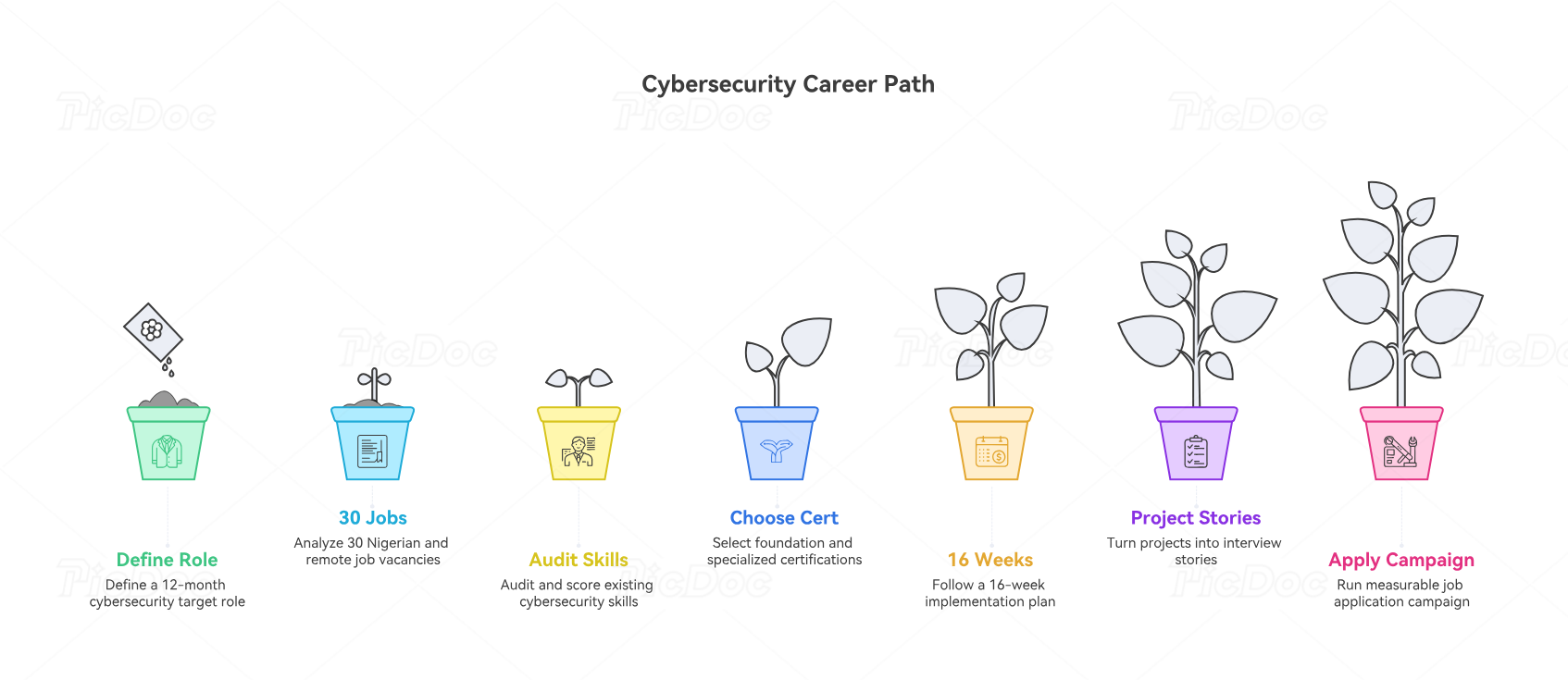
Step 1: Define one target role
Write a specific twelve-month objective, such as becoming a junior SOC analyst, moving from IT support into cloud security, transitioning from audit into cyber assurance, or developing from system administration toward security engineering.
This decision determines whether your next priority is penetration-testing expertise, GRC specialization, privacy analysis, or cybersecurity program management.
Step 2: Analyze 30 Nigerian and remote vacancies
Create a spreadsheet containing:
Job title and seniority
Industry and employer type
Technical responsibilities
Governance responsibilities
Required tools and platforms
Laws and frameworks
Requested certifications
Experience requirements
Communication expectations
Evidence you currently possess
Evidence you still need
Count recurring requirements. A skill appearing across most vacancies deserves immediate attention. A certificate requested by only a small minority should receive lower priority unless it closes a strategically important gap. This protects learners pursuing security automation, cybersecurity data science, vulnerability research, or digital identity from following fashionable paths without validating demand.
Step 3: Audit your existing capabilities
Score yourself from one to five across networking, Windows and Linux, cloud, identity, scripting, logs, vulnerability management, incident response, governance, risk, data protection, documentation, and communication.
An IT administrator may already possess strong infrastructure knowledge while lacking risk documentation. An auditor may understand controls and evidence while requiring deeper technical confidence. A developer may understand applications while needing stronger knowledge of identity, monitoring, cloud exposure, and secure architecture.
Use the audit to compare pathways into security architecture, cybersecurity auditing, blockchain security engineering, and AI security analysis.
Step 4: Choose one foundation and one specialization
Use ACSMC as a broad foundation when you need connected exposure across operations, governance, cloud, risk, incident response, and management. ACSMI describes flexible online pathways, scenario-based learning, interactive labs, assessments, and portfolio-oriented exercises. International learners can complete the program remotely without residency or in-person attendance.
Then select one specialization:
CySA+ or GCIH for defensive operations
OSCP or PenTest+ for offensive security
CISA for auditing
CRISC for cyber risk
ISO 27001 for GRC and ISMS work
ISO 27701 or CIPM for privacy
CCSP or a cloud-platform credential for cloud security
CISM or CISSP for eligible experienced professionals
Reverse-engineering training for malware research
Nigerian professionals considering international mobility can compare regional expectations through ACSMI’s certification guides for the UAE, Saudi Arabia, Qatar, and Singapore.
Step 5: Follow a sixteen-week implementation plan
Weeks 1–4: Study networking, operating systems, identity, vulnerabilities, security controls, and basic risk.
Weeks 5–8: Develop cloud, logging, detection, incident-response, governance, privacy, and NDP Act awareness.
Weeks 9–12: Deepen one specialization and complete practical labs.
Weeks 13–16: Finish portfolio projects, conduct mock interviews, revise weak domains, and begin targeted applications.
Produce one usable output every week. Examples include a network diagram, access-review procedure, detection rule, incident timeline, data-flow map, risk entry, vendor assessment, or executive summary. This approach supports research-analyst careers, cybersecurity content education, certification training, and bootcamp instruction.
Step 6: Turn every project into an interview story
Explain each project using seven elements:
Business context
Affected asset or process
Threat or control weakness
Evidence reviewed
Decision made
Recommendation and owner
Expected risk reduction
Clearly identify simulated work as simulation. Ethical transparency strengthens trust and demonstrates professional boundaries, which are essential in red-team operations, penetration-testing management, security research, and cybersecurity leadership.
Step 7: Run a measurable application campaign
Maintain separate résumé versions for technical operations, GRC and audit, cloud security, and management. Track applications, recruiter responses, screening calls, technical interviews, final interviews, offers, and repeated rejection patterns.
Weak screening conversion usually indicates poor targeting or résumé positioning. Repeated technical-interview failure identifies knowledge or evidence gaps. Final-stage rejection can reveal communication, stakeholder, compensation, or role-fit issues. Use this data to refine your route toward security leadership, privacy leadership, policy direction, or cybersecurity product management.
5. Certification Costs, Career ROI, and Expensive Mistakes to Avoid
Calculate certification cost as a complete investment. Include training, examination fees, practice resources, laboratory access, foreign-currency conversion, payment charges, retakes, renewal fees, continuing education, connectivity, backup power, and study time.
A lower advertised price can produce a higher total expense when the learner later purchases several disconnected resources. A broader program may create stronger value when it replaces fragmented preparation and produces artifacts relevant to cybersecurity risk management, cloud architecture, privacy analysis, and SOC progression.
Use a four-part return-on-investment test:
Vacancy relevance: Does the credential appear in your target role family?
Capability relevance: Does the curriculum close a genuine weakness?
Evidence potential: Can you create practical artifacts from the learning?
Progression value: Will the knowledge support your next career stage?
A credential with weak performance across these tests should wait. This rule prevents candidates targeting quantum-security analysis, cybersecurity data science, blockchain security, or security automation from buying specialized education before validating the career case.
Mistake 1: Collecting overlapping foundational certificates
Several beginner credentials cover similar domains. Completing all of them can delay specialization, portfolio work, and applications. Choose one reliable foundation, then invest in role-specific depth.
Mistake 2: Studying without producing evidence
Completed videos and quizzes give an employer little insight into your judgment. Build risk registers, incident reports, cloud reviews, detection workflows, control matrices, and executive briefings.
Mistake 3: Ignoring Nigerian regulation
Global frameworks gain local value when you can connect them to the NDP Act, NDPC expectations, incident reporting, controller and processor duties, and organizational evidence. This localization is critical for regulatory specialists, GRC professionals, privacy analysts, and cybersecurity auditors.
Mistake 4: Listing tools without describing decisions
Tool names create weak credibility when the candidate cannot explain the problem investigated, evidence found, confidence level, action recommended, and outcome expected. Employers need reasoning they can trust.
Mistake 5: Applying across unrelated roles
A résumé targeting SOC analysis, penetration testing, privacy, cloud architecture, audit, and management creates an unclear professional identity. Use role-specific versions connected to red-team development, cybersecurity auditing, program management, or digital-identity specialization.
Mistake 6: Pursuing management titles without leadership evidence
Leadership readiness appears through ownership, prioritization, measurement, communication, mentoring, and accountable follow-through. Create a security roadmap, risk dashboard, incident plan, governance calendar, and executive briefing before targeting cybersecurity policy leadership, security product management, Chief Security Architect roles, or VP-level progression.
6. Frequently Asked Questions About Cybersecurity Certification in Nigeria
-
A beginner can start with Security+, ISC2 Certified in Cybersecurity, or a structured multi-domain program such as ACSMC. The appropriate choice depends on your technical background, target role, budget, available study time, and preferred learning structure.
Beginners should first develop networking, operating-system, identity, cloud, vulnerability, incident-response, risk, and communication fundamentals. They can then compare specialization routes into SOC operations, GRC, penetration testing, and privacy analysis.
-
Employers establish their own education and experience requirements. Candidates from IT, engineering, audit, finance, law, risk, data, customer operations, or unrelated academic backgrounds can strengthen their prospects through structured education, laboratories, portfolio evidence, certifications, professional communication, and relevant work experience.
Career changers should translate their existing strengths. An auditor may already understand evidence and controls. A banker may understand fraud and operational risk. A developer may understand application architecture. A project manager may understand coordination and accountability. These strengths can support transitions into cybersecurity auditing, risk management, security product management, or cybersecurity program management.
-
A practical combination includes broad cybersecurity knowledge, NDP Act awareness, privacy operations, risk assessment, and evidence management. ACSMC can provide cross-domain security foundations, while ISO 27001, ISO 27701, CISA, CRISC, COBIT, or CIPM can deepen the target signal.
Build a processing inventory, data-flow map, privacy-risk assessment, breach-response procedure, supplier questionnaire, control-evidence matrix, and management report. These artifacts support privacy-analysis careers, regulatory specialization, Chief Privacy Officer development, and GRC progression.
-
ACSMI describes the program as fully online and designed for international schedules, time zones, career changers, and working professionals. Its learning structure includes written lessons, video instruction, audio materials, interactive labs, scenario-based tasks, assessments, and tool-oriented workflows. International students can participate without a visa, residency, or in-person attendance.
Learners should review current tuition, payment methods, technical requirements, assessment rules, refund terms, and certificate-verification details before enrollment. They can also compare international certification planning through ACSMI’s guides for Pakistan, India, Singapore, and Australia.
-
The timeline depends on prior knowledge, work commitments, technical complexity, and the amount of practical evidence you plan to build. ACSMI describes flexible completion options ranging from focused pathways to longer self-paced study. The program’s official guidance emphasizes retention, applied practice, and portfolio development alongside lesson completion.
A working professional can use a sixteen-week plan containing three study sessions, one laboratory block, one revision session, and one portfolio deliverable each week. Candidates pursuing vulnerability research, security architecture, AI security, or malware-oriented research should reserve additional time for specialist practice.
-
Certification can improve access to interviews, specialist responsibilities, remote opportunities, consulting work, and promotion discussions when it supports a capability employers need. Career return depends on role fit, experience, portfolio quality, technical competence, communication, employer requirements, and market conditions.
Measure return through stronger application conversion, broader responsibility, increased project ownership, improved job mobility, and access to higher-value role families. Professionals targeting cybersecurity program leadership, Chief Security Architect roles, security product management, or senior security leadership should connect every credential to measurable organizational outcomes.
