
The Ultimate Guide to Getting Advanced Cybersecurity & Management Certification in Kenya: Everything You Need to Know in 2026-2027
Kenya’s cybersecurity market needs professionals who can investigate attacks, secure cloud systems, protect personal data, assess risk, and explain security decisions to leadership. Whether you are pursuing an IT-support-to-cybersecurity transition, planning a security analyst career, developing cybersecurity management expertise, or targeting regional consulting opportunities, your certification strategy must produce practical evidence that employers can evaluate and trust.
1. Why Advanced Cybersecurity and Management Certification Matters in Kenya in 2026-2027
Kenya’s expanding digital economy has created a deeper dependency on cloud platforms, mobile applications, digital payments, telecommunications networks, online public services, and connected infrastructure. The Kenya National Broadband Strategy 2025–2030 recognizes cybersecurity and resilience as national priorities while referencing the National Cybersecurity Strategy 2022–2027. This direction increases the relevance of skills developed through a critical-infrastructure cybersecurity pathway, cloud-security specialization, cybersecurity programme-management career, and security-policy analyst roadmap.
The operational threat level gives employers a clear reason to prioritize trained security talent. During January–March 2026, the National KE-CIRT/CC detected approximately 3.37 billion cyber-threat events, including more than 3.23 billion system attacks, 68.7 million malware attempts, 46.3 million brute-force attacks, and 12.1 million web-application attacks. The report connected much of this exposure to weak patching, outdated infrastructure, default credentials, system misconfiguration, phishing, limited awareness, and AI-enabled attacker automation. Professionals following an incident-responder career path, threat-intelligence analyst roadmap, cybersecurity automation career, or senior analyst pathway are therefore preparing for measurable operational problems.
National KE-CIRT/CC operates as Kenya’s national coordination centre for detecting, preventing, and responding to cyber threats. Its work connects local organizations, international technology providers, telecommunications stakeholders, investigators, and other institutions involved in cybercrime response. This environment rewards candidates who can move beyond alert observation into triage, escalation, evidence preservation, containment, recovery, threat sharing, and executive communication. Those capabilities align with a cybersecurity analyst-to-engineer progression, detailed incident-response pathway, threat-intelligence development plan, and chief security architect career.
Kenya’s legal environment creates equally strong demand for governance and compliance capability. The Computer Misuse and Cybercrimes Act establishes Kenya’s framework for preventing, detecting, investigating, and prosecuting computer and cybercrime. The 2024 Critical Information Infrastructure and Cybercrime Management Regulations added a more detailed operational layer, while the Computer Misuse and Cybercrimes Amendment Act was enacted in October 2025. A professional targeting a cybersecurity regulatory career, cybersecurity auditor position, risk-management specialization, or cybersecurity policy leadership role must understand how legal requirements become controls, evidence, reporting procedures, and accountable ownership.
The Data Protection Act 2019 creates another important career lane. It provides for the registration of qualifying data controllers and processors, regulatory audits, data-protection officers, impact assessments, security safeguards, privacy-by-design, processor oversight, data-subject rights, and breach reporting. A controller must notify the Data Commissioner within 72 hours after becoming aware of a qualifying breach, while a processor should notify the controller without delay and, where reasonably practicable, within 48 hours. These responsibilities create direct opportunities across the privacy-analyst pathway, GRC specialist roadmap, chief privacy officer career, and cybersecurity compliance analyst track.
The painful reality for many Kenyan candidates is that completing courses rarely fixes an unclear professional identity. A résumé containing networking, help-desk, system-administration, audit, cloud, and certificate keywords may still leave employers unable to determine what responsibility the applicant can own. Advanced training creates stronger leverage when it connects existing experience to a defined destination, such as a SOC analyst role, red-team operator career, digital-identity specialization, or cybersecurity leadership pathway.
ACSMI describes its Advanced Cybersecurity & Management Certification as scenario-driven, multi-domain training containing more than 300 interactive modules. Its coverage includes governance, risk, compliance, network defence, cloud security, SOC operations, incident response, threat hunting, ethical hacking, malware analysis, security automation, and management decision-making. This breadth can support candidates exploring an offensive-security engineering career, cybersecurity programme-management role, artificial-intelligence security career, or CISO advancement pathway.
Cybersecurity Certifications and Career Impact: Kenya’s 26-Credential Advancement Matrix
| Certification or Credential | Best Career Stage | Strongest Career Application in Kenya | Practical Evidence to Build | Best-Fit Career Path |
|---|---|---|---|---|
| ISC2 Certified in Cybersecurity | Entry level | Junior security, IT-security support and graduate roles | Asset inventory, phishing investigation and access review | IT support to analyst |
| CompTIA Security+ | Entry to early career | SOC support, endpoint security and baseline defence | Hardening checklist, log review and incident ticket | Cybersecurity analyst |
| CompTIA Network+ | Foundation stage | Network administration and security transition | Network diagram, segmentation plan and traffic analysis | Network administrator transition |
| CompTIA CySA+ | Early defensive career | Monitoring, detection engineering and SOC investigation | SIEM queries, alert timeline and threat-priority record | Senior analyst pathway |
| CompTIA PenTest+ | Early offensive career | Vulnerability assessment and junior penetration testing | Rules of engagement, findings register and retest report | Ethical-hacking transition |
| Certified Ethical Hacker | Foundation to intermediate | Ethical-hacking methodology and assessment vocabulary | Attack-path analysis and risk-rated assessment report | Red-team specialist |
| OSCP | Intermediate offensive career | Hands-on penetration testing and red-team operations | Sanitized penetration-test report with remediation guidance | OSCP penetration tester |
| GIAC Penetration Tester | Intermediate to advanced | Enterprise assessment and consulting engagements | Assessment methodology, evidence pack and executive summary | Penetration-testing manager |
| GIAC Certified Incident Handler | Intermediate defensive career | Incident containment, recovery and coordination | Incident playbook, decision log and lessons-learned report | Incident responder |
| GIAC Certified Forensic Analyst | Intermediate specialist | Digital investigations and evidence examination | Forensic timeline, evidence log and investigation narrative | Incident investigation |
| CISSP | Experienced practitioner | Senior security, architecture, consulting and management | Enterprise security roadmap and control architecture | Chief security architect |
| CISM | Management track | Governance, security-programme leadership and reporting | Executive dashboard, programme charter and risk briefing | Security leadership |
| CISA | Audit and assurance track | Technology audits, control testing and compliance assurance | Audit plan, evidence matrix and corrective-action tracker | Cybersecurity auditor |
| CRISC | Risk-management track | Enterprise technology risk and control ownership | Risk register, treatment plan and residual-risk statement | Risk-management specialist |
| CCSP | Experienced cloud practitioner | Cloud governance, architecture and security operations | Shared-responsibility map and cloud-control assessment | Cloud-security specialization |
| AWS Certified Security – Specialty | Platform-specialist track | AWS identity, encryption, logging and workload protection | IAM review, threat model and logging architecture | Identity management |
| Microsoft Azure Security Engineer | Cloud-security track | Azure, Entra ID, Defender and hybrid security | Conditional-access design and privilege review | Security automation |
| Google Professional Cloud Security Engineer | Cloud-specialist track | Google Cloud architecture and data protection | Cloud identity model, data map and monitoring plan | Cybersecurity data science |
| ISO/IEC 27001 Lead Implementer | GRC and management track | Information-security management-system implementation | ISMS scope, risk methodology and treatment plan | GRC specialist |
| ISO/IEC 27001 Lead Auditor | Assurance track | Internal audits, supplier assurance and certification readiness | Audit programme, evidence sample and nonconformity report | Compliance analyst |
| COBIT Foundation | Governance foundation | Enterprise IT governance and accountability design | Governance objectives and responsibility matrix | Policy analyst |
| CDPSE | Privacy engineering track | Privacy-by-design and secure data-processing systems | Data-flow map and privacy-control requirements | Privacy analyst |
| CIPM | Privacy management track | Privacy programmes, breach governance and DPO support | Processing register, breach workflow and accountability plan | Chief privacy officer |
| IEC 62443 Training | Industrial-security track | Energy, manufacturing, utilities and operational technology | Zone-and-conduit model and OT recovery scenario | Critical-infrastructure security |
| SABSA Certification | Architecture track | Business-aligned enterprise security architecture | Business-attribute profile and architecture traceability map | Security architect |
| Advanced Cybersecurity & Management Certification | Career changer through leadership level | Integrated technical, governance and management capability | Portfolio combining investigation, risk and executive reporting | Cybersecurity leadership |
2. How to Choose the Right Cybersecurity Certification Track in Kenya
Start by selecting a responsibility that employers actually hire people to perform. “Cybersecurity professional” is too broad to guide your study plan. A clearer target could be investigating security alerts, managing cloud identities, testing web applications, coordinating data-breach response, conducting technology audits, or leading security programmes. Review Kenyan vacancies and compare recurring responsibilities with a cybersecurity analyst pathway, GRC career roadmap, penetration-testing career, and cybersecurity management transition.
Choose the defensive-security track for SOC and response roles
A defensive pathway should develop networking, endpoint investigation, identity monitoring, SIEM analysis, vulnerability prioritization, evidence handling, malware awareness, and incident communication. The National KE-CIRT/CC’s January–March 2026 assessment identified system attacks and malware as Kenya’s largest threat categories while highlighting phishing, credential compromise, misconfiguration, outdated systems, and poor patching. A candidate pursuing a SOC analyst career, incident-response specialization, threat-intelligence analyst role, or security-engineering pathway should build evidence around these exact weaknesses.
A strong defensive portfolio might contain a phishing investigation, credential-compromise timeline, SIEM detection query, malware-triage worksheet, containment decision record, and post-incident report. The employer should be able to see how you distinguish suspicious activity from routine noise. Use the incident-response effectiveness analysis, insider-threat prevention report, healthcare threat assessment, and financial-sector incident analysis to practice sector-specific prioritization.
Choose the offensive-security track for testing and red-team roles
Offensive-security candidates need disciplined testing methodology, legal authorization, scoping, exploitation, evidence collection, risk rating, report writing, and remediation validation. Tool familiarity carries limited value when the candidate cannot explain why a finding matters or how it should be fixed. Develop your pathway through an ethical-hacking transition guide, OSCP penetration-testing roadmap, red-team operator pathway, and penetration-testing manager career.
Your portfolio should contain sanitized deliverables rather than uncontrolled attack screenshots. Include rules of engagement, asset scope, methodology, validated findings, evidence, business consequences, severity reasoning, remediation instructions, and retest criteria. Candidates interested in deeper research can connect this work with a vulnerability-researcher career, ethical-hacker-to-consultant pathway, red-team specialist roadmap, and ethical-hacking leadership track.
Choose GRC, privacy, audit, or policy for regulatory work
Kenya’s Data Protection Act makes privacy capability especially useful in financial services, healthcare, education, telecommunications, retail, technology, government, and any organization processing substantial volumes of personal data. The Act addresses registration, audits, data-protection officers, impact assessments, security safeguards, retention, processor contracts, breach notification, and data-subject rights. These obligations support the business case for a privacy-analyst career, cybersecurity compliance pathway, cybersecurity auditor transition, and regulatory-specialist roadmap.
GRC candidates should build a risk register, data inventory, processing map, control matrix, audit-evidence request, vendor-security questionnaire, breach workflow, and executive risk memo. These artifacts demonstrate how legal language becomes operational accountability. Strengthen the management side through a cybersecurity policy analyst career, risk-management specialist pathway, cybersecurity policy-director roadmap, and chief privacy officer progression.
Choose cloud and identity security for Kenya’s expanding digital infrastructure
Cloud-security training should cover identity, privileged access, encryption, secrets, logging, workload protection, network controls, API security, resilience, data location, supplier oversight, and shared responsibility. Kenya’s 2026 threat reporting identified cloud service providers among affected sectors and warned about exposed databases, insecure serverless configurations, vulnerable open-source libraries, weak access controls, and gaps in visibility across cloud and hybrid environments. Candidates can respond through a cloud-threat specialization, digital-identity career, security-automation pathway, and AI-security analyst roadmap.
Choose security management when your next role involves ownership
Experienced professionals should select management-oriented training when their target role includes budgets, policies, personnel, vendors, audits, crisis coordination, metrics, architecture decisions, or executive reporting. Valuable pathways include a cybersecurity programme-manager career, director of information-security roadmap, VP of cybersecurity pathway, and CISO career progression. Build proof through a security strategy, budget proposal, risk dashboard, third-party governance model, board briefing, and incident-escalation framework.
3. The Skills and Portfolio Evidence Kenyan Employers Can Trust
A certificate confirms completion. Employer confidence develops through evidence showing what you can analyze, decide, produce, and defend. Every major learning block should therefore create a portfolio artifact connected to the target role. This method works for candidates following an analyst advancement pathway, cybersecurity engineer roadmap, GRC career track, or security-architect progression.
Build investigation evidence
Create a realistic incident scenario involving phishing, credential theft, suspicious login activity, malware execution, privilege escalation, data access, or service disruption. Produce a timeline, affected-asset list, evidence register, containment options, escalation decision, communication plan, and recovery checklist. Tie your work to an incident-responder career guide, threat-intelligence pathway, insider-threat analysis, and incident-response improvement framework.
The difficult part of incident response is choosing actions while information remains incomplete. Your portfolio should identify confirmed facts, working assumptions, unknowns, immediate risks, evidence-preservation needs, legal considerations, and decision deadlines. This approach demonstrates the reasoning expected from a senior security analyst, incident-response specialist, threat-intelligence analyst, or security programme manager.
Build governance and privacy evidence
Design a Kenya-focused data-protection exercise. Map personal-data flows, classify sensitive information, identify controllers and processors, document processing purposes, assess security safeguards, define retention periods, and create a breach-notification workflow. Include the 72-hour controller reporting window and the processor-to-controller notification requirement in your scenario. This provides meaningful proof for a privacy analyst, GRC specialist, cybersecurity auditor, or chief privacy officer.
Add an evidence matrix showing each control, its owner, expected proof, testing method, identified gap, remediation deadline, and residual risk. This converts abstract compliance knowledge into a deliverable that a manager or auditor can use. Apply the method through a cybersecurity compliance career, regulatory-specialist roadmap, policy-analyst pathway, and risk-management specialization.
Build technical and cloud evidence
Create a small cloud environment and document its identity model, privileged roles, logging, encryption, network controls, backup strategy, secrets handling, and monitoring. Then introduce several weaknesses, such as a publicly exposed storage resource, excessive permissions, disabled logging, outdated dependency, unprotected API, or missing multi-factor authentication. Produce a remediation plan aligned with a cloud-security threat assessment, digital-identity roadmap, cybersecurity automation career, and AI-security analyst pathway.
Build management and communication evidence
Prepare two versions of the same security finding. The technical version should document evidence, exploitability, affected assets, control weaknesses, and remediation steps. The executive version should explain exposure, business impact, available options, cost, ownership, and the recommended decision. This communication skill is essential across a cybersecurity consultant career, security product-manager pathway, director of information-security role, and VP of security progression.
Quick Poll: What Is Blocking Your Cybersecurity Career Growth in Kenya?
Choose the obstacle that should control your 2026–2027 certification strategy.
4. Step-by-Step Roadmap for Earning Cybersecurity and Management Certification in Kenya
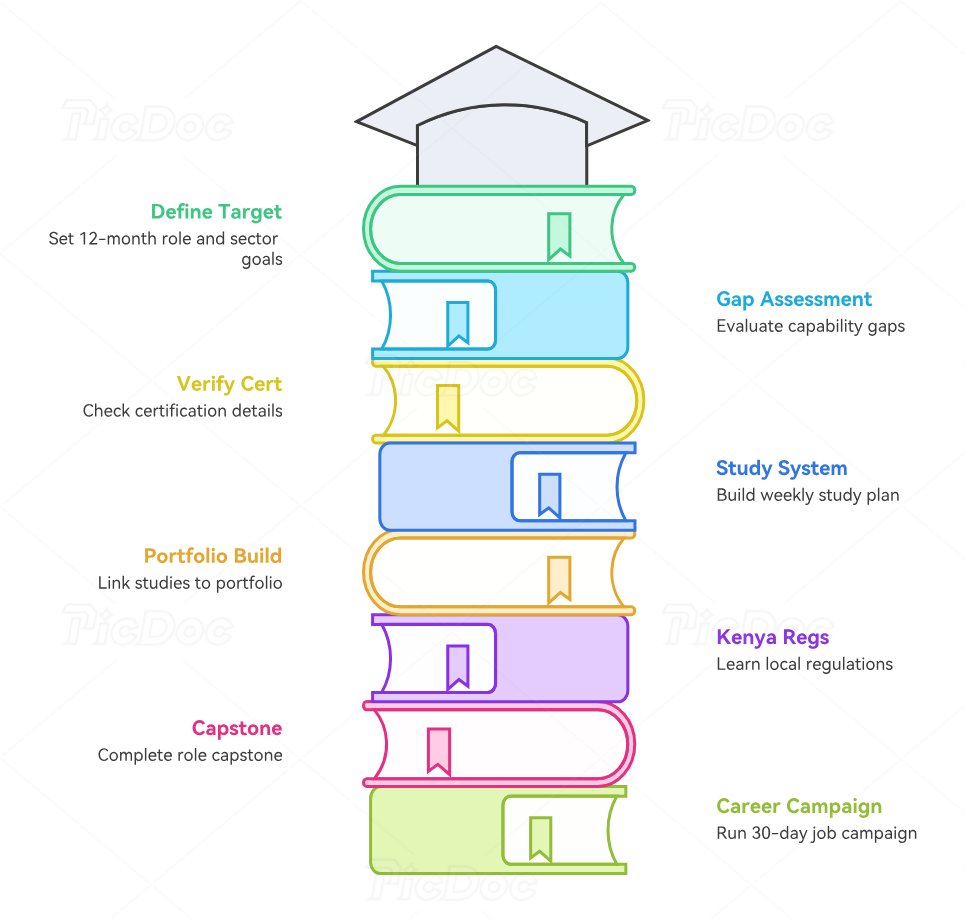
Step 1: Define your target role and sector
Write a precise 12-month target. Examples include becoming a SOC analyst in financial services, moving from network administration into cloud security, transitioning from audit into cybersecurity assurance, or preparing for a security-management promotion. Use a security-analyst career plan, network-administrator transition, cybersecurity-auditor roadmap, and security-leadership guide to identify the work each destination requires.
Sector choice matters because risks differ. Financial organizations prioritize fraud, identity, third-party connections, availability, compliance, and transaction integrity. Healthcare organizations prioritize privacy, availability, ransomware resilience, privileged access, and medical-system continuity. Government and critical infrastructure place greater emphasis on public services, national resilience, coordinated response, and recovery. Explore these differences through the financial-sector incident analysis, healthcare cybersecurity report, critical-infrastructure assessment, and cloud-threat report.
Step 2: Conduct a capability-gap assessment
Assess yourself across networking, operating systems, cloud, identity, endpoint security, logging, vulnerability management, incident response, forensics, governance, privacy, audit, risk management, technical writing, stakeholder communication, and leadership. Score each capability as unfamiliar, usable with guidance, or independently defensible. Compare your results with a senior analyst pathway, incident-responder roadmap, risk-management career, and chief security architect guide.
This audit prevents a common financial mistake: paying for advanced material while foundational gaps continue to block practical performance. Someone who cannot explain DNS, authentication, privilege, logs, network traffic, or basic risk will struggle during a penetration-testing pathway, threat-intelligence career, security-automation role, or cloud-security specialization.
Step 3: Verify the certification before enrolling
Review the official syllabus, practical exercises, assessment format, experience requirements, identity-verification rules, renewal obligations, continuing-education requirements, retake policy, payment terms, refund policy, and total cost. Include currency conversion, bank charges, examination vouchers, rescheduling, lab subscriptions, learning materials, and possible retakes in your budget. Compare the credential’s practical relevance with an OSCP career roadmap, GRC specialist pathway, security programme-manager career, and cybersecurity product-manager guide.
ACSMI’s current programme information describes the ACSMC as online, scenario-driven training spanning technical defence, offensive security, incident response, governance, risk, privacy, cloud, automation, and security management. Review its current programme structure and eligibility conditions directly before enrolling because course components, tuition options, and learning arrangements can change.
Step 4: Create a realistic weekly study system
Divide each study week into six components: concept review, practical lab, scenario analysis, written documentation, verbal explanation, and closed-book retrieval. For example, after studying identity attacks, inspect sample authentication logs, identify suspicious activity, document the timeline, recommend containment, explain the risk verbally, and retest yourself several days later. This approach supports a SOC analyst transition, threat-intelligence pathway, red-team specialist career, and cybersecurity consultant progression.
Step 5: Connect every module to a portfolio artifact
After network-security study, create a segmentation proposal. After cloud-security study, produce a shared-responsibility and access-control review. After incident-response study, build a playbook and evidence log. After risk study, produce a treatment recommendation. After privacy study, build a data-flow map and breach workflow. After management study, create an executive dashboard. Use the incident-response report, insider-threat assessment, critical-infrastructure analysis, and financial-sector report as scenario inspiration.
Step 6: Add Kenya-specific regulatory knowledge
Study the Computer Misuse and Cybercrimes Act, its current amendments, the 2024 critical-information-infrastructure regulations, the Data Protection Act, ODPC guidance, and National KE-CIRT/CC reporting resources. Focus on operational questions: Who must be notified? Which evidence should be preserved? What information belongs in a breach record? Who owns the decision? Which systems qualify as critical? How should controller-processor obligations be documented? This applied approach strengthens a cybersecurity regulatory career, privacy-analyst pathway, policy-analyst career, and cybersecurity auditor transition.
Step 7: Complete a role-specific capstone
A defensive capstone could investigate a simulated compromise across email, identity, endpoint, and cloud logs. An offensive capstone could assess a deliberately vulnerable application and produce a professional client report. A GRC capstone could map controls to Kenya’s data-protection requirements and build an audit-ready evidence register. A management capstone could propose a 12-month cybersecurity improvement programme. Connect your capstone to a cybersecurity engineer role, penetration-testing manager pathway, compliance analyst career, or cybersecurity programme-management role.
Step 8: Run a focused 30-day career-conversion campaign
Create separate résumé versions for your primary role and one or two closely related alternatives. Replace long lists of tools with evidence showing investigations completed, risks assessed, controls designed, reports produced, and decisions communicated. Compare regional positioning through the South Asian cybersecurity market, Singapore certification environment, UAE cybersecurity pathway, and Saudi Arabian security market.
Track applications by target role, required skills, résumé version, interview stage, rejection reason, and follow-up action. After every ten carefully selected applications, identify the weakest signal in your profile. It may be technical depth, sector experience, portfolio quality, seniority mismatch, communication, or missing work authorization. Adjust your strategy using a cybersecurity analyst roadmap, security consultant pathway, security leadership guide, and cybersecurity freelance-market analysis.
5. How to Convert Certification into Interviews, Promotions, and Income Growth
For interviews, place certification beside evidence of use. A weak résumé statement says, “Completed incident-response training.” A stronger statement says, “Developed a simulated breach-response workflow covering alert validation, evidence preservation, containment ownership, regulatory assessment, recovery, and executive communication.” Build similar statements through a security-analyst pathway, incident-response career, cloud-security specialization, and GRC analyst roadmap.
Prepare six detailed interview stories covering an investigation, security weakness, difficult trade-off, stakeholder disagreement, process improvement, and professional mistake. Explain the environment, available evidence, constraints, action, result, and lessons. Candidates targeting a senior analyst position, penetration-testing manager role, security programme-management position, or director of information-security career should emphasize prioritization, ownership, uncertainty management, and communication.
For an internal promotion, identify an unresolved problem inside your organization. Examples include slow incident escalation, incomplete asset records, weak privileged-access reviews, inconsistent vulnerability prioritization, missing supplier assessments, poor audit evidence, untested recovery plans, or unclear security metrics. Use your certification knowledge to propose a limited improvement project. Connect the work with a cybersecurity leadership transition, VP of cybersecurity roadmap, chief security architect pathway, and CISO advancement plan.
For salary negotiation, document measurable responsibility. Useful evidence includes reduced incident-response time, improved patch coverage, closed high-risk vulnerabilities, stronger audit readiness, fewer excessive privileges, improved recovery testing, increased detection coverage, better supplier oversight, or automated repetitive security tasks. Professionals can widen their options through a cybersecurity consulting career, freelance cybersecurity market analysis, cybersecurity educator pathway, or cybersecurity content-creator career.
Maintain a quarterly evidence file containing projects, metrics, stakeholder feedback, incident contributions, audit outcomes, reports, presentations, process improvements, and leadership examples. This record prevents valuable work from disappearing before an appraisal or job search. It is especially useful for professionals progressing toward a cybersecurity certification-trainer career, bootcamp-instructor pathway, cybersecurity research role, or cybersecurity writer and educator career.
Avoid collecting credentials faster than you can apply them. Three overlapping certificates accompanied by limited evidence often create less employer confidence than one relevant certification supported by a strong investigation, technical assessment, risk document, and executive briefing. Choose each new credential only after identifying the responsibility it will help you acquire. This principle applies across a red-team career, privacy pathway, security automation career, and cybersecurity leadership progression.
6. Frequently Asked Questions About Cybersecurity Certification in Kenya
-
ISC2 Certified in Cybersecurity and CompTIA Security+ can support broad foundational development, while the correct choice depends on your first target role. A future SOC analyst should add networking, log analysis, endpoint security, identity monitoring, and incident documentation. Use an IT-support transition guide, cybersecurity analyst roadmap, incident-responder pathway, and threat-intelligence career guide to build the surrounding capability.
-
A structured programme can serve career changers when they allocate enough time to networking, operating systems, identity, cloud fundamentals, risk, security operations, and documentation. Candidates coming from help desk, software, audit, data analysis, project management, telecommunications, or system administration may already possess transferable skills. Map those skills through an IT-support-to-analyst pathway, network-administrator transition, GRC specialist roadmap, and cybersecurity programme-manager career.
ACSMI describes ACSMC as multi-domain training designed for learners progressing through foundations, technical defence, data protection, incident response, cloud security, offensive security, governance, automation, and management. Prospective students should review the current syllabus and eligibility details to determine whether its depth and pace match their background.
-
CISM, CISSP, CRISC, CISA, ISO/IEC 27001 credentials, cloud-security qualifications, and broader management programmes support different responsibilities. CISM focuses strongly on programme leadership, CRISC on technology risk, CISA on audit and assurance, and CISSP on broad senior-practitioner knowledge. Compare these directions using a security-management transition, director of information-security roadmap, VP of cybersecurity pathway, and CISO advancement guide.
-
The required time depends on your starting knowledge, weekly study capacity, certification depth, lab requirements, and portfolio goals. A foundational credential may fit within a concentrated multi-month schedule. Advanced penetration-testing, cloud, architecture, audit, forensics, or management credentials can require a longer preparation window. Plan using an OSCP career roadmap, cybersecurity auditor pathway, security architect progression, and cybersecurity risk career.
-
International credentials can improve recognition when they match the role and are supported by practical evidence. Employers still evaluate technical depth, communication, sector knowledge, professional experience, portfolio quality, and the ability to solve unfamiliar problems. Strengthen international positioning through the Singapore cybersecurity guide, Australian certification pathway, UAE cybersecurity guide, and Qatar certification landscape.
-
Certification can strengthen cross-border credibility when accompanied by clear written communication, documented projects, internationally understood frameworks, practical platform skills, and a strong professional profile. Remote employers may also assess work authorization, contracting arrangements, time-zone overlap, secure working conditions, data-handling practices, and sector experience. Study regional expectations through the Hong Kong cybersecurity pathway, Saudi Arabian certification guide, Oman cybersecurity market, and Bahrain certification environment.
