
The Ultimate Guide to Getting Advanced Cybersecurity & Management Certification in Norway: Everything You Need to Know in 2026-2027
Norway’s cybersecurity market needs professionals who can protect critical services while translating technical exposure into decisions executives, regulators, and operational teams can act on. An advanced cybersecurity and management certification can help establish that capability when its assessment, specialization, and workplace evidence fit a defined career target.
This 2026–2027 guide explains Norway’s regulatory environment, credential-selection criteria, preparation costs, portfolio requirements, and hiring strategy. It also addresses the trap that stalls many qualified applicants: accumulating certificates while remaining unable to demonstrate risk ownership, incident leadership, supplier assurance, or measurable resilience.
1. Why Advanced Cybersecurity and Management Certification Matters in Norway in 2026–2027
Norway entered 2026 with a more demanding digital-security baseline. The Digital Security Act and its regulations took effect on October 1, 2025, establishing requirements for providers of essential and digital services. Covered essential-service sectors include energy, transport, health, water supply, banking, financial-market infrastructure, and digital infrastructure.
This environment raises the value of professionals who can connect a cybersecurity program manager career, GRC specialist pathway, cybersecurity regulatory career, and risk management specialization to real operational duties. NSM’s Digital Security Act guidance provides the current Norwegian reference point.
The law creates a direct employability lesson: knowing a framework’s vocabulary carries limited value when a candidate cannot determine scope, identify critical dependencies, select proportionate measures, preserve evidence, or escalate a serious incident. NSM states that covered organizations must report incidents that significantly affect service delivery. Its 2025 national incident framework also clarifies cooperation among organizations, sectoral response environments, and the National Cyber Security Centre.
A candidate building toward incident response leadership, cybersecurity policy analysis, cybersecurity auditing, or security architecture should therefore practice decisions, escalation, and cross-organizational coordination. NSM’s incident-reporting guidance makes those expectations tangible.
Financial services add another layer. Norway implemented DORA through national law and regulation on July 1, 2025. The framework covers ICT-risk management, incident handling, resilience testing, ICT service agreements, supplier oversight, and supervisory cooperation. Finanstilsynet added further technical rules in January 2026, while institutions faced operational reporting requirements during 2026.
This creates strong use cases for a cybersecurity risk specialist, privacy analyst, cybersecurity product manager, or senior security leader. Finanstilsynet’s DORA overview confirms the Norwegian implementation timeline and operational domains.
Norway’s EEA position also requires disciplined regulatory interpretation. EU measures can influence Norwegian organizations through EEA incorporation, sector rules, customers, supply chains, and multinational group policies, yet the EU application date alone does not establish the Norwegian legal date. Applicants who casually claim that every EU cybersecurity rule already applies in identical form expose a credibility problem.
The stronger professional can separate current Norwegian law, contractual expectations, parent-company requirements, and developing EEA measures. That distinction strengthens a cybersecurity policy director pathway, chief privacy officer career, regulatory specialist roadmap, and cybersecurity research analyst role.
Demand also extends beyond compliance. Statistics Norway reported that employment in IT occupations grew from 81,500 in the fourth quarter of 2020 to 99,300 in the fourth quarter of 2024, a 21.8% increase compared with 6.8% growth across employment overall. Norway’s public sector recorded especially strong IT-job growth, while most IT workers remained in private and publicly owned enterprises.
Those figures do not isolate cybersecurity vacancies, yet they show the expanding digital workforce surrounding security work. Candidates entering through an IT support transition, network administrator transition, security automation career, or digital identity pathway can use the wider trend strategically. The official Statistics Norway analysis supplies the underlying workforce figures.
2. How to Choose the Right Certification for a Norwegian Cybersecurity Career
Begin with a target responsibility rather than a famous acronym. A candidate seeking governance leadership needs risk, control, incident, supplier, and executive-decision capability. A candidate seeking technical leadership needs architecture, identity, cloud, detection, or offensive depth.
A credential aligned with a cybersecurity program manager role will produce different value from one supporting an offensive security engineer, penetration testing manager, or chief security architect. Recruiters can detect when an applicant chose a certificate through popularity rather than role fit.
Use a four-part filter. First, map at least 20 Norwegian vacancies and record recurring duties, experience thresholds, preferred credentials, language expectations, sector knowledge, and technical platforms. Second, classify each requirement as knowledge, applied skill, management evidence, or eligibility condition. Third, score candidate certifications against those requirements. Fourth, select the option that closes the highest-value gap while complementing your existing experience.
Someone moving from IT support can use the security analyst transition guide. A network administrator can follow the ethical hacker transition. An auditor can use the cybersecurity audit roadmap, while a manager can follow the cybersecurity leadership pathway.
Then inspect the provider. Verify the legal identity, issuing organization, assessment format, exam security, instructor qualifications, sample syllabus, retake conditions, renewal policy, refund terms, and digital-verification mechanism. If accreditation or formal recognition is advertised, confirm the claim in the accrediting body’s own directory and understand exactly what it covers. “Aligned with,” “mapped to,” “recognized by,” and “accredited by” describe different relationships.
This check matters for a cybersecurity certification trainer, bootcamp instructor, cybersecurity content educator, and research analyst, whose professional credibility depends heavily on precise claims.
Demand applied assessment. Strong advanced programs require learners to classify risk, design or evaluate controls, respond to a scenario, interpret incomplete evidence, communicate trade-offs, and defend a recommendation. A recall-only multiple-choice course may add keywords to a résumé while leaving decision-making untested.
Ask whether the course produces artifacts relevant to a GRC specialist, privacy analyst, security product manager, or cybersecurity policy analyst. Valuable outputs include a risk-treatment memo, incident report, supplier review, control map, architecture decision, and board briefing.
International portability may matter because Norwegian employers operate across Nordic, EEA, and global markets. Compare the Norwegian route with advanced-certification planning in Sweden, Ireland, Singapore, and Australia.
Portability improves when the credential is verifiable and the portfolio demonstrates transferable decisions. Norwegian market fit still depends on local law, sector context, communication, and eligibility.
3. Eligibility, Cost, Language, and Career Barriers to Resolve Before Enrolling
Entry requirements vary widely. Some advanced management credentials require documented professional experience. Others allow training and examination before experience is complete, while course certificates may have no prerequisite. Verify the distinction among course completion, examination success, and full certification status.
A learner who pays first and discovers an unmet experience requirement later faces delayed value and misleading résumé language. Use the senior analyst to VP pathway, cybersecurity policy director guide, chief privacy officer roadmap, and penetration testing management route to compare the experience expected at different leadership levels.
Calculate the full completion cost in Norwegian kroner. Include tuition, exam voucher, VAT where applicable, books, labs, practice tests, retakes, annual membership, renewal fees, continuing education, travel, proctoring equipment, and currency conversion. Then divide the total by the number of target vacancies where the credential or demonstrated capability provides real leverage.
A more expensive credential can produce strong returns when it unlocks a defined role. A cheaper credential can waste money when it duplicates existing knowledge. Candidates considering an AI security career, security data scientist pathway, blockchain security role, or quantum security specialization should test whether Norwegian vacancies support the specialization before investing heavily.
Language deserves role-specific analysis. English can be sufficient in multinational technology environments, research, consulting, or highly specialized teams. Norwegian often becomes more important when responsibilities include local policies, public-sector stakeholders, employee training, incident coordination, customer communication, or regulatory documentation.
Study five representative vacancies rather than relying on a general claim about the market. Build bilingual command of risk owner, residual risk, serious incident, essential service, recovery objective, supplier dependency, security measure, and risk acceptance. That precision helps a regulatory specialist, cybersecurity auditor, incident responder, and cybersecurity educator.
Security-clearance and citizenship or residency conditions can also shape access to defense, government, national-security, and sensitive-infrastructure roles. A professional credential does not override a vacancy’s clearance, authorization, background, or legal eligibility requirements. Read each posting carefully and keep a parallel list of positions where your current status is eligible.
This protects candidates following a red-team operator pathway, vulnerability researcher career, security architecture route, or cybersecurity policy career from building an application strategy around inaccessible vacancies.
Assess technical prerequisites across networking, operating systems, identity, cloud, logging, vulnerability management, incident response, secure development, risk, privacy, continuity, supplier governance, and executive writing. Score each domain from zero to three and bridge repeated zeros before advanced study. Weak foundations turn management concepts into memorized phrases.
A focused bridge through digital identity management, security automation engineering, offensive security, or cybersecurity data science creates enough technical depth to challenge assumptions and govern specialists intelligently.
4. A 12-Week Certification and Portfolio Plan Built for Norwegian Employers
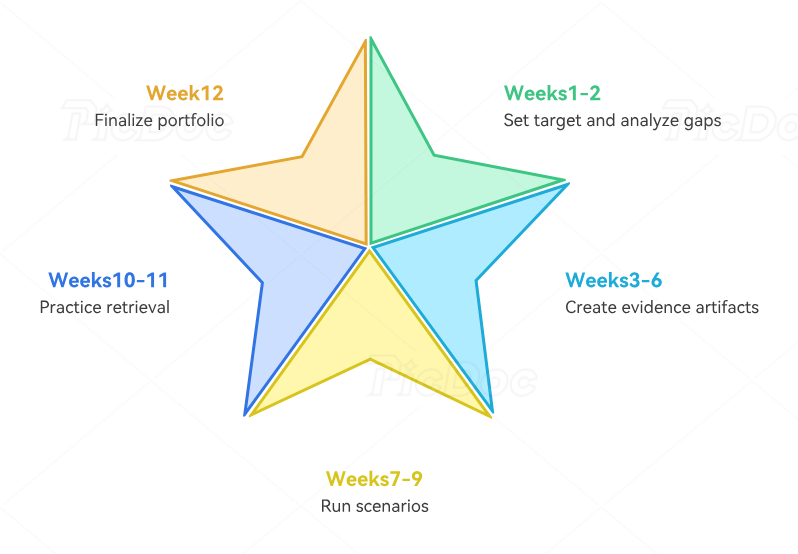
Weeks 1–2 should establish the target. Select one job family, analyze 20 vacancies, identify the six most common capabilities, and choose a certification that addresses the largest credible gap. Read Norway’s current rules and guidance relevant to the target sector. Create a regulatory-status sheet separating current Norwegian law, EEA measures under development, industry standards, and contractual requirements.
This exercise immediately supports a GRC career, regulatory specialist pathway, policy analyst role, and cybersecurity research position.
Weeks 3–6 should convert each major learning domain into evidence. Produce a fictional essential-service scoping memo, a risk register, a supplier-assurance review, and an incident-escalation matrix. Use NSM’s risk-management sequence—scope, context and criteria; risk assessment; risk treatment; monitoring and review—to structure the risk artifact.
The official NSM risk-management guidance emphasizes systematic assessment and treatment, making it a strong reference for a risk management specialist, security program manager, cybersecurity auditor, or chief security architect.
Weeks 7–9 should run scenarios. Use a ransomware disruption at a fictional energy supplier, a cloud outage affecting a financial service, compromised privileged credentials at a municipality, and a vulnerable connected product used in maritime operations. For each scenario, define assets, stakeholders, decisions, notification questions, containment options, recovery priorities, supplier dependencies, residual risk, and lessons.
This portfolio can bridge an incident response pathway, security product management career, identity management specialization, and vulnerability research route.
Weeks 10–11 should focus on retrieval and judgment. Complete timed practice assessments, maintain an error log, and classify every missed question as knowledge, interpretation, prioritization, or time-management failure. Revisit the weakest category until you can explain the answer and reject plausible alternatives.
Practice briefing four audiences: engineer, operations leader, legal adviser, and executive. That audience control matters for a certification trainer, cybersecurity content educator, policy director, and security executive.
Week 12 should combine exam execution with career conversion. Complete the assessment, verify how the credential may be represented, and build a six-item portfolio index. Each item should state scenario, assumptions, assets, evidence, alternatives, selected decision, residual risk, owner, deadline, and success measure. Remove real names, credentials, customer data, network details, and confidential findings.
A sanitized penetration-testing artifact, red-team exercise, AI security assessment, or automation workflow shows capability while preserving trust.
5. Turn the Certification into Interviews, Promotion, and Salary Leverage in Norway
Search for responsibility clusters rather than one English title. Relevant vacancies may appear under information security manager, cybersecurity manager, security adviser, sikkerhetsrådgiver, cyber risk manager, GRC specialist, information security officer, SOC analyst, incident responder, security architect, cloud security engineer, IAM specialist, technology risk specialist, or digital resilience manager.
Build a bilingual vacancy map and connect each cluster to the program manager pathway, security architect roadmap, privacy analyst guide, or cybersecurity risk career.
Prioritize sectors where your prior experience creates a credible bridge. Norway’s energy, petroleum, maritime, finance, telecom, cloud, public administration, health, transport, research, and defense-adjacent environments have different threat, regulation, resilience, and eligibility needs. A former operations professional may build a stronger energy or maritime narrative than a generic technology narrative.
A financial-services candidate can combine DORA knowledge with cybersecurity auditing, GRC specialization, privacy leadership, or security program management.
Rewrite the résumé around scope, decisions, and outcomes. “Responsible for security” provides no evaluable evidence. A stronger bullet reads: “Mapped 16 critical-service dependencies, assigned control owners across five teams, and reduced overdue high-risk treatments by 32% within two quarters.”
When exact metrics are confidential, use honest scale indicators such as systems, business units, suppliers, users, exercises, findings, or control families. Pair the credential with two projects aligned to a security product manager role, incident response position, digital identity career, or cybersecurity automation role.
Prepare five interview decisions: accept or treat residual risk; escalate a serious incident with incomplete facts; challenge an important supplier; prioritize limited resilience investment; and communicate a control failure to management. State what information you need, who owns the decision, which trade-offs matter, and how follow-through will be measured.
Candidates pursuing offensive security engineering, red-team operations, penetration testing management, or vulnerability research should also demonstrate scoping, authorization, safety, and remediation judgment.
Use a 30-60-90-day conversion campaign. During days 1–30, complete the portfolio, update the résumé, map 30 suitable employers, and build ten decision stories. During days 31–60, conduct targeted outreach, request feedback from Norwegian practitioners, and submit high-fit applications. During days 61–90, measure qualified applications, screening calls, portfolio discussions, final rounds, and recurring objections. Repair the weakest conversion stage.
Further specialization can follow through AI security, blockchain security, quantum security, or security data science after market evidence supports the investment.
6. Frequently Asked Questions About Advanced Cybersecurity and Management Certification in Norway
-
Requirements depend on the employer, role, sector, contract, and any clearance or authorization conditions. Many employers assess experience, education, technical capability, language, sector exposure, and professional credentials together. Read the vacancy and verify formal requirements with the responsible organization.
Certification can strengthen a GRC application, cybersecurity audit career, program manager role, or security architecture pathway when accompanied by role-matched evidence.
-
Many professional routes accept experience or foundational knowledge, although provider and credential rules differ. Diagnose your gaps before enrollment and complete prerequisite work where needed.
The IT support transition guide, network administrator transition, IT management leadership pathway, and cybersecurity auditor roadmap offer practical entry points for different backgrounds.
-
Norway is part of the EEA, and EEA incorporation plus Norwegian implementation determines when relevant EU measures become Norwegian law. Norway’s Digital Security Act and regulations took effect on October 1, 2025, implementing the earlier NIS framework, while NIS2-related implementation work continues. Verify the current official position when publishing or advising.
This distinction is essential for a regulatory specialist, policy analyst, risk specialist, and cybersecurity research analyst.
-
A qualified learner may complete a focused 12-week cycle, while a career changer may need an additional foundation phase. Readiness should be measured through scenario performance: risk analysis, control justification, incident escalation, supplier evaluation, and executive communication.
These capabilities support an incident response career, cybersecurity program manager role, privacy analyst pathway, and VP-level security progression.
-
Language expectations vary by employer and responsibility. English may support roles in multinational, research, consulting, and specialist technology environments. Norwegian becomes more valuable for public-sector work, local governance, employee communication, policies, incidents, and regulator-facing duties.
Evaluate actual vacancies. Bilingual capability strengthens a cybersecurity policy career, regulatory roadmap, security training role, and content education pathway.
-
Energy, petroleum, maritime, finance, digital infrastructure, telecom, public administration, health, transport, cloud, consulting, and research all create security needs with different entry barriers. Select a sector where your prior experience strengthens the narrative.
DORA expertise can support finance; resilience and operational-technology thinking can support critical infrastructure; privacy and identity can support health and public services. Match the target with a security product manager career, identity specialist route, security automation pathway, or chief security architect plan.
